This review was commissioned by Aris Katsaris.
Just four episodes left in The Owl House's second season. I'll be tackling episodes 18-19 this post, and then 20-21 the next. After that, all that's left of the show will be the miniseries that passes for season three.
From what I understand about the production conditions, I don't expect season 3 to be anything other than a mess. Hopefully these last four S2 episodes themselves won't be any worse than just "a little too compressed."
...
Imagine a world where studio-produced art was allowed to be good, instead of having to be what some lizard-brained finance bro thinks will be profitable.
That would be a pretty cool world.
...
So, the penultimate pair of episodes.
"Labyrinth Runners" is easily the weaker of the two. There's one important plot point, but most of the episode's runtime has nothing to do with it at all. Most of the material is either a character study of Gus, or more reconciliation between Willow and Amity. There's nothing wrong with either of those things (Gus in particular is a character who's gotten precious little exploration), but it feels like they should have happened much earlier in the series. Like, late season one or so. Coming at this point, it feels like it's both getting in the way of the main plot, and like it's setting up character work that won't have time to pay off.
A perfect example of what I mean comes right at the start of the episode. The teaser is a flashback to Gus and Willow first making friends in elementary school.
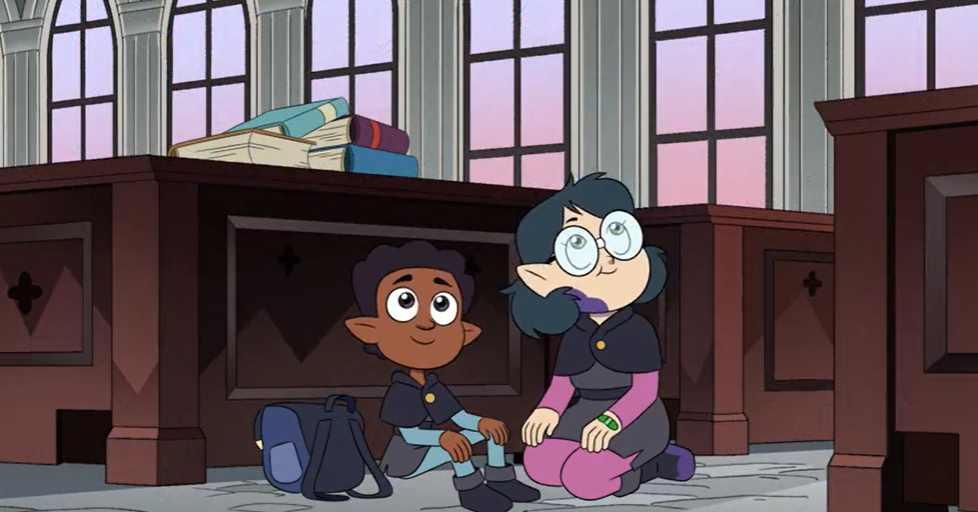
See what I mean about this feeling like it belongs earlier in the series?
This episode also reveals (I think? Maybe this was established earlier, but if so it was either an episode we skipped over, or so long ago that I totally forgot about it) that Gus has this unique superpowerful ability to project illusory landscapes over large areas around himself - including moving objects, people, sounds, everything - that reflect his inner thoughts and feelings. It's an involuntary power that only comes out when he's sufficiently stressed and anxious, and once it starts he has no ability to control the manifestations, only to (slowly, laboriously) shut it down again by getting a grip on his emotions.
This power might end up playing an important role in resolving the finale, in which case it needed to be set up and established much earlier. Or it might not, in which case this whole thing is another weirdly over-the-top sideshow that's taking up space during the tense last few episodes of buildup to Belos' endgame, and it should have happened much earlier. Take your pick.
The plot of the episode (which takes place while Luz and Co are still sailing home from their titanhunter misadventure and the fate of the Clawthorne sisters unknown after the Imperial Coven raid on the owl house) hinges on a pair of co-occurring developments at Hexside. One of them is an attempt by the government to get as many bodies as possible marked with the coven-runes and as much magic sealed away for Belos' FMA plot as possible before the date. The other, following up from "Hollow Mind," is Hunter hiding from his former master and organization, and (for reasons that really aren't explained very well at all) choosing to camp out at Hexside sleeping in broom closets and scavenging school lunches.
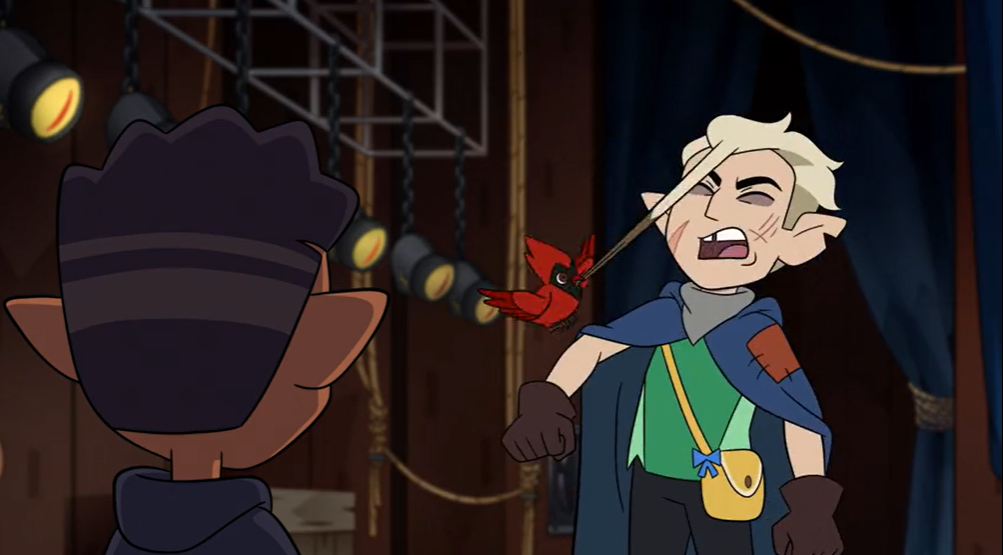
This is the part that actually advances the plot. Due to shenanigans, Hunter makes contact with Gus, and Gus in turn brings him over to the rebellion and lets him testify to others about Belos' true nature and genocidal intentions.
But, that only takes up a small fraction of the episode. Most of it is about Gus having his involuntary mirage arcana power set off for the first time in a long time, and Willow and Amity having to resolve residual friendship problems with each other and with Gus in order to calm him down again. Hunter manages to actually do it in the end, using some mindfulness exercises that he learns that Willow once taught to Gus way back when, which is an elegant way of connecting the two plot threads in the end. I just wish more of the episode could have been about Hunter becoming one of the friends, and less about the already-existing friends relitigating old drama.
That said, the most entertaining thing about this episode is antagonist Adrian Vernworth. As the head of the Illusionists' Coven, Adrian is one of Belos' cabinet members who hasn't gotten much screentime yet, and this episode had me wishing we'd seen more of him throughout season 2.
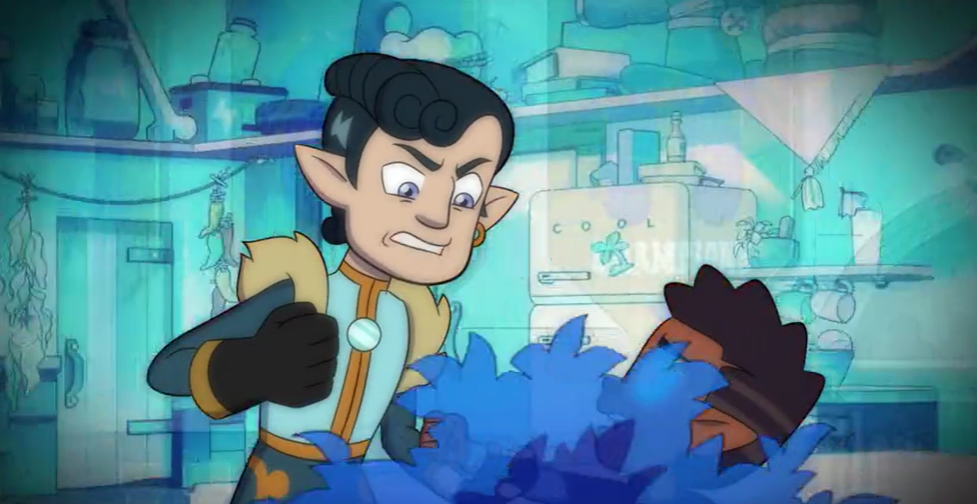
Basically, imagine the most pompous, self-absorbed wannabe Broadway director ever, only he's trying to apply the acting and stage production to the enactment of state violence, and the uniformed thugs are all just sort of uncomfortably trying to accommodate him and hoping to not get a childish diva screaming fit pointed their way. It's a good bit, and manages to reimagine the same joke in enough different ways that it doesn't get old despite the many repetitions.
Adrian is definitely the joke villain out of Belos' lineup, and he's good at being what he is. Unfortunately, he ends the episode by suffering a massive dose of psychic damage after accidentally turning Gus' nightmare illusion projector back on himself and having to be dragged away for psychiatric care. Which means he likely won't be the same next time we see him. Still, very fun while he lasted.
Adrian's incitement of the main episode plot is sort of another of those worldbuilding headscratchers, though in this case it might be down less to indecisive vision, and more to arc compression. Basically, Adrian comes to the school to carry out Belos' order to induct every possible witch into the covens immediately. The baffling thing is that on the whole, the Hexside student body reacts to this with trepidation at best and horror and outrage at worst. Even though, up until now, most of these kids seemed to be pretty excited about joining the covens. We saw the state propaganda being pretty darned effective on this front.
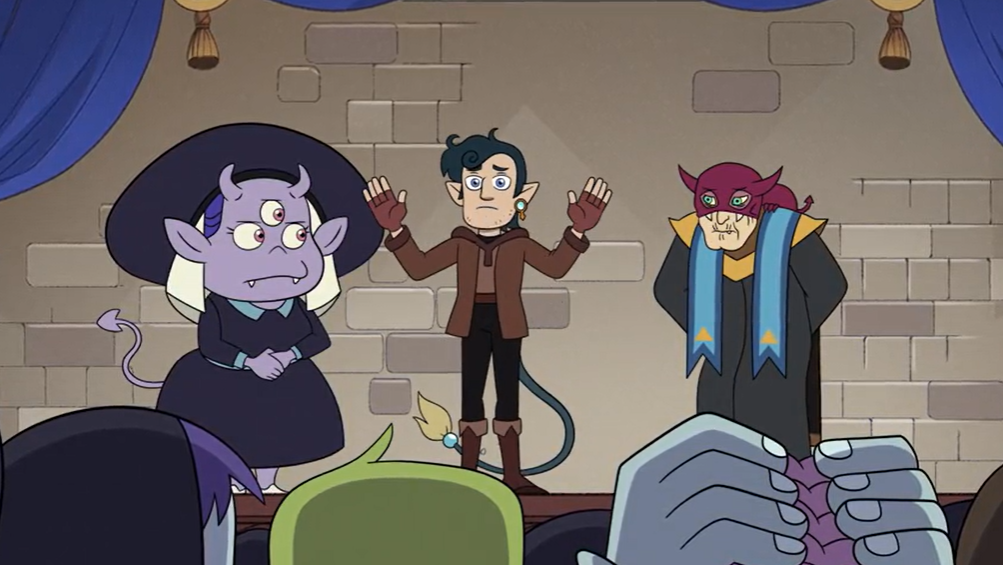
Like, his initial approach is to have Principle Bump call a school assembly and tell all the kids that he's going to defy his orders and help them slip passed the new coven drive by planting illusory glyphs on them that will fool the Imperial Coven inspectors. In actuality, he's using this as a ploy to plant real coven-glyphs on all the kids and induct them for real without their knowledge. And, like...sure, I can believe that Adrian would do a pointless, overcomplicated deception when the situation doesn't call for it. That's absolutely in character for him. But the way everyone else reacts to the revelation is off.
Basically, this plot would work a lot better if the general public has already lost a massive amount of trust in the regime, with these children in particular having been shown to get antsy about the covens. I don't recall anything like that happening, though. Last that we knew, most of these kids were looking forward to coven-induction and would have been excited to get to do it early. Heck, just having it so that Hunter showed up at Hexside and got the word out among the students in the episode before this one would have helped a lot.
It's not a bad episode. Just, too many things going on in it, and some of those things are ill timed. Really, it's mostly a matter of the episodes before and after this one making it weaker by comparison.
On that note, it's time to move on to S2E19, "O Titan Where Art Thou?" This one here really feels like the beginning of the end for The Owl House. It's an interesting synthesis of old and new, touching back on themes, threads, and character motivations from throughout the series. It has its rough spots, but on balance I'd easily call it one of the strongest episodes of show.
We start with Luz, King, and Hooty returning to the Boiling Isles. They've all got a lot on their minds, but King easily has the most. The heir to the Boiling Isles, in a literal sense. An orphan who's been living on the corpse of his own father without ever realizing it. A small creature with big feelings who has just learned that it can become a god. The curious thing is that King isn't reacting to this revelation the way he thinks he should be.
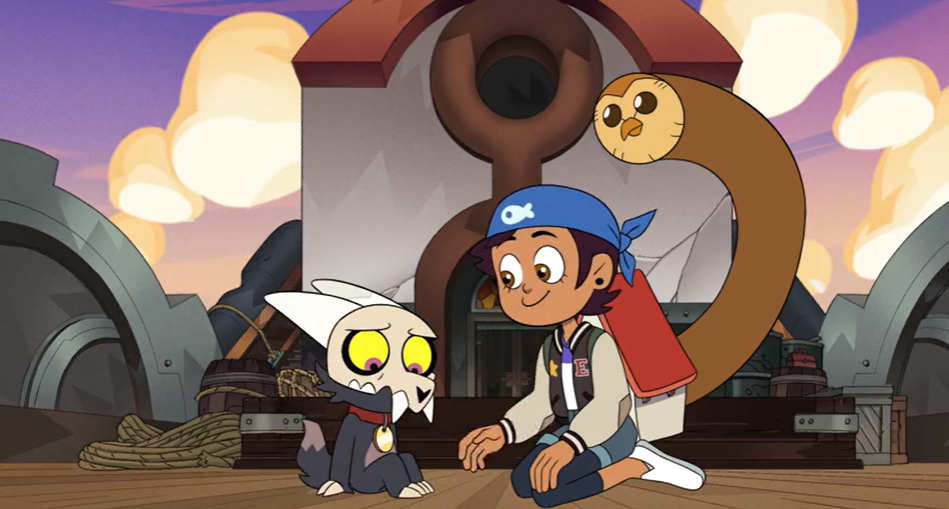
He's always fantasized about being a dread emperor. The name Eda gave him, "King," is itself a play on that. You'd think that learning just how big and powerful he can potentially become, realizing that he might be the literal god to whom all the people of the Boiling Isles should be directing their worship, would be validating to him. But it's not. The reality of power and importance has wiped the fantasy of it clear out of King's mind.
...
It might be partly because the first time anyone ever recognized him for his true importance, it resulted in them trying to kill him. But I don't think it's just that, or even mostly that.
Likewise, I find it significant that when King thought the titanhunters were his real people, he wasn't disappointed by their relative mundanity. Or by his own apparently equal status among them, rather than him being a prince or something as he'd long believed. They treated him well for as long as the misunderstanding held out, but only because (as far as we were shown) they treat each other well in general. That wasn't the legacy that King had always fantasized about, but it's one that pleased him greatly.
Now it turns out that the truth is much closer to his "king of all demons" fantasy after all, but it's not thrilling him.
I think what it comes down to is that "dread king of demonkind" is something Eda basically forced on him. She saw him knocking his little toys over and thought it was cute, so she played into it and ended up misguiding an impressionable young child. Not her fault, exactly. She didn't even know King was a person rather than a pet yet, when this started. But still. The fact is, this was only ever a game that she taught him, and for the last several years King has been slowly outgrowing it. It just took this for him to realize that he's outgrown it.
Also, since we're talking about the titanhunters, I'll just take this opportunity to say that he got away with the sacrificial regalia they had him in before Luz's rescue.
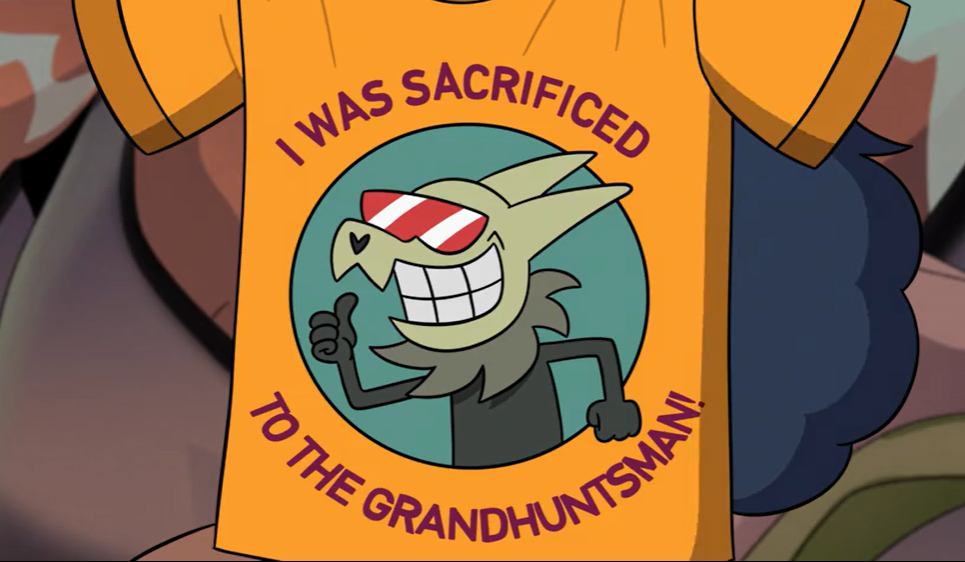
Heh.
...
Additionally, since his brush with death, King has started to have dreams that might not actually be dreams at all.
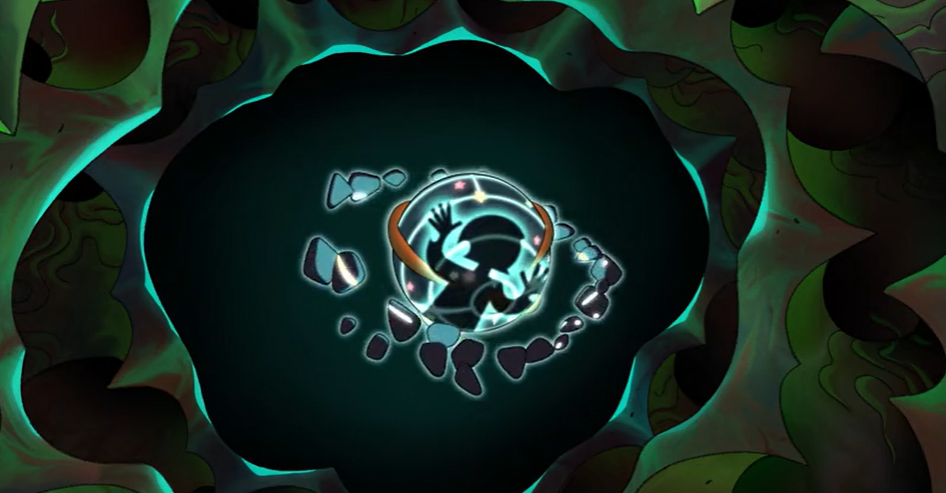
I don't think that King ever got a look at the Collector before. He just heard about him/them from Luz. So, these visions he's starting to have about the Collector, which feature an accurate depiction of the entity and also hint at some extra lore that Luz didn't have access to, pretty much have to be real.
And, in these dreams, the Collector seems to be...an awful lot like King himself, at least in some ways. The Collector really does seem to be a child, lonely and desperate for company in his imprisoned state, with Wittebane basically playing a more knowing, more manipulative version of Eda's role.
...
Hmm. It occurred to me before that the entity Eda saw in the owlbear's memory had taller proportions and an older-sounding voice than the Collector. Maybe Collector and King are really close parallels, both being orphaned children left behind by different races of gods?
Hmm. Well, if that's the case, then - unless the titanhunters are totally offbase - it seems likely that the titans and collectors are responsible for each other's near-extinction. Perhaps it's the residual heat of this divine war of extermination, not yet fully dissipated, that keeps the seas of this world boiling?
...
King's Collector-visions don't go anywhere just yet, but they clearly will soon. I wonder what exactly was the catalyst for these starting? Or perhaps King was actually having these dreams all along, but just hasn't thought them important until now? For now, just an intriguing mystery that I only hope this series will have time to do justice to.
Anyway, King, Luz, and Hooty find Bonesborough hung with wanted posters for the lot of them, and this time the story seems to be taking those somewhat seriously. The owl house itself has been ransacked; Luz and Co arrive just in time to see the last wagon full of their own furniture and belongings being dragged off to an Imperial Coven facility. Fortunately, the imperials don't seem to have bothered to keep monitoring the house after emptying it, so Luz is able to get in and find a hidden message directing them to Eda and Lilith's hideout without getting caught.
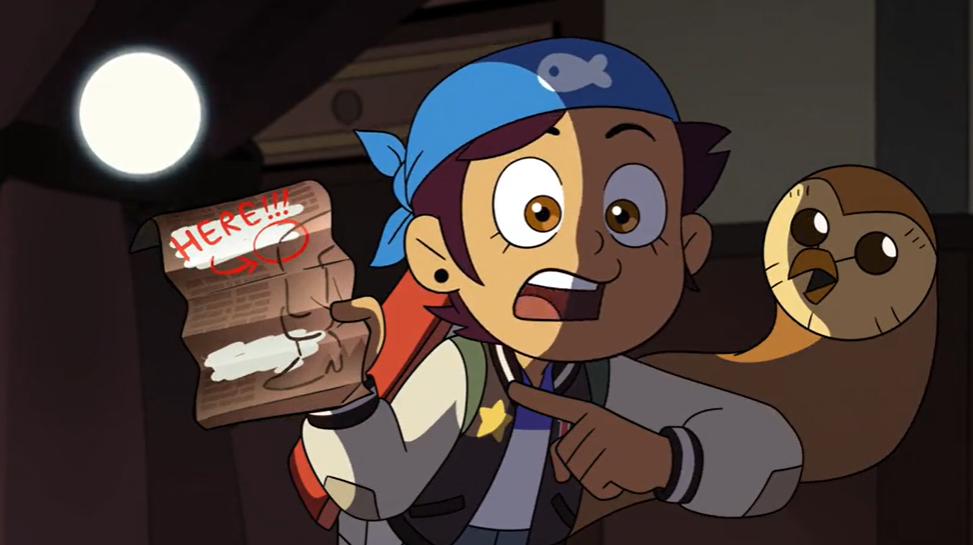
The Raised Knee is a wild location that Eda knows well and the imperials have long shunned for its "wild magic" significance. She and Lilith have been camped there since they escaped arrest, trying to decide what they can and should be doing to prevent the imminent genocide of their nation.
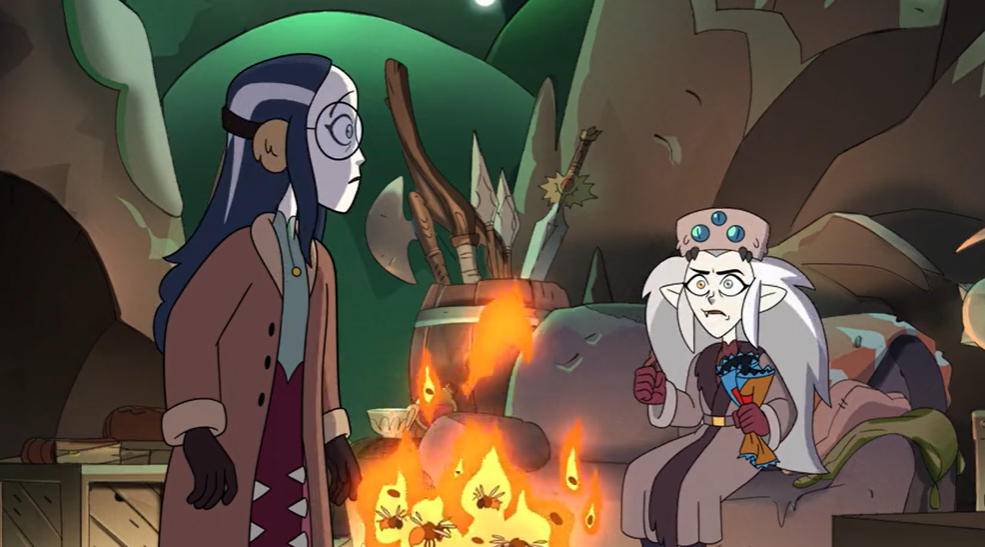
Unfortunately, their options are pretty much exhausted along with their personal magical powers. Eda consoles herself that at least the children she's made herself responsible for have been sent out of the blast radius, only for that to be ruined too when Luz, King, and Hooty find their camp.
It turns out it was Lilith who unilaterally left that message. Eda was hoping they'd find a new life among King's tribe and never come back.
Anyway, Luz is sure that the Clawthorne sisters are camped here as part of some supergenius plan to prevent the Day of Unification. Eda doesn't have the heart to tell her the truth, that they've got nada and are pretty much just waiting to die with everyone else. Lilith, meanwhile, reacts to the news that King is a baby titan by immediately starting to worship and grovel before him and forgetting all about how she used to treat him like shit. Oh my god someone please just throw Lilith off the mountaintop.
Well, after this point the episode splits into A and B plots.
Our A-plot has Luz deciding that - since Eda doesn't have any rebel missions for her to do at the moment - she's going to do something nice to help King through his emotional turmoil. One of the items taken by the imperial coven was King's favorite toy, a (nonmagical, inanimate, just to be clear ) stuffed rabbit. Luz wants to go steal it back for him. Amusingly, Eda doesn't like the idea of Luz risking her life to steal some toy, and Luz turns it around on her by pointing out, well...the pilot episode of "The Owl House." You know, when Eda had them all break into an imperial prison complex to steal back one of King's toys.
It's a cute little continuity nod, and sort of a meta joke about how the tone and stakes of the show have changed. However, I think it also works as a demonstration of Eda's character development. At series' start, she was basically a fifty year old child. Arrested development born of exile, playing a reckless Peter Pan role for other lost children. Since then, she's been made to grow up, and started to act like a parent rather than a ringleader. It's inconceivable to Eda that she could have ever done the exact same thing that Luz is about to do, even though it was less than a year ago.
But, by that same token, she can't exactly tell Luz not to. At best, she can tag along with her and try her best to prevent the worst outcomes.
The B plot is, basically, King trying to escape from a creepily fawning Lilith. And, oh my god, the show is FINALLY acknowledging what an awful fucking person Lilith Clawthorne is. It still doesn't go as far as I wish it did, but it goes much further than it has up until now, and it ends with King verbally tearing her apart in a way that I found immensely satisfying.
In a way, I guess this episode is about both the Clawthorne sisters reflecting on their own character arcs since the series' start. Eda realizing how much she's changed without noticing. Lilith realizing how much she hasn't changed despite thinking she has.
King's subplot is mostly some lighthearted comedy about him running into a disgruntled punch-clock-villain member of the Imperial Coven and the two of them basically playing hookie for the day.
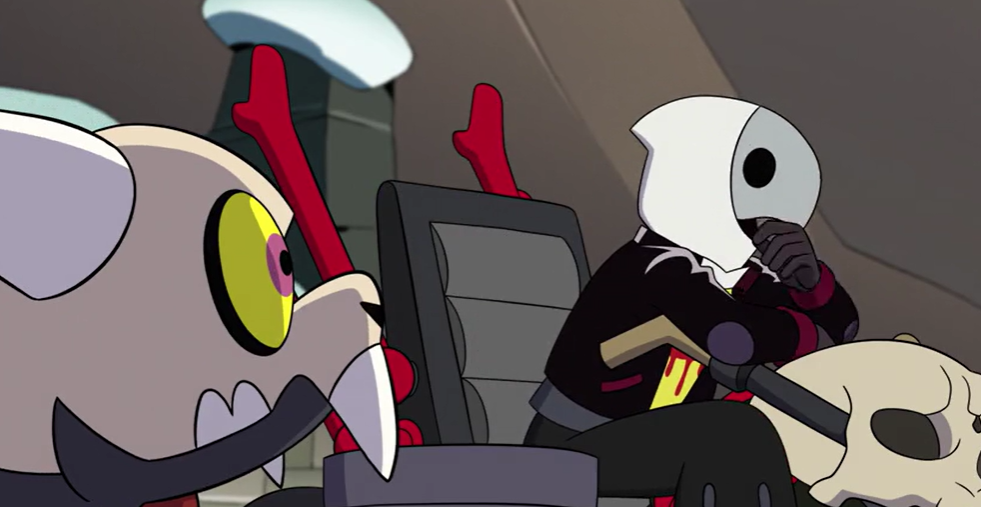
Both of them have had the misfortune of having to cohabitate with Lilith Clawthorne at different times, which gives them plenty to commiserate over. It turns out they have a lot of other things in common too. The soldier is just a year or three out of high school, and realizing just how much of a gold-painted turd the regime he'd been indoctrinated into wanting to join actually is. King, likewise, has finally gotten his life's dream validated, only now it doesn't feel right to him at all. Central to both of their false dreams is the figure of the god-king. This perfect, infallible strongman that they wanted to identify with, but whose image falls apart the instant it comes in contact with reality. In the words of Steve the disgruntled cop, "how is the emperor even so sure that the titan wants anything? What if the titan is just, like, a regular guy?"
This is also the basis of the dressing-down that King gives Lilith at the end. The reason she started falling all over King as soon as she found out what he was is because she's still an authoritarian follower. She’s still looking for a cult leader to yield all personal responsibility and moral culpability to. And, sorry, but King doesn't feel like being that for her. Thankfully, she actually seems to take it to heart and start doing genuine introspection, at least somewhat. Maybe she'll manage to get at least slightly better in the time the series has left.
Mostly a silly, breather-y subplot, but it ends up tackling some pretty heavy themes. Good stuff.
Meanwhile, the attempted stuffed animal heist ends up falling apart when Eda finds an opportunity to get in touch with Raine, and uses it to try to arrange for Luz and King to be spared on the Day of Unification. Begging Raine to please, if they have any love left for her at all, to spare the children on her behalf.
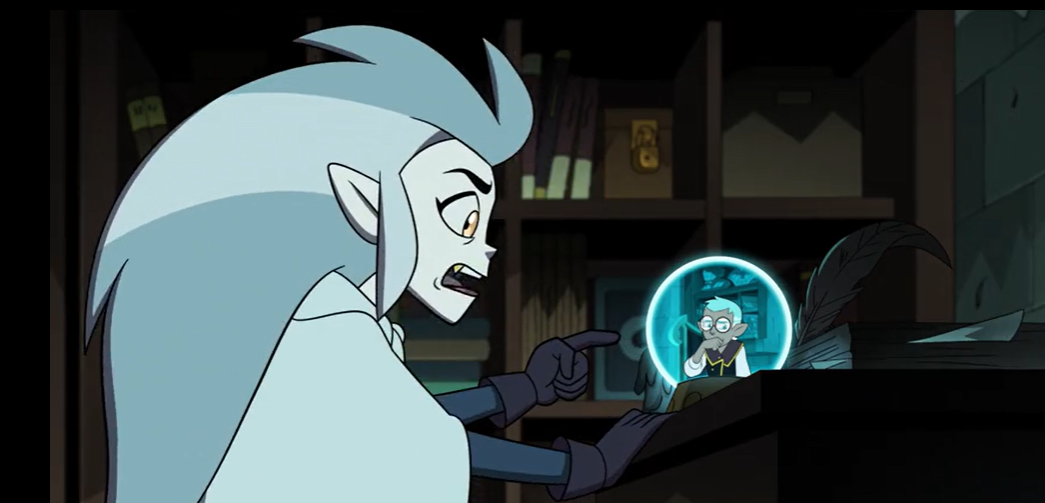
Raine unfortunately can't be open with their responses, since they're not alone in their office. But they manages to code their language well enough to tell Eda they'll do what she's asking for while preventing the other imperial officials with them from catching on to who they're speaking with and about what.
Unfortunately, Luz catches Eda mid-conversation, the truth about Eda's lack of any plans or hopes to come out, and a big fight to break out over whether Luz should be allowed to keep fighting on her own regardless of how Eda feels.
An actual Luz vs. Eda battle ensues. They're not trying to kill each other, but Luz is using all of her combat tricks short of that to try and escape, and Eda is using all of her owl-harpy form's strength and speed to fight through it.
Unfortunately, they both seem to have forgotten that they were literally inside of an enemy fortress at the time.
...
Okay, maybe Eda still has some maturing to do after all, heh.
...
I won't lie, when the two of them get ambushed and captured by Imperial Coven security guards, I thought we were already launching the endgame plot with the b-cast needing to rescue Luz and Eda and stop the genocide spell at the same time. But no! The twist is that there's no cliffhanger after all, and the reason for this was perfectly foreshadowed.
See, we know from previous episodes that Raine Whispers has already secretly broken free of the brainwashing and reestablished contact with their old rebel network. And we know Eda had just alerted Raine to her and Luz's presence a couple of scenes ago. True, Raine doesn't quite have the pull to make unilateral arrests or move high-value prisoners around at his own discretion anymore, but that's where another twist comes along. Darius, the head of the abominator coven, has been turned.
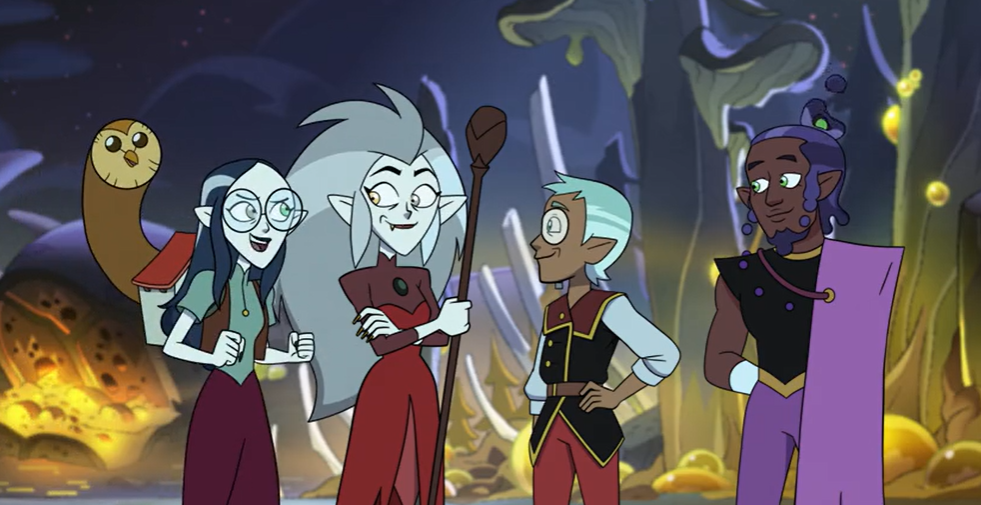
As a reminder, Darius has historically been one of Wittebane's most competent and clear-headed underlings. He was the one who managed to outfox Eda and Raine in the first place back in "Eda's Requiem" and arrest the latter; something that none of the other coven heads could succeed at. He was also the one who took it upon himself to try and turn Hunter from an office nuisance into an administrative peer, and during that incident he also showed that his faith in Belos' leadership has been on the decline. Well, for the last few episodes, Darius has been investigating things offscreen. Hunter's sudden flight, the weirdness surrounding Raine, and the general sketchiness of this whole Day of Unity thing all tripped Darius' suspicious nature. We don't see him figuring out the plot on his own and reaching out to Raine, but we've seen enough of him in previous episodes for this to seem like a perfectly natural development rather than a writer asspull.
Anyway, since Darius has been sort of unofficially been doing Hunter's job even before the latter's defection, he easily has enough pull with the Imperial Coven rank-and-file to save the day now.
...
Something else worth pointing out here is that Darius has always been characterized as pretty ruthless and harsh, as well as being smart. The show doesn't subvert that here. He's still the kind of person who would join an authoritarian regime and act - happily - as one of its chief enforcers. He's not a good guy. He just now knows that the emperor is plotting to kill everyone, and so it's in his interest to side with the rebellion.
Going back to this show's Fullmetal Alchemist comparisons and/or inspirations, Darius is basically Olivierre Armstrong. Don't know if his role was consciously inspired by her, but the parallels are pretty strong.
...
Anyway, with at least two of the nine coven heads now in the know and committed to not being genocided, and contact with Raine's old rebel network reestablished, fortunes have basically turned around. There is a large and organized resistance with enough manpower and insider-access to bring Wittebane down before he does the thing (they settle on the name CAT, for Covens Against the Throne. lol). It turns out that Luz's childish optimism was, in this one case, a better guide than Eda's recently developed adult sensibilities. Their time together has been a learning experience for both.
The episode ends with King and a deflated Lilith meeting up with the rest and starting to pool their heads on a plan. And with Eda recovering that palistrom log from among the confiscated items, and taking the time - even with time being so short - to help Luz carve it into her own palisman.
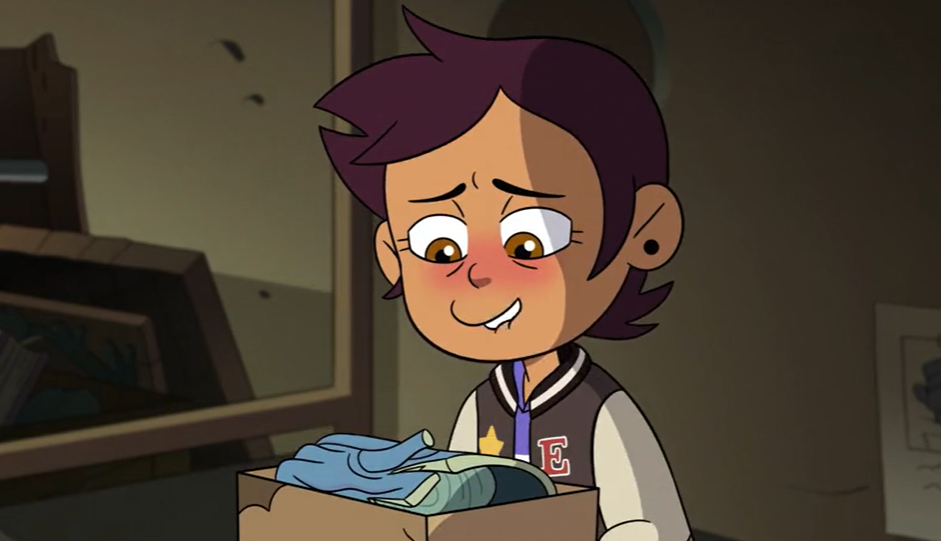
The mark of a true witch, in the old Boiling Islands tradition.
Episodes 20-21 will be up soon.