The Owl House S2E15-17: "Them's the Breaks, Kid," "Hollow Mind," and "Edge of the World" (continued)
"Hollow Mind" is the epitome of what I mean when I said "bizarre one-off contrivances that appear and disappear within the space of one episode in order to make the next story beat happen without any foreshadowing or buildup." It continues on from the Phillip Wittebane plotline from "Elsewhere and Elsewhen," and just like that episode it's means of answering the plot question raises bigger questions than the story realizes.
Now, the existence of Inception magic was established back in season one. That much is good setup and payoff. But the payoff in this case comes in the form of...fuck, just typing this out is making me feel like I must be misremembering it, but I'm not...so, some masked dissidents are trying to break into Emperor Belos' mind to steal his secrets. And they're somehow doing this from a random fucking alleyway in the Boneborrough marketplace.
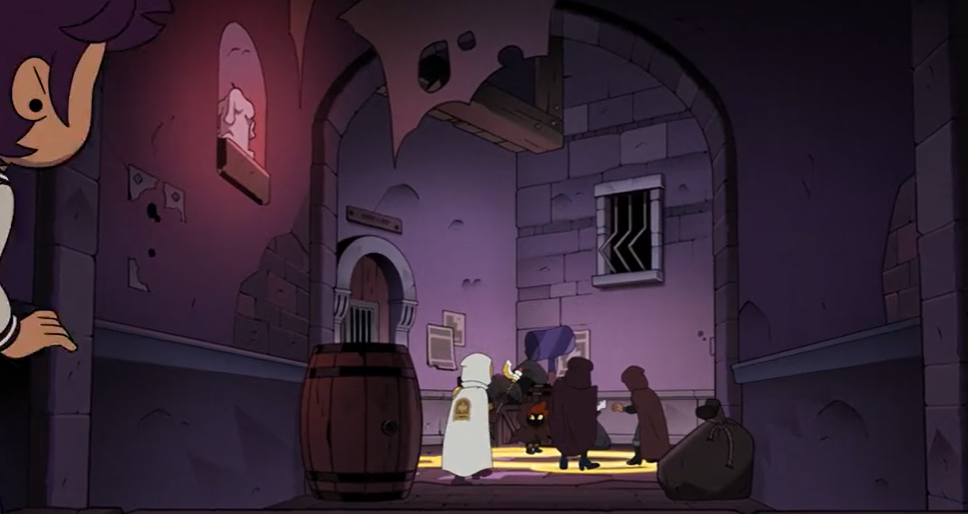
Do they, um. Do they not have to be near Belos to do this?
If they don't, then why the actual fuck are they doing it out in public and not in the secrecy of someone's basement?
If it has to be outdoors, why in the middle of...I just...
What?
Then, on top of that, Luz only gets involved in this because she happens to be at the market with Eda, and happens to see Hunter in his Golden Guard uniform hurrying by and decides to go chase him. And then his botched arrest of the dissidents happens to send him and Luz instead of the rebels into Belos' mind.
Not only is it a big string of coincidences. Not only does it rely on this absolutely perplexing, world-breaking premise that the rebels are doing this in the place where they are doing it. But it also means that the answers Luz has been looking for don't come from her season-long research into the subject. They fall out of the sky and happen to hit her on the head. Extremely unsatisfying for the treatment of Luz's character, as well as contrived.
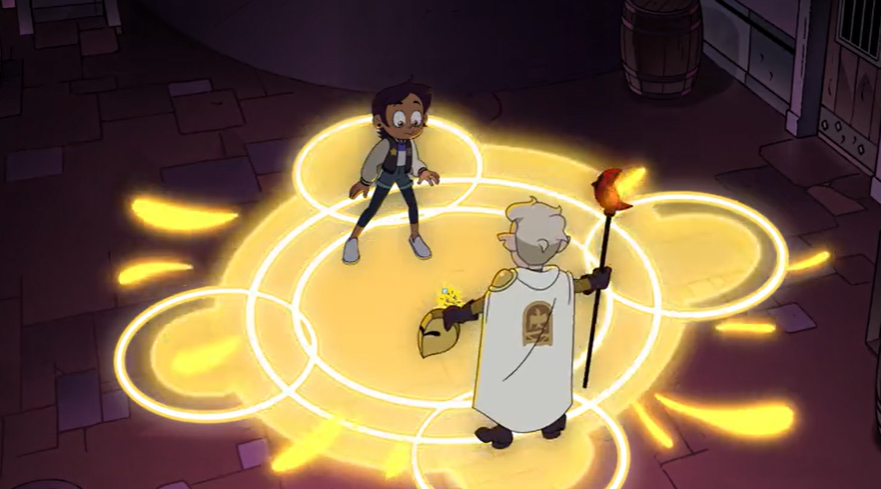
Now, for the most part, this episode does two things. One is getting Luz and Hunter the information they need to make the next part of the plot happen. Which it does an annoyingly hamfisted, but technically sufficient, job of. The other is being a character study of Phillip Wittebane, and at that it does far better.
The sheer depths of Phillip's duplicity are literalized in the structure of his mindscape. His ability to believe his own lies when convenient takes the form of him having two memory libraries, one for "Emperor Belos" and one for Phillip Wittebane. The former contains a mixture of genuine memories and self-invented ones. Including twisted versions of events that Luz herself was present for, thereby enabling her to figure out pretty quickly what this is.
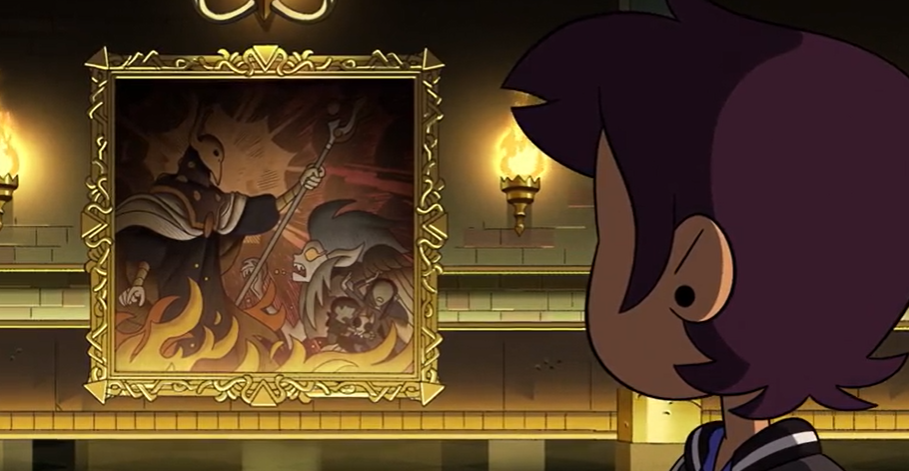
The prophet-king of the Boiling Islands is a real person. Phillip crafted him with such meticulous detail, put so much heart and soul into his performance, that he's able to truthfully tell Phillip's lies.
That said, he's also still pretty clearly artificial. Belos' memory warehouse is too perfect. Too neat and orderly. No winding paths or pointless detours or uneven corridors, like the forest landscape we saw in Willow's mind way back when. It's all a perfectly clean and orderly gallery, almost identical to the real one in his meatspace palace. As opposed to the space where his true subconscious resides.
The scenery design there is also pretty clever.
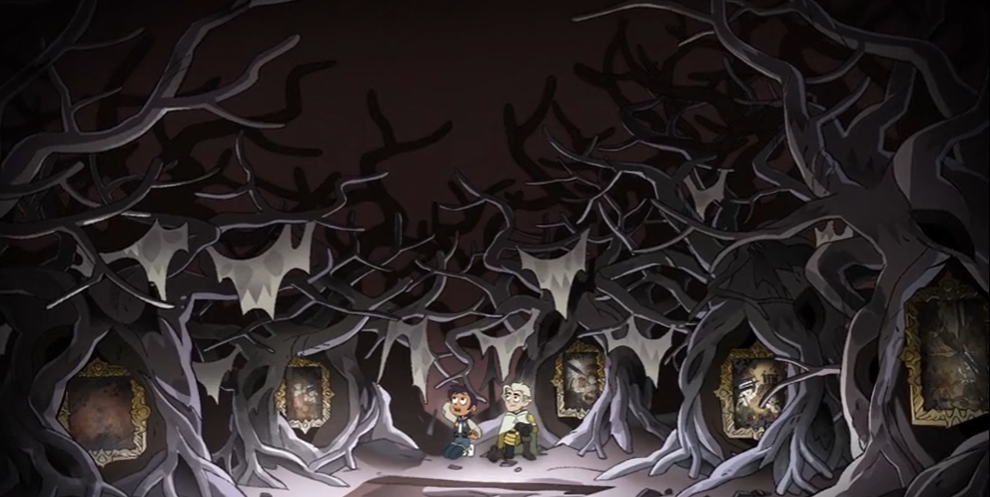
That it's the most archetypal "witch's forest" imaginable is surface-level. The foliage or spiderwebs made of ripped up canvass is a touch that it took me a minute to notice, but I appreciated once I saw. There are some truths that he's shredded even the most suppressed, unconscious memories of. Some lies that he actually couldn't tell you the reality of anymore, even if you put him under hypnosis. The maze-like tangle of branches suggests a complicated web of overlapping falsehoods pushing outward and making the truths of the trunk-paintings hard to access.
I wonder. Does the aesthetic come from Wittebane knowing that he is, from the perspective of any of his old countrymen, a witch, and being secretly okay with that? Or is he still somehow avoiding that conclusion, with this appearance being a haunting symptom of that denial? Or maybe this is just what the mind of a person who kidnaps children, does evil magic, and lives in a remote hideout full of horrors looks like, and earthlings have retained some folkloric recollections of that.
I lean more toward Phillip knowing and accepting that he is, in fact, a witch. For reasons that I'll get into shortly.
Going through Belos' suppressed memories serves as shock therapy for Hunter. He sees Wittebane's rise as a cult leader, passing his glyph-magic off as divine miracles and faking assassination attempts on himself to make it seem like "they" really were afraid of him spreading the truth.
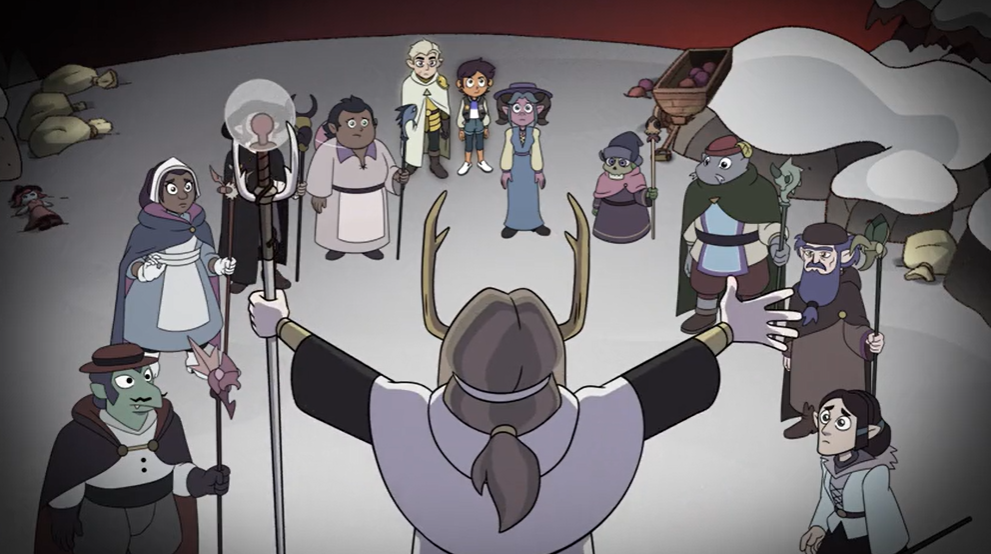
He goes from fringe cult leader, to major powerbroker, to warlord and eventually king.
...
There are a few things I wish these scenes could have given more context for. For instance, there was clearly some source of tension and disillusionment that enabled him to get his hooks into some Boiling Isles communities, but we're not shown what it was. There's also an implication that the "wild magic" and "wild witches" that the titan allegedly hates have had their definitions slowly expand over the course of "Belos'" career. Back when he was starting out, "wild magic" seems to have been something practiced by a shadowy cabal without the general public's knowledge. We're left to sort of infer that as he controlled more and more of the Boiling Islands and fewer and fewer people remembered what things were like before, Phillip was able to gradually shift the meaning of the term to include all spellcasting outside of the cult's coven system.
Most of this is just implied. I wish it was gone into in more detail. This episode being overstuffed and unable to go indepth into most of the ground it covers is yet another of its "quantum cancellation scramble" problem.
...
Another important detail is that, in many of his memories, Wittebane appears to have a young man in the Golden Guard regalia at his side.
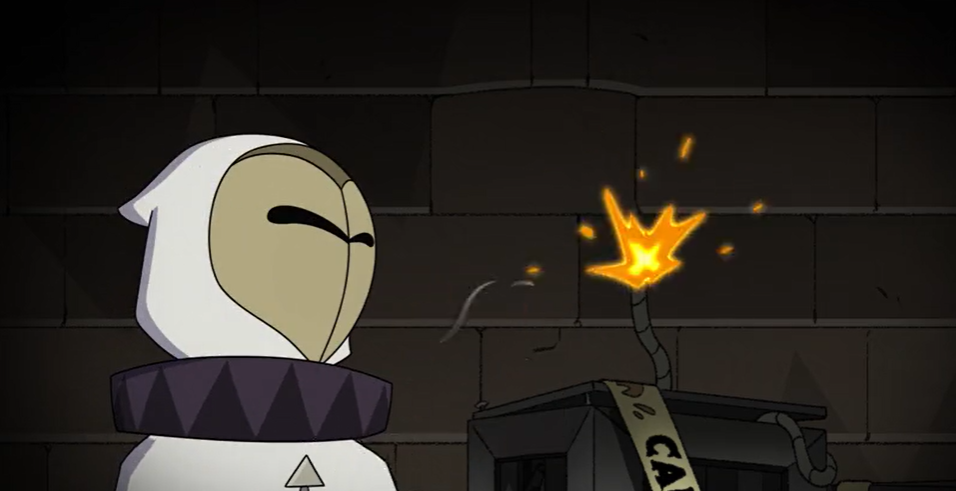
Hunter is only the latest in a succession of them. All of them appear to have died young on account of Wittebane either sacrificing them to advance his agenda, or having them killed when they showed signs of defying him.
This part, naturally, is what has the biggest impact on Hunter. He can't deny that Belos treats him pretty much the same way as all the other Golden Guards before him. He already knew that he wasn't the first to wear that name and uniform, but he didn't know that all of his predecessors also seemed to think that they were Belos' nephew.
...I'm not sure how other people in the palace would be able to avoid letting this part slip to Hunter at some point, but okay, I'll roll with it I guess.
Hunter's last straw is when he sees Belos' first attempts at his magic-binding tattoo glyphs that restrict one's casting to a specific type of magic (and presumably also marks them as a sacrifice to the Collector or whatever). It took him a few tries before he got it right. And he kinda had to recruit new cultists after each of those early attempts. And the current Golden Guard at the time swallowed his own visible discomfort with this and helped him hide the bodies and collect the dropped palismen.
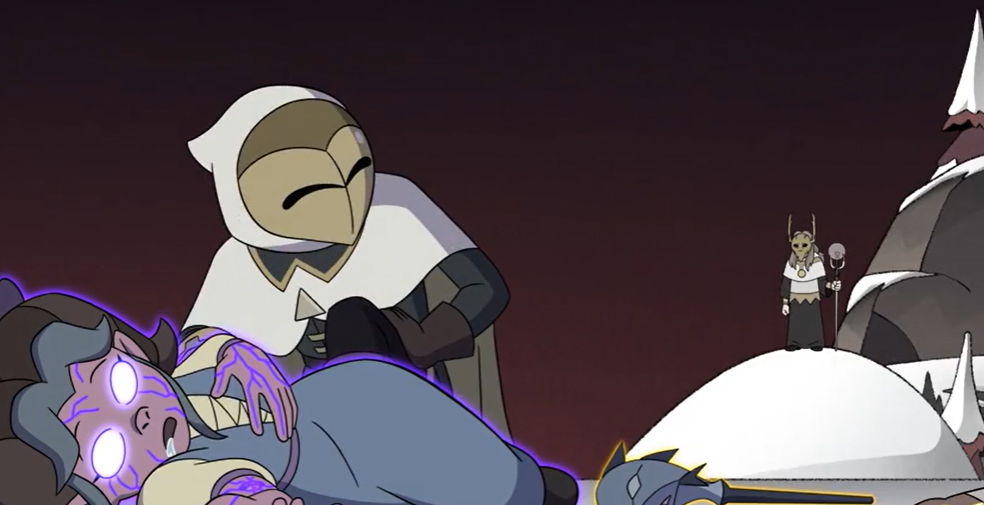
Hunter's deconstruction in the face of overwhelming evidence is pretty well written. He doubts what he's seeing. Then doubts the accuracy of Belos' own memories. Then doubts his own understanding of how mindscapes work, despite him earlier having claimed (and demonstrated) himself to be very well-read on the subject. The anger directed at Luz for (sort of) showing this to him. Anger at himself for doubting.
This is true to life. I've seen this. I've - I'm not remotely proud to say - been this. The way Hunter is written here is one of the strongest parts of this episode, at least for me.
The last straw is when he and Luz happen into a very recent memory of Wittebane conspiring with the Collector.
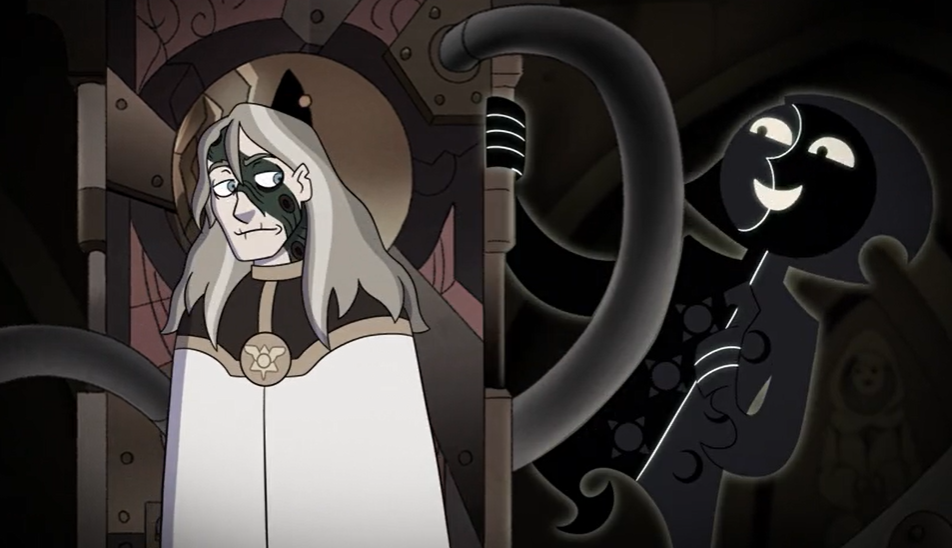
Apparently the two have spoken on a somewhat frequent basis since Wittebane first entered that door in the titan's skull a couple centuries back. And, from the sound of things, the Collector is imprisoned and needs a big sacrifice of life force to free himself, which Belos is giving him in return for...something. He spoke before about fusing the Boiling Islands and Earth for some reason. I'm not sure if that was true or not. But whatever this is, it's definitely not just wanting to go home again; I don't think that would require quite so much as all this.
As for the Collector himself...very childish appearance and personality. That may just be an act (Wittebane himself just put on a similar performance himself, after all), but I'm not sure. On inspiration, I looked back at the owlbear's memory sequence in "Knockin' on Hooty's Door," and...the entity seen in that dream resembled the Collector, but its proportions were different and its voice sounded older. Maybe that's what the Collector looked and sounded like before he was imprisoned and weakened. Or maybe there are others like him. Adult and child members of the same species, maybe? Not enough information to speculate further.
Anyway, this memory takes place during the time of another season 2 episode, right after an onscreen conversation between Hunter and Wittebane. Which means that Phillip and the Collector actually talk about Hunter for a bit. And they have a very strange exchange on the subject.
Collector: "I'm starting to feel like you make those things just to destroy them. Haha, admit it."
Wittebane: "Of course I don't, Collector. It hurts every time he chooses to betray me."
So. Hunter is a...clone? Homunculus? Something along those lines. He's gone through multiple incarnations, with disloyal instances all being terminated. There's some later imagery that suggests that the torn scraps of canvass hanging from the trees in the secret memory grove are actually fond memories of previous Golden Guards that Wittebane couldn't bear to hang onto after murdering them.
...I swear there was mention of a pair of brothers vanishing from colonial Gravesfield. "Nephew." Hmm. I think I have a theory.
But now, on to the question of Phillip Wittebane's level of self-awareness.
Throughout the whole memory-diving sequence, Hunter and Luz have repeatedly crossed paths with a pair of ghostly figures. One of them is a small child wearing a mask like Belos'. The other is a gruesome, mutated version of Phillip that takes a lot more from "Over the Garden Wall's" Beast than he usually does.
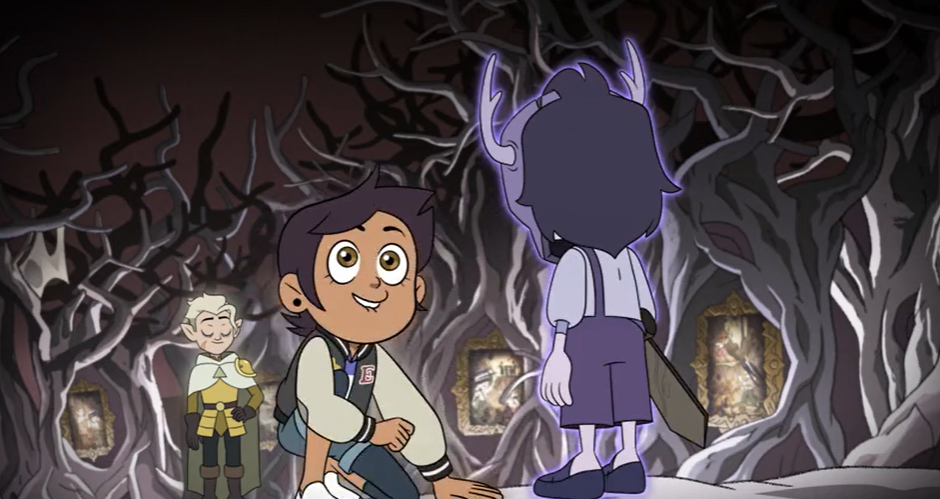
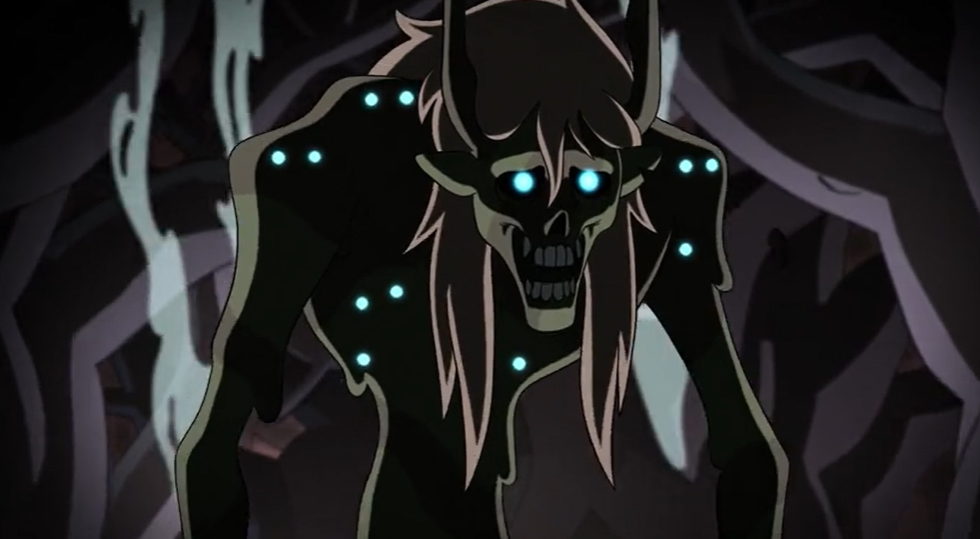
The Beast entity is pursuing the child entity, which in turn is fleeing in fear.
Neither of them are quite sure what's going on here. Luz remembers the monstrous, burning version of Willow's inner self back from the season one episode that introduced this concept, but it being split in two like this? Hunter, despite being formally educated in this type of magic, doesn't have a clue what's going on with this either. The episode does a clever subversion, letting the audience think that perhaps Phillip and Belos are actually duelling personalities in a schizoid mind, or that Belos has managed to split his dreamspace-avatar into two halves for his dual memory gallery. But no, it's weirder and kinda more shocking than that. When Hunter and Luz attempt to combat the Beast, the child takes advantage of its momentary distraction to kill it. Before then changing its form to that of Phillip Wittebane's current adult self.
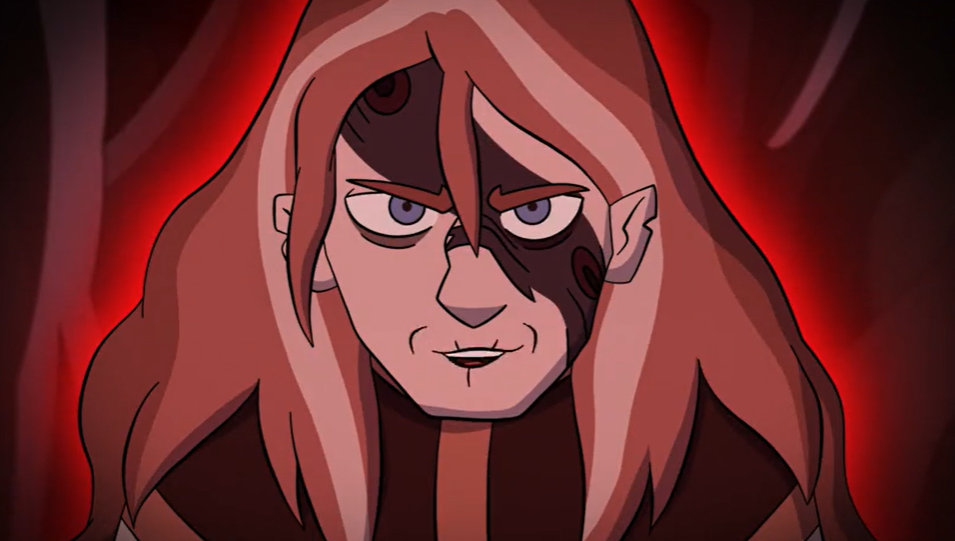
The beast-thing was actually a psychic remnant of all the palismen he's been consuming, and it had been causing more and more trouble for his mental state (and possibly physical state? this may be related to the bodily decay he's been staving off) recently. He deliberately made himself look like a child just to mystify and confuse the psychic intruders, hoping that they'd keep following him until they ended up getting between him and the palisman-ghost-thing.
Now, I don't recall Willow being this conscious and lucid about what her own inner self was doing when Luz and Amity went in. And it was unclear how much of their interaction in her dreamspace she remembered (as opposed to just recalling the vibes of) when she woke up afterward. So, I'm not sure if Wittebane was actually consciously aware of people breaking into his mind and decided to take advantage of the situation with this stratagem, or if he wasn't but his subconscious mind is just as devious and clever as his conscious one is. In either case though, this proves that Phillip Wittebane possesses exceptional self-awareness.
I don't think he could possibly be blind to what he's become. I don't think he's in denial about anything. He believes his own lies, but he chooses to believe them in a calculated, strategic manner.
The resulting encounter with the inner Belos' true self has Luz learning what the audience probably figured out long before the explicit reveal in "Elsewhere and Elsewhen." And...the show tries to play it as Luz realizing she's responsible for causing Belos' conquest of the Boiling Isles due to the time travel incident, but I already explained in my review of that episode why that doesn't really seem true to me. I can believe that Luz believes that it's her fault, but me not sharing her opinion on the subject does lessen the impact.
...
On an amusing side-note, Phillip reveals the surprisingly mundane reason for his taking a fake name. Phillip Wittebane's many crimes and betrayals had ruined his reputation, him having been run-out of many towns and cities throughout the Boiling Isles. The persona of "Belos" was invented literally just to whitewash his reputation.
I don't know, I think that's just kind of funny.
...
Before Luz and Hunter manage to escape having their minds evaporated by Wittebane's powerful avatar (with some outside assistance from Eda, whose been in contact with them from meatspace for some time), Luz gets Wittebane to share his true motives. Apparently, he never stopped thinking of himself as a witch hunter, even as he knowingly embraced witchcraft on every literal and metaphorical level you can think of. He knows that he's a witch. He knows that he's been doing all the things that people are supposed to hate witches for. But the way he sees it, this is all just one big undercover operation, and he's doing the lord's work by immersing himself in the dark.
He's dedicated, I'll give him that. He managed to stay on task for multiple centuries. Even knowing that he'd lose all the power and privilege that comes with kingship at the end.
...
I feel like going into what actually motivates Phillip to keep going through with this after everything he's learned and everything he's gained would, unfortunately, have strayed onto ground that Disney wouldn't ever permit in one of their shows. For all that Phillip Wittebane is a witch-hunter from Puritan New England, with all the coding that you'd expect, the show very carefully tiptoes around mentioning his religion. And that's a noticeable blank on the map.
When Luz and Hunter perused Phillip's memories of first getting his cult started, the doctrine that "the prophet Belos" preaches to the witches is really blatantly taking after the type of Calvinism a 1700's New Englander would have practiced. "The Titan has judged us all sinful, for in sin we wallow." "Only those who accept the mark have a hope of earning his forgiveness." He's definitely using what he already knows to create this phony religion. But the show can't be explicit.
I think what's being implied is that Philip's religion gives him a blanket of righteousness, as well as someone to persecute and feed his endless vainglory and bloodlust. Which you could probably guess just from him having been a witch-hunter. Even in societies that believe in witches, normal, well-adjusted people aren't the ones dedicating their lives to hunting them. But, with that religious justification in mind, I could see how Wittebane might cling to his fantasy of defeating a great evil and earning God's favor while also getting to do all the fun evil stuff - up to and including making sacrificial pacts with demons - along the way. I could see that fantasy appealing to him more than just forgetting the plan and enjoying his reign as king does. Bloodlust, megalomania, and vainglory are his motives, but without his religion I don't think those motivations would be able to stand up to the temptations of kingship.
So, it's a shame the show can't go more into that. Just like it suffered from not going into that with Phillip's modern earth minime Inquisitor Infowars, back in "Yesterday's Lie." It's a missing puzzle piece needed to make Belos' whole deal really click, and it's a shame the audience needs to insert it on their own.
...
So, Luz and Hunter escape with sensitive information about Belos' history and plans. Hunter is now fully onboard with the rebellion, in fear for his life, and having an identity crisis. On the bright side, during the escape from Inner Phillip, Hunter started using glyph magic from some cards he got from Luz. A power that his "uncle" seems to have been deliberately keeping from him, on account of his previous instances' betrayals.
Wittebane may or may not be aware of how much they learned. Depends on how conscious he is of his "inner self's" actions.
This episode should be great. It's badly undermined, just like its conceptual prequel "Elsewhere and Elsewhen," by the contrivances and railroading needed to make it happen when it does. And also by the compression, as there's enough material here between Phillip's history, Hunter's deconstruction and embrace of glyph magic, etc for at least two episodes. Add in the (at least, I strongly suspect) censorship issues, and these story beats become really frustrating when you think about how good they potentially COULD have been.
To end on a bit of levity, a favorite exchange of mine from early in the episode is Luz going "This is bananas!" and a distraught Hunter replying "I don't know what those are, but right now I don't even care!" The snark in this show is almost always good. Especially when it actively supports the worldbuilding like this.