The Owl House S2E11-12: "Follies at the Coven's Day Parade" and "Elsewhere and Elsewhen"
this review was commissioned by Aris Katsaris.
Man has it been a while. Probably should have broken up the Andor reviews a bit more to get through other items like this one concurrently. As it is, I really had to go back and refresh my memory, because I barely remembered what was going on where I last left off with The Owl House. In brief:
Hunter, aka Golden Guard, has had seeds of dissent planted in him by Luz after a failed assassination attempt by rival imperial enforcer Kikimora.
Eda found out that her "curse" is actually involuntary possession by an owl-like demon that was forced into this parasitic body-sharing state in ancient times during a battle with mysterious humanoid invaders (possibly the ancestors of the modern day witches, perhaps someone else). She and the owlbeast have learned to communicate, and can sometimes work toward common instead of cross purpose now.
An old flame of Eda's, Raine Whispers, has been helping a rebel cell from their high placement within the regime, but let themselves get caught and presumably executed in order to save Ida on account of her having dependants.
Another member of King's species tried to reach out to him, but was thwarted by Hooty's stupidity.
Luz and Eda managed to kludge together a semifunctional portal to Earth, through which Luz had a bittersweet meeting and coming-clean with her mother and also helped a refugee from the Boiling Islands find safety and security in Luz's own home. Additionally, it turns out that Luz's mom is pretty badass and maybe also a murderer now lol.
Luz is still slowly recovering more of Phillip Wittebane's journal data. Her interest is still in trying to figure out how to perfect the portal device; she doesn't yet realize that she's been reading the villain's autobiography.
So, there's a LOT going on, basically. Tons of concurrent plot threads, any or all of which be could pulled next. These next couple of episodes tug on quite a few of them. "Follies at the Coven's Day Parade" continues the intrigue within the imperial court, the fate of Raine, and the emotional damage Luz took from the partial reunion with her mother. "Elsewhere and Elsewhen" moves things much further along with the Wittebane Journal, and also pokes a little bit more on Eda's character development now that she's gotten control of the "curse."
Both of them are pretty good episodes, and move the plot forward effectively. However, they also both feel like they needed a bit more setup, or at least a little more runtime. "Elsewhere and Elsewhen" being by far the worse offender in this regard. On balance I think I'd put them both in the upper 25% of Owl House episodes I've seen so far, but probably not in the top 10%.
"Follies at the Coven's Day Parade" revolves around an insidious new weapon of the regime's. One of Belos' lieutenants has developed a memory-modifying potion, and they seem to be testing it out on the captured Raine. The lieutenant in question is one Tara Snapdragon, head of the Herbalists' Coven. I think we've seen her in the background during meeting room scenes in the imperial palace, but this is her first time actually doing anything, and as supporting antagonists go she makes a strong first impression.

Just the clear sadistic delight radiating off of her as she tests her new concoctions on human guinea pigs, the obvious satisfaction she gets from controlling people with her drugs and potions, all just barely masked behind archetypal grandmotherly mannerisms. Within "The Owl House's" dissection of witches, witch hunters, and the like, Tara is the most straightforward example of a fairy tale witch we've seen so far. As far as this episode shows us, Tara isn't motivated by a misguided sense of loyalty to the government, or a desire to impress the emperor, or even really careerist ambition; just a megalomaniac taking advantage of the power that working for a dictatorship provides.
It's a bit discomforting when you remember that - assuming business as usual - Willow is going to have to work for this lady when she graduates. The other covenmasters we've met so far have (with the obvious exception of Raine) been various flavors of ruthless and harsh, but Tara is very likely the worst one to be in the power of.
Anyway, basically, they're trying to see if they can keep Raine as head of the music-magic coven even after his treason conviction by drugging key memory sequences away. If it works, they can keep a generally competent official in place without having to invent a story to explain his disappearance or (much worse) making a huge show of weakness by letting people know that one of the covenmasters had been a rebel agent all along. If it works, they can presumably start using this potion on other troublemakers who they don't already have as close a watch on.
Meanwhile, Imperial Coven bigwig Kikimora has been having a very bad time of her own. She blew a lot of political capital on that failed plot to kill Hunter, and was subsequently humiliated during a resourse-hunting expedition. She's starting to fall out of Belos' favor, and she knows it. Her other rivals at court, including Tara, can smell the weakness.

It's about to be Coven Day, one of Belos' tacky state holidays where everyone celebrates how much they love the social order he imposed on them, and there's going to be a big parade through the main street of Bonesborough. A parade that Raine - as the leader of the entertainment-focused bards' coven - will be personally participating in. News of this baffles Eda, who had assumed that Raine was extrajudicially executed (or at least thrown in a very unpleasant dungeon cell somewhere very hard to break out of) after they parted ways a few episodes ago. Meanwhile, Luz has been enchanted when she learned about Eda's romantic history with Raine, and Amity has recently discovered that Luz lied to her when she said that the earth-portal was a complete failure (really, Luz just didn't want to tell her about the events of "Yesterday's Lie" because they were too painful for her to discuss). Consequently, Luz wants to help Eda figure out what the hell is going on with Raine, and Amity wants to help Luz with whatever she's doing to see if she'll stop keeping secrets from her (and, ultimately, be less inclined to vanish off back to earth without a word as Amity distantly fears might be the plan. That girl has serious abandonment issues).
There's a big theme of failed or deferred reconciliations running through this episode.
Anyway, the catalyst for the plot is when Luz happens to catch a rare site of Kikimora outside in the city center without a retinue of guards or attendants, sobbing into her magic cell phone thingy to her mother about how she won't be able to come home for the holidays this year; with all the shit she's gotten herself into at work, she absolutely needs to work overtime and win back brownie points wherever and however she possibly can for fear of what might happen if she truly falls out of favor. She sounds like she's on the brink of an outright nervous breakdown, and like she considers her position in the emperor's court to have become a prison.
So, against Eda's misgivings, Luz makes a move to conspire with Kikimora. Offering to kidnap her from the parade and then secretly release her back to her family while letting the regime thinks she's in criminal captivity, provided that she helps them nab Raine as well so that they can try and unfuck their brain.
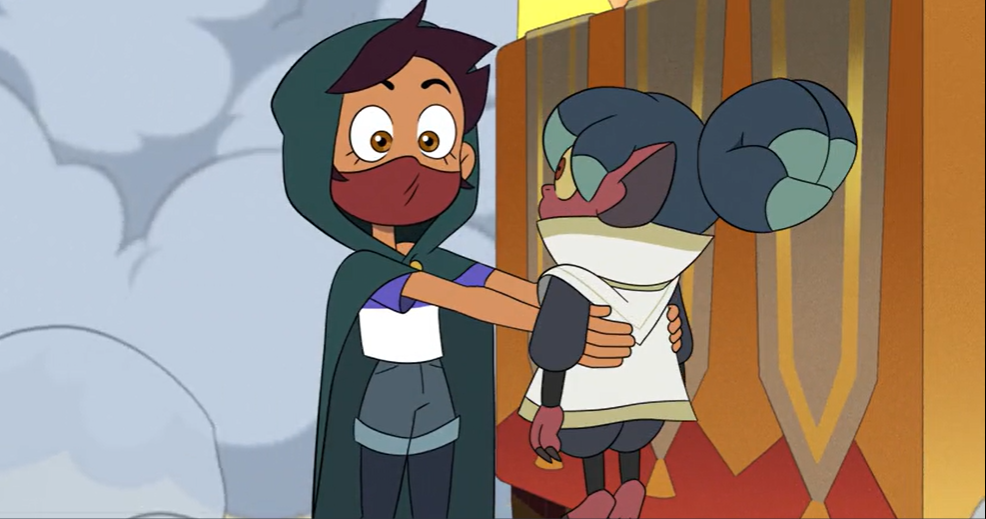
And, heh, well. After Lilith and kinda-sorta Hunter, the show had me primed to expect turning another imperial agent to be disappointingly easy, despite Kikimora having been characterized as extremely committed and ruthless up until now. I was rolling my eyes that an in with her just randomly threw itself at Luz and she was able to exploit it with just a single conversation. But, it turned out the show was one step ahead of me; Kikimora is absolutely planning to betray them after they get themselves in the public eye again by kidnapping her and Raine, thus winning herself some status back.
At the same time, Kikimora herself is being scrutinized by Tara, who would just love to catch her in a seditious act and be given authority to melt the brain of yet another of her erstwhile peers.
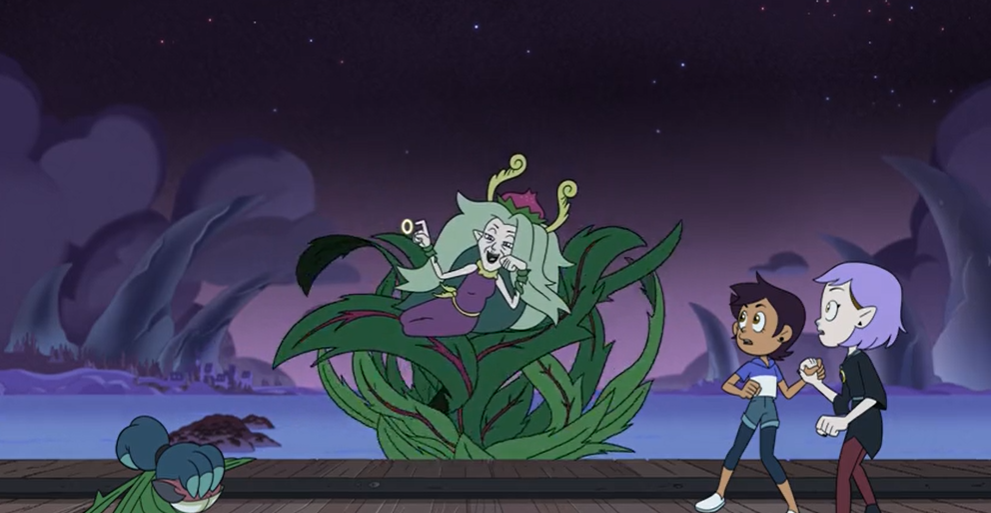
The plan ends up failing at multiple points, as the episode title implies. After managing to nab Kikimora and Raine from the parade (with the former's secret assistance) and having a near miss when they almost get caught by Tara, the gang has everything go wrong. Raine puts up an unexpected amount of resistance, catching Eda offguard when he proves to have no memories of having met her again since college, or of having taken part in a resistance movement. He ends up fighting her violently, while insisting that he'd hate to have to kill his high school sweetheart but he'll do it if she doesn't flee.
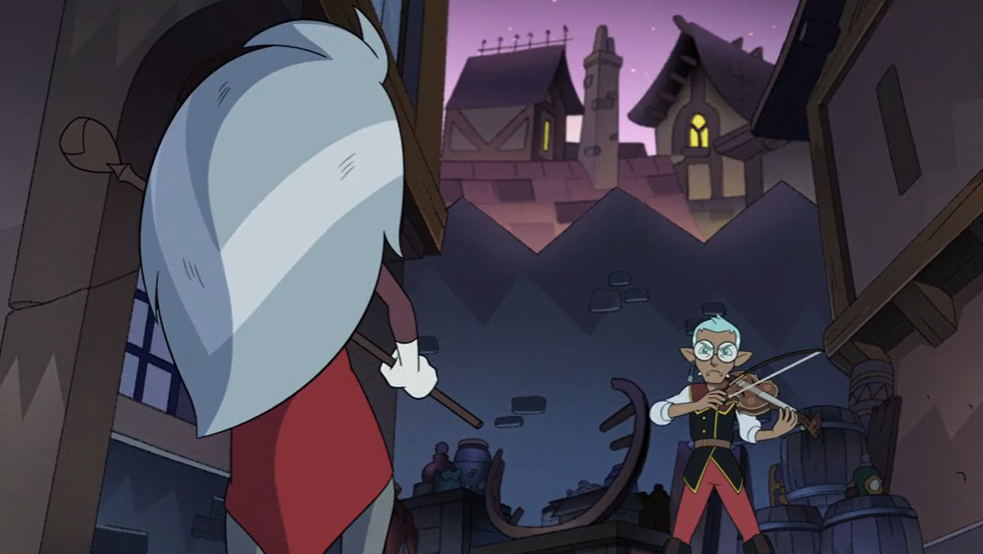
With time of the essence and soldiers closing in, Eda has no choice but to comply. Even the sound of her playing their old favorite song together only gives him a moment of uncertainty, not quite managing to break through the memory block. Tara's new herbal potion is powerful, alright. Its effects might turn out to be reversable, but it'll take a lot more doing.
Meanwhile, Kikimora makes her own sudden and inevitable betrayal of Luz and Amity who were in the process of smuggling her to the coast. Only to suddenly be grabbed by Tara, who had secretly been following them ever since they "lost" her at the city's edge. Turns out that Tara wasn't just hanging around at the parade to monitor Raine and make sure he was remaining under her spell; she was also on orders to keep tabs on Kikimora and look for signs of dissent or betrayal. Kikimora passed the test; cynical though her motives were, the fact that she put an entrapment scheme into place and seemed to be planning to turn the criminals over to the government (who could then easily leverage them to get Raine back) earned her a passing mark. She doesn't get the execution that Belos had been considering sentencing her to in the wake of her recent shenanigans.

Kikimora didn't even realize how much shit she was in. At this point, after hearing this, she might be wishing she actually had been earnest in her offer to help Luz. Too late now though; no way in hell are they ever trusting her again. If they do end up saving Raine later in the series, it almost certainly won't be with Kikimora's assistance.
Fortunately, Tara doesn't keep Luz and Amity in custody. Apparently, the emperor instructed her to leave them free for the moment, for reasons unknown. Curious.
Luz, for her part, realizes how much she was projecting onto Kikimora when she heard her wishing she could be reunited with her mother. Trying to vicariously "save" this unrepentant villain based just on that shallow commonality, without knowing anything else about her. Eda was right (though to be fair, Eda herself did go through with the plan despite her misgivings about using Kikimora; she obviously thought the latter might be genuine). Luz comes clean to Amity about the portal incident, confronting and sharing her pain instead of trying to externalize it and blinding herself to reality in the process and also quieting Amity's own fears about what might have been going on there.
The real show-stealer for this episode, though, were King and Hooty. They got a little comedic subplot of their own by serving as a distraction for the parade security during the abduction/rescue, via a parade float stuffed to the brim with seditious hardware. This whole thing was just gold from beginning to end, starting with them unveiling the float itself:

Escalating when they initiate the distraction by having the Fingergun-Belos' head burst open and launch this illegal fireworks display right in the middle of the city center when no one was expecting it:

To the part where the Imperial Coven moves to seize the float, only for it to turn out that Hooty has actually extricated himself from the owl house and infested the float instead, allowing him to animate it in unexpected ways:
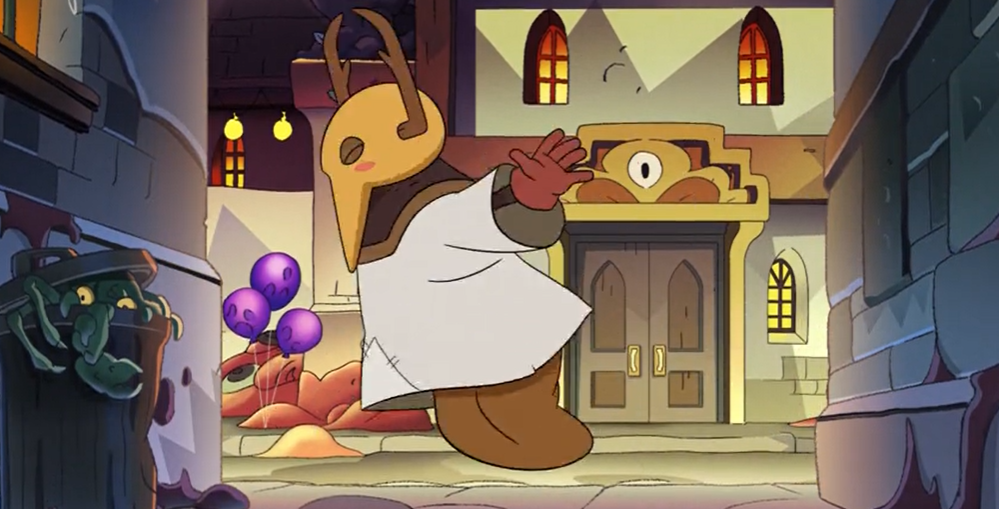
Literally stomping on cops while hootily screaming such gems as "Hey, look at me, I'm your god!" and "Stealing is legal now!"
Risky move, leaving the house undefended like that. But totally worth it.
The episode ends with the kidnapping/rescue attempt managing only to be a minor terror attack with little real impact. The Coven Day parade is followed by a public address from the emperor, in which he declares that the prophesized "day of conjunction" is now only a month away, and making his first-ever unmasked appearance to the Boiling Isles street.

Apparently, he wants the entire population of his empire to assemble upon the titan's skull for this event. Which will be heralded by a total solar eclipse. Which definitely isn't ominous and Fullmetal Alchemist-y. Last that we knew, Belos wanted to merge Earth with the Demon Realm, though his reasons for wanting that are yet unknown. What he's planning to do with all the witches and demons at that time, also unknown. Probably bad though.
Strong episode. Moves the Raine plot along to shift the ball back into the protagonists' court, advances the drama within the imperial palace, and introduces a pretty effective new villainous henchwoman while also doing some good character stuff with Luz and Amity. I feel like the meeting with Kikimora was a little bit too convenient, and the characters jumping into a conspiracy with her - even one she wasn't participating in good faith in - was too fast and needed at least one more previous encounter with Kikimora to set up. Even at its weakest moments though, this episode never made me wait long before I got more of King and Hooty being entertainingly ridiculous and making me forget about those minor misgivings.
Episode 12, "Elsewhere and Elsewhen," is...okay, if them happening to stumble into an unattended imperial security bigshot having an unguarded phone conversation last episode was too convenient, the enabling gimmick of this episode is just fucking insane. I like what they use it to do. The bulk of the episode is really good stuff. But in order to let it happen, the show had to introduce that most notorious ruiner of fantasy plots: time travel.

I'm not against time travel on principle. It's just something that quickly eats everything else going on in a story if you're not supremely careful with it. My general philosophy on the subject is that if you don't want your story to be all about time travel, you should really think thrice before including it at all.
In this case, the writers do an okay-ish job of explaining why time travel won't be used again after this, why the scope of its usage IN this case is so limited, etc. But only okay-ish. Not great.
Basically, Luz is frustrated with the slow pace of Wittebane journal contents she's getting from the book-rat. She also begins to suspect that some pages might have been missing from the journal before it ever ended up in the library, or that Wittebane might have neglected to write down some key details. She wishes she could go back in time and talk to this guy herself, and - by total insane coincidence - there's an urban legend about naturally occurring time portals that warp unpredictably from place to place around the Boiling Isles' coastline. And, by even more insane coincidence, Lilith happened to be obsessed with the time travel legends as a young woman, and invented a device that would theoretically let her track the location of those pools, but she could never find a suitable power source for it. And, oh what do you know, the titanblood that they still have a tiny amount of is apparently a perfect solution to that problem.
They find the warping "time pools" almost immediately, but then for some reason don't even think about trying to find them again with their perfectly functional tracking device after they next warp away. And, while they DO have access to the time pools, they JUST use them to talk to Phillip Wittebane; not for anything else besides that. Despite the pools enabling you to travel back to literally any point in the history of the Boiling Isles.
-__-
Lilith makes it clear that they should try to avoid causing time paradoxes, so I'll grant that there's good reason for them to not try to go back and prevent Belos from ever coming to power or the like. But...the sheer amount of intelligence they could be gathering? The questions they could be answering?
It never even occurs to them to try and find out where King's egg came from? Or where the owlbeast originated? Or the process of how glyph-magic gave way to innate spellcasting? Or any of the million other mysteries whose answers could be found in the recent and/or ancient past that have been troubling them throughout the series?
The only really convincing answer to this is that the writers needed time travel to exist in order to facilitate this one specific episode plot, but they don't want to have to deal with it ever again after this. The explanations provided for the characters to be cooperating with the author here are paper-thin.
Well, that was a rant. Now, on to what makes this episode good even despite its foundational flaw.

First of all, while I strongly dislike Lilith and still feel like the show is way, way too forgiving of her, her use within this episode is effective. First of all, it gets into her love of history and archaeology; an aspect of her character that was only sort of hinted at before. She originally wanted to be an archaeologist before circumstances and misguided atonement attempts pushed her into the Imperial Coven (hence her youthful interest in the Time Pool legends in the first place). The episode manages to bash that side of her against the less pleasant one we're already familiar with. When they go back three hundred years to the late pre-imperial era, Lilith warns Luz about the chaos and violence of the society ruled by "wild magic" that they're going to find.
Only for them to find a happier, more harmonious version of the Boiling Isles. In virtually all ways superior to its state in the modern day.

There must have been some sort of hardship or crisis not long after this point for Belos to have taken advantage of, but it hasn't happened yet, and the status quo that his "solutions" prevented a return to was far, far superior to what he's given them.
Lilith and Luz's diametrically opposite reactions to seeing this version of the world is an understated, but extremely important, aspect of this episode.
The real meat of it, though, is when they track down Wittebane. He had a bushy enough beard at this time for them not to recognize him as the man who will become Emperor Belos, though Lilith does start experiencing some strange deja vu that she can't quite put her finger on as they interact with him. There's an amusing subversion with his introduction, as Lilith and Luz find him in the process of being bullied by a pair of hulking demons as they mock him for being a human and threaten to burn his precious journal.
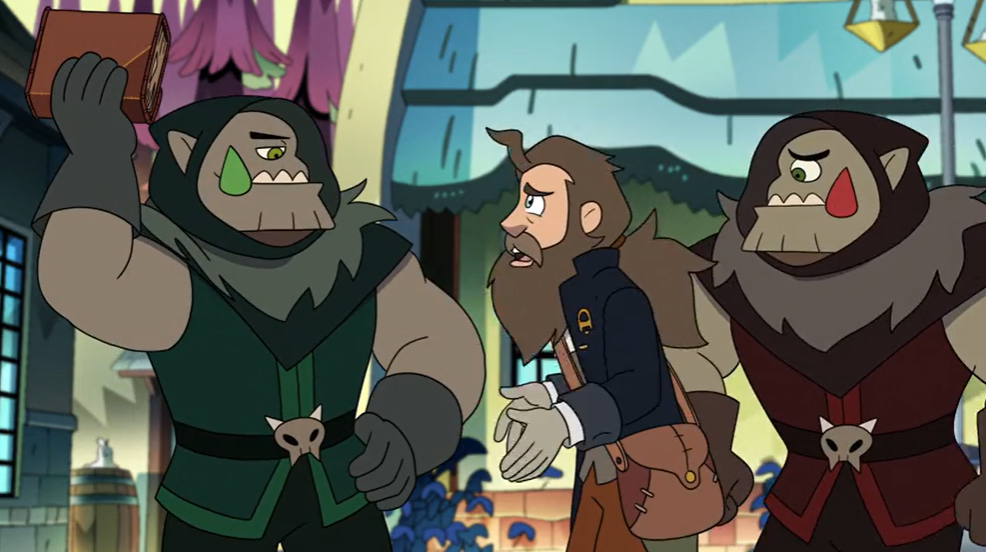
It seems like the show is doing a woobie-turned-villain thing with Belos, but nope! By the end of the episode, it turns out that these two were beating up Wittebane because they (correctly) suspected him of murdering their friend.
...
You know, if those two demons had just taken it easy on the racial slurs, Lilith and Luz might not have jumped to conclusions and they could have gotten a chance to explain themselves. There's a lesson in here.
...
Wittebane is currently trying to contact a being called the Collector, who he seems to think might be able to help him with interdimensional travel. Mentions of this entity in the journal entries were one of the details that made Luz suspect there were missing entries, as the journal never actually said who the heck this entity was or how Wittebane learned about it, and nobody that Luz knows in modern times has heard of it either.
It turns out that the way to contact the Collector is hidden in a bizarre magitech complex built inside of the titan's skull. And that there are monsters guarding it that he needs other people to distract for him while he makes his way through.
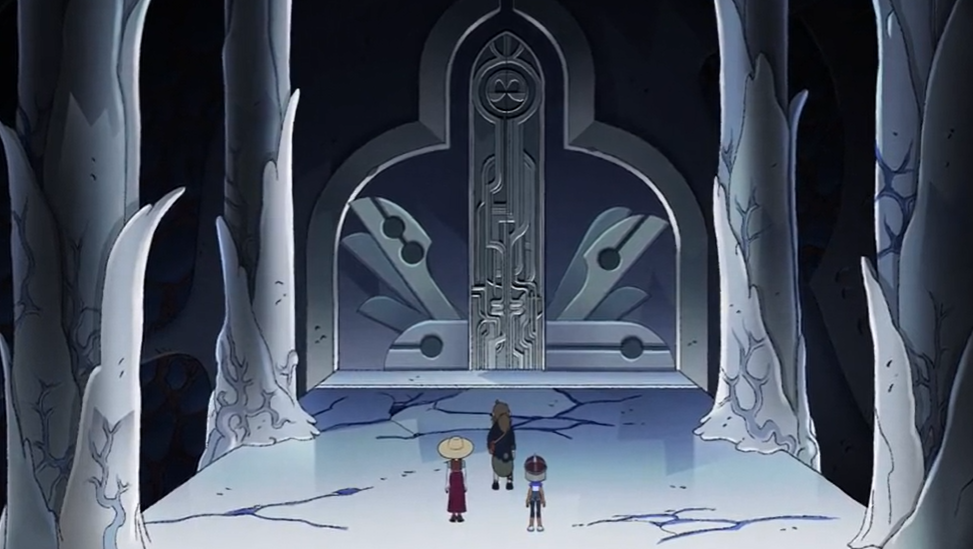
This was the fate of that humanoid demon who disappeared in his company earlier; unfortunately, he wasn't able to keep the monsters busy for long enough, so Wittebane tries again using Luz and Lilith.
The characterization here is clever. Wittebane is a master of telling people what they want to hear, divining their prides and shames and using them to flatter their egos and make them want to prove themselves to him. It's these kinds of manipulative headgames, among a few other details, that make Lilith feel that deja vu. He also turns out to have independently mastered glyph magic, which he uses as a way to build exploitable comeraderi with Luz (and also confirms my suspicions about the basis of Belos' onscreen item-based tricks).
The real rugpull, though, is when he starts writing in his journal about his companions' tragic demise at the hands of the complex's guardians before the attack has even happened yet. Which recontextualizes almost every single journal article of his we've seen so far, because he very often mentions bad things having happened to places and people he met in his journeys. Always with the same "woe is me" kind of phrasing that he uses to prematurely describe Luz and Lilith's deaths. It's a genuinely chilling moment.
Another memorable moment is when - after seeing through the lie that they told about who they were and why they wanted to seek the Collector with him - Wittebane decides that they were planning to betray him and that therefore he's in the right for doing it to them first. He also, in one moment, writes off their deceptive behavior as "typically witch-like."
...
In my review of "Yesterday's Lie" I inferred that Inquisitor Infowars might be a preview of Emperor Belos' true nature. Looks like I was right.
Wittebane looks for confirmation of the iniquity he expects to see in the "witches" (literal and figurative) around him, and then uses that as an excuse to exploit them in remarkably witch-like ways himself (I mean, come on, luring people into the woods to sacrifice them? How much more on-the-nose can you get lol). The fact that he has no trouble with using magic himself while still clinging onto his disdain for "witchcraft" just epitomizes this.
At the same time, Wittebane has extra layers of self-awareness that the historical society nutjob lacked. Inquisitor Infowars expected to be seen as a hero for hunting witches and demons in the exact way that he hunted them. Wittebane, on the other hand, understands that he needs to lie in his memoirs about exactly what he's been doing and how he's been doing it. The kind of deception he employs in his journal isn't something you can get from unconscious prejudices or blind spots, it's very much calculated.
Put simply, Inquisitor Infowars was a dumb hypocrite with zero self-awareness. Phillip Wittebane is a smart hypocrite who is totally aware of his own hypocrisy, but doesn't care. A much more dangerous individual even before factoring in his remarkable cunning, charisma, and eventual magical ability. I have little doubt that this guy had committed and covered up some serious crimes even before he got isekai'd to the Boiling Isles, and that he's as willing to apply a label equivalent to "witch" to his fellow humans as he is to Boiling Isles entities whenever it's convenient for him.
And like...well, the show isn't ever going to go into this explicitly, for fear of bringing down the wrath of the Mouse. But. Wittebane was plucked from a Puritan settler colony, on the eve of a genocidal push deeper into the continent. The kind of hypocrisy he runs on is just a more personal application of "the Indians aren't Christian, which means that they have no morality, which means that it's okay for us to kill them and take their stuff." He's been trained to assign dehumanizing labels that turn anyone he wants something from into fair game.
...
Lilith and Luz escape his attempted betrayal, and beat him up for his trouble before returning back to their own time. In a little coda scene, we learn that Wittebane is already starting to suffer physical decay due to whatever life-extension method he's been employing, and that he's already sucking the juice out of palismen to stave it off.

Getting punched in the nose by Lilith caused a bloody wound to open up, in a way that you wouldn't expect from normal human flesh.
He also walks out of this adventure with a strange metallic disc from the Collector facility in the titan's skull, which will presumably aid him along his path to becoming Emperor Belos.

This might be a grandfather paradox, but also might not. Wittebane likely would have succeeded at this sooner or later even without that specific pair of dupes.
This episode also has a b-plot, involving Eda's further reconciliation with her parents. We get to meet the girls' father for the first time; apparently, he used to be a palisman-carver before she badly mauled him during an early owlbear fit. It was this incident that precipitated Eda running away from home, and she's been too guilty and ashamed to even look her father in his scarred, one-eyed face ever since then.

Getting back in touch with Lilith for this adventure also meant having to talk to the parents again, and now that she can control the owl-curse Eda was willing to be pressured into talking to her father. He doesn't blame her at all. He knows it wasn't her fault. But he has trouble getting Eda to believe it herself.
He gives her a gift; a palistrom seed, from the secret grove that he and the Bat Queen have been nurturing over the decades as the state has clamped down on this resource. A gesture with multilateral symbolism, in terms of getting passed the trauma, starting new lives, and also surviving the regime with their family and their culture both intact.
Also...this scene reminds me of how much I hate Lilith. SHE is the one who caused their father to lose his eye and the use of one of his hands, not Eda. And then she tried to "atone" for it by being a bootnecker for the same dictator who's been stomping on his traditional role and profession. And...she's just gallavanting around with Luz this episode, not interacting with this whole other subplot at all. Instead, it's all just about Eda learning to forgive herself.
...
I really, really, REALLY don't think that this series understands just how loathsome Lilith Clawthorne is.
It's been a problem throughout season 2. It's not getting better. I don't think it's going to get better.
...
Still, Lilith-shaped hole in this subplot aside, it's poignant and effective.
On one last note for this episode, we see some imagery associated with the Collector, both in the titanskull facility and in Wittebane's illustrations, and it looks familiar.

The moon and stars motif is very reminiscent of the humanlike being that we saw antagonizing the owlbeast back in its own memory in "Knockin' on Hooty's Door." Maybe just a superficial similarity. Maybe not.
In any case, the celestial motif of the Collector correlates pretty obviously to the solar eclipse that Belos is planning to do his thing during. And he wants to bring everyone to the titan's skull for it, where that Collector installation is hidden. Planning to sacrifice everyone to the Collector? That would fit.
"Fullmetal Alchemist-y" is becoming more and more a propos.