Dungeon Meshi S1E1-3
This review was commissioned by Pseudo Nym.
Dungeon Meshi, awkwardly localized as "Delicious in Dungeon," is a show that people have been recommending to me for several years. I'm generally wary of directly Dungeons & Dragons inspired media, especially if said media is produced in Japan, but I always had a good feeling about this one. Part of it was the creatively comical premise. Part of it was also that, after watching the first bit of Frieren, I've learned to be a bit more openminded about DnD anime.
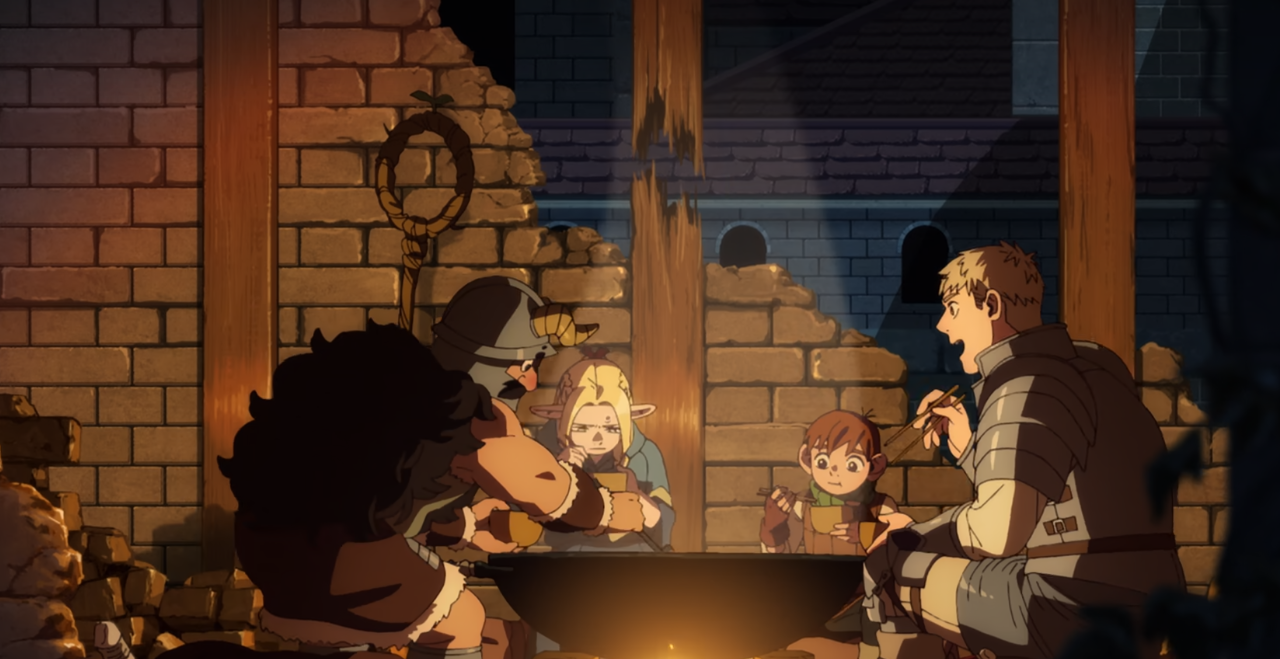
Something that Dungeon Meshi has in common with Frieren is that it scrupulously avoids being litRPG. That is to say, while it isn't shy about being set in someone's Dungeon's and Dragon's campaign world, it doesn't acknowledge game mechanics as in-universe principles. Rather, it assumes that the rules of DnD (or whatever similar fantasy roleplaying ruleset the creators had in mind) are an imperfect abstraction and simplification of what's actually supposed to be happening ingame.
Now, that said? The kind of tongue-in-cheek humor that Dungeon Meshi is written with nonetheless suggests that this might very well BE someone's dnd campaign, with players that aren't taking the story 100% seriously. Tonally, I'd almost compare it to the pre-webcomic era of "Order of the Stick," back when it was a series of shorts that ran in Dragon magazine (though, as aforementioned, without the rule jokes). Perhaps a better comparison would actually be the silly little one-panel cartoons that appeared in some of the first edition DnD manuals.
It's an unusual balance being struck here, being implicitly meta without ever breaking the fourth wall, but it works.
Anyway, the pitch. The series opens with a typically balanced party of adventurers, deep in the bowels of an old school style megadungeon. They had some navigational problems on the way down, which led to them having to ration food, which in turn led to the hungry and unfocused party losing a fight with a dragon. Just as she's being sucked down the beast's gullet, the party cleric casts some kind of last-ditch escape spell that sends the party back to the surface. Unfortunately, it only transported them with the items and clothing that they had on their persons, without any of their wagons and pack animals laden with supplies and loot. Even more unfortunately, the priestess herself died to the dragon's teeth as the spell was taking effect, which prevented her from being brought up with her living companions.
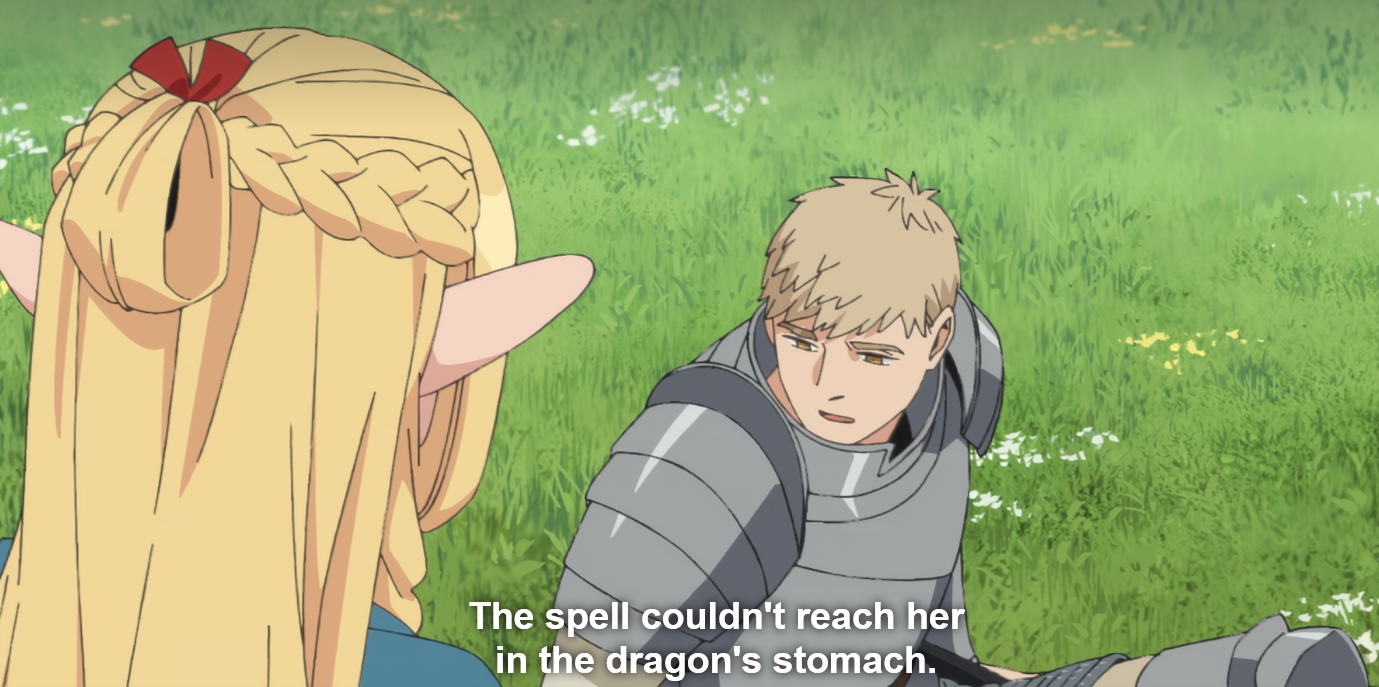
With all their supplies lost, no money to buy more, and their cleric lost, several other members of the party give up and head home. However, Laios the human fighter - whose sister was the one who died saving the rest of the party - isn't willing to abandon her to death. Resurrection magic isn't hard to access in this world, provided you still have a body to use it on. He also happens to know that dragons digest their prey very slowly over the course of their months-long slumbers between hunts. If he can just get back down there, kill the dragon, and get his sister's half-digested remains out of its stomach, he can have her revived. Two of his companions - Marcille the elf sorceress and Chilchuk the halfling thief - share his commitment to the woman who saved them.
In their current financial state, they don't have a hope of resupplying in time to recover the body before it's fully digested. So, Laios - always prone to having outlandish idea and then committing to them in defiance of any criticism, obstacles, or common sense - proposes an alternative solution.
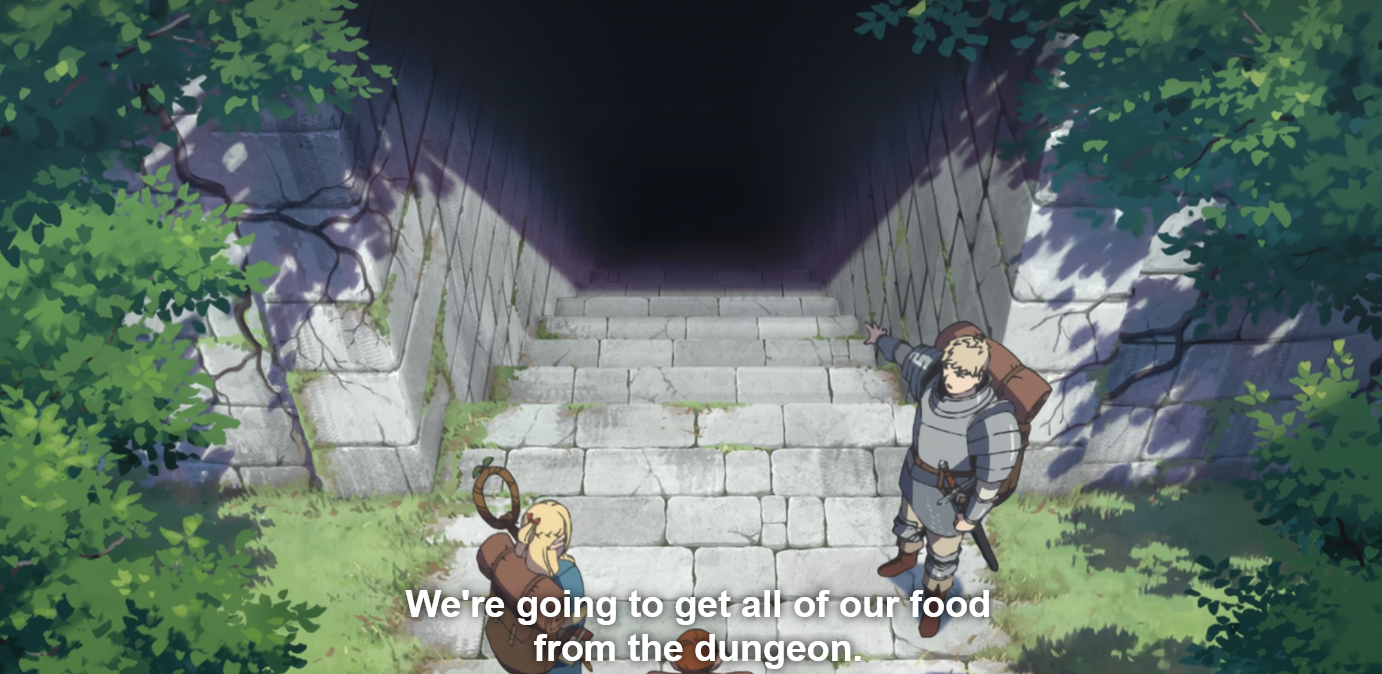
Eating monsters is normally a practice relegated to criminals and outcasts. Marcille and Chilchook think Laios is even crazier than they normally think he is when he proposes it. But, for want of other options, they reluctantly take him up on it.
At first, Laios is guided by the highly questionable instructions of a cookbook he somehow got his hands on, presumably authored by one of those aforementioned outcasts or criminals. However, as luck would have it, their initial inept attempts at cooking a mushroom-monster they bring down brings them to the attention of Senshi, an accomplished dwarven warrior-chef who's been cooking and eating dungeon creatures for many years and considers himself a professional.
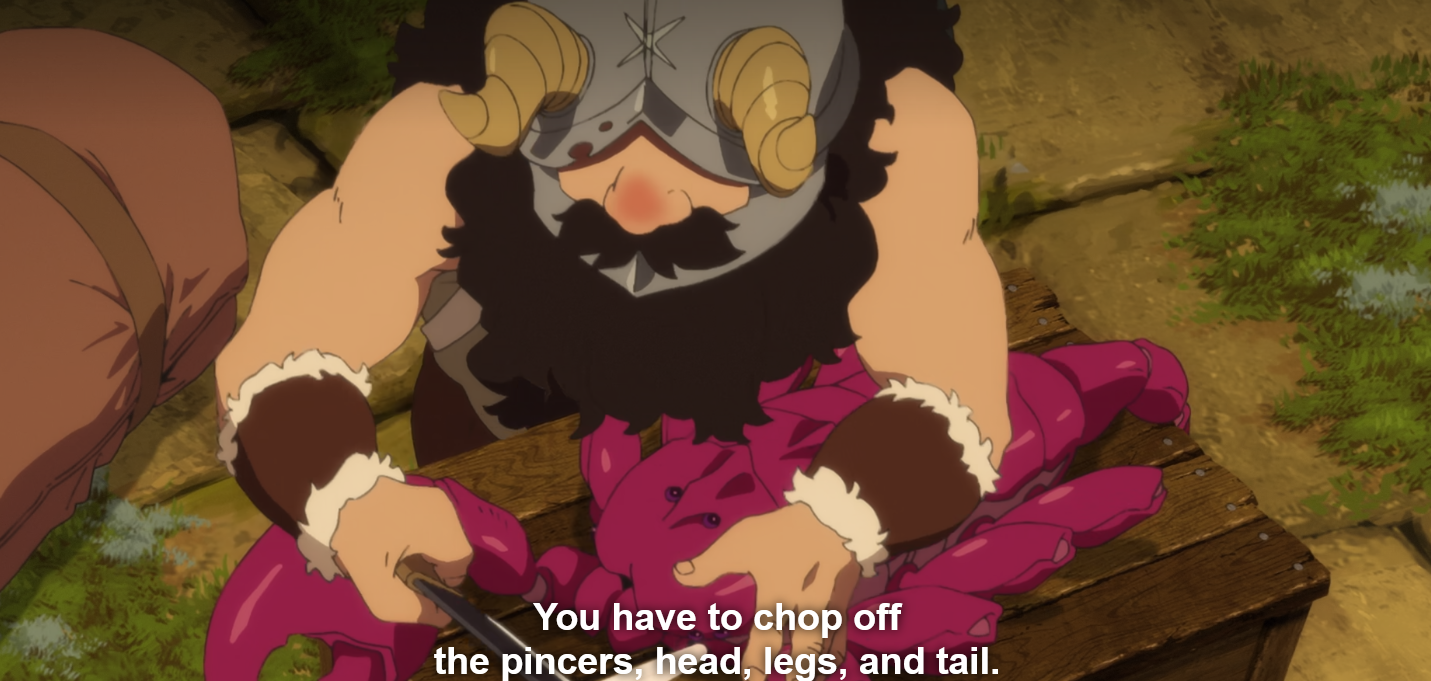
And thus, with the vital skillset they'd previously been missing now present, the party begins its descent through multiple levels of cursed dungeon haunted by deadly - yet also quite edible - monsters.
The main joke here is that each episode spends a relatively small amount of time on our heroes(?) figuring out how to kill or escape monsters, and a relatively large amount on them figuring out how to cook them.
...
This tickled my funnybone extra hard on account of me having had a similar idea a few years back.
After getting addicted to the cooking minigame in Breath of the Wild, I thought about running a quest about an adventuring fry-chef journeying across an ersatz not!Hyrule in search of recipes and ingredients and also defeating evil when it gets in the way. Complicated mechanics for cooking that take a lot of thought and strategizing, and incredibly simplified and intentionally-too-easy rules for resolving combat. The big climax would have had the character entering the castle ruins in search of the royal fruitcake recipe and slaying Not!Ganon in self defence.
So yeah. This show isn't exactly the same thing as that, but it's amusingly close.
...
I'm happy to say that humor isn't the only thing Dungeon Meshi brings to the table (heh), though. It's primarily a fantasy comedy series, but once the goofy premise has gotten you watching you start to appreciate other things as well.
For instance, as far as old school DnD inspired fantasy goes, this show is surprisingly good when it comes to worldbuilding. Including in some very clever and subtle ways. Like, take Senshi the dwarf's whole schtick. When we see other adventurers from time to time, elves and halflings are both fairly common, but we've yet to see another dwarf in these early episodes. And then you realize that dwarves live underground in dungeon-like environments, and Senshi's recipes might actually just be traditional dwarven cuisine. But, if we're far away from the dwarf homeland and dwarves aren't often found in this region, then it still makes sense for eating dungeon critters to be a fringe practice normally relegated to outlaws and refugees in this part of the world, and thus for most of our protagonists to be new to it.
It never spells this out, but once you realize it the choice to make Menshi a dwarf rather than any other traditional DnD species starts to look very carefully considered.
Likewise, in a much heavier example, the characters offhandedly mentioning "resurrection trauma." In a world where resurrection magic isn't too hard to access, there's an uncomfortable callousness concerning the prospect of death in battle that wouldn't make as much sense in any other kind of world. And yet, on the flip side of that, adventurers and warriors seem to be at high risk of a sort of PTSD-like condition that comes from dying and being brought back. Much like in real life, there's stigma about mental illness that pushes the characters to minimize and downplay the suffering it causes them, which in this world has the effect of toxically enabling the cavalier attitude toward dying to keep being perpetuated.
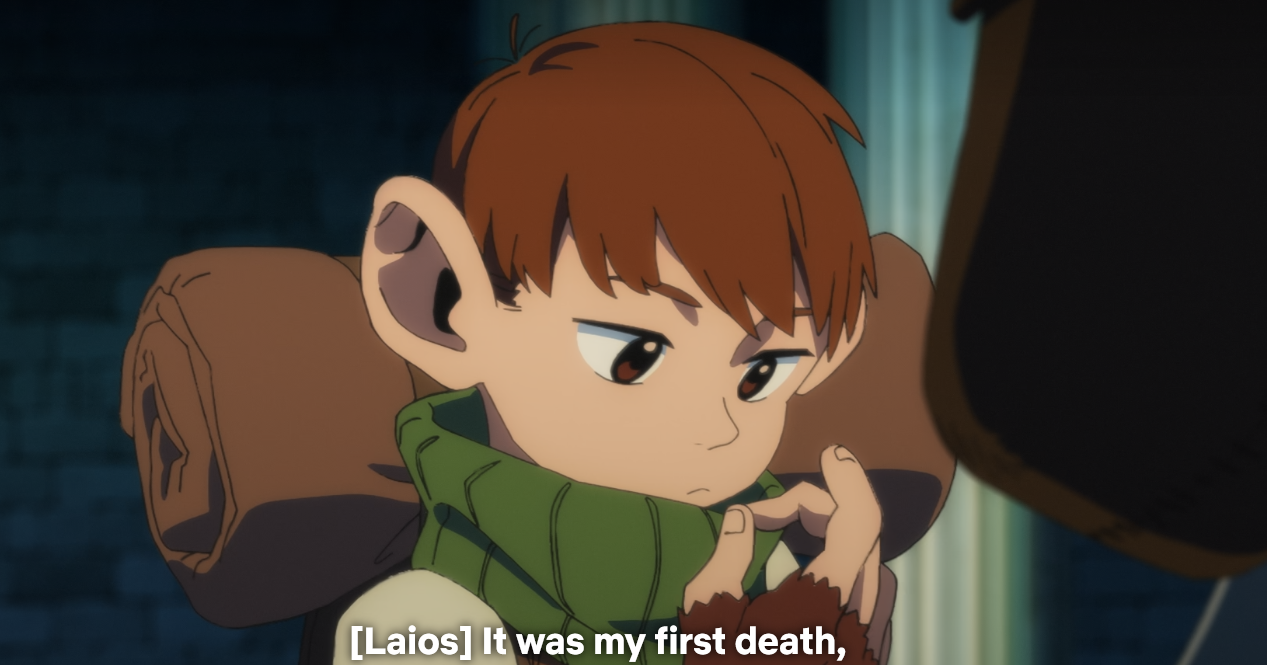
The show doesn't get too into this. It's still mostly a silly parody. The social commentary here is purely subtextual. But the fact that it's present at all still makes Dungeon Meshi's one of the most holistically well-considered OSDnD worlds I've encountered.
The attention to consequences and implications also shows itself in the shorter term. Like the way that this megadungeon used to be full of gold enamel just sitting on the walls waiting to be pried off, but over the years adventurers have stripped the upper levels clean and forced later treasure-hunters to descend further into the more dangerous depths to get the same kind of haul. Or how a modern catacomb complex that got connected to the megadungeon has - after being cleared of both monsters and desecrated bones - been turned into a sort of staging area and safe haven for adventurers, almost like a kind of underground tavern.
The creators also seem to know a fair amount of real world food trivia, and work it cleverly into the series. An early example of this being when Laios - before the party lucked into Senshi's guidance - assures his companions that scorpion venom is only dangerous when injected...only to end up retching and clutching his stomach in agony when he tries whole-roasted giant scorpion.
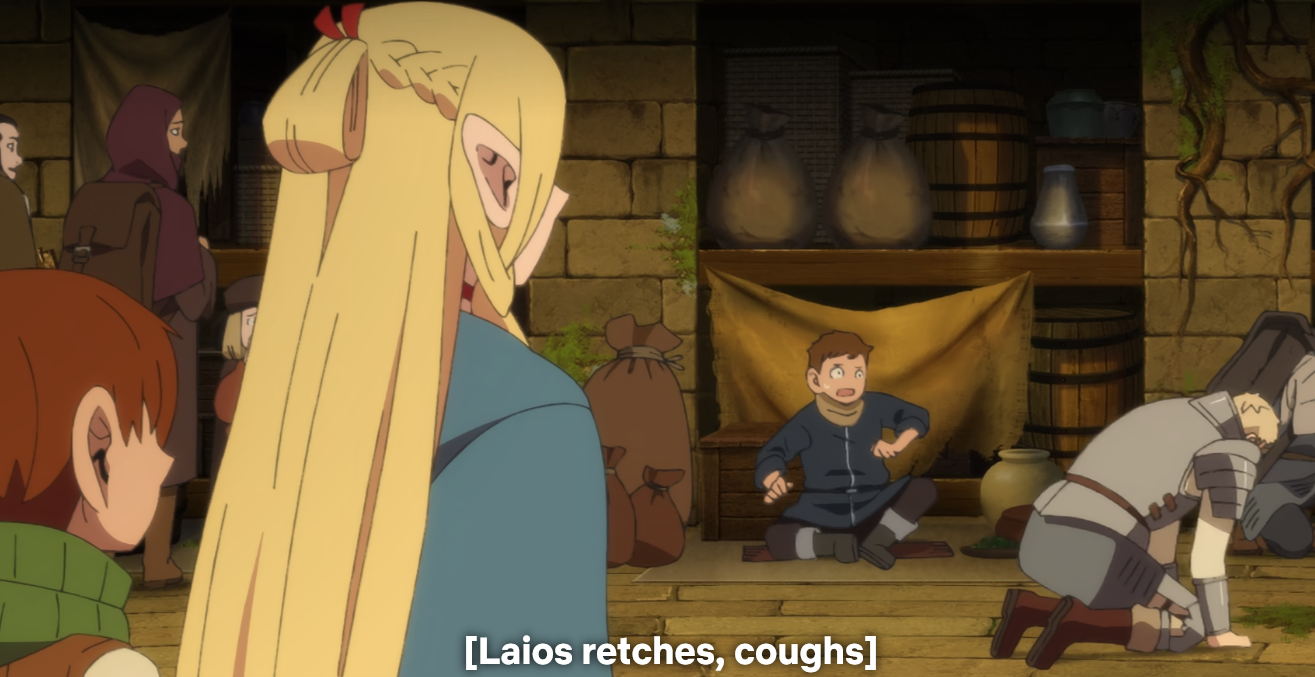
Scorpion venom is only dangerous when injected, but ingesting it causes a severe burning sensation, and doing so on an empty stomach is going to make you really regret it. This is the basis of the real life Mexican drink mezcal alacran, which uses scorpion venom to give the drink an extra kick as it goes down. This is an obscure food fact that I randomly happened to know, and it came up in the first ten minutes of the first episode. There are probably dozens more real life food facts that I don't know in these three episodes that sailed right by me.
If there's somewhere I'd have to criticize Dungeon Meshi, at least based on these first three episodes, it would have to be the characters. Not all of them. Laios and Senshi are both great. Laios for his ability to vacillate between dedicated brother and traumatized veteran at one moment, and impulsive himbo who can't keep his goofy out-of-nowhere obsessions under control the next, while still being unmistakably the same guy. Senshi for playing every pop fantasy dwarf cliche straight, but repurposing them to be about cooking instead of smithing or combat or the like, and doing so in a way that makes sense and helps the world building. The other two party members, though, are kind of disappointing.
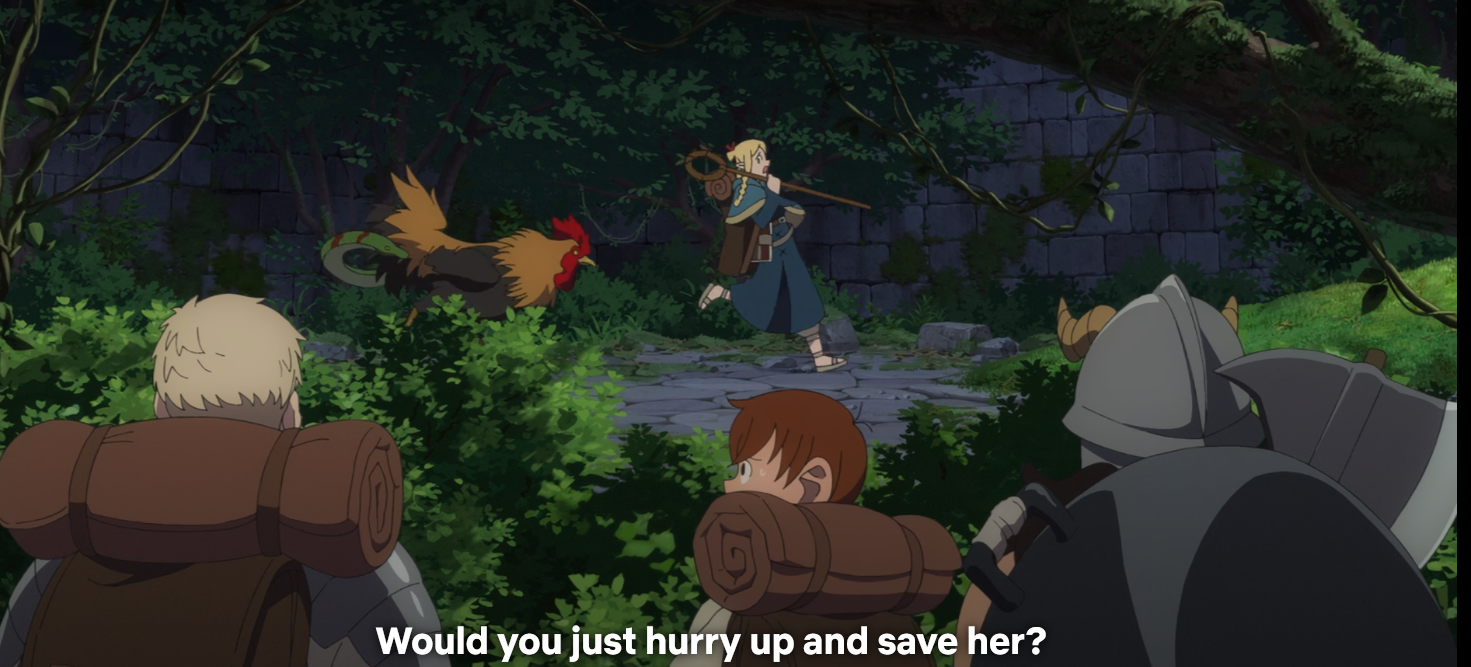
Chilchuk the thief just plays the straight man to the first two's antics. Marcille the wizard just complains about everything. If there's more to either of these characters, it doesn't become apparent until later in the series.
My biggest disappointment with them is how little the series does with them being a halfling and an elf respectively. Like, looking at both the classic DnD versions of these races and at the Tolkien originals that they were bastardized from, there's so much wasted potential. Like, DnD halflings have a whole luck thing going on, and both they and the original Tolkien hobbits have a whole cutesy thing about being really into food. Both of those traits could be used for dramatic, emotional, or comedic effect in Dungeon Meshi, but so far it's done nothing with them. Likewise, the nature-loving aspect of elves never comes up with Marcille, even when Laios is geeking out about ecology and food webs right in front of her. The nicely alien detail that DnD elves have where they meditate for four hours instead of sleeping could also lend itself to shenanigans and/or drama, if it were a thing here.
You could make either of these characters humans, and it wouldn't change anything about them at all. And they would also still be boring. Especially Marcille. Seriously, she just whines about stuff all the time. There was also one sequence about her and a carnivorous plant monster in the second episode that felt, errrrm, kind of uncomfortable. Especially when you remember that the only other female character in this story spends it in her brother' refrigerator.
On the bright side, the unevenness of the characters is usually pretty well disguised by witty banter. And, this part of the show is what I was referring to when I said it was meta without breaking the fourth wall or acknowledging game mechanics. It's just the kind of snark the characters direct at each other, while believable in-universe, also hits the nail right on the head for "players ribbing each other about their unconventional (read: stupid) ideas for getting through the dungeon."
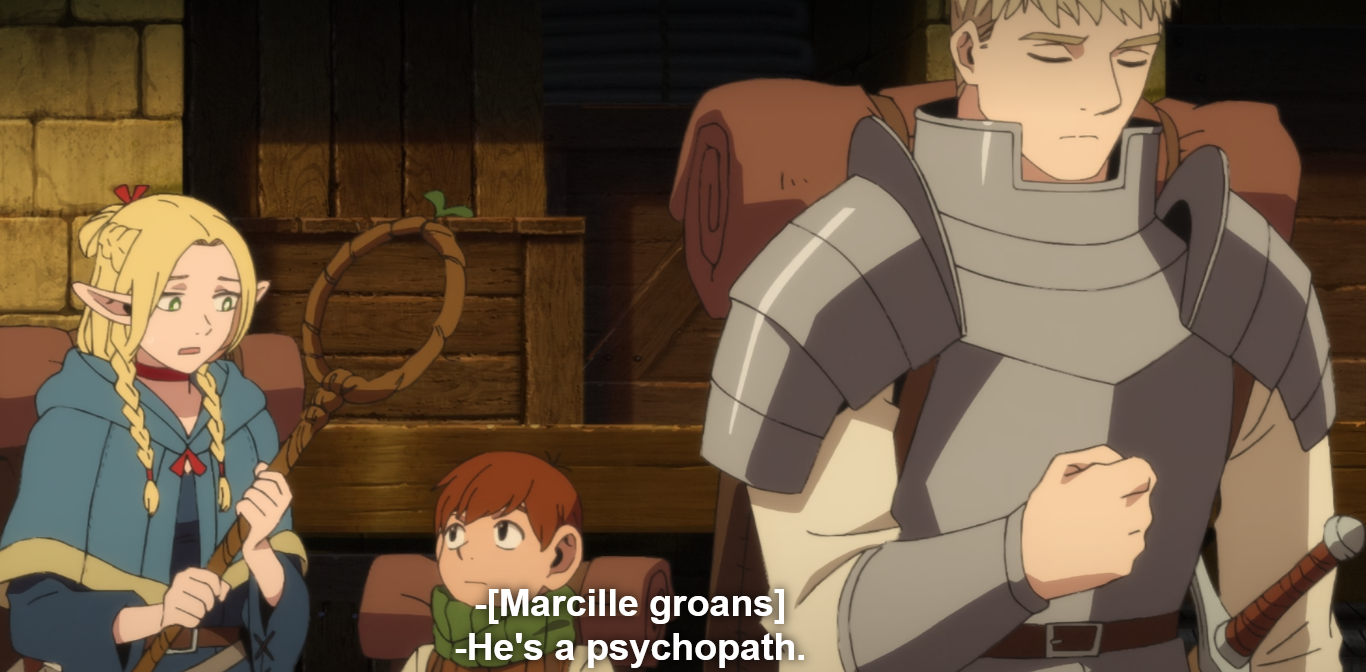
In fact, the whole setup lends itself very readily to a metagame explanation. They had a PC die, but her and Laios' players talked the DM into letting them try and get her body back from inside the dragon as long as they do it fast enough, bombarding them with half-true factoids about reptile digestive processes until they gave in. In the meantime, the cleric's player made a new character - built entirely around the "let's eat the monsters until we can afford more supplies" brainblast they just had - to play until they can get their original PC resurrected.
There's nothing to make this reading explicitly the intended one. But there are enough subtle little hints for me to suspect that the writers did in fact have it in mind. It doesn't totally make up for the character issues I talked about above, but it at least gives you something moderately entertaining to speculate about when Marcille and Chilchuk are being boring.
On a similarly meta-ish note, while the show never talks about game mechanics, or has an injured character act like they run on hit points instead of biology, or the like, there are some well appreciated hints about this specifically being early edition DnD. The emphasis on supplies and logistics, for instance, is something that more recent versions of Dungeons and Dragons basically completely did away with (this is specifically something that indie "Old School Renaissance" DnD-like games have made a point of bringing back). Then there's the Vancian way Marcille's magic seems to work. Preparing a spell for later casting is an ordeal that takes hours, so wizards can't just replenish their power on the go; they need to do it all before heading down into the danger zone, and the party needs to work hard over potentially several days of dungeoncrawling to conserve those spells for when they really need them.
If I were maybe a decade older, and started playing TTRPG's a decade earlier than I did, this show's nostalgia value would probably be much greater for me.
As far as visuals go, Dungeon Meshi pleasantly surprised me. At the beginning of the series, we get a (nicely succinct) loredump about the megadungeon that this whole story takes place in. Basically, an ancient city of wonders was sucked into the ground by a dark wizard's curse, and recently - for unknown reasons - it's started becoming accessible from the surface via certain caves and catacombs. Adventurers have flocked to the region to plumb the city-turned-megadungeon. At first, these spelunkers were wannabe heroes with hopes of finding out what happened to it and maybe even returning it to the surface world. After a few years though, with no clues being found but quite a bit of ancient wealth being brought back up, it basically turned into just a gold-rush for treasure hunters.
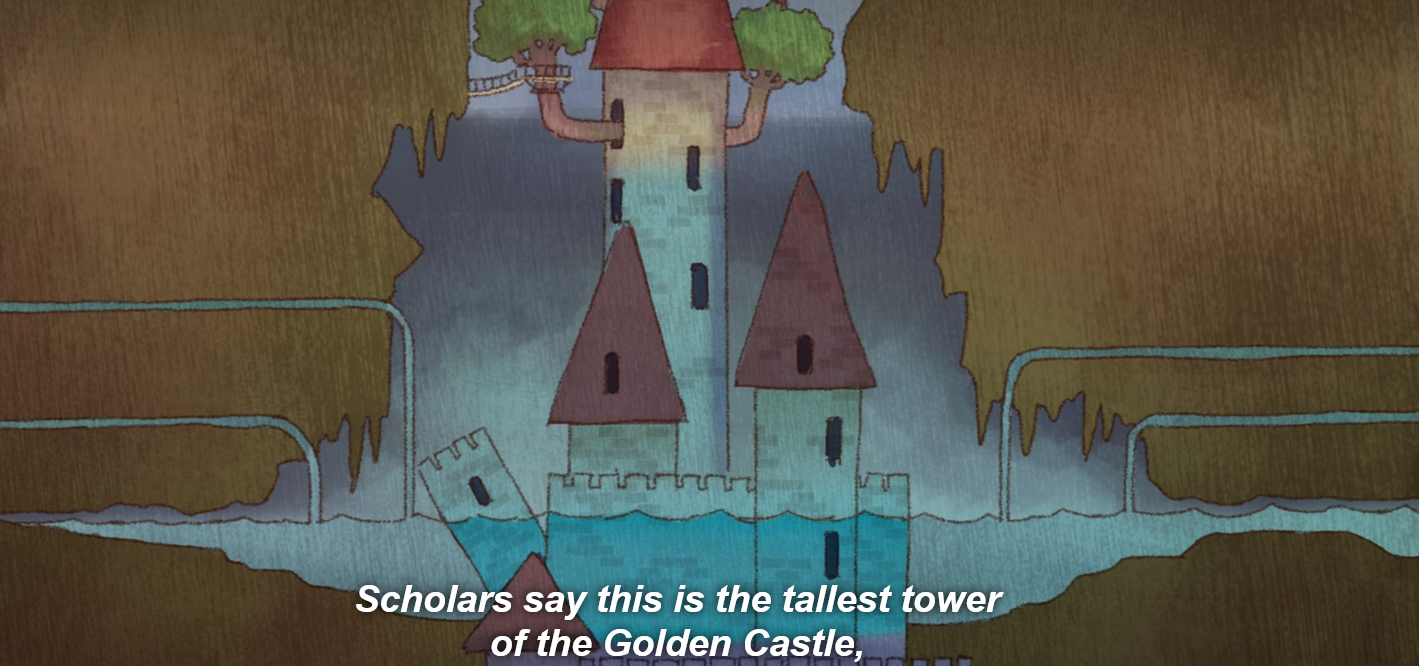
This lore hasn't factored into the events of the story just yet, but it does serve an important purpose. This cursed city's enchanted state has preserved its biomes and districts in a twisted version of their original glory, which allows the series to avoid the monotonous aesthetic of endless caves and flagstones and include a range of appealing, fantastical aesthetics. Like, after the initial patch of natural caves and modern catacombs that the dungeon broke into, the first layer of the cursed city itself looks like this:
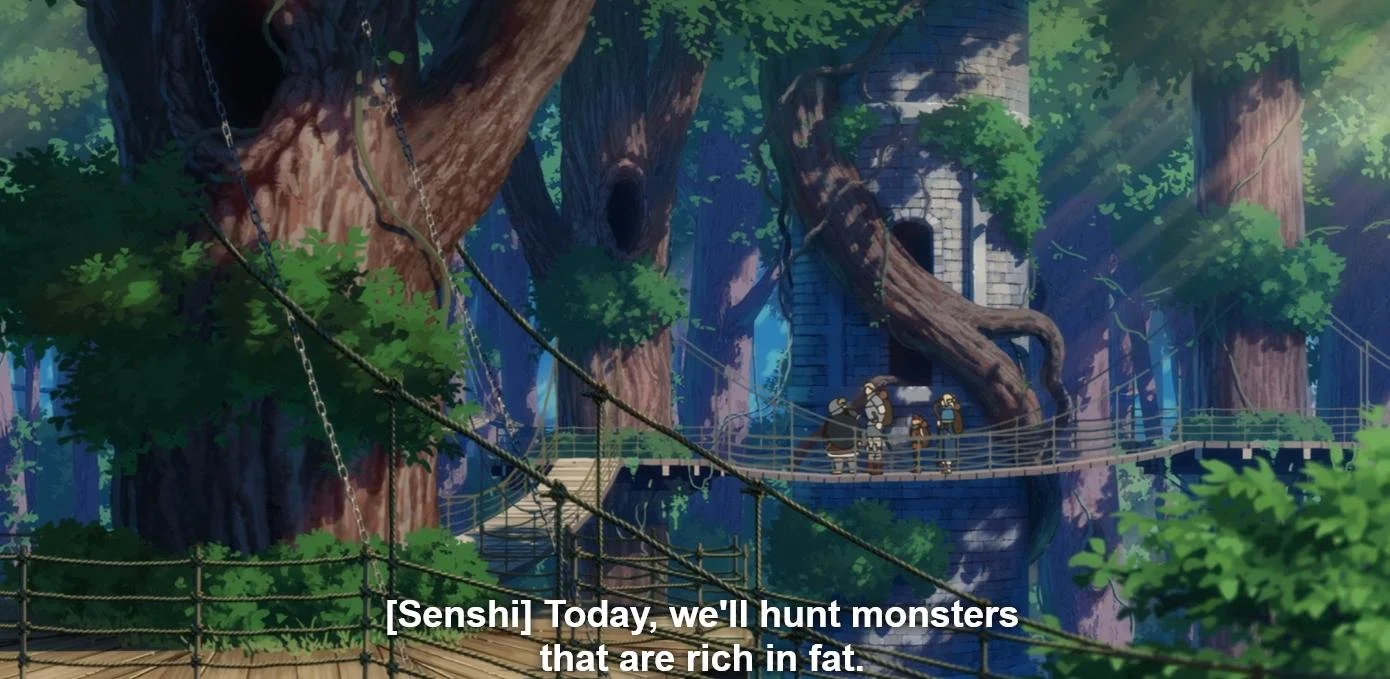
So much more visually interesting than I was expecting. And also so much more work for the artists, given the amount of detail and fidelity they put into shots like this one.
The background plot about this sunken city and the curse of a mad archmage may or may not ever come into the foreground. For the early episodes at least, the only overarching goal is reviving the party cleric. In the meantime, the backstory just serves to give the creators a blank check to create hacky high-magic environments for the characters to eat their way through.
All other qualities aside, the silly premise and even sillier shenanigans that stem from it are still the main draw of Dungeon Meshi. The series does a pretty good job of keeping the joke fresh (tee-hee) with each new episode. Whether the party are trying to figure out how to pick mandrake roots without getting their brains melted, repurposing the inexplicably auto-reloading dungeon traps for meat chopping and wok-frying purposes, realizing they can apply what they've learned about the meat-grain direction of mushroom demons to combat against living specimens, or enjoying the fruits of (I can imagine) a long out-of-game argument convincing the DM that it would make the most sense for a boiling oil trap to use olive oil, the show's central gimmick is a gift that keeps on giving.
I think my favorite part so far was in episode three, when Laios has one of his sudden lunatic obsessions about - of all things - wishing he could eat animated armor. Even Senshi the dwarf tells him he's out of his goddamned mind this time. The joke ends up being on the rest of the party, though; with great effort and struggle, Laios discovers that these armor suits are not animated by dark magic like everyone thinks, but rather by networked colonies of mollusks that hide between the plating layers. Mollusks that taste just like clams when you steam or fry them. You can even use bits of their old puppet-armorsuits' plating to serve them on the half shell.
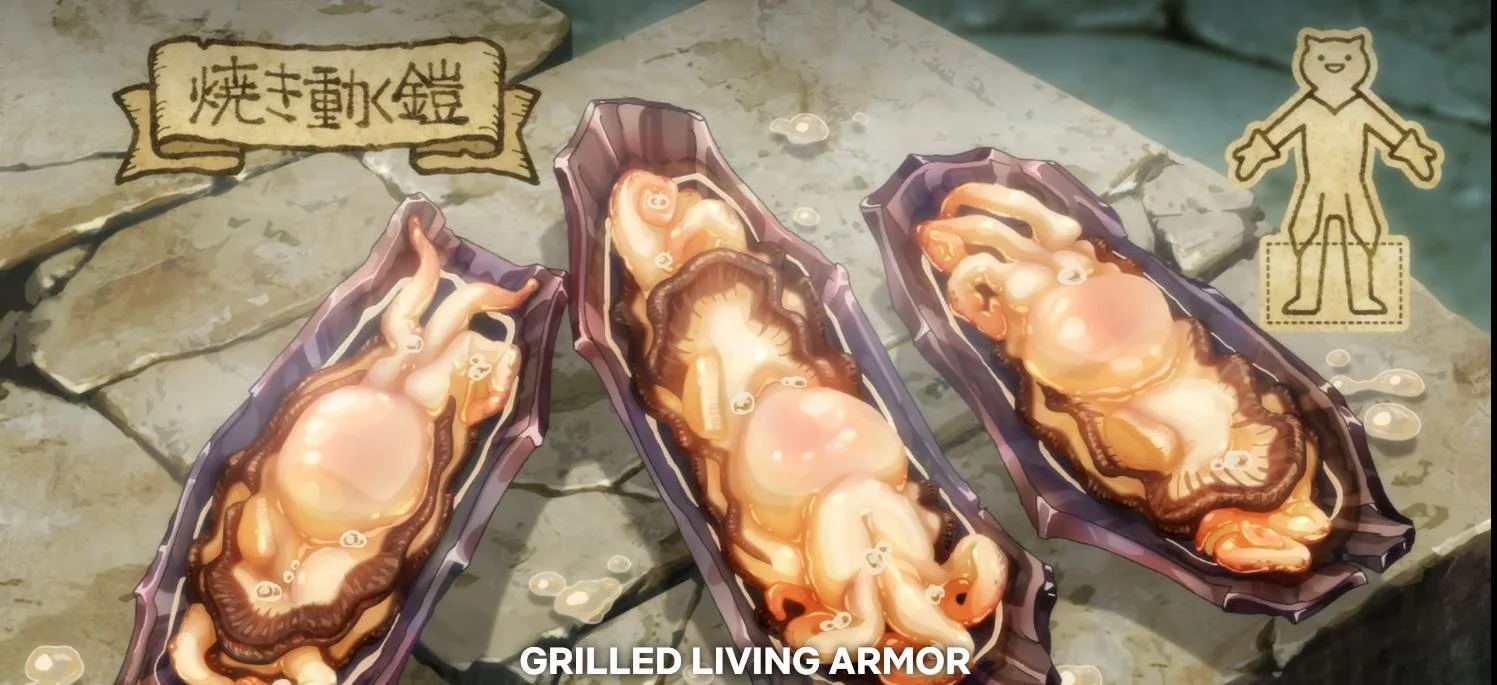
Just make sure you clean the helmets really thoroughly before trying to use them as steaming-crocks. :v
The fact that this particular adventure is also the one that introduces the concept of ressurection-trauma (Laios' first ever death was to an animated armor suit, and being able to eat them now turns out to be somewhat therapeutic for him because of reasons) only further highlights the delightful absurdity.
I don't think I could call Dungeon Meshi a great work of art, exactly. It's not nearly ambitious enough for that. For what it is though, it's exceptionally good. Not flawless by any means (I really hope Marcille gets less annoying as the series goes on. Seriously, she's probably the only one thing in Dungeon Meshi that I actively dislike so far) but tons of fun, pretty to look at, and occasionally a little bit thought-provoking. If you're into cooking and/or role playing games, particularly the older or retroclone dungeoncrawler varieties, you'll get a lot more out of this show. Even if you aren't though, I'm sure you'd still find it entertaining.