Star Wars Andor S1E8: "Narkina 5" (continued)
The next few minutes are intercut between Cassa in the Narkina prison-factory, and Mon Mothma suffering through more noxious dinner parties in her stupid Coruscant mansion. We're introduced to her debating the merits of fascism with rich centrist fencesitters. Specifically, she's trying to grill them about what they think Emperor Palpatine is doing right with his policies, as opposed to what he's doing right in his speeches. Her interlocutors, in turn, are hard at work demonstrating their inability to distinguish between what was in his speeches and was in his policies. When she starts making some real progress toward pinning them down, they announce that this is getting too heated and change the subject to how nice the view of the Coruscant skyline is or what they did on their latest vacations.
I was about to say that I want to hand it to the writers for capturing exactly how painful and frustrating these conversations are, but...well, it's also such a common experience this past decade that I'm not sure how much credit is actually due. It's just a rote repetition of a common real life thing that everyone is familiar with. If you are reading this review, you have probably had at least one of these conversations, and you can probably plot out how the Andor scene goes just by repeating it from memory and swapping out the names.
I hate it. Thanks.
Whenever possible, she tries to nab more private meetings with her banker(?) friend whose politics are in a spiciness contest with her politics. Moving and hiding the money is getting harder and harder even for him, but he's trying.
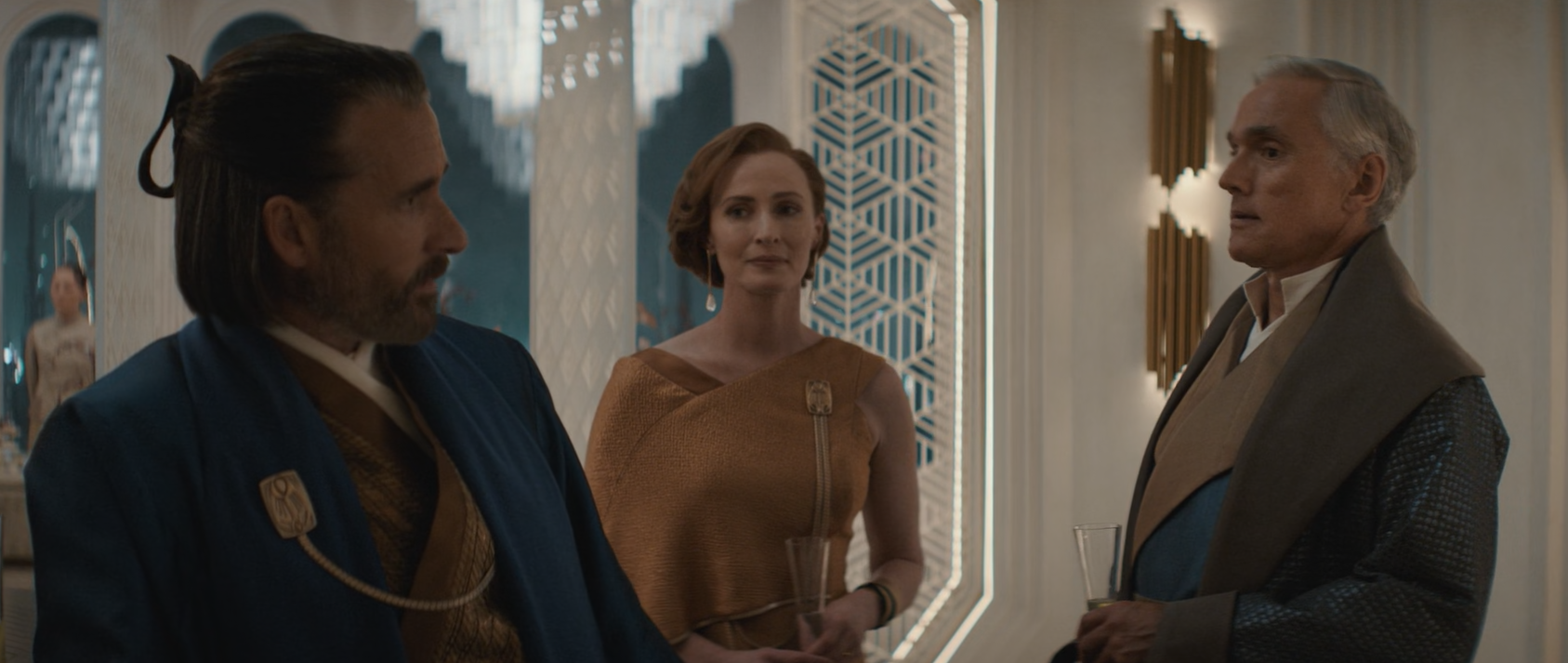
Mon Mothma's daughter is starting to get suspicious about why this old friend of her mother's who hasn't even visited Coruscant in years is suddenly coming over and having private conversations with her every week or two. Hopefully she'll just assume that they're having an affair or something.
...
Also...in this series of conversations, we kinda learn just how much of a sham the "democracy" of the Old Republic was in the first place. Apparently, Mon Mothma has been holding onto her senate seat since she was sixteen years old.
Think about all the things that would need to be true in order for this to be the case.
Think about what the selection process likely entails, who's doing the selecting, and what their interests probably are.
Given what's been said and implied in previous Wars media, with figures like Leia and Padme seeming to have a revolving door between senate seats and planetary royalty, it also seems likely that Mon Mothma's world is not in any way exceptional in this regard.
Imagine coming from a planet with widespread political education and universal suffrage. Imagine being elected to the Galactic Senate by virtue of the hard-earned trust of your people. Imagine casting your vote on a matter of critical importance, and being outvoted by THESE FUCKING PEOPLE.
I don't even know what's more miraculous. That Mon Mothma is as progressive as she is, or that the Republic was able to avoid becoming an outright dictatorship on its own long before the evil wizard showed up.
...
Also, Mon Mothma apparently married her jerkass husband a year before her senate ascension. At age 15. I suspect neither of them had much choice in the matter. I guess this is unsurprising, in light of everything else.
As I said before, we cut between the noblemen arguing about how bad the Empire's policies really are and Cassa being a winner of the Empire's slavery sweepstakes. And man, it just keeps getting worse.
For instance, unlike modern for-profit prisons that (usually) let the inmates at least eat their meals and spend their meager free time together, the Galactic Empire's technology allow it to eliminate these opportunities for community and conspiracy. You take your liquid meals via a tube attached to the wall of the single-person cell that you sleep in. Alone, save for whichever two or three people you can glimpse in the cells across the hallway, ten feet away.
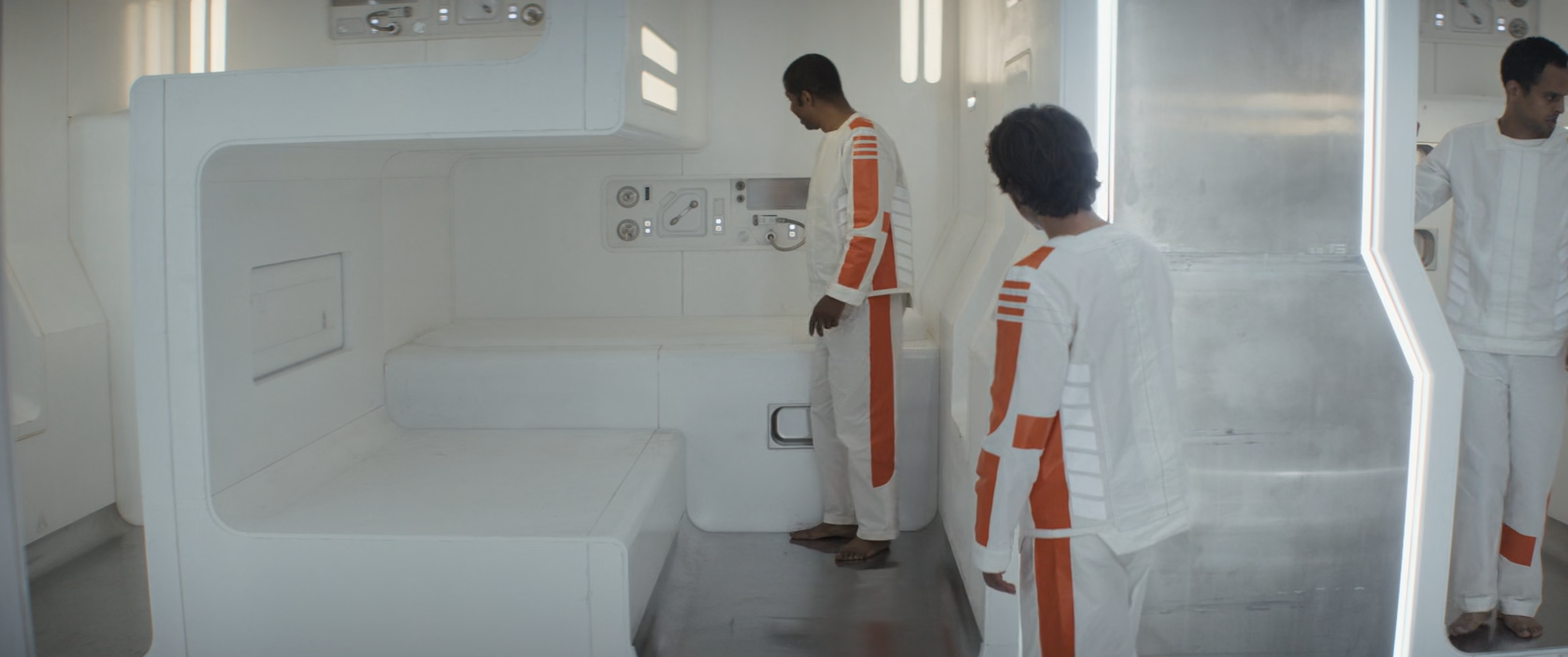
The hall floors are electrified whenever inmates aren't supposed to be entering or leaving their cells for their shifts. Showers are done communally and chemically, but in a process that takes about fifteen seconds for the entire shift crew, so no time for fraternization.
For some reason, the skyways connecting the cellblocks in the outer walls of the rig from the factory in its center are really pretty, though. Like, with glass windows that they can look at the impressive CGI interior and make hand signals to members of other crews through.
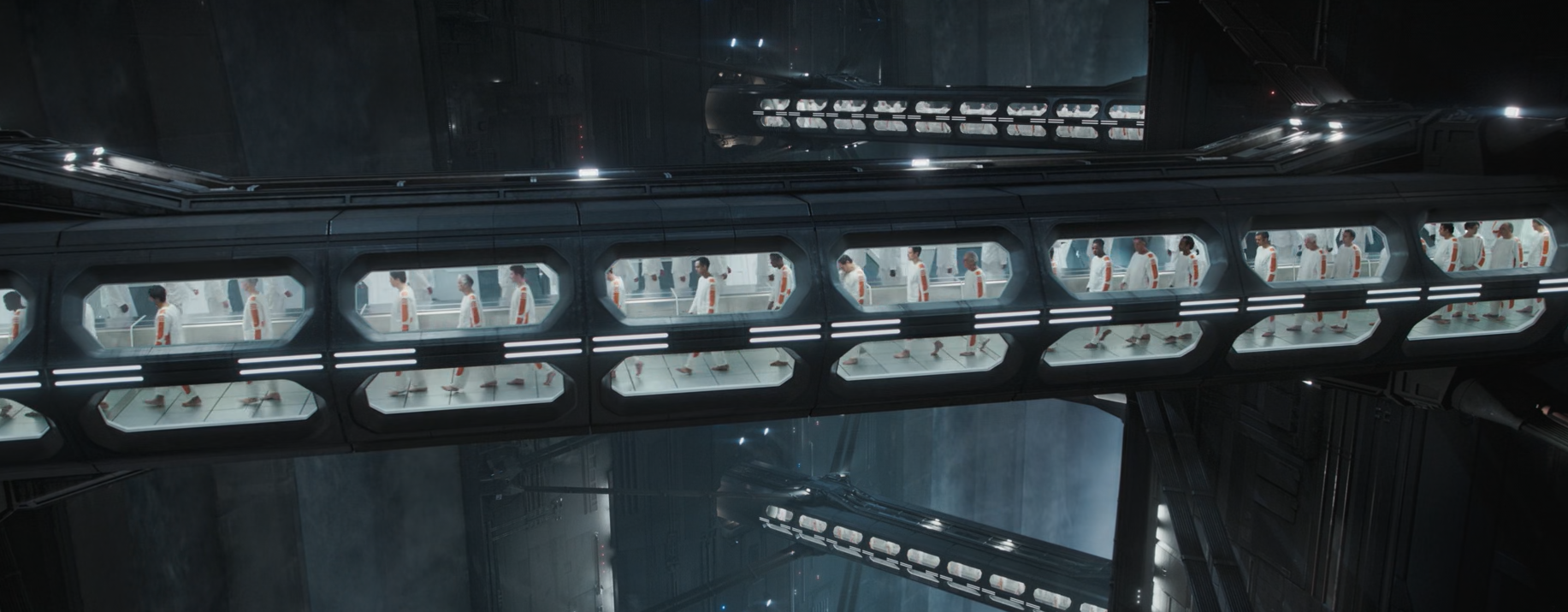
I'm guessing the windows are left over from some time before this was a slave pit or something. But prettiness aside, the resemblance that this provided view bears to an ant colony is definitely intentional.
The reward for most productive floor of the day is flavor in the liquid meals of its members. The specific crew within that floor, meanwhile, gets flavor and texture. The least productive floor gets floor-tazered at the lowest (debilitating and painful, but not deadly at least for most people most of the time) setting on their way back to their cells after shift.
Not long after his incarceration, Cassa is informed by some of his fellow inmates that their sentences were retroactively lengthened since they were sent here. Not because of misbehavior on their part, but because of policy changes. The post-Aldhani security reforms have as much as doubled the sentences of many of them. In effect, none of them know how long they're actually going to be here. The government will let them go when it decides to let them go - if it ever decides to let them go - by no agency of theirs. Their floor kapo obsessed with not jeopardizing his own imminent release might just be brutalizing his fellows for a sheer, wishful delusion. Broken into the shape desired by his masters.
And, while Mon Mothma has her parties, Cassa's incarceration goes on. And on.
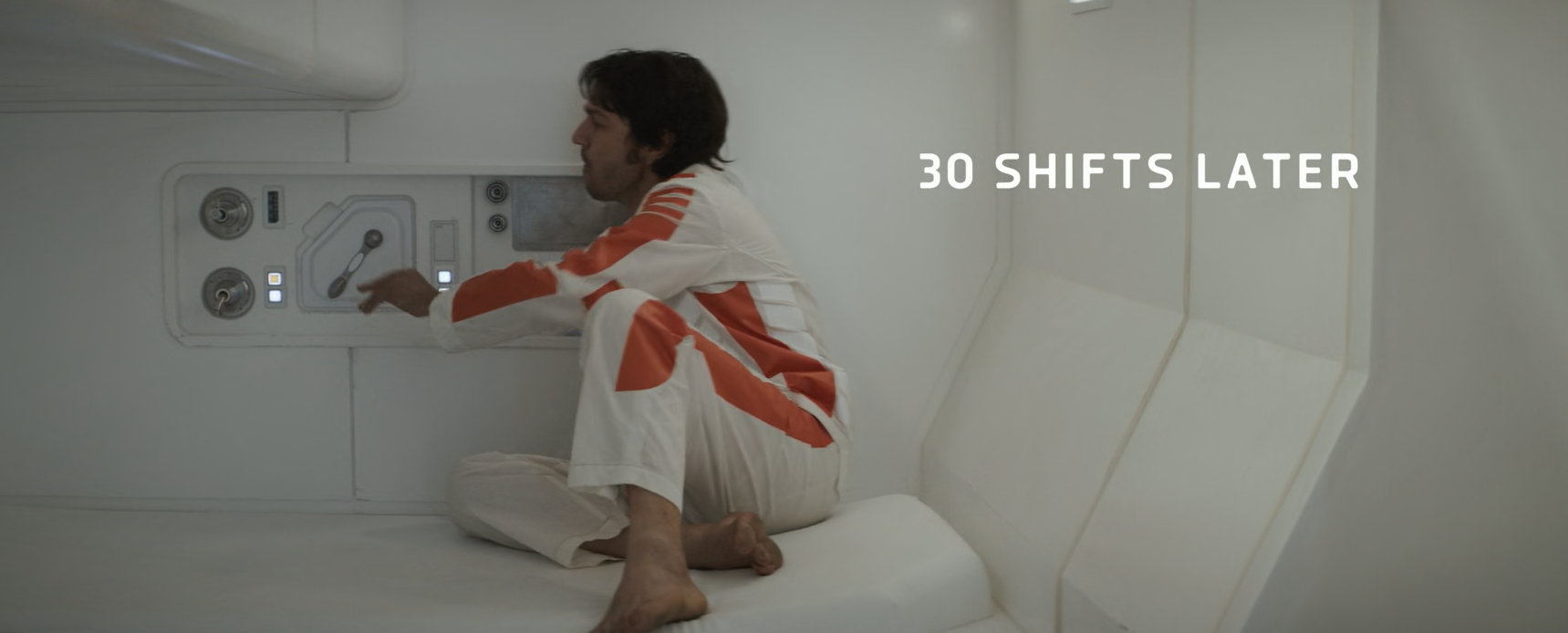
One month in, he witnesses his first suicide. The lethal voltage running through the cellblock floor during sleeping hours in lieu of locked cell doors offers the inmates a single method of opting out of their indefinite torture and enslavement.
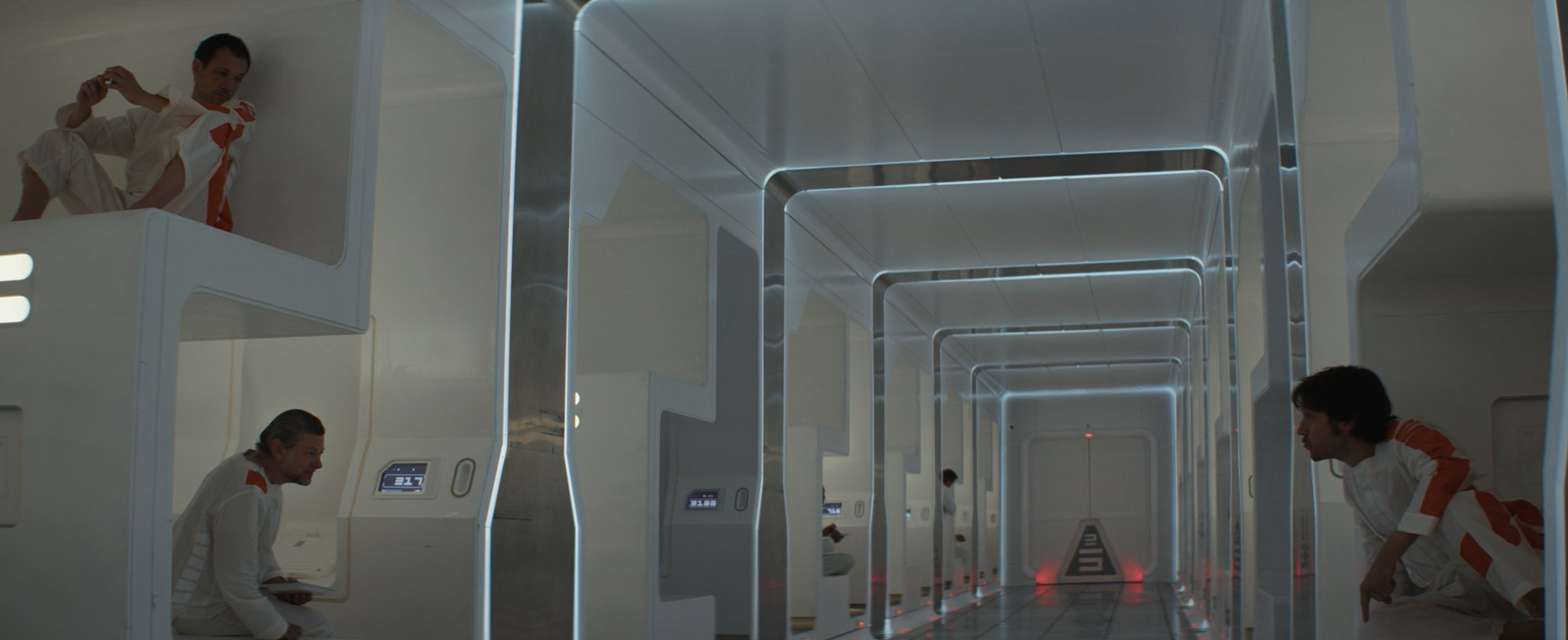
In the not-that-infrequent event of such a suicide, the other prisoners have to endure the smell of cooking flesh until the power shuts off come "morning" and they can remove the body before starting their shift. It's considered polite to wait until just before then to jump, if you decide to jump.
I'd question the wisdom of making suicide this easy, assuming the wardens actually care even a little about getting work done. But then, if they didn't do this, they'd probably have much more disruptive problems with inmates jumping up on the worktables and obligingly beating each other to death with blunt instruments during shifts. So, maybe this really is the least bad option from a worker retention perspective, all else being the same.
In the back half of the episode, we get a few looks at Luthen. The decision to hunt Cassa down again was apparently indeed his own, rather than an overzealous colleague's. The paranoia over Cassa, the loose end who might betray him, still being out there is actually becoming a problematic hangup of his, in a way that almost parallels Cyril. If anything, his companion who relayed his instructions to Val earlier seems to be the voice of reason telling him to drop it.
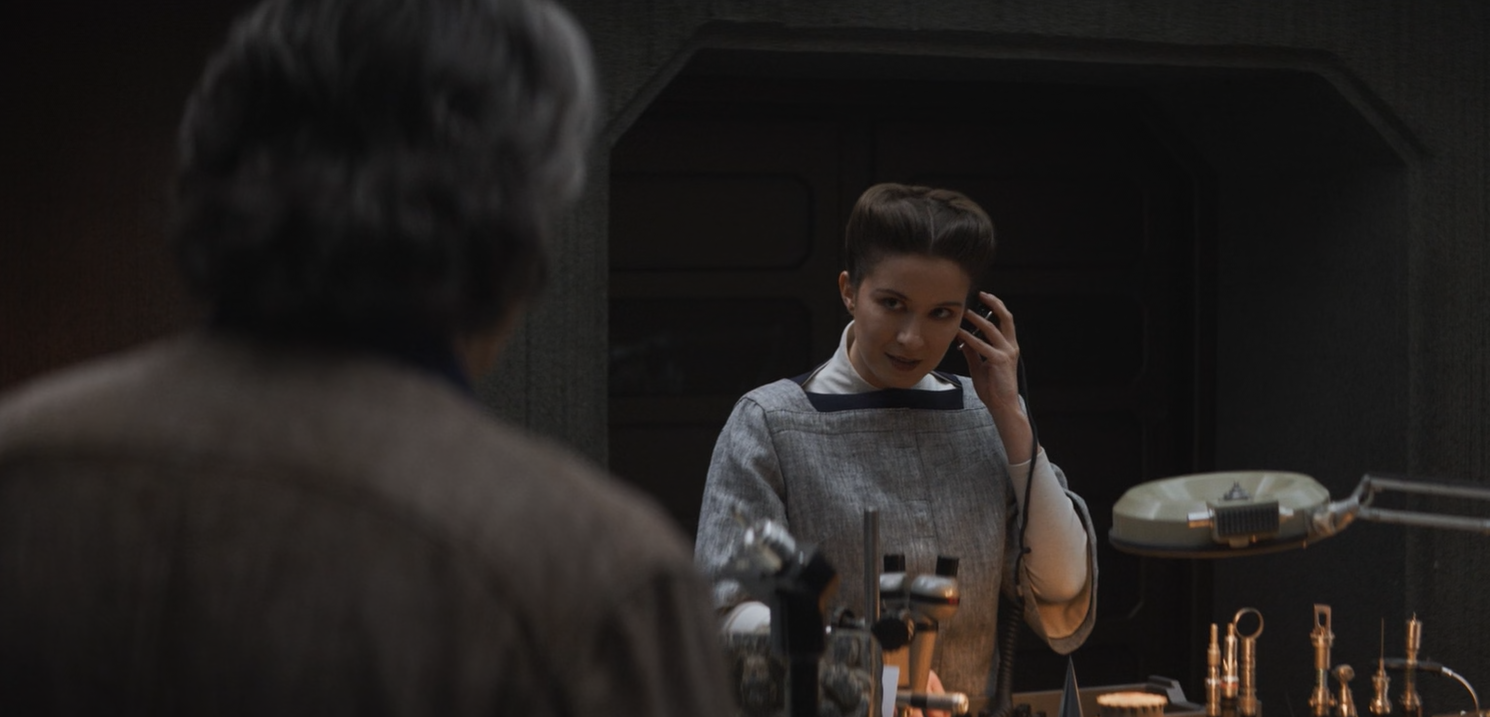
Said companion is named as Leah, by the way. She's not the only Leah who will ever join their organization, but she is the first, and that still counts for something.
She doesn't put it in as many words, but of the many, many ways that Luthen has had to make himself vulnerable in order to be effective, letting Cassian Andor see his face and ship is far from the most critical. However, it's the only one that he feels like he has any chance of being able to mitigate at this point, so he's fixating on it. Clinging to the illusion of agency, even if he has to kick down to do it.
The Galactic Empire doesn't even need to do anything to corrupt you. It just needs to know that you know that it exists.
If that's not enough of a problem, we also see the trials and tribulations that Luthen is going through to make effective use of the money and military equipment he's accumulated. On a planet called Segra Milo, we see him doing his best to negotiate with a whole militia of Nameks. A whole picklejar of them. And their leader is the most indefatigably theorypilled of them all.
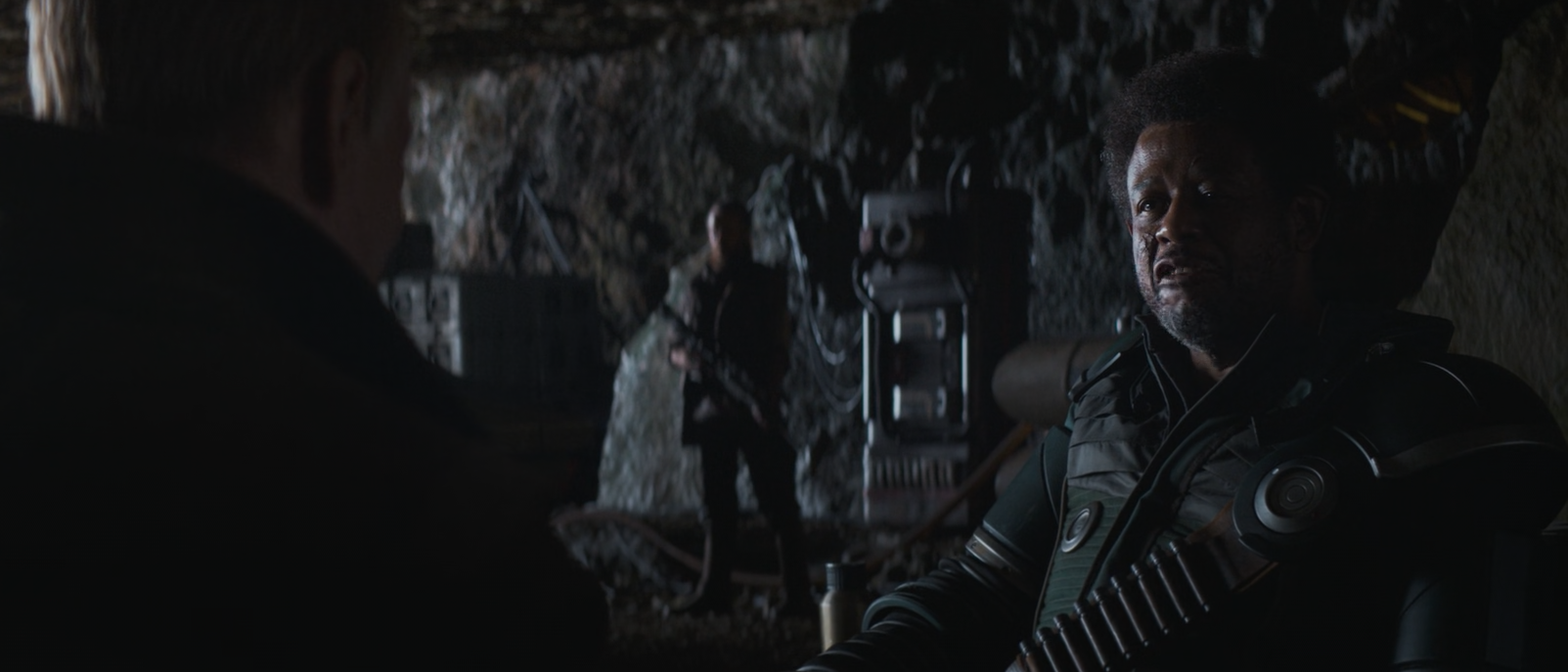
No matter what argument he tries to make or deal he offers to strike, Luthen is told that the Judean People's Front will not be collaborating with the People's Front of Judea. If he wants to get the JPF onboard with this network of his, he needs to exclude the PFJ, no ifs or buts.
...
Okay, I'll give King Namek here a little bit more credit than that by acknowledging that the group he refuses to work with are kinda sorta a diehard Confederacy of Independent Systems holdout. AKA, the plutocrat-led separatist movement that Sheevy spun up in order to start the Clone Wars.
Which, on one hand, sure, there's a good point to be made there. On the other hand, I'd be very hesitant to assume that everyone fighting for the CIS was just a corporate stooge, considering that it marketed itself as a flag for anyone with a grievance against the Republic to rally to and the Republic was very, very good at generating grievances. Also, after making a performative example of the dozen or so executives and despots at the very apex of the CIS' leadership (who also were conveniently the ones most able to incriminate him), Palpatine basically bought those megacorps back into the Empire with his over-the-top pro-corporate policies. They're just the Galactic Empire's disc one bosses now.
In other words? Anyone who is still flying the CIS flag at this point wasn't in it for the money. Doesn't make them good guys, necessarily, but I'd at least be willing to hear them out.
I think the story is striking a good balance with this. While King Namek, supreme dictator of the anarchist hierarchy, isn't exactly being reasonable here, his objections aren't coming completely out of left field either. He's making an understandable mistake that a person who looks old enough to have seen the CIS at its worst might make.
...
This scene also offers us some more insight into Luthen. The question of his backstory and his vaguely-implied connections to the Jedi is still unanswered, but when King Namek asks him about his ideological motives the answer that he provides feels genuine to me.
In Luthen's own words, his "ideology" is fear of the Galactic Empire. That's all. He's terrified of what it's doing, what it will do, and how soon the day might come when it becomes too powerful for anyone to resist. He doesn't care what comes next, he's just sure that it can't possibly be worse than this. Break the Empire, and then the Space Liberals, Space Communists, and Space Anarchists can genocide each other to their hearts' content for all he cares.
Interesting. You know, I'm not sure that the name "Alliance to Restore the Republic" has actually been spoken aloud yet, come to think of it. Given Luthen's apathy toward galactic republicanism, I'm starting to suspect that that name only became a thing after people like Mon Mothma took the stage-center from him.
Kind of a pity that that's the way it went, tbh. Maybe that was the only platform with enough grass-roots popularity to get enough people involved, but still, kind of a shame.
In keeping with the general tone of this episode, Luthen is not successful in getting these people onboard. And, it just keeps getting harsher from there.
I could probably finish this episode now, but...honestly, this is genuinely hard for me to watch and write about right now. There's gonna be a long conclusion to write, most likely, and the emotional effort is going to be significant. So, I'll make this a three parter.