“Waller vs. Wildstorm” (part two)
Well, I was wrong about some things, and right about others.
Lois Lane's character arc never really goes anywhere, unfortunately. Honestly, this story kind of feels like a waste of Lois, especially if it was going to go through the motions of setting up a thing for her dealing with anxiety and imposter syndrome that it then just forgets about. The final issue of this four-parter does indeed bring gender into the dynamics in a big way, but Lois has nothing to do with it.
As for what I was right about? Well, this is in fact the darkest and most depressing superhero comic I've ever read. It's not even close. I can't accuse it of being too bleak or too cynical, though, because...it's basically a true story. Not the superhumans and organ-harvesting-for-magic-power aspects, of course, but literally everything else about it has happened many times over. You just need to change the names and adjust the dates a few years forward or backward, and there are a dozen countries that could fit Gamorra's place and at least as many people who can stand in for Waller, King, and their supporting cast. That's what makes this comic actually dark, rather than the kind of juvenile grimderp I spent my "New Statesmen" review guffawing at.
Once again, I won't try to parse the minutiae of the plot. It's complicated, there are a lot of names dropped that I assume would be impactful or shocking for someone more familiar with the DC and/or WildStorm universes, and...there are some details that I'm pretty sure would be nonsense even if I did know all of the lore. I said that the characters and politics were what carried the first half of this series above the so-so plotting, and - with the disappointing exception of Lois Lane - that continues to be true for the back half.
After talking to Lois, the irate Jackson King spends the next few days running around town assassinating a few familiar faces who he knows to be involved in the recent skullduggery before returning to his own hotel room every night in a blur of angry thoughts. He listens to the (not legally admissible, most likely) confession he recently managed to extract from Amanda Waller, and thinks about the implications that Lois Lane implied, and gets even madder. To the point of doing something incredibly stupid.
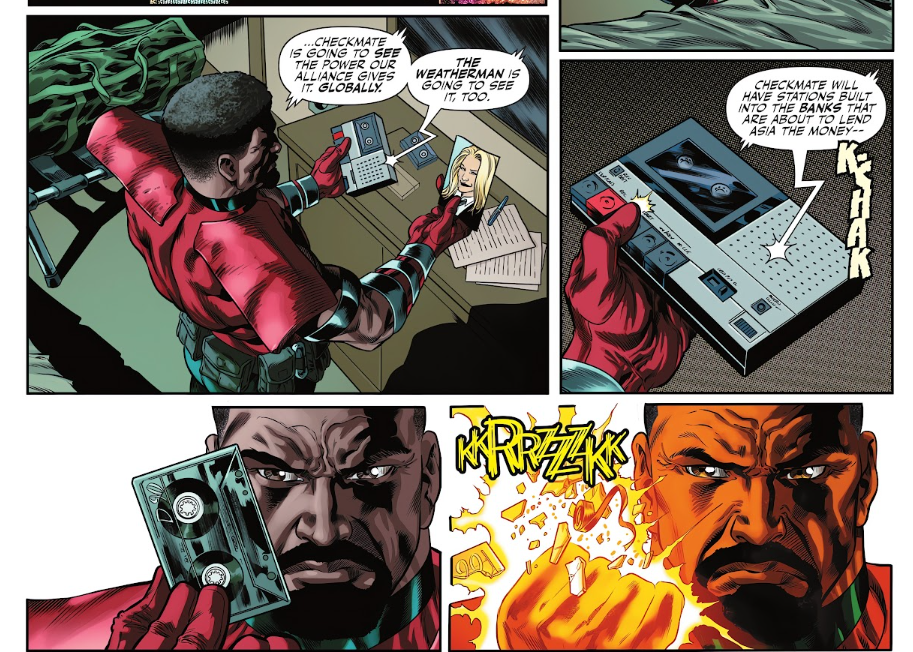
Like I said, it might not have been legally admissible, but it was still something. However, even if that tape was a sure-fire way to blow this thing open, I think Battalion would have still destroyed it. In his mind, that statement must be useless, because Waller *had* to be lying in it. Because if she was telling the truth, then that would mean that he's been a soldier for imperialism all along, and any progress he thought he made for civil rights at home was really just adjusting the gears that power the international death machine. Given that at least one US citizen just got dissected to have her cybernetics gifted to Yumiko Gamorra, it might not even be that strictly "international" in its morbidity. He's not willing to accept that he's wasted so much of his life, suffered and struggled so much, just for that. So, Waller's statement implicating the whole of the agency has to be a lie and therefore useless.
Again, I'm really not clear on exactly to what degree Battalion and the rest of his Stormwatch team were beholden to the Checkmate agency, to the United States government in general, or to the international community. He's Checkmate's inspector general now, but it seemed like back in his active superhero days it was a little more complicated? Whatever, the vibes of the scene are strong even if the details are fuzzy.
...
I've talked to military veterans with this exact mentality. They'll say that any number of policymakers or commanding officers above them were corrupt, but their minds won't allow them to make the conclusion that their own service served those corrupt interests.
I don't think it's because they saw admitting that as an impeachment of their morals, or intelligence, or susceptibility to deceit. At least, I don't think it was primarily that. The impression I got was that they were so invested in the time they spent, the trauma they suffered, the physical and moral buy-in they undertook, that they couldn't accept that it wasn't for a good reason.
This is all anecdotal, of course. I don't know how common this particular mind trap actually is, among veterans or in general. But what I'm seeing on the page here definitely feels like it's trying to capture this, at least to me.
...
While he's stewing in his emotions and discarding perfectly good evidence, Battalion is the target of an assassination attempt. Waller wanted something subtle and plausibly deniable. Unfortunately, her idiot supervisor Adeline Kane's husband happens to be a metahuman mercenary on location, which means her family gets a big payout whenever he does any assassinations for Checkmate. And he doesn't do subtle or plausibly deniable. So, instead of a quiet poisoning or whatever like Waller intended, this cackling lunatic shoots Battalion's hotel window with a supertech rocket launcher from across the fucking city.
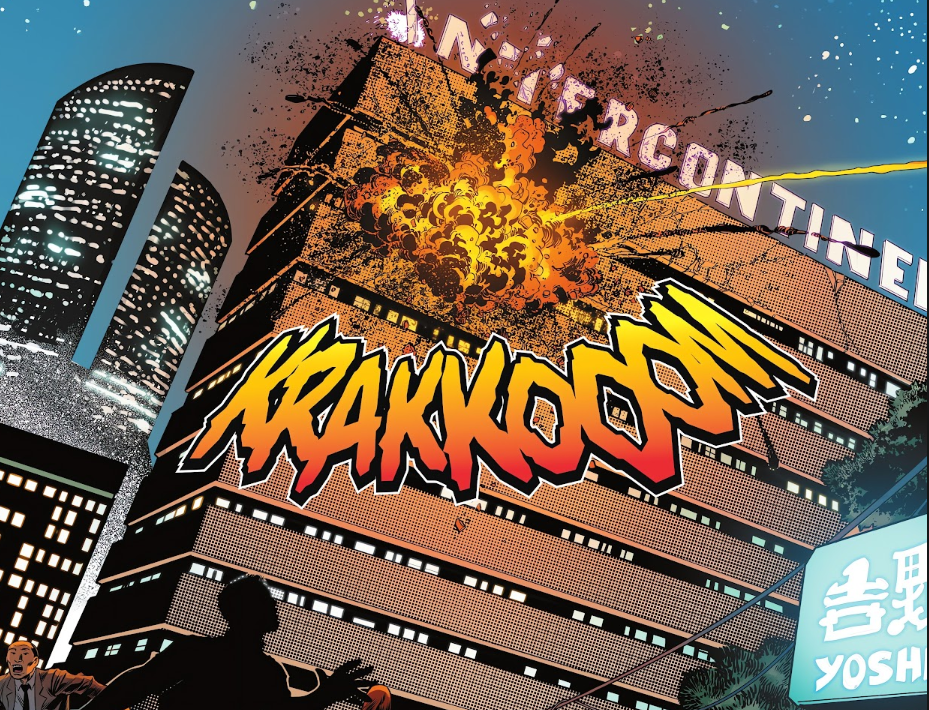
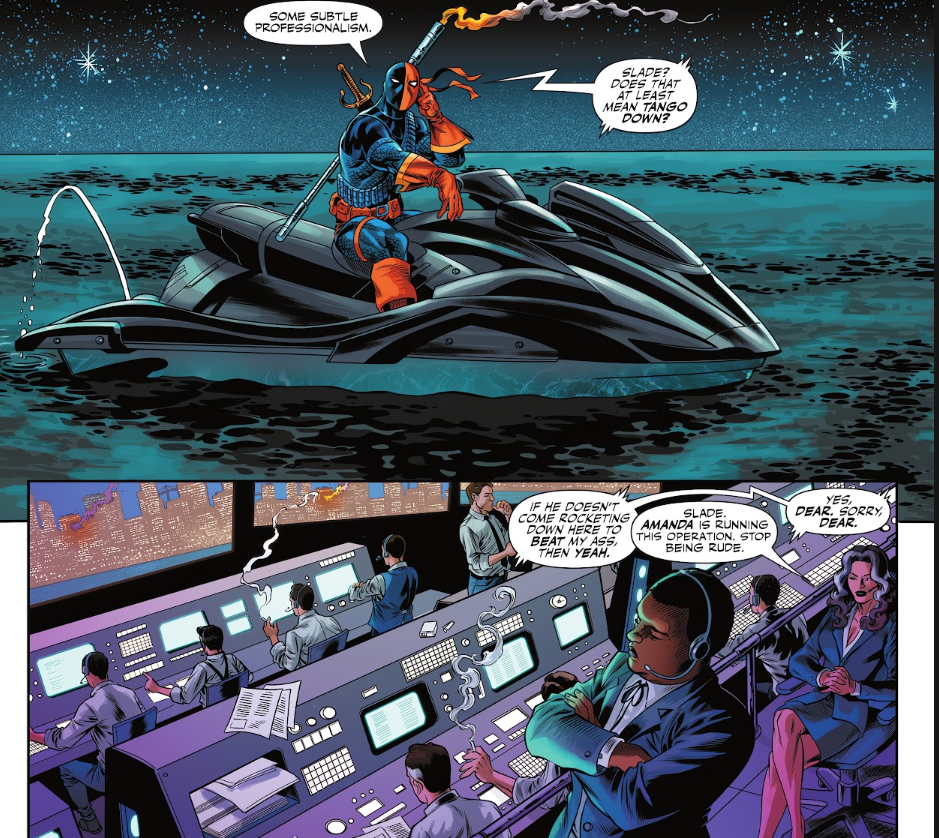
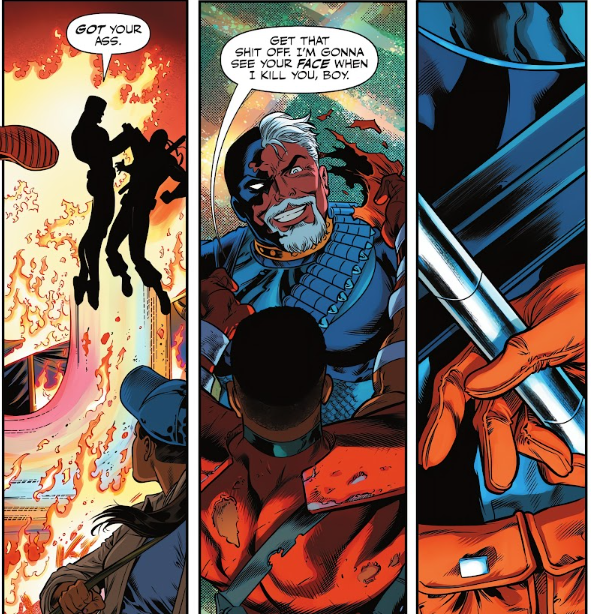
Slade Wilson, aka Deathstroke, is a character I vaguely recognize from other DC media. Looking into it a bit, apparently he's a supervillain whose backstory has always given him a US black ops history of some kind. So, this would be set during the "backstory" period of this continuity's version of him. But anyway, his main job in this comic is to provide the main action setpiece that occupies much of the third issue. It turns out that Checkmate hadn't realized that Jackson King's teammates managed to recover his old "Battalion" power suit and smuggle it to him before he returned to Gamorra. He happened to be wearing it at the time of the assassination attempt, which means he shrugs off the rocket and starts chasing Deathstroke in a running battle that moves all along the Gamorra City waterfront.
It's not empty spectacle, though. The action scene is intercut with the panic going on at Checkmate headquarters as Amanda Wallers with her professional and ideological interests in a successful covert mission splatter like bugs on a windshield against her superior Adeline's petty greed, nepotism, and stupidity. All of the hard work she's sunk into this operation being thrown out the window because her dumbass boss DEMANDS that her murderhobo husband get paid millions of dollars by the agency to do a job they don't need him to do and cause a gigantic incident in the process.
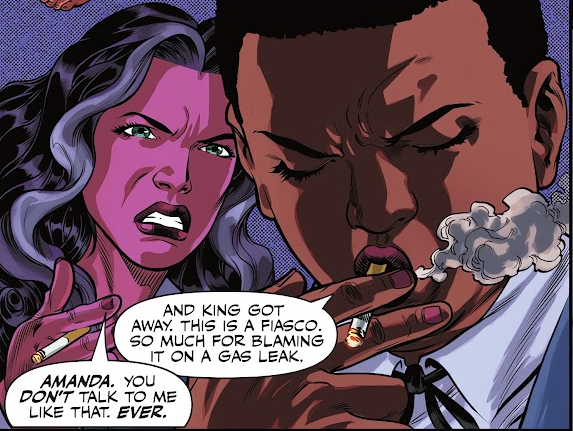
On one hand, it's horrifying. Deathstroke is causing a shitton of destruction as he flees Battalion, liberally using civilians as human shields etc. On the other...it's goddamned hilarious. Adeline Kane is basically making the crying wojak face for ten straight pages as Waller berates her for how her incredibly petty flavor of corruption is going to literally get them all arrested. The most articulate thing she's able to bleat out between her sobbing is that Waller needs to stop being so mean to her supervillain husband, he's a sweet boy and he's trying to help their agency, honest. For all that this version of Amanda Waller is a monster, you genuinely feel sorry for her throughout this sequence.
It's pretty effective satire. These agents are as corrupt, fragile, and childish as the billionaires who's bidding they do. A corrupt, stupid authority is ill equipped to keep corruption and stupidity out of its lower ranks. As above, so below.
...
Given how much investigative journalism one of this comic's authors has done about the US intelligence community, I strongly suspect that there are specific real life people being fictionalized into these Checkmate officers.
...
Meanwhile, Lois Lane does a smart and figures out the late metahuman known as Cybernary's place of employment, where she manages to secure an interview with a facility janitor who knows too much. Said janitor is all but confirmed to be spying for someone else, but whatever interests he represents they seem to be served by letting the Daily Planet print his intelligence provided the source is kept well hidden.
I like this guy, for what little we see of him. I have a suspicion he's another preexisting DC or Wildstorm character that I don't happen to know about.
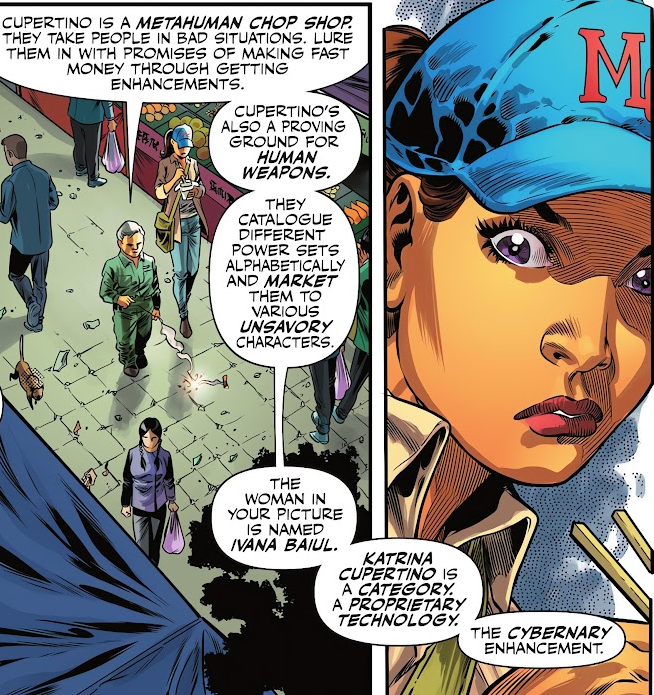
Also, his dwarfism is totally irrelevant to his role in the plot. Which is good representation, honestly. One out of every however many random people will be a dwarf, or blind, or wheelchair bound, etc. You don't think twice about it in real life, and you shouldn't have to think twice about it in fiction either. If there isn't a story reason for a given character to NOT be disabled, then you might want to consider making them so once every so often. It's representative, and it's realistic!
Anyway, he fills Lois in on exactly who the sacrificed metahuman was and how she was able to be sacrificed. Apparently, a US citizen - born to an immigrant family - who got scouted by a company owned by Deathstroke and his spook wife for her cybernetic compatability, debt-trapped out here to Gamorra to test the prototype cybernary suit, and then dissected when it was found they couldn't nonlethally remove the implants to pass them on to the client once testing was done.
...
Honestly, this is one of the plot details that screams nonsense to me (they seriously couldn't find a local Gamorran citizen to test it on? It had to be a US citizen who also conveniently is an attractive young woman with a lower middle class family in the states who Lois can make a media circus out of? Etc). The reason I'm not glossing over it in the review is because I think there are some real life incidents that it's trying to gesture toward.
In particular, I'm thinking of the Contra affair. Specifically, the part of it where the CIA let the contras smuggle hard drugs into the United States where they empowered American criminals and immiserated American addicts. Allegations that these drugs were funneled into primarily black inner city neighborhoods as a way of keeping this further out of sight have never been substantiated, but they've certainly been made.
I'm also thinking about Little Saint James. Specifically, the highly, highly credible evidence that Jeffrey Epstein was a CIA and Mossad asset. They oversaw him trafficking American children out to that island just as much as children from other countries. These details of the Epstein case weren't being talked about back in 2023 when this comic came out quite like they are today, but there were already rumors. Once again, considering this comic's authorship, I have little doubt that its writers had reason to believe those rumors in advance of the general public doing so.
So, this actual plot point in the comic is stupid in its realization, sure. But I understand why it's in there, and it is saying something important.
...
On a related, but much lighter, note:
Thinking about fictional influences as well as real life ones, it occurs to me that there are an awful lot of Metal Gear Rising: Revengeance parallels in this plot. Enough that I wouldn't be surprised if there was direct inspiration. Neocolonialist organ-harvesting to make super soldiers. Backdrop of some new capitalist opportunists growing to fill a recent power vacuum. The conspiracy's lead field operative being a hulking, kill-crazy cyborg mercenary. Etc.
...
In a sort of annoying coincidence, the running battle between Battalion and Deathstroke happens to cross paths with Lois Lane while she's on her way back from interviewing the janitor. Which means she sees the battle end with Deathstroke killing the storied hero.
It's kind of Battalion's own fault, to be honest. Once again on account of his pride. Specifically, he can't just kill Deathstroke quickly once he's gotten the upper hand; has to go through the trouble of pulling his mask off so he can look him in the face all macho-like before he kills him. Giving Deathstroke the extra second he needs to pull out another concealed weapon and use it.
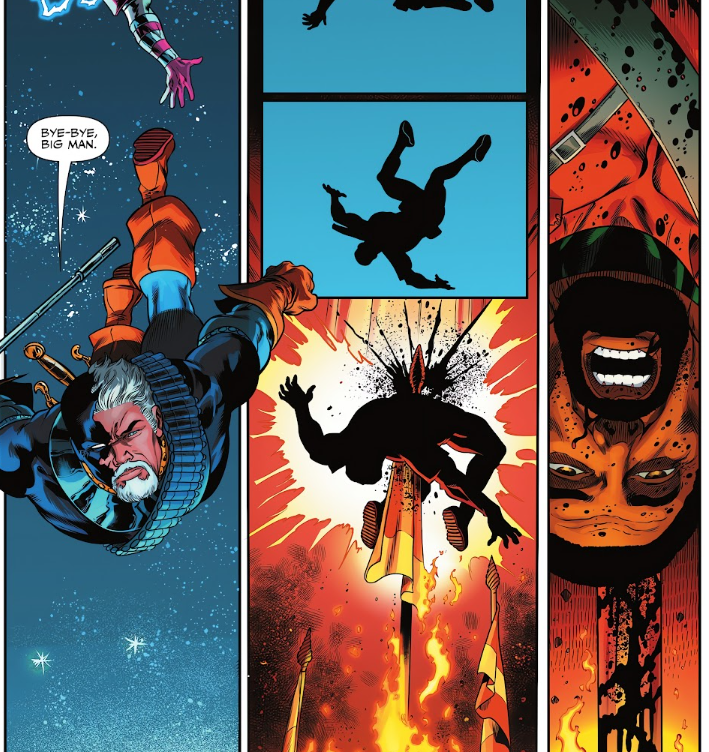
Waller has a reaction to this herself. I don't know how genuine she was being when she told Battalion that she idolized him as a kid, but I don't think she was completely lying. I get the impression that she was against assassinating him in the first place, even before she tried to have him at least murdered quietly and deniably. Seeing him get ganked this brutally, though, seems to make the reality of what she's participated in hit home in a way it hadn't before.
Deathstroke wants to kill Lois too, when he catches sight of her. Fortunately for Lois, even his idiot wife thinks that killing a reporter for a major American news outlet in front of hundreds of witnesses might be a bridge too far, and talks him out of it. He disappears into the smoke, leaving King's body among those of many civilians who died or were maimed in the crossfire.
The fourth and final chapter has Lois publishing her story. It hits the presses just as the plot has already come to fruition. The communist guerillas she interviewed at the beginning all get brutally slaughtered by Cybernary II: Girlboss Edition, with the help of a jungle-controlling power that Checkmate extracted from the brain of that little El Salvidorian boy we saw them dragging away in an earlier scene.
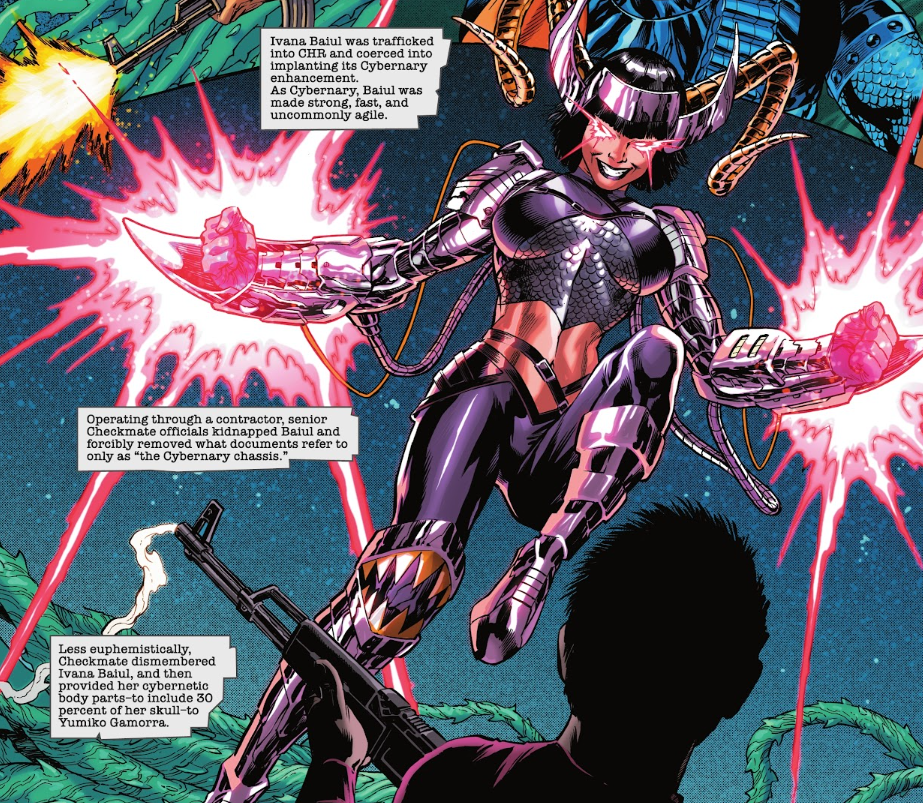
Foreign investors don't want to sink money into a country with an active rebellion going on. And the land those guerillas are sitting on needs to be opened for development, and the natives they live among opened for proletarianization. The stolen plant-warping power turns the guerillas' usual terrain advantage against them, and Cybernary II gets to be an adventurer by personally incinerating General Rong with her fancy new cybernetic power suit. Western corporate elites now own Asia, give or take. Mission accomplished.
The Daily Planet story does make a buzz, though. Especially given the death of a well-liked hero and the disappearance of a sexy young perfect victim in connection to the events described. That's got to have consequences, right?
Indeed it does. Cybernary I's family gets a big payout on the taxpayers' dime. And both Amanda Waller and dumb stupid idiot Adeline Kane get dragged before a congressional oversight committee, where they are given a stern talking to and told that they really need to be much more discrete. At least, they're told that by the committee members who aren't sleeping through the meeting.
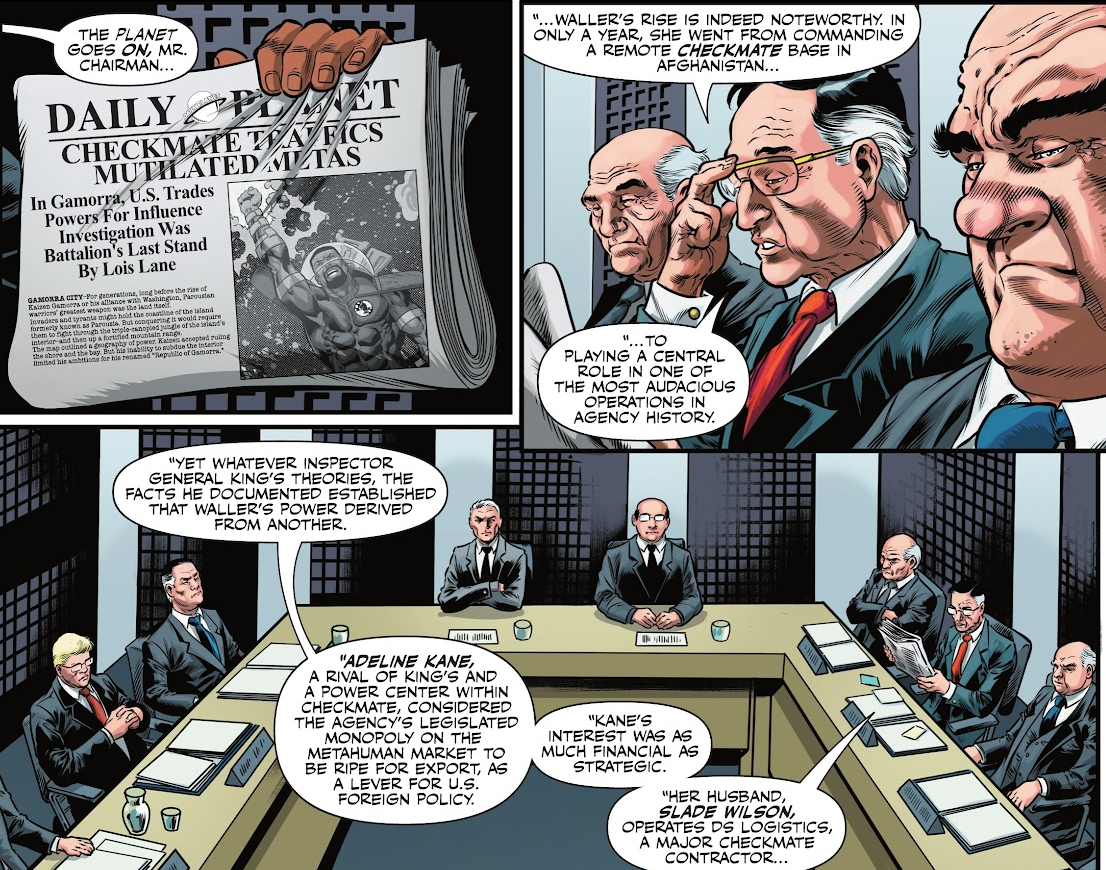
Both women get an official reprimand. Deathstroke's company, DS Logistics, is dropped from America's non-black budget contracts. It's implied that Adeline's marriage falls apart as a result of this.
Anyway, that will be all as far as official consequences are concerned.
The final sequence of the comic has the two Checkmate women being invited up to the space station inhabited by the "Weatherman," a brain-augged metahuman who basically plays mission control for the Stormwatch and other associated hero groups. The Weatherman has been alluded to occasionally throughout the comic as, like, the highest authority within the cape world. Waller implicated him in her confession to Battalion, and Battalion refused to hear it. Amanda also implied that she's long wished to be up in the sky like Weatherman, and she said that she hopes "one of us" can one day work on that satellite.
The Weatherman is a white man, of course. Sitting on one side of him is another American spook. Sitting at his other side is Kaizen Gamorra, Yumiko's father. He never actually died.
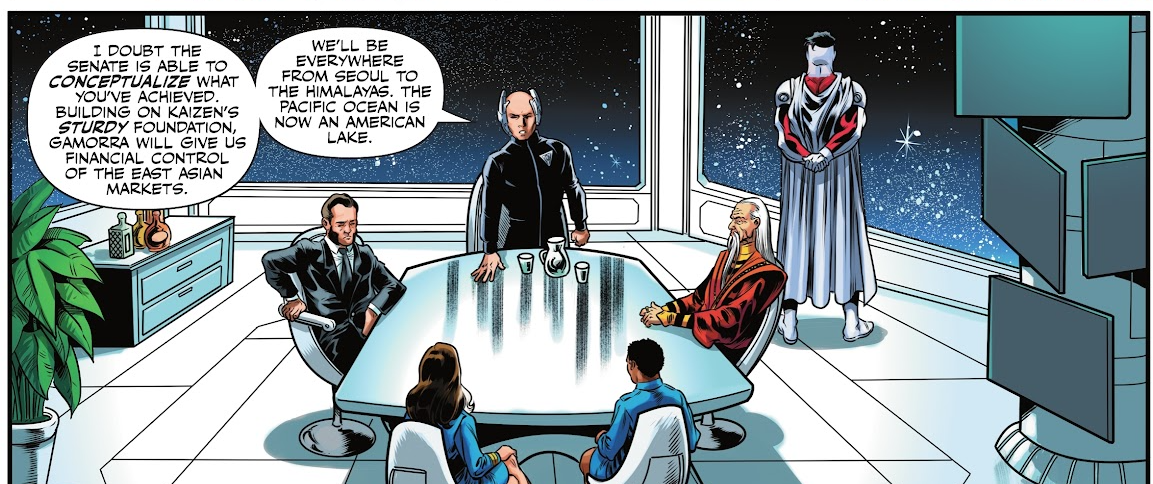
Kaizen might look like a tiresome Yellow Peril stereotype (and I suspect that in his original provenance that's more or less what he was), but he's actually the best-written, most entertaining, and least unlikeable character in this scene. Kaizen is openly contemptuous of his own daughter, and of her American handlers. He might have been a very bad guy during his own stint as dictator, but (to hear him tell it) he at least saw the value of peace and compromise. He was willing to let the rebels maintain their jungle domain in his island-kingdom's interior without going out of his way to antagonize them. He was careful to balance his relations with the USA and USSR as best he could to keep himself from having to roll over entirely, even if he was overall an American proxy. He no longer wants to have anything to do with the world order because of the direction it's going, which is why he faked his own death and let his daughter ruin everything instead of having to roll over and do so himself.
Like I said, he's a villain. He's a collaborator, and his desire to wash his hands of the situation he created is hypocritical in the extreme. But the fact that he's the only person in the room who even seems *AWARE* of how much worse they're making the world and feels any kind of ambivalence about it still makes you default to hating him the least.
That said, his dismissiveness of his own daughter does have a whiff of misogyny to it. One DOES get the impression that he's lumping women's liberation in with all the other, less pleasant, aspects of dawning modernity. He might not despise her for the right reasons, or at least not all of the right reasons.
...
And, in a way, I feel like that makes this ending even stronger and more depressing. The girlboss figurehead is being allowed to take over by the men who actually make the decisions. The old patriarch is still there, in hiding, and he still seems to have more influence among the people who really matter than she does.
...
The last figure in the evil meeting room is Majestro. I have no idea what role this guy plays in the main DC or Wildstorm continuities, but here he's a representative of an alien empire, and Earth is an important strategic location in their war against other aliens. He approves the promotion of people to any REAL power within the system. He's also bringing Kaizen Gamorra to the imperial homeworld for a comfortable retirement after his service to the proxy of the proxy of the crown.
The imperialism goes all the way up. Earth is, itself, a third world country being ruined by an expansionist power.
As the humans talk the minutiae of the new capitalist order in Asia and how to handle the metahuman fallout of Battalion's death etc, Majestro just stands aside and looks out the window, waiting for these lackeys to work out the petty details and come to a conclusion important enough for him to have to pay attention to.
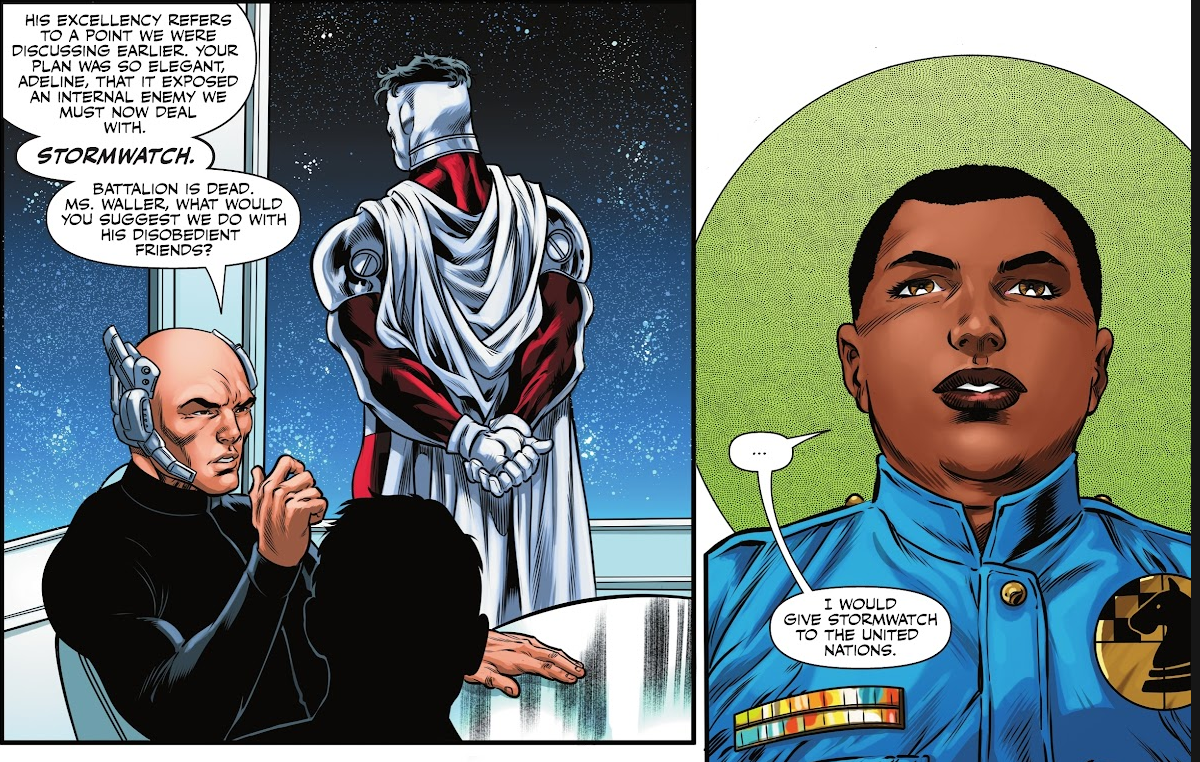
The old Stormwatch team - which apparently WAS beholden to the United States up until now? I think? - is now handed over to the United Nations. The UN countries on the council will vote in lockstep with capital, though, even if they occasionally take performative steps of disagreement against the United States specifically. This way, everyone will think that Stormwatch isn't working for the empire. Stormwatch themselves might believe they aren't working for the empire. But they will continue to defend global capital's interests, and Majestro's people will still use that structure to cement its military interests around Sol.
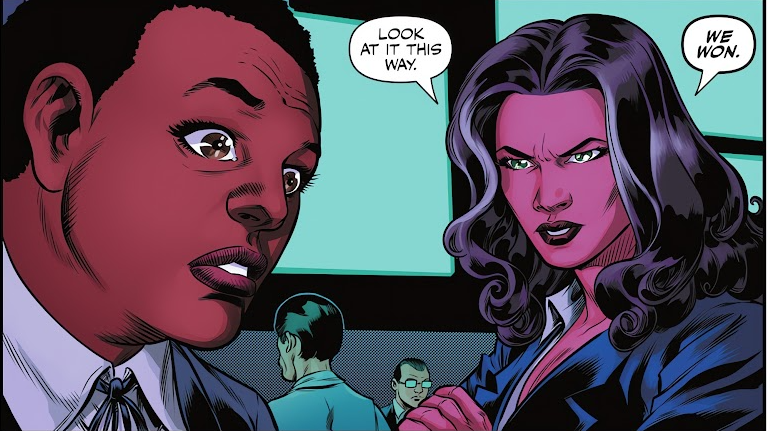
Lastly, how to reward the Checkmate ladies who enabled this Asiatic coup. Kane and Waller turn viciously on each other, trying to claim all the credit for the success and put the other down (Waller much more convincingly, of course. Kaizen backs her up on this in somewhat hilariously snarky fashion, based on the reports his daughter gave him over who did more actual work). In the end, Weatherman and Co come to their decision. Adeline Kane is demoted. Not indicted. Not arrested. Just demoted.
As for Waller...
She was under the impression that she and Adeline might have been competing for a permanent assignment on this space station. Being promoted to the elite of the elite of the global order's true administration. Which could maybe even, potentially, one day, give them a path to becoming the new Weatherman after the current one and/or his successor retires.
Instead, she's being sent to run another blacksite on Earth. This one at a prison in Louisiana, where she'll presumably be tasked with starting this continuity's version of the Suicide Squad.
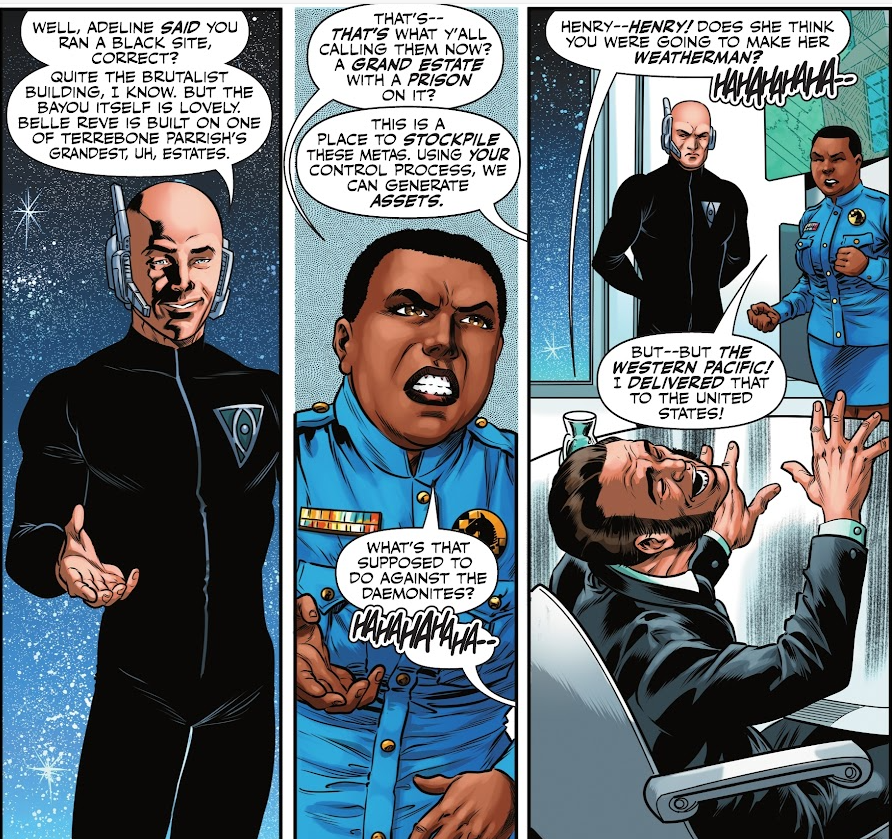
They never explain why her thinking she could have a place up here is so ridiculous. They don't have to. She already knows.
She helped kill her own civil rights idol for them, believing that doing so was necessary to complete the process he started. She at one point prior to that had his suit taken away, grounding him to Earth, hoping that she could rise up even higher by doing so.
And, yeah. That's funny. It's why they're laughing.
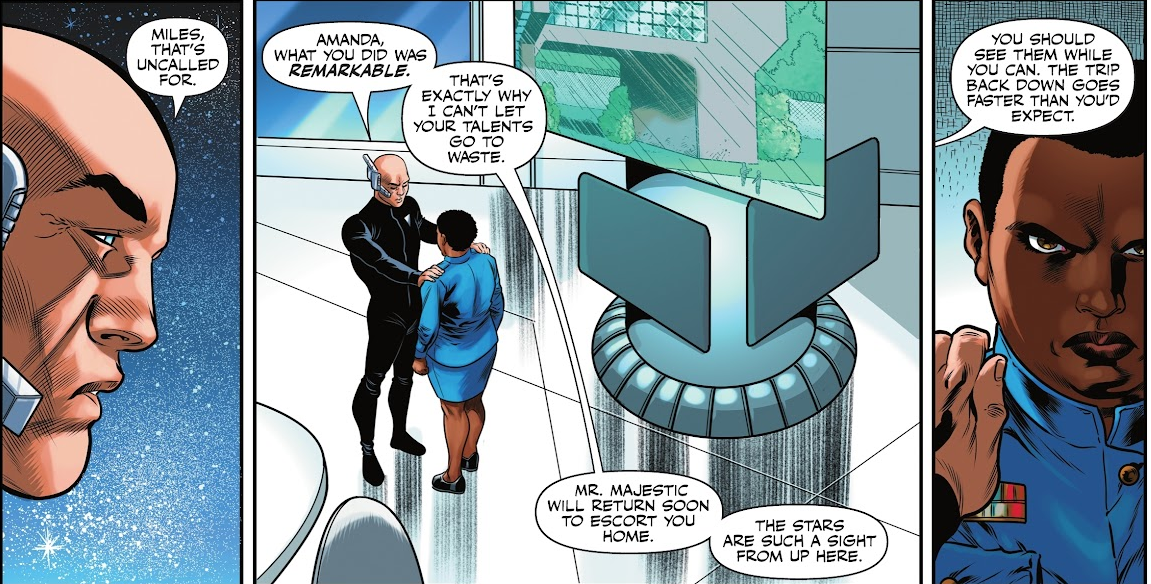
It's ambiguous exactly what's most on Waller's mind right now. Cynically, she could mostly just be mad about her personal ambitions being doomed before they started. More charitably, she could be (accurately) taking this as a sign that her people's place in the western-dominated order will never be secure. They will always be kept in a place where any privileges granted can be rescinded just as easily. America will never be sufficiently comfortable in its self-perception of greatness to not turn on its old punching bags. Throwing East Asia onto the fire is just going to buy them another decade or two at most.
The comic closes with the ending of Lois Lane's article, accompanied by a visual of Waller - angry and embittered, but STILL following orders and doing the atrocities.
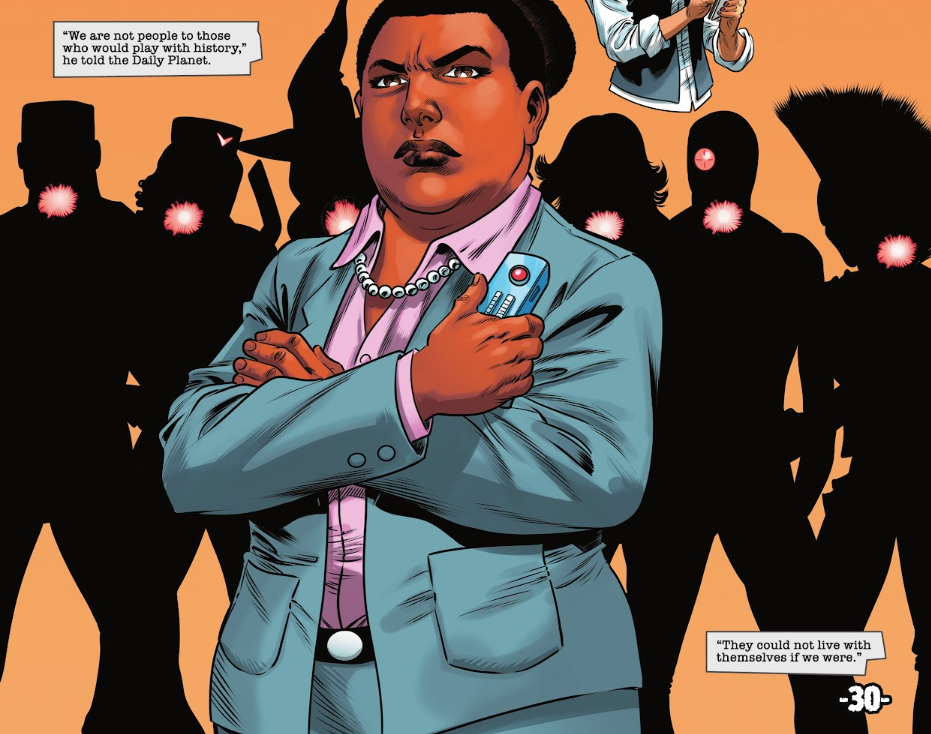
Making it clear that Waller has learned absolutely nothing from this. And that she never will.
Like I said. It's the darkest, most depressing superhero comic I've ever read. Mostly because it's actually multiple ongoing true stories shoved into a spandex leotard. The leotard might not fit perfectly (like I said, the fantasy counterpart plot has some details that try to reflect real world ones but just don't add up in practice), but that's not the point of this comic.
I want to have more of a conclusion, but I think the comic really speaks for itself.
So yeah. That one time in 2023-4 when DC comics ran a four-issue advertisement for Minecraft.