Star Wars Andor S1E9: "Nobody's Listening" (continued more)
Okay, so, what the doctor tells them is that there was an inmate on floor 4 who completed his sentence and was escorted out to freedom by the guards...only to be introduced to floor 2 for the next shift. The guards ignored him when he protested that this was a mistake, and when they didn't listen to him it triggered a riot throughout floor 2. With the end result that all 100 inmates on floor two - both shift crews - were electrocuted. Not just the ones who were rioting, all of them. Seemingly to prevent any knowledge of what happened from getting out to the rest of the prison.
From that, Cassa and Kino conclude - with the doctor's grim agreement - that none of them are ever going to be freed.
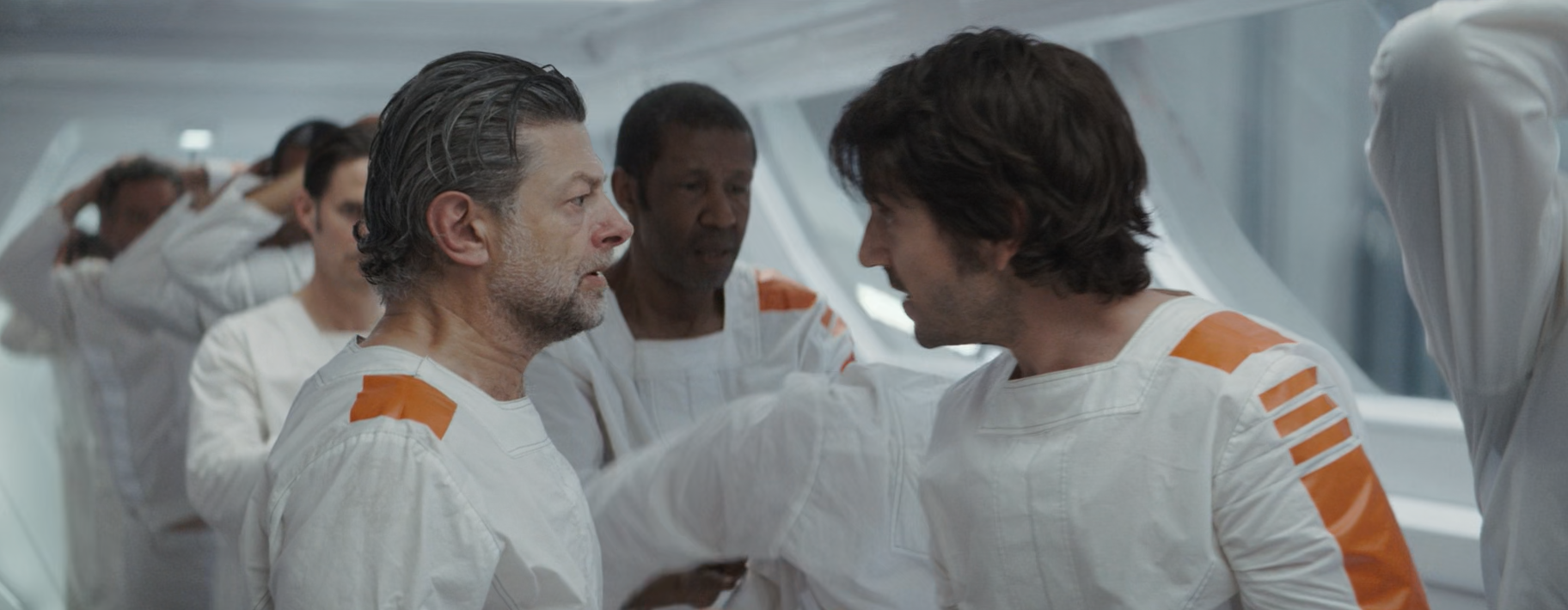
Erm...say what, now?
...
Okay, so, obviously some kind of mistake was made if they're bringing a freed inmate back into a prison full of people who think they're going to be freed when their sentences are up. Like, no matter what nefarious thing they were *intending* to do with that inmate, sending him back into a work floor full of laborers motivated solely by the dream of freedom wasn't it.
My three questions here are 1) what was supposed to happen with that freed inmate? 2) what were the guards trying to cover up, considering that it genuinely was a mistake? and 3) how did Cassa and Kino manage to infer what they just inferred from the information available?
For question one:
I thiiiiiiiiiink the implication is supposed to be that after completing their sentences (possibly after said sentences have been retroactively extended by policy changes etc), the inmates are just shipped to another horrible place where they're held extralegally and exploited in some other way that doesn't require them to have any hopes for the future. I think? But if that's the case, then it brings two other questions to mind.
1. If they're throwing people into the Narkina gulag left and right, for little or no reason, and not limiting their depredations to, eg, a disliked and ignored minority or the like, then aren't people going to notice that their family and friends are ALL disappearing off the face of the galaxy instead of being released in a few years? Like, this is something that would be hitting people all over the socioeconomic spectrum, seemingly on planets that have a lot of tourism going on.
I can see this being the direction the Galactic Empire eventually wants to go in. Universal imprisonment and slavery, accepted and endured by all. But I feel like doing this at THIS point would be a bridge too far. Multiple bridges too far, even. Like, I don't think Luthen even needs to do anything if this is how fast the Empire is already pushing the envelope.
2. If they have a way of extracting labor from the inmates that doesn't require them to have any hope for their futures, as this second hypothetical prison they're being sent on to would have to use, then what is even the point of the Narkina V method? I guess they just don't work as fast when they're that hopeless?
I suppose it could also be that after Narkina V they're being chopped up to have their organs sold or whatever. But that just brings me to the next issue I raised above.
For question two:
If the inmates released from Narkina V are being freed as per the law, then sending this guy back in to another floor was a mistake. If the inmates released from Narkina V are being sent somewhere else to be turned into cat food, then sending this guy back in to another floor was a mistake. Both mistakes look the same from the inside. Only one of them requires a massive cover-up that would be worth sacrificing 100 labourers for.
Why didn't they just say "oops, sorry" and drag the guy back out again? He still gets sent to the cat food factory. The rest of the floor 2 inmates might lose a little bit more confidence in their own futures than they've already lost these recent months, since they've seen a person's destination get mixed up due to some petty bureaucratic error, but the fact that the prison responded to the mistake quickly and appeared to rectify it would probably restore most of it. They didn't need to act like they had some huge secret to protect.
And, conversely, if they were stupid and knee-jerk enough to tip their hand like that instead of covering it up with a simple "woops, sorry, taking him back out now," then they'd also probably be stupid and knee-jerk enough to kill the entire floor even if there wasn't a sinister secret to protect. If they're that bad at thinking things through, then "oh god, prisoner unrest, murder everyone on the entire floor aaaaaahhhhh!" is something that could happen even if the inmates are being released back to their homeworlds as promised.
Which leads me into question three:
How did Cassa and Kino come to their conclusion based on this evidence?
From the framing, it seems like the audience is supposed to be on the same page as them. But, for the reasons I've said, I don't know how they're supposed to have come to their conclusion or why I should be taking it on faith that they are correct. Sure, it would be harrowing to learn that the guards are that quick to murder an entire floor whenever some dickhead in the main office makes a typing error, but it doesn't fundamentally change their situation. MOST OF THE TIME, entire floors do not get randomly executed. This was a seemingly unique event in the experience of all the inmates. So...how did they get to "none of us are ever being freed?"
There are possible answers to all of my previous questions, but try as I might I just can't think of a satisfying answer for that last one. Basically, Cassa and Kino would need to already have the answers to those previous questions in order to come to their conclusion, and I don't think they know more about their situation than the audience does at this point.
"Andor" has had some pacing issues and a few moments of chuckle-inducing writing here and there. This is the first time that it's made me let out a flat "huh?" and taken me out of the story as I try to figure out what the hell is supposed to have just happened.
...
Anyway, the guard soon comes back in to help move the body out, and Cassa and Kino are herded back to their work crew. As they walk Kino quietly whispers everything he knows about the guards' numbers and positions throughout the facility.
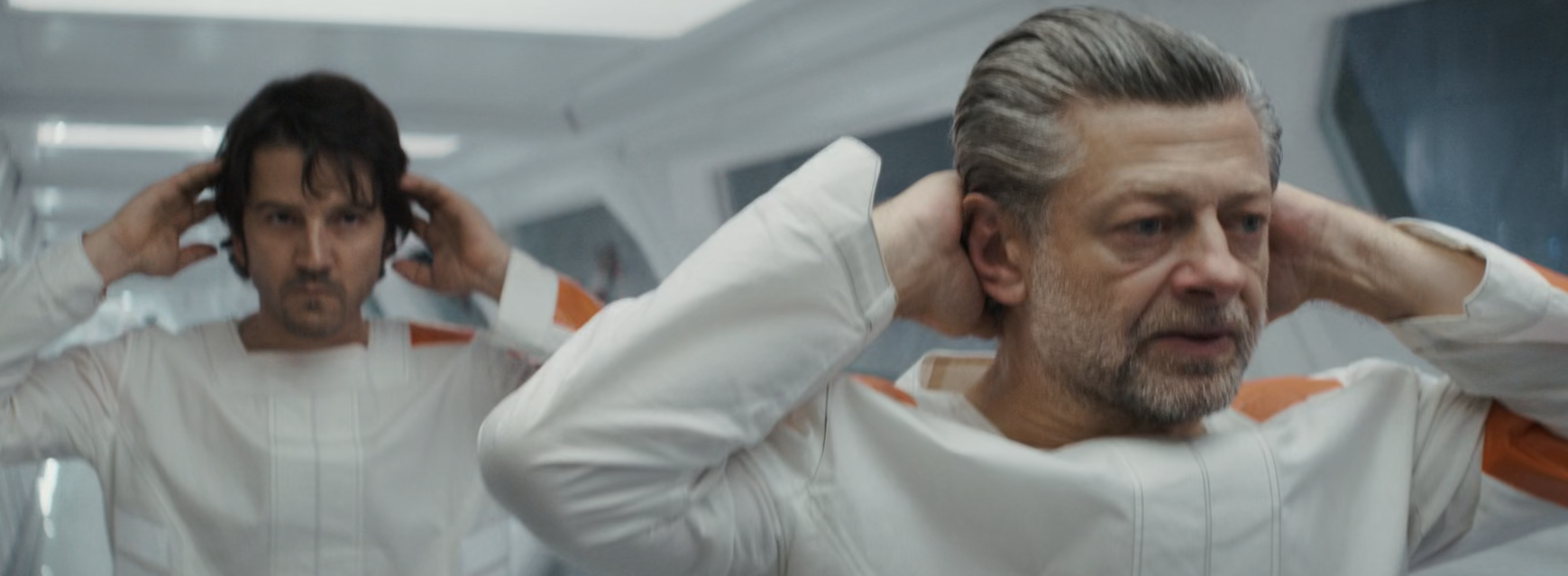
His hope for eventual freedom that he's allowed to consume and bestialize him has (bafflingly, but I've already gone into that) been taken away. He can allow himself to be the person we've hitherto seen only glimpses of again. And, I'm pretty sure with his knowledge and influence combined with Cassa's outside-context-problem guerilla fighter skills, this prison really doesn't stand much of a chance.
And, that brings these three episodes to an end. They're...much less of a self-contained arc than the previous couple of sets, as it turns out.
I'll get the critical part out of the way first.
I liked almost everything in these three episodes. Just...I wish those things were actually doing something to move the plot forward.
Maybe part of the problem is that the previous six episodes gave me the wrong expectations, so my discombobulation comes from episodes 7-9 not trying to form the kind of arc that 1-3 or 4-6 did. I'll grant that possibility. But even without those expectations, I'm trying to think of what meaningful things actually happened in these episodes, and the list I'm ending up with is awfully short. Cassa gets arrested and plans to escape. And plans to escape more. And plans to escape even more. Dierdre is following Luthen and Cassa's trails. And following them. And following them more. Cyril and Mon Mothma both mostly just stand around being frustrated, having interactions with other characters that might pay off later but don't yet. "Announcement" set up a new status quo, but then - aside from Bix getting arrested and Dierdre getting more power - there were precious few changes in that status quo from the midpoint of "Narkina V" until the end of "No One's Listening."
No matter how a series is structured, three consecutive episodes of setup without anything paying off is just too much. The fact that they also have some clumsy writing moments like Cassa's coincidental arrest (important thematically though that arrest was, the time and place were just way too convenient), whatever the hell is supposed to have happened at the end of "No One's Listening," and the writers letting 6 Juggernaut Star Scours the Universe come up with the Empire's torture techniques, don't exactly help either.
Now, that said? I can see how all of this talking, worldbuilding, and social manoeuvring IS there to set things up for payoff. It's good setup. Really good setup, in most cases. I can see the multiple boulders that it's rolling uphill, and I can see the deep valley that they're all going to come crashing down right into each other's paths with incredible energy, and I'm excited for that. It's just taking too long at once without anything else to break it up.
And now, with the pacing issues and occasional derp moments out of the way? The substance here is some of the best television I've ever watched. If you were to fix the pacing issues and give the protagonists more room to exercise agency here and there, they might even be the best 135 minutes of TV I've seen in my life.
The themes being telegraphed all the way back at the beginning of the series in Cassa's visit to Morlana I have fully come home to roost. The fractal evils of oppression, reproducing themselves within themselves over and over again as the scale shrinks down. Being forced to kill the second thug after he'd already surrendered, even after the two of them had that strange moment of cooperation as they tried to come up with an alibi they could both avoid arrest with, and then the grim necessity of cold-blooded murder when they failed to do so. Even resisting the murder machine requires replicating it. Luthen and Leia are basically the living embodiments of that.
War is terrible, holistically, from top to bottom, for everyone, in every way. But some people are determined to make it necessary, and then everyone else has no choice but to concur. Misery replicating misery, ruined and ended lives rippling outward like dominoes, in the hope of creating the slimmest chance of something eventually changing. Criminals become no better or worse than law abiding citizens (Cyril's situation, the people who Mothma needs to bite the bullet and work with, etc). Psychopaths become socially indistinguishable from neurotypicals (Dierdre and Friends, full stop). This is especially true of resistance fighting, but there's no type of warfare that this isn't broadly true of.
But people keep starting it. For no better reasons than wanting to be slightly richer, or wanting a few more bragging rights, or having some dumbass personal grudge.
...
As I've said before, in my reviews and in other discussions, the institution of slavery is - without exception - a state of war between slaves and slaveowners. The Galactic Empire is at war with an ever-growing percentage of the galactic population. Just because it wants to be.
And there's no way to get rid of it except by repeating it even more.
...
Something that I appreciate about this show is that it manages to accept these truths without falling into the Hard Decisions trap. All too often, both when writing fiction and (much more unfortunately) when acting in real life conflicts, people end up mistaking "brutal pragmatism" with "being brutal is pragmatic." Warfare doesn't reward the party who makes the biggest moral sacrifices. The course of action that requires greater sacrifice isn't always the strategically optimal one. Successfully fighting a superior force means doing whatever is optimal, taking all probable first and second order effects into account, regardless of whether or not it is moral.
So, when Luthen starts sinking time and resources into killing off loose ends from the Aldhani mission just because he feels helpless and wants to be doing something? That's a mistake. He's wrong, and Val with her objections is right. The show knows that it's a mistake, and clearly portrays it as a mistake.
When Luthen deliberately provokes the Galactic Empire into ramping up the oppression because there's no other way to get the manpower the rebellion needs? That's not a mistake. He's right, Mon Mothma is wrong, and the show isn't shy about this either.
On every front, from every angle, Andor just gets it.
What these three episodes succeed at very well is showing us what authoritarianism really means, and what resistance against authoritarianism really means. It doesn't pull any punches, and it shouldn't.
If there's a benefit to the snail's pace of these three episodes, it's the amount of detailed worldbuilding and character study that have room. Watching Cyril, Val, Luthen, Mom, and so many other characters slowly make decisions as they interact with each other lets you really get a sense of their nuances and complexities. Watching these people - average or exceptional - go through life in the used-future world of Star Wars makes the latter feel ever more real. I feel like there has to have been a way of achieving all this while still having the plot advance just a tiiiiiny bit faster, but if it's going to be slow then I'll at least happily enjoy the fine detailing as it crawls onward.
I guess I'd say that these three episodes are like the Ferrix arc, but moreso. Episodes 1-3 had good character work, worldbuilding, themes, and politics, but had some minor pacing and structural issues. Episodes 7-9 have truly amazing character work, worldbuilding, themes, and politics, but abominable pacing and structure. Highest highs and lowest lows.
So far, I'm going to say that the Aldhani episodes have been the high point of the season, having most of the same merits as what comes before and afterward but virtually none of the flaws. An episode of introduction, then an episode of getting everything into place, and then an episode of nail-biting tension and rip-roaring action where it all pays off. Perfectly paced heist story. Going straight from there to the Narkina plotline just makes the latter seem even more amorphous and sluggish.
And...uh...I'll just finish this off by repeating one more time how fucking amazing the Narkina factory interiors look.