Iruma-Kun: Welcome to Demon School #1
This review was fast-lane commissioned by @Darken
"Iruma-Kun: Welcome to Demon School" by Osamu Nishi is a shonen manga that's been coming out more or less persistently from 2017 up to the present, and its anime adaptation - starting in 2021 - is likewise ongoing. It seems to have had a positive reception, though I don't hear it mentioned as often (at least in the web spaces I tend to frequent. May or may not be representative...) as quite a few other series to come out in that time period. This review order covers the first volume of the manga, including its extra-long first and second issues.
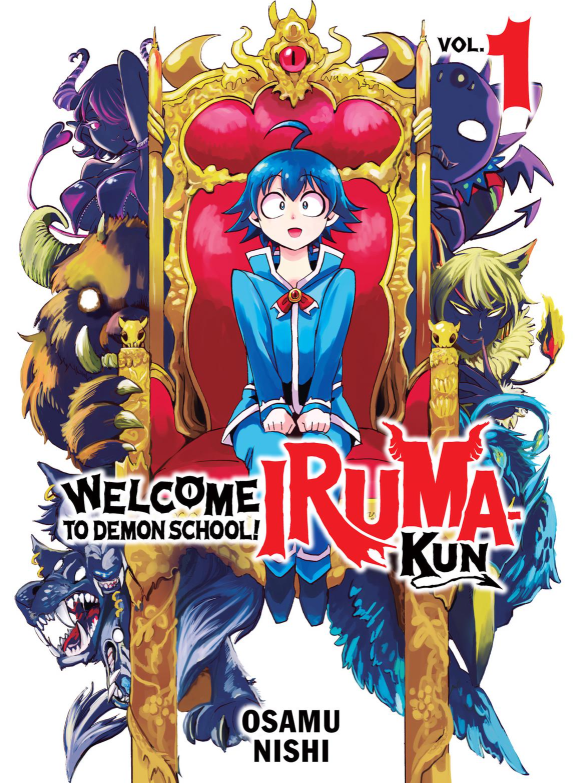
I'll be covering the first of those starting episodes in this post, and so far...well, this might be an unfair comparison given just how popular and critically acclaimed "Chainsaw Man" is, but there's enough overlap in genres, subject matter, and publication timelines that I sort of can't help it. So.
Demon School isn't terrible, but it also is definitely no Chainsaw Man. It might get better in subsequent issues, but it's not off to a strong start.
The titular Iruma Suzuki is the put-upon son of greedy, indifferent parents who have done little but exploit their son for their own financial gain since the day he was born. Well, not literally the day he was born, but they only let one year get away from them.
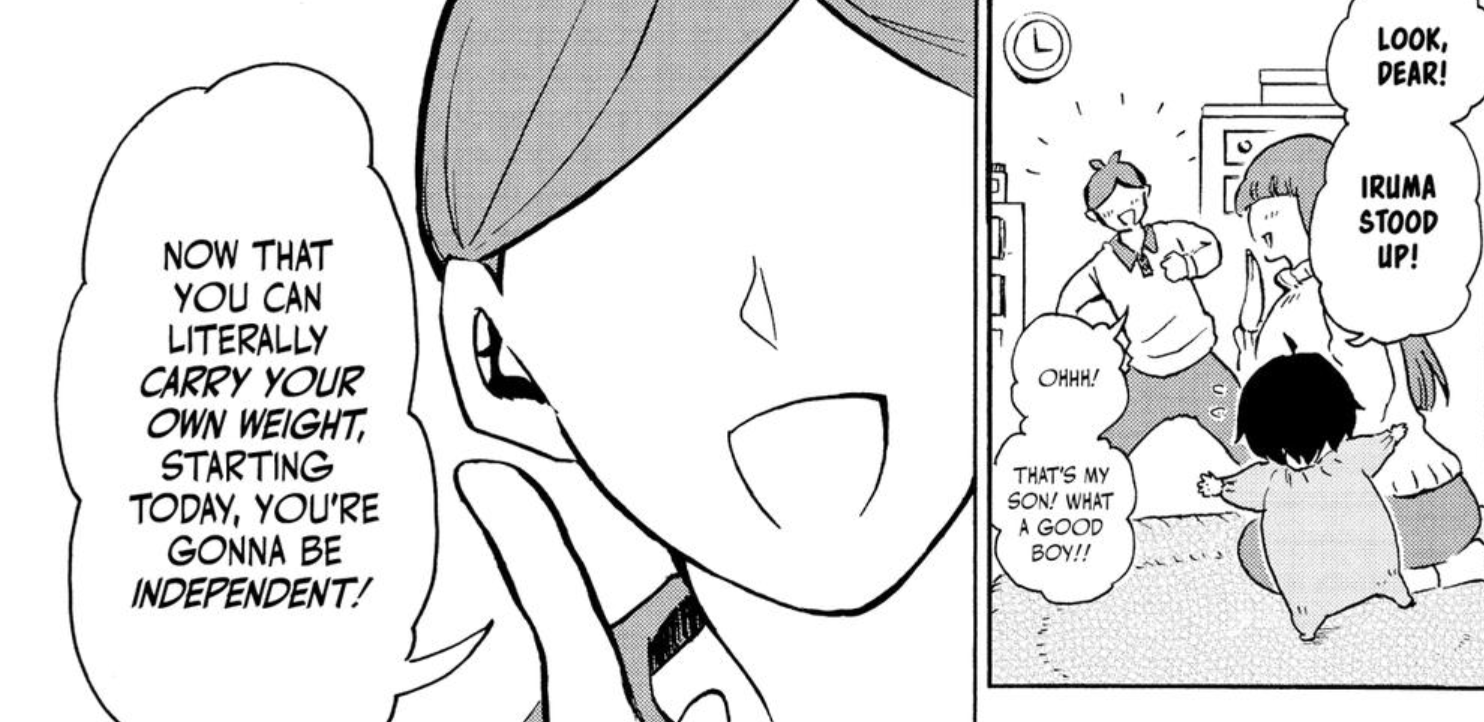
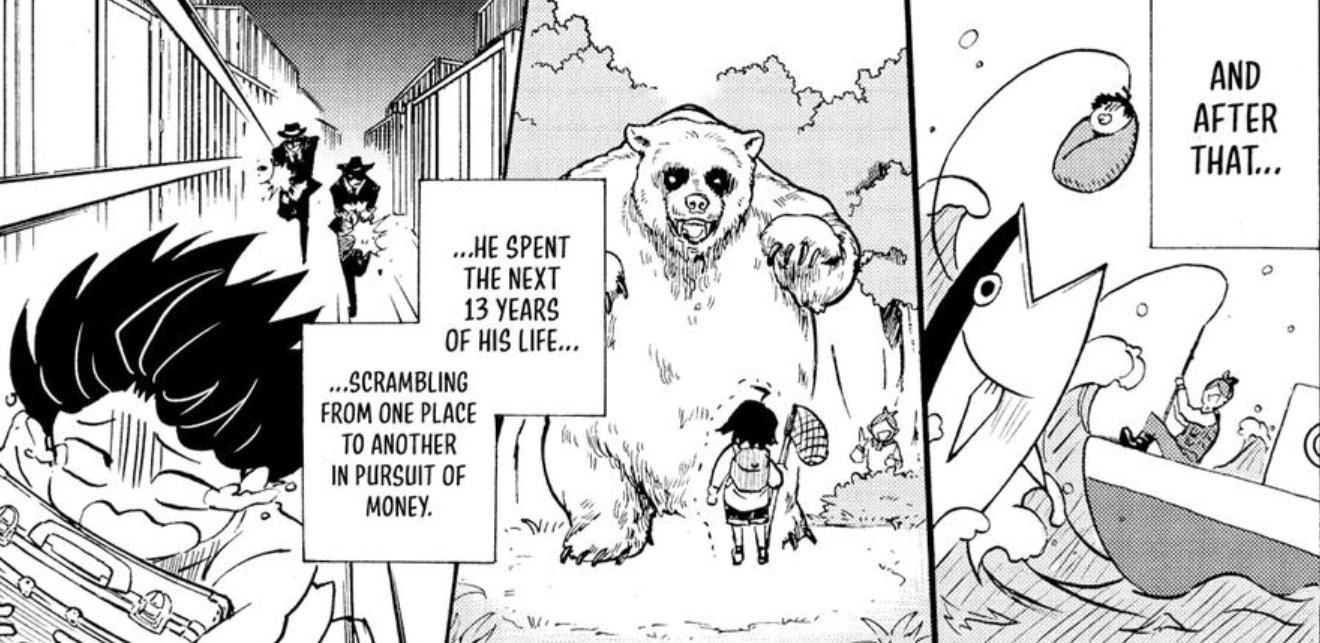
I trust you can see where I'm coming from with the CM comparison. Isolated teen boy protagonist with a comically terrible childhood written in such an over-the-top way that the reader is sure to chuckle rather than tear up. Then there's the incident in his mid-teens where he gets sold out to demons for profit, albeit in Iruma's case its his own parents who do the selling, and it's also much more literal.
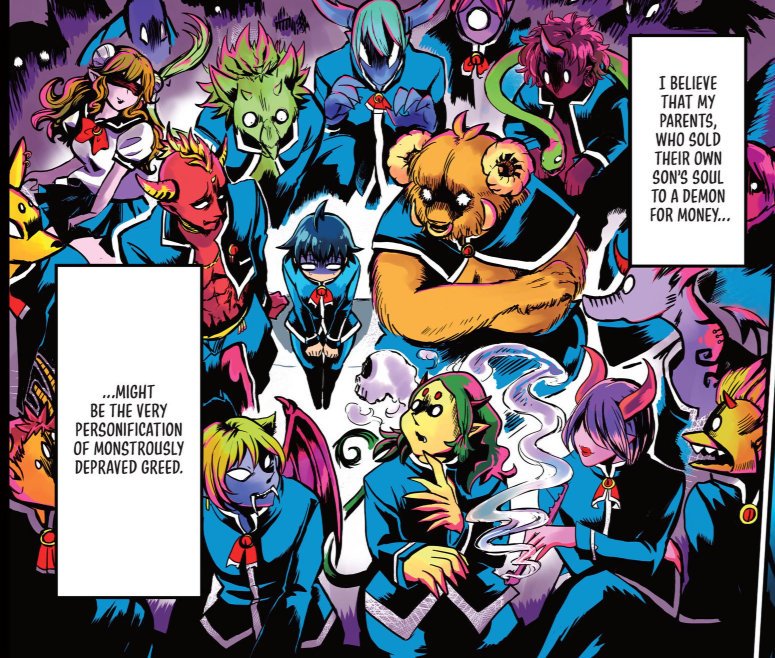
Iruma's parents summon a demon and sell it their son for a large, though so far unquantified by the story, amount of money.
This inciting incident is followed by a double-subversion that I found to be far the cleverest and most amusing part of the issue. Like, if the rest of this comic could be half as amusing and subversive as this part, I'd like it a lot more. First of all, it turns out that the reason the demon was interested in purchasing a human child is because he's a sad old widower who never had any children of his own, and as his twilight years come on he just wishes he had a grandson. So, this was his way of adopting one.
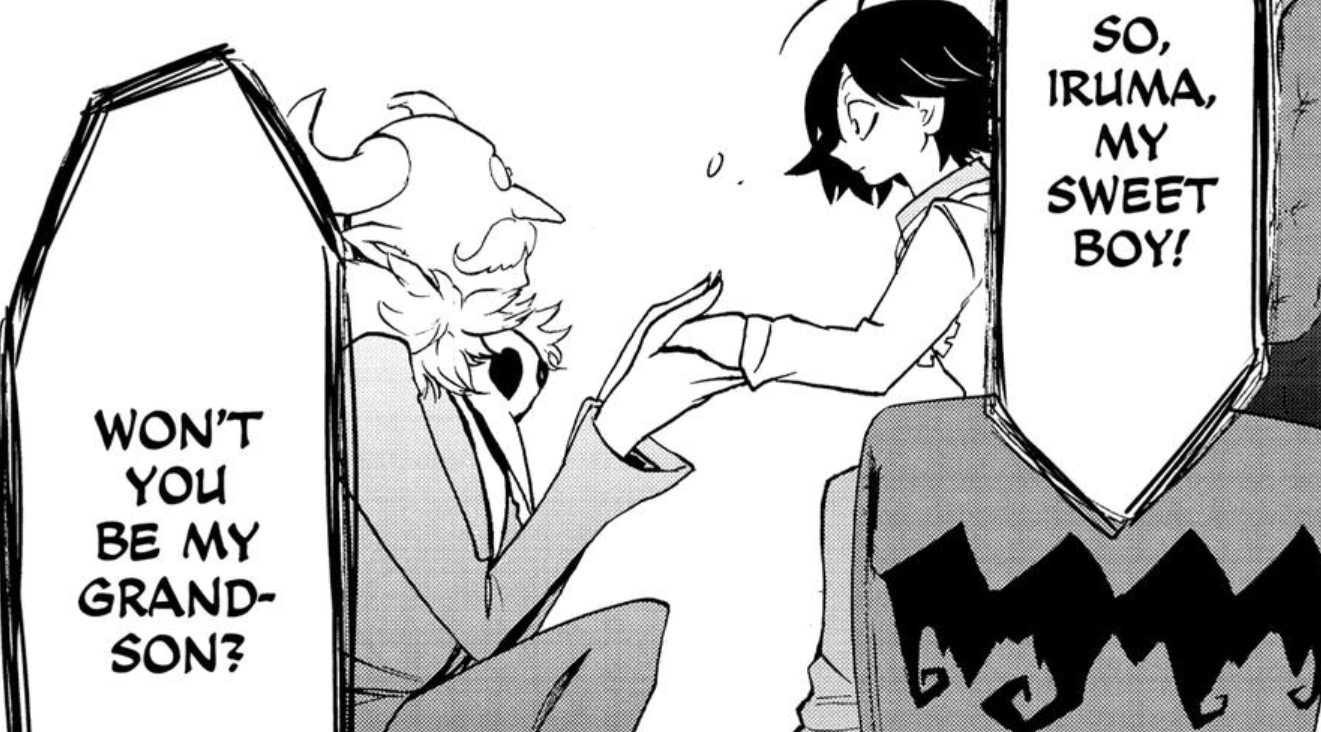
This wealthy old demon has already equipped his hell-palace with a bespoke "grandchild-spoiling set" of luxurious furniture, board games, appetizers, you name it.
So, that took me by surprise and elicited a chuckle. The "double" part of this subversion comes along with an answer to the question "so, what's the source of conflict going to be, if the demon is actually nice?" When Iruma, despite his fear and misgivings, accepts the grandfatherly demon's request, the latter casually informs him of what the alternative would have been.
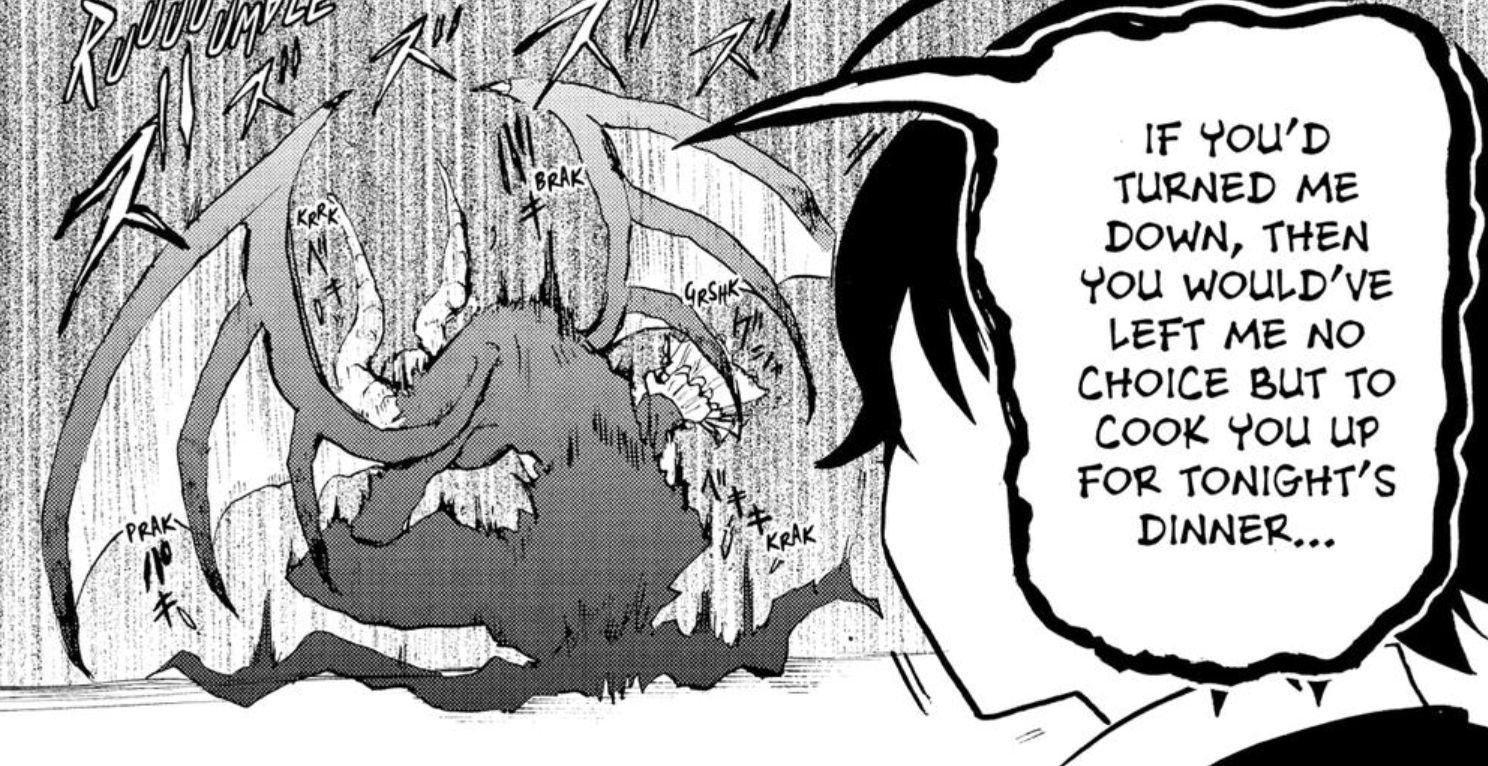
He ain't fucking. Demons eat people. That's what they usually do. Him wanting to adopt a human is just a weird exception that randomly issued from the mind of one senile old eccentric.
In fact, demons are downright *obsessed* with eating humans. As evidenced when Iruma is enrolled at the titular demon school, and he hears his first recitation of the school song.
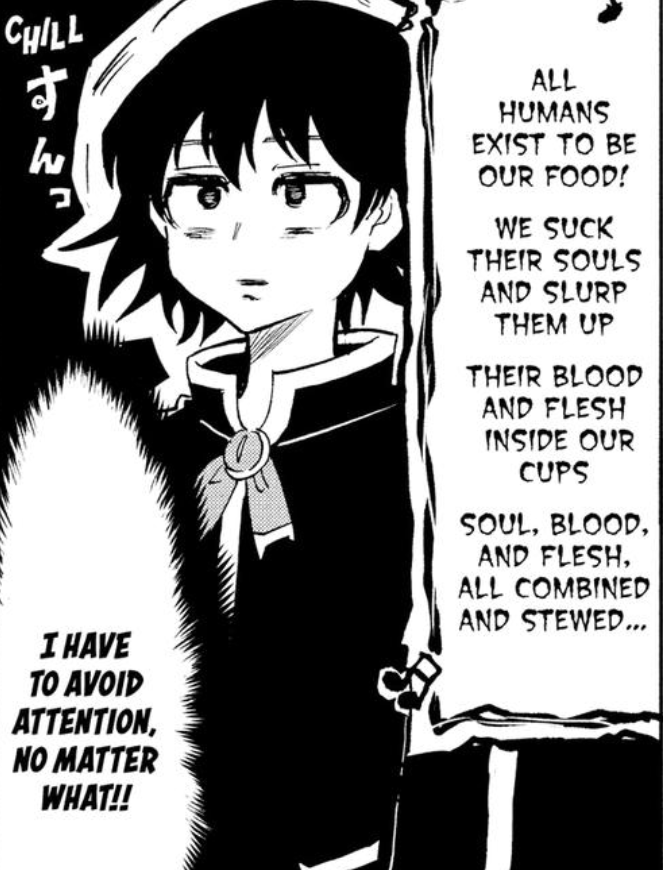
Once again, I'm sure you see why I can't read this and not think about Tatsuki Fujimoto's work. And also Kaiu Shirai's, for that matter. But mostly Fujimoto. Again, these were all written at around the same time, so I'm not calling any of the aforementioned works a ripoff of the others. Just, they're very hard to not compare to each other, and of the three Osamu Nishi's offering is off to by far the weakest start.
The main issue I have with the beginning of "Welcome to Demon School" is that it leans (even) more heavily on comedy than the likes of Chainsaw Man, and with a scarce couple of exeptions, most of them concentrated in the first few pages of the comic, it just...isn't very funny. I know, humor is incredibly subjective, and it's hard to explain why one does or doesn't find something funny in a way that will incline anyone else to agree with them. But for me, after the first dozen-odd pages, these gags just hardly ever landed.
In some cases it's down to them being overly predictable. For instance, Iruma's most defining character trait is that his parents have beaten him down to the point where he can't say no to almost anyone about almost anything. This manages to be darkly funny the first couple of times that the humor hinges on it. It even manages to be poignant once, when the adoptive grandfather demon is begging him to accept his love and care (and hasn't yet told him that the alternative is being killed and eaten, of course) and Iruma's fear and trepidation are wrestling against his inability to say no to such a kind-seeming man making such an emotionally powerful request. But then the comic uses "Iruma is too nice for his own good and can't say no to anyone" for like, twelve more plot points and/or jokes without any complicating factors or new information coming out of it, and it's just so predictable and repetitive by the end of the issue that I just got bored.
Other times, it's a matter of punchlines just not getting the needed setup. Like, later in the issue, there's a sequence where this demon kid wants to beat Iruma up for (unintentionally) slighting her at a school event, and Iruma's learned cowardice and avoidance have made him so good at running and hiding from harm that she can't land a blow. And then, in the middle of the (clumsy, non-diegetic) exposition about that, the comic drops this in:
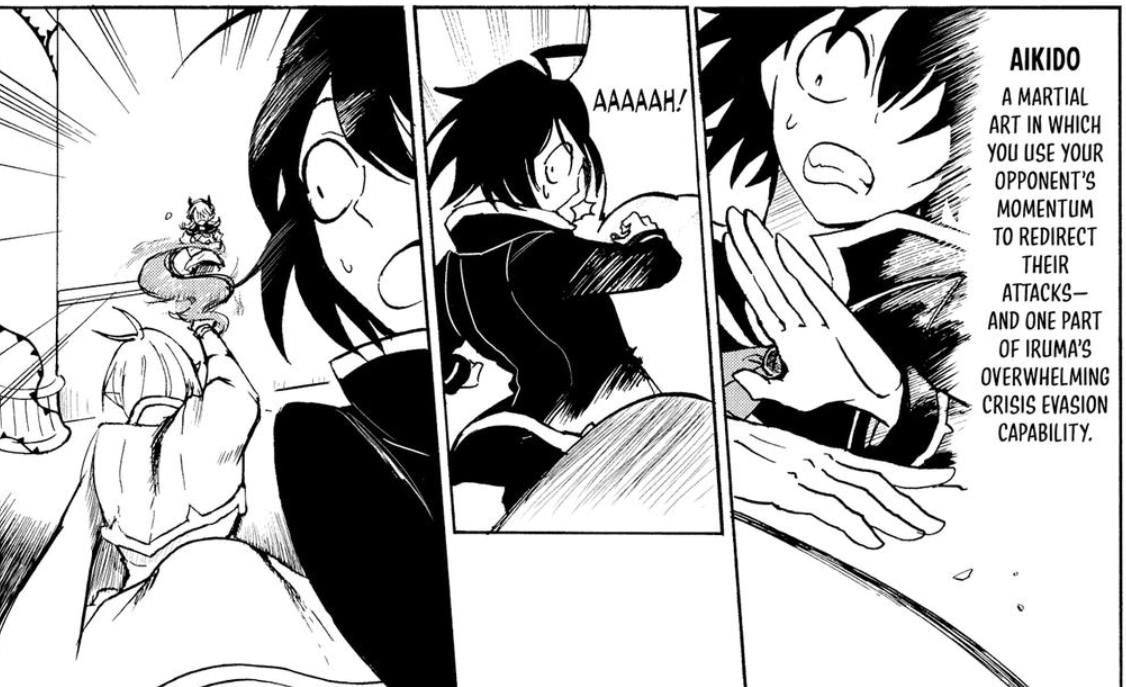
So, um. This put-upon abused kid is also formally trained at Aikido? Is that supposed to be funny because of its improbability or something?
Or is the intended joke supposed to be that Iruma has had to dodge so much abuse in his fourteen years of life that he's independently reinvented the martial art of Aikido himself without ever realizing it? That version could be funny, if it was written differently. Maybe the localization is to blame for it not coming across as such in English. But anyway, there are a bunch of things like that. Where the comic just tells you a thing like it expects it to be funny, and maybe it WOULD be funny if there'd been some actual setup for it, but there just wasn't.
The last problem I had with the humor is that very quickly after establishing the situation with Iruma's adoptive grandfather, the focus of the story becomes the demon school itself. And, it's a parody of the shonen magic fighting school genre. And, much like plague of LitRPG isekai shite that would follow it into the otakusphere's spotlight, the shonen magic fighting school is beyond any hope of parody. It was already beyond parody in 2012, let alone 2017.
Aside from the humor, there's also the art. I considered starting my critique with this, but it occured to me that just waiting until later in the review once I've had occasion to post a few screenshots would basically just make the argument for me. The art just isn't great. Maybe it gets better later, but so far it's not great.
All that accounted for, there are definitely some positives. Like I said earlier, this comic isn't terrible. For instance, the way it introduces and sets up Sensei (a plague be upon his house) makes you not realize that that's who he is at first, so you get used to him as an amusingly idiosyncratic character before you realize that he's the same tired parody of the same noxious archetype that you've already seen a million times.
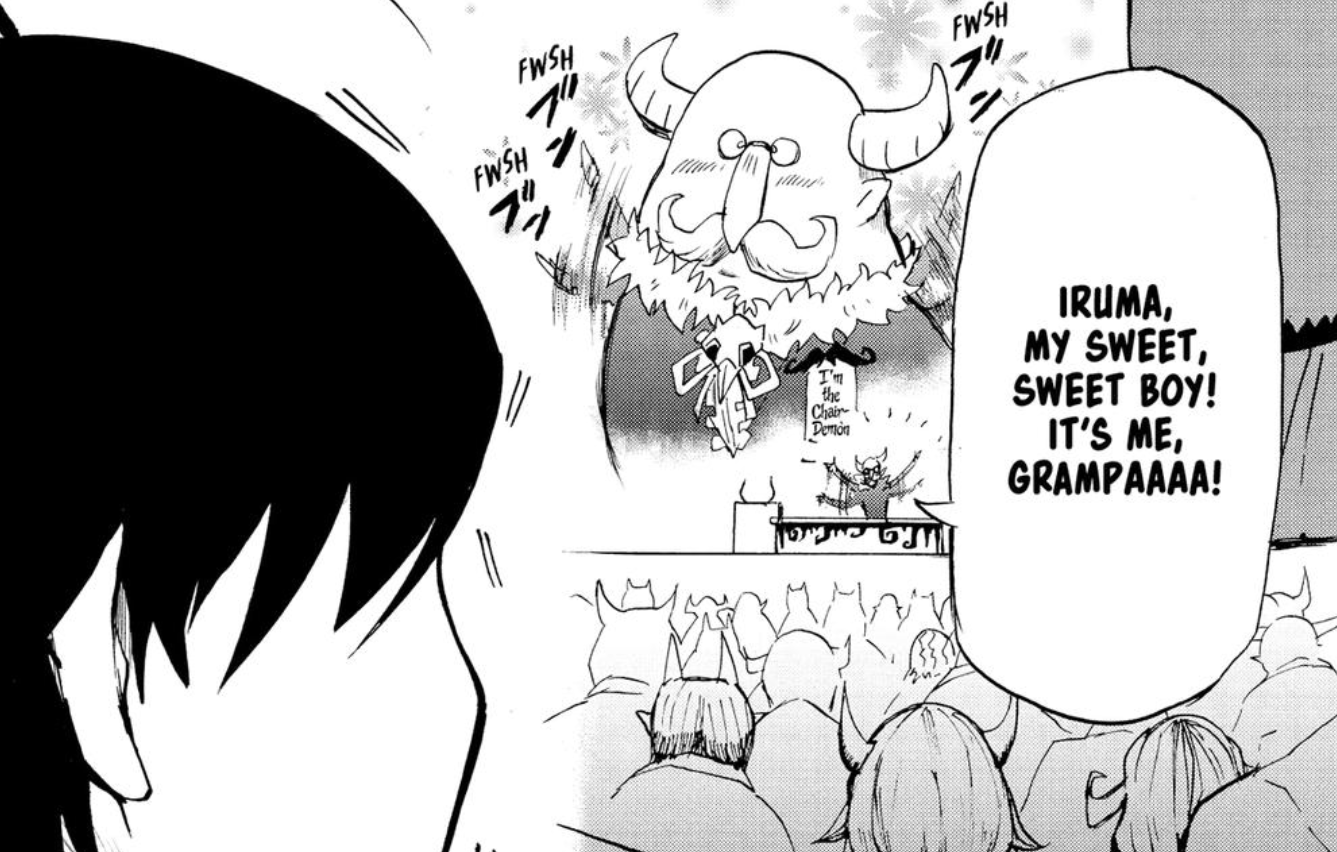
The archetype is "crazy-seeming old schoolmaster makes unreasonable demands and puts his charges in pointless danger, but he's always right and you're never allowed to question him no matter how illogical the story needs to get in order to validate his actions." The parody is "nah, turns out he actually is just senile/insane/etc after all." I'm sick to fucking death of both of them. In this case though, the joke (at least for this first issue) is "wait, the crazy senile old demon who adopted me is also Sensai???" And that's a bit more novel. That was set up and deployed properly. It helps that it makes a lot of things from the early pages make more sense in retrospect. "Wait, old senile demon dude just adopted Iruma and hasn't even had a chance to use his grandchild-spoiling equipment on him yet, why is he already so eager to send him off to school?" "Oh, he runs that school himself, that explains it."
There's another gag, that comes toward the end during the middle of the otherwise incredibly tiresome honor duel against an offended rival student that every fucking shonen magic fighting school story comes packaged with, that I found set up and paid off effectively enough. Earlier, in a scene that drags on for way too long to be as funny as it means to be, Sensai tricks Iruma into reading out the words of this complicated spell that disintegrates the caster if casted improperly, but makes them incapable of tripping or falling over for 24 hours if successful. In his later duel against honor student (which naturally means fighting champion. Because of course it does. The protagonist never even thinks to question the martial focus of the nondescript "school" he's initially told about, because why would a school with standardized curriculum and classrooms full of students ever teach anything besides highly personalized fighting styles that hinge on unique individual powersets? ), after said rival gives up trying to hit the untouchable Iruma with ranged fireballs, he charges in to tackle him and accidentally German-suplexes himself with Iruma's temporary unfallability.
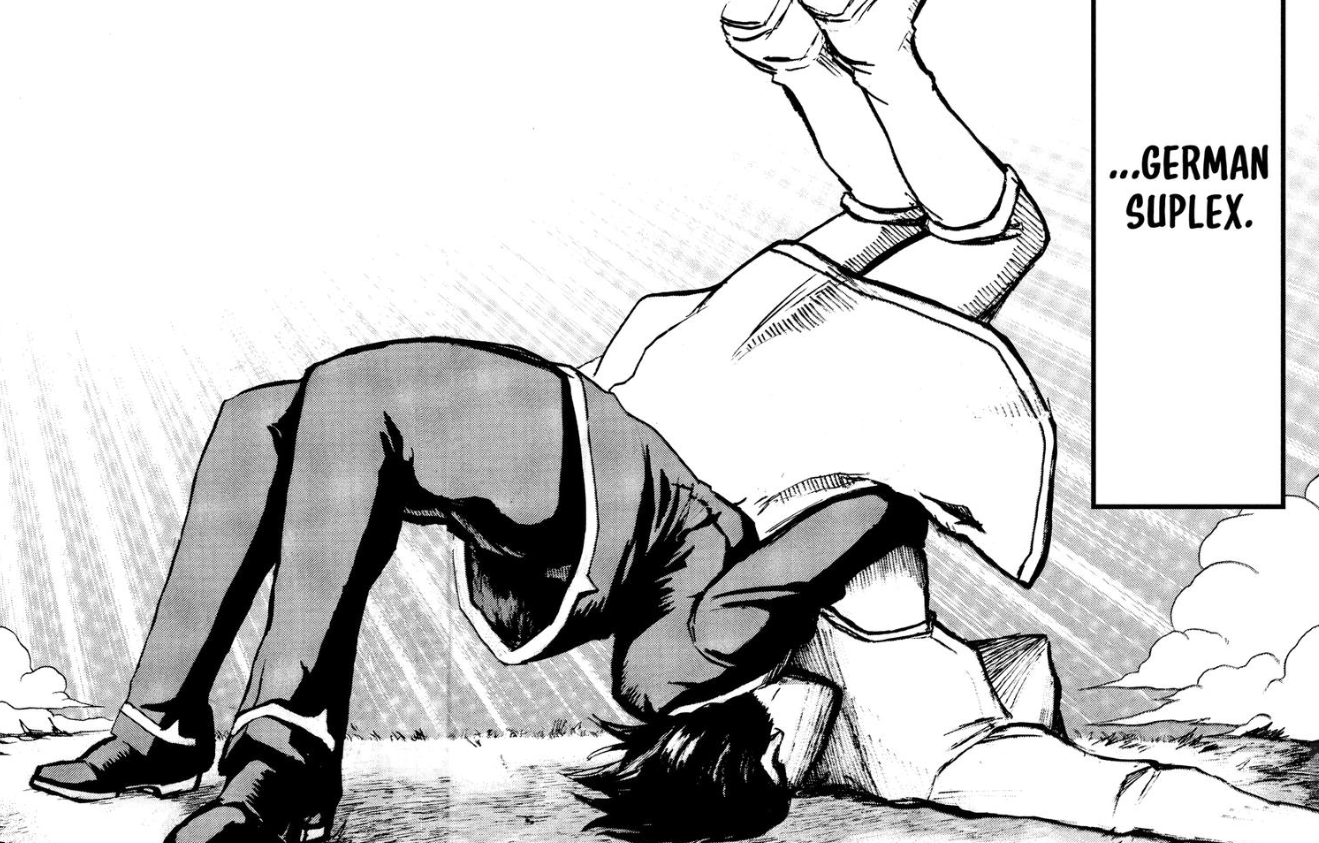
This would have been predictable without a lot of other stuff going on in the scene to distract you away from the anti-falling spellcasting that was just established. With the way it plays out though, it works.
So, there are some clever, funny, and inventive moments throughout this double-length intro chapter. There just aren't enough of them, and the stuff between them is a boring, forgettable, poorly-paced, generic slog that fails to distinguish itself from the thing it's ostensibly parodying.
Anyway, the status quo at the end of the issue has the erstwhile rival character - Alice Asmodeus, of the illustrious and well-known House Asmodeus - being defeated by Iruma in the duel, but then not promptly killed by him. In demon culture, this apparently means you need to become a loyal retainer of the person who defeated and spared you, so Alice is now Iruma's minion. And eagerly promises to kill and maim and spill blood in her new master's name. Because that's a thing your classmates expect of you at a school that notably isn't full of corpses.
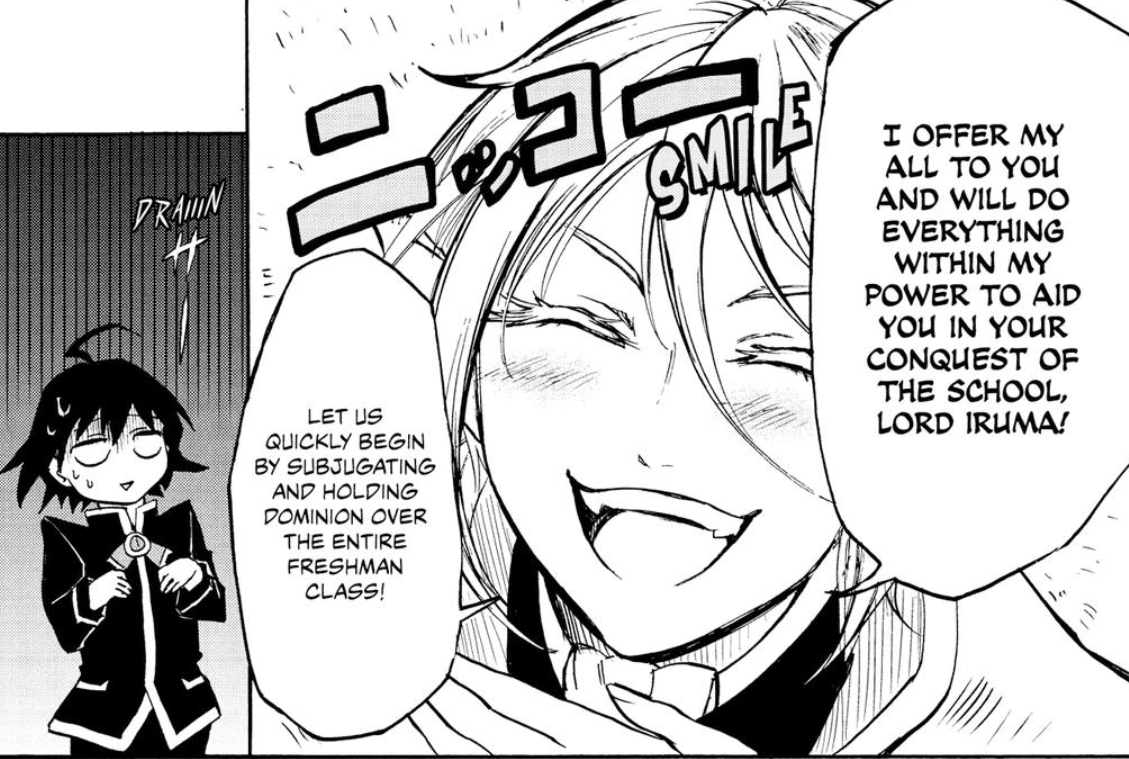
Why was she so eager to pick a fight, knowing that those would be the stakes? I have no idea. She has no reason to not believe that Iruma actually is Sensai's grandson and likely the heritor of considerable magic power from a prominent noble bloodline, as far as I can tell, so I don't see why she'd be so confident in her own victory...yeah, I have no idea why that would ever seem worth it to her.
Anyway, status quo at the ending is all the other demon kids believing that Iruma is indeed a blood-descendent of Sensai with vast powers (apparently him being able to properly enunciate that complicated, dangerous spell without any errors when most people couldn't was just coincidence?), and no one suspecting that he's actually an edible human despite smelling yummy (they attribute this to him wearing a popular perfume). And also having the scion of the infernal house of either wrath or lust (depending on which demonologist you ask) as his reluctant friend/servitor.
It could get good. I can definitely see ways in which it could get good. So far though, I'm mostly just underwhelmed. I kind of expected to have more to say about this intro chapter, but I really can't think of much else worth talking about.
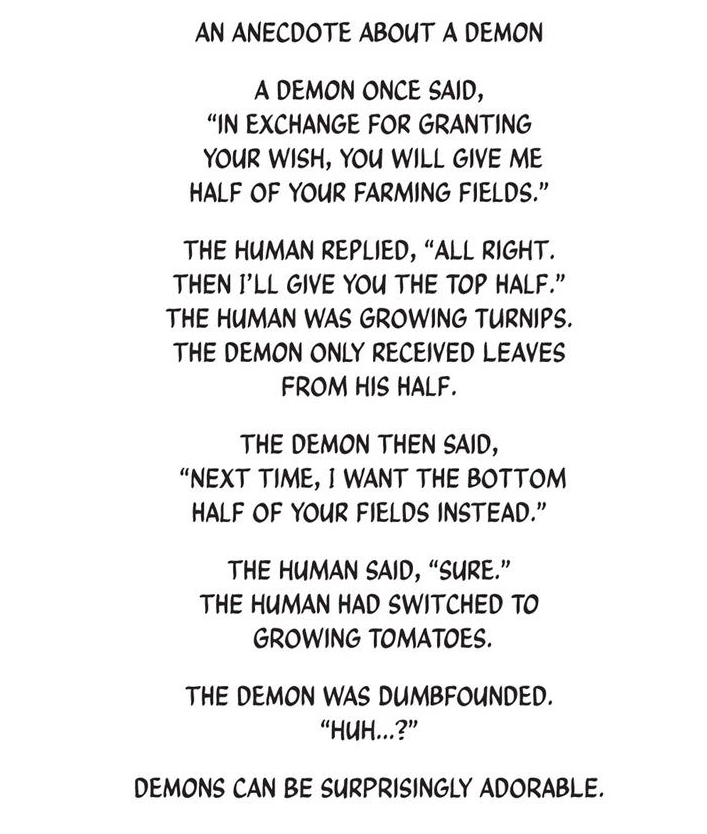
Well, there's also this silly little flash fiction piece that serves as an opening "quote" that mildly amused me.
So that's cool. But hopefully there will be more for me to talk about in the following issues.