Oh My Goddess! S1E21: "The One I Yearn For Is A White Winged Angel"
Keiichi is often a passive protagonist, buffeted around by either his cursed fate or the antics of his divine housemates so much that he's basically just a passenger. The last episode I watched was an extreme example, with a hapless Keiichi getting turned into a literal object early on and just sitting there while Urd and Belldandy run around trying to save him.
Well, this one is different. Not because Keiichi is an active protagonist, but because the episode doesn't try to make him any kind of protagonist at all. He's onscreen for maybe five cumulative minutes at most, and plays a strictly supporting role. This episode is about the goddesses' relationships with each other and with the ethereal world they came from, and its entirely from their perspectives.
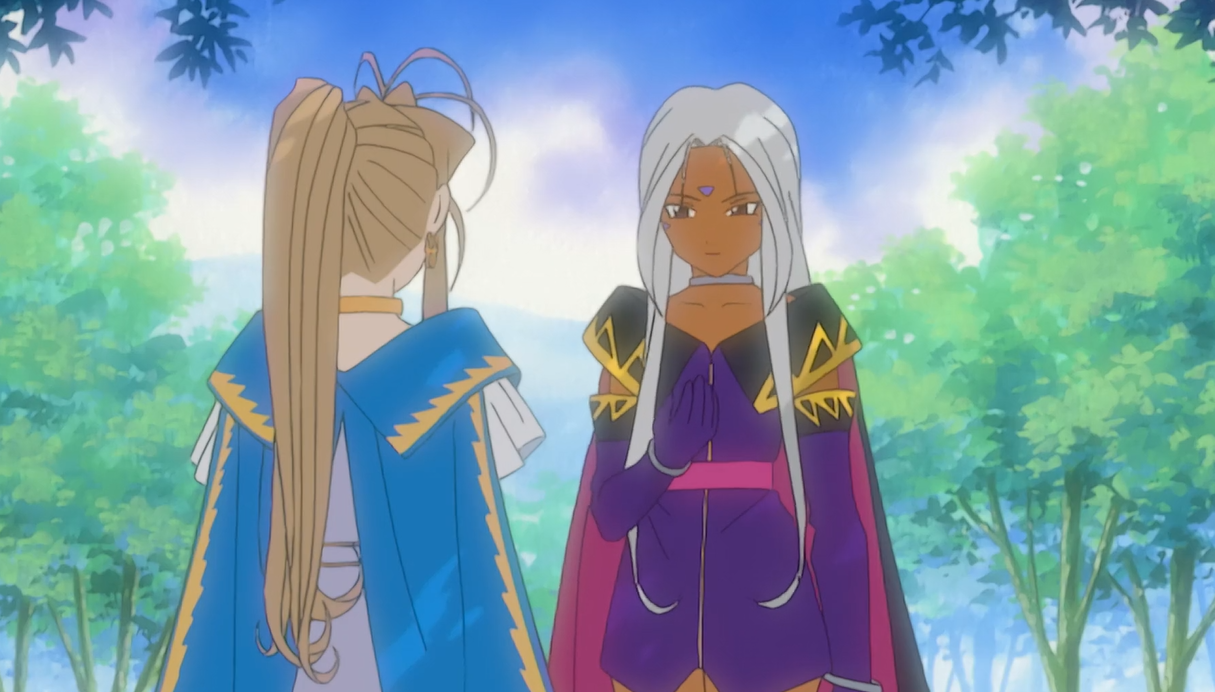
I dig their home reality's fashion sensibilities, if nothing else.
On one hand, things not revolving around Keiichi for a change is a welcome change of pace. On the other hand, the world of the goddesses isn't one that's easy to get invested in, and the emotional stakes that this episode seems to be aiming for don't quite hit. On balance, while I wouldn't say it's an especially good episode of OMG, it is an interestingly different one.
...
In fact, Keiichi is barely even IN this episode at all.
The first couple of minutes are spent resolving what I assume is the aftermath of episode 20's plot. Keiichi apparently got turned into a woman somehow, and Belldandy and Urd need to turn him back.
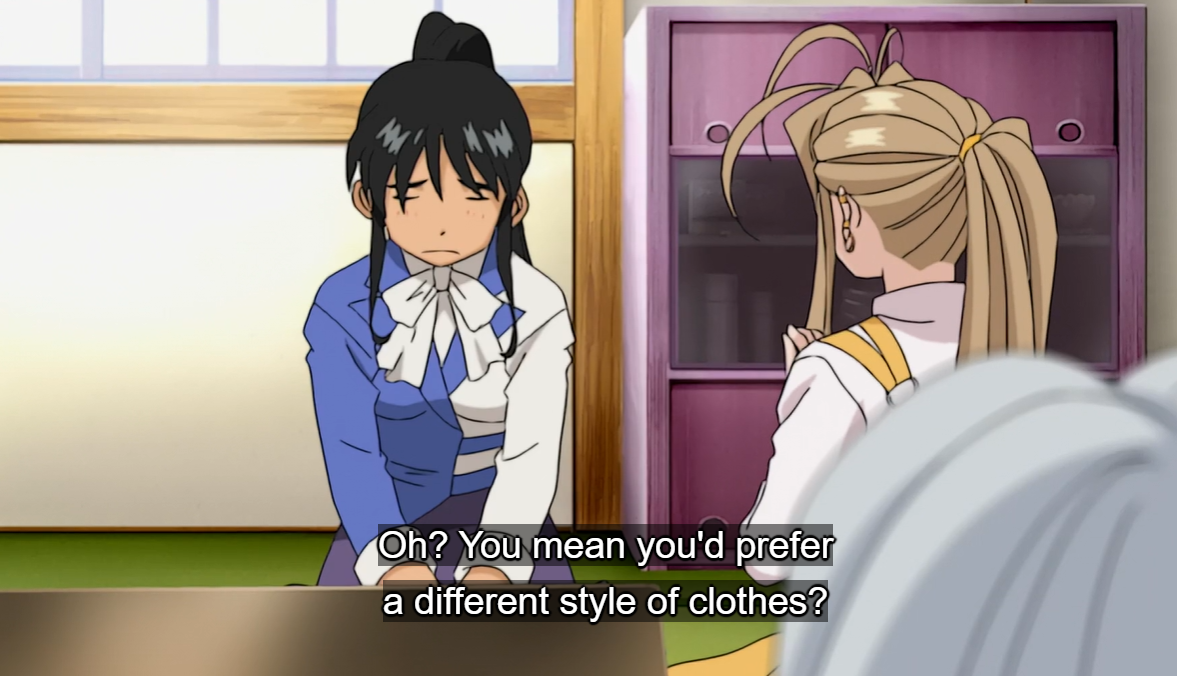
Literally just the first two minutes of the episode, and not acknowledged again after that. Then there's a little bit in the middle/end part of the ep where Keiichi semi-voluntarily helps Skuld test some of her whacky inventions.
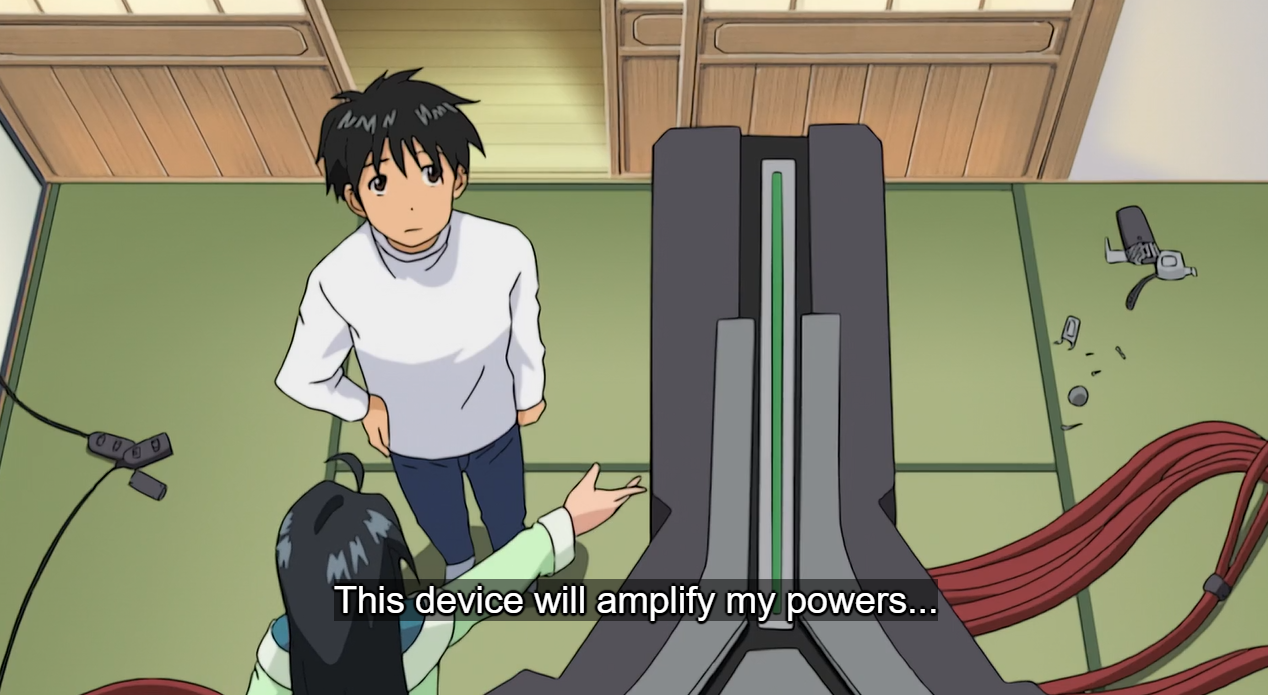
They're very much Skuld's scenes. Keiichi is just a supporting character.
If you watched this episode in isolation, you'd probably infer that OMG was a sitcom about three witch sisters cohabitating, and that one of them happens to have a boyfriend. I'm not sure if that premise would have made for a better series than the one we got, necessarily, but it definitely would have dodged some of the questionable gender politics.
...
Anyway, the protagonist of this episode is Urd, and the inner conflict of hers that drives the plot is rooted in the culture of the godly realm that the sisters hail from. Back in S1E11, Marller's conversation with Belldandy seemed to imply that "goddess" and "demon" are just career choices for entities like themselves, with all of them growing up in the same spirit world neighbourhoods before going to school and getting cosmically aligned jobs. Apparently it's more complicated than just that, though, because in this episode we learn that Urd is deeply ashamed of her own half-demon heritage.
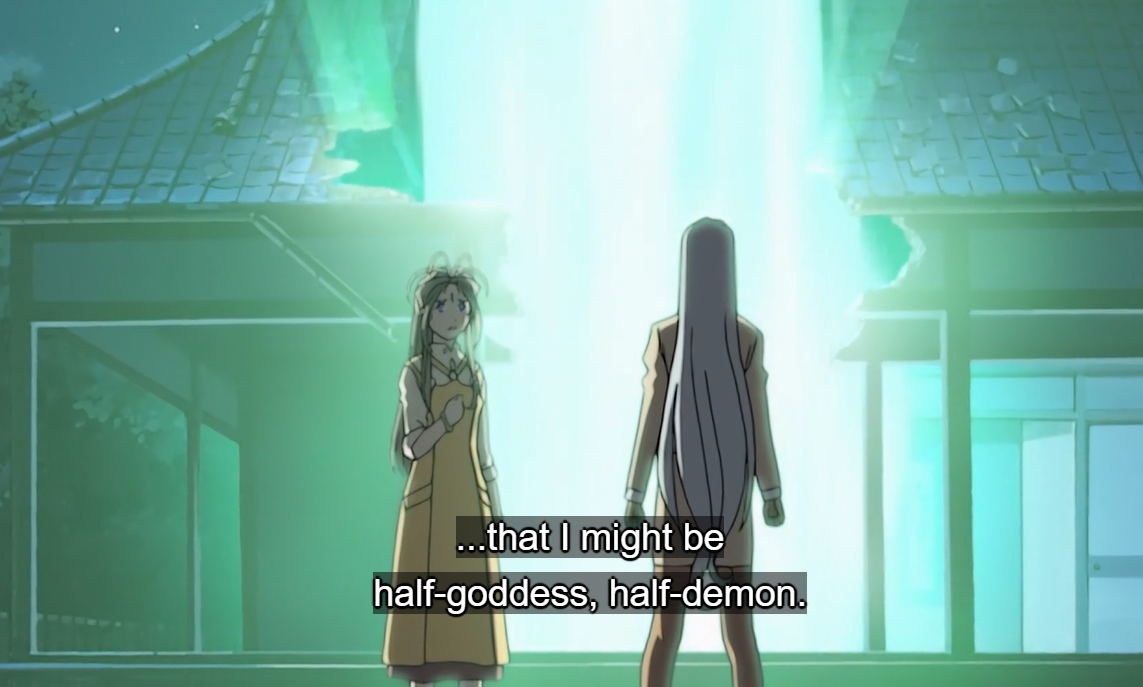
So, there apparently is more innate to the distinction between "god" and "demon" than just personal choices. Not sure how exactly it works, but these two episodes collectively imply something a lot more finnicky about the nature of these entities than either of them in isolation.
Curiously, this episode is also the first time I can recall in either this series or the OVA that the sisters are implied to have more than one parent. All of them regard the reigning god referred to as "the Almighty" as their father. A flashback in this episode also suggests that the three were never babies, but were rather born fully formed and articulate at what looks like a physical age of around 8 or so. At least, that's what I think is implied by Belldandy looking like this when she met her big sister for the first time:
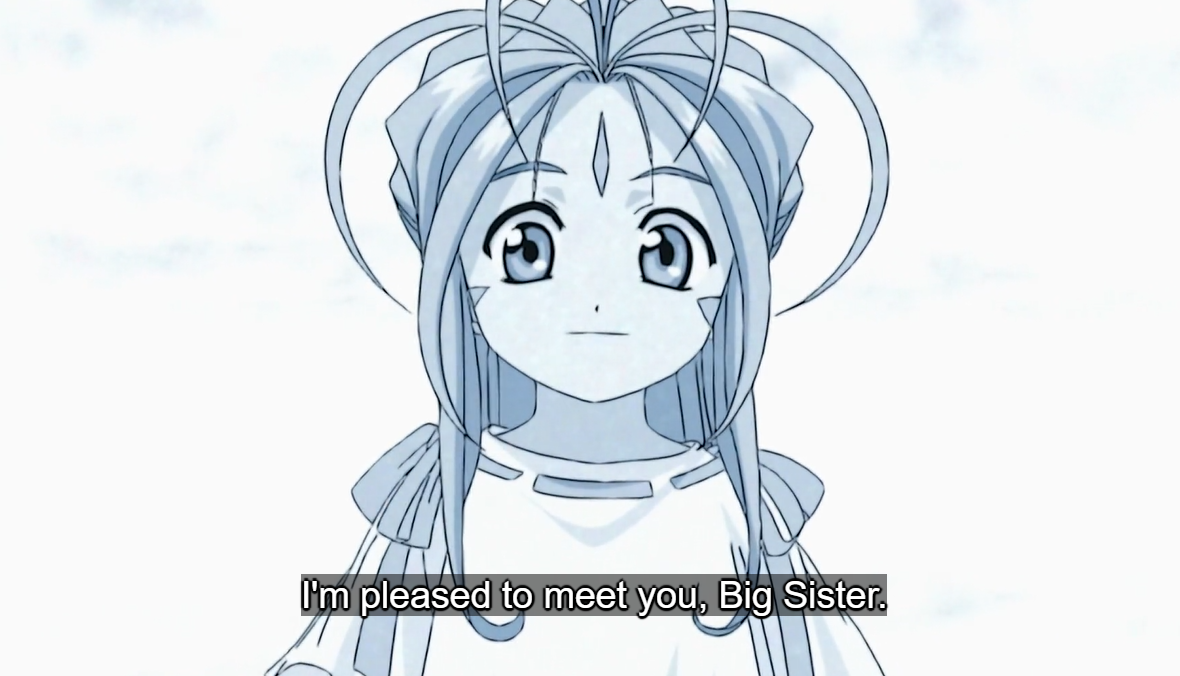
This, along with some other details from the OVA, had me imagining a "sprung fully formed from the skull of Zeus" kind of origin for the three. But then at the end of the ep we get the reveal that Urd's closeted self-loathing issues stem from her being half-demon, which the other two sisters aren't. Which I guess means they must have different mothers. Which in turn means that they must have mothers in the first place.
Maybe I'm overthinking this, and the intent is that Urd just lived with her mother off in the demon neighorhood and didn't get to meet her half-sisters until she was older? Normal baby-births could be a thing then, I guess that's possible.
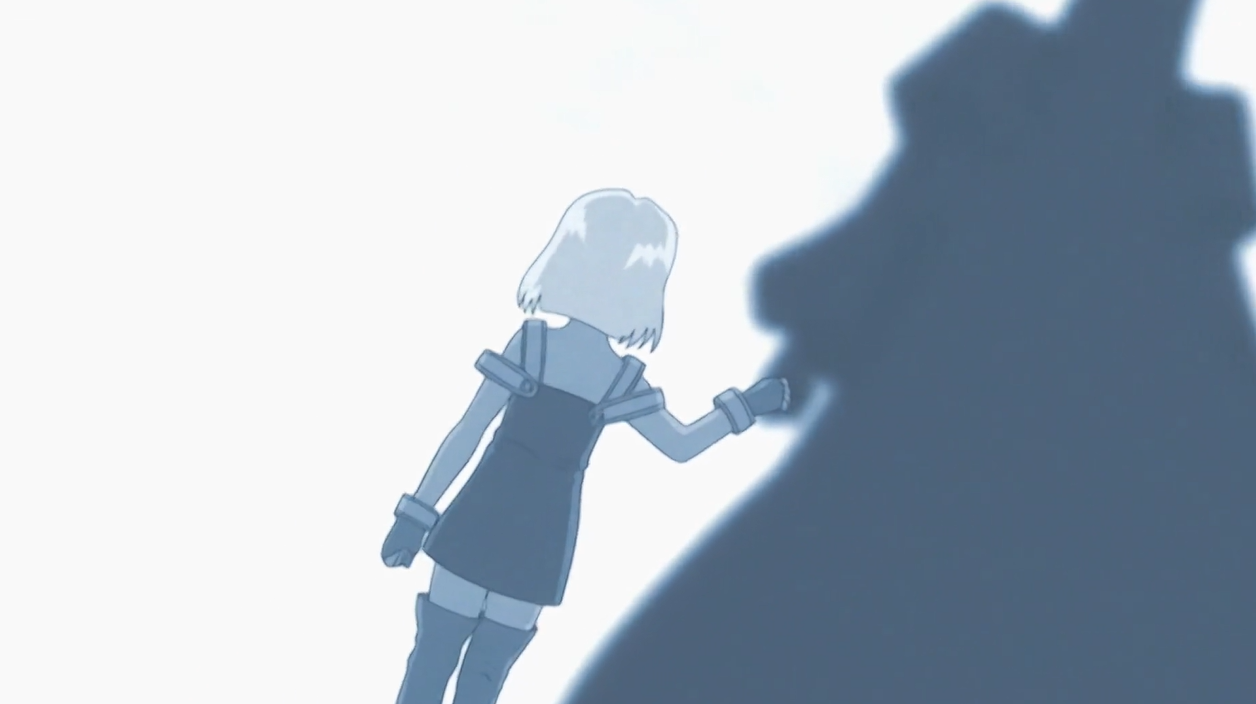
Maybe that's what this shot is supposed to imply? The shadowy silhouette holding Babby Urd's hand is never identified, and it's not clear if it's taking her toward or away from the rest of her family.
Speaking of pediatric development, this episode also opens some doors to speculation on exactly how old the sisters are. The catalyst for the plot is youngest sister Skuld (who I guess joined the cast sometime between E11 and E20) being impatient to get her own angel, which goddesses only receive at a certain point in their development and training. Belldandy and Urd, who each have angels, tell Skuld that she's still a good century away from being ready for this yet.
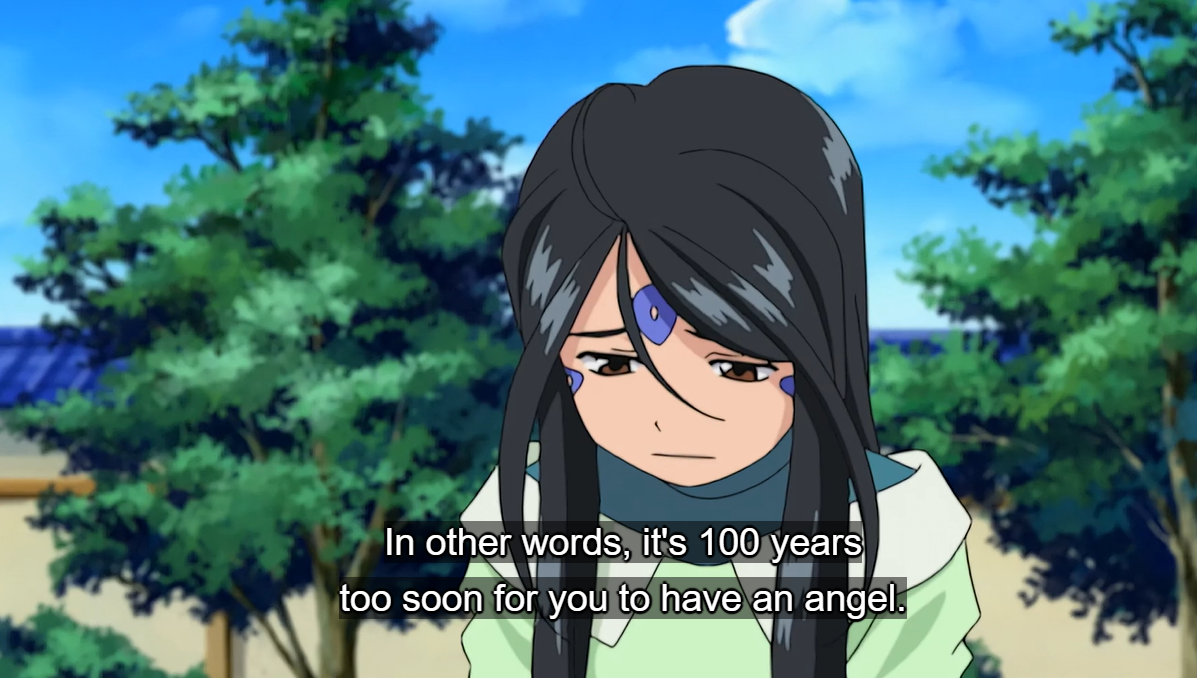
So, a hundred years is a meaningful amount of childhood development time (or, at least, of schooling time) for their kind. It's completely up in the air how old Skuld is, or how long its been since her older sisters each received their own angels, but this does mean that they aren't primal fixtures of the universe like their Norse namesakes. Ages are likely in the millennia rather than eons, and the world looked more or less similar from a mortal perspective before they were born.
I don't think that they're capable of dying of old age, but I wouldn't be sure of it at this point. They're getting more human and less conventionally "godlike" the more we learn about them.
...
For all that this show plays with a mix of Shinto and Christian concepts with minor Norse trappings, OMG's worldbuilding actually reminds me of a different mythology entirely.
There's this genre of 18-19th century Eastern European Jewish fairy tales - think of the Herschel of Ostropol stories and similar - that are pretty much just like this. Like, there's this civilization of nebulously defined spirit-entities who live comically mundane lives as farmers or woodcutters in rural spirit-villages in their own world, only every once in a while one of them will be chosen by God and get a job distributing good and bad fortune to humans or cleaning up ink that gets spilled from the Book of Life or something like that. It's pretty much the same vibe that OMG seems to be gesturing at.
I doubt there's direct inspiration going on. It's a fairly intuitive fantasy-comedy idea that multiple people in different cultures could well have independently invented. The similarities do amuse me, though.
...
There's even more goddess lore that gets introduced (or perhaps reiterated? There's more than half a season's worth of episodes I haven't seen that come before this one) here. For instance, while the past/present/future motifs of the Norn-ish sisters is downplayed compared to their OVA versions, they get elemental themeing instead. Belldandy's trick in the first few episodes, where she threw a paper bill to the wind and enchanted it to lead them to their goal, apparently wasn't just a fluke; she's specifically an air spirit. Urd is a fire spirit. Skuld, going by the results of her power-amplifying device's malfunctioning, is water. There doesn't seem to be an earth sister, but given that the existing three were born centuries or millennia apart it's entirely possible that she just hasn't been born yet.
You know, looking back at everything I've written, I might be starting to rethink my position about whether this show would be better if it wasn't centered on Keiichi. The author seems a lot more interested in the goddesses and the world they came from than the series usually calls for.
Well, anyway, as for the actual plot of "The One I Yearn For." We've seen Belldandy show her stand-like angel, Holy Bell, back in the introductory episodes. Early in this episode, we see her conjure it again when she needs an extra power boost to sing a dead tree back to life. This is apparently a hobby of Belldandy's, which, sure, legit. Seeing this, Skuld approaches her big sister and asks for help getting her hands on an angel early, since having an angel is super cool and stuff.
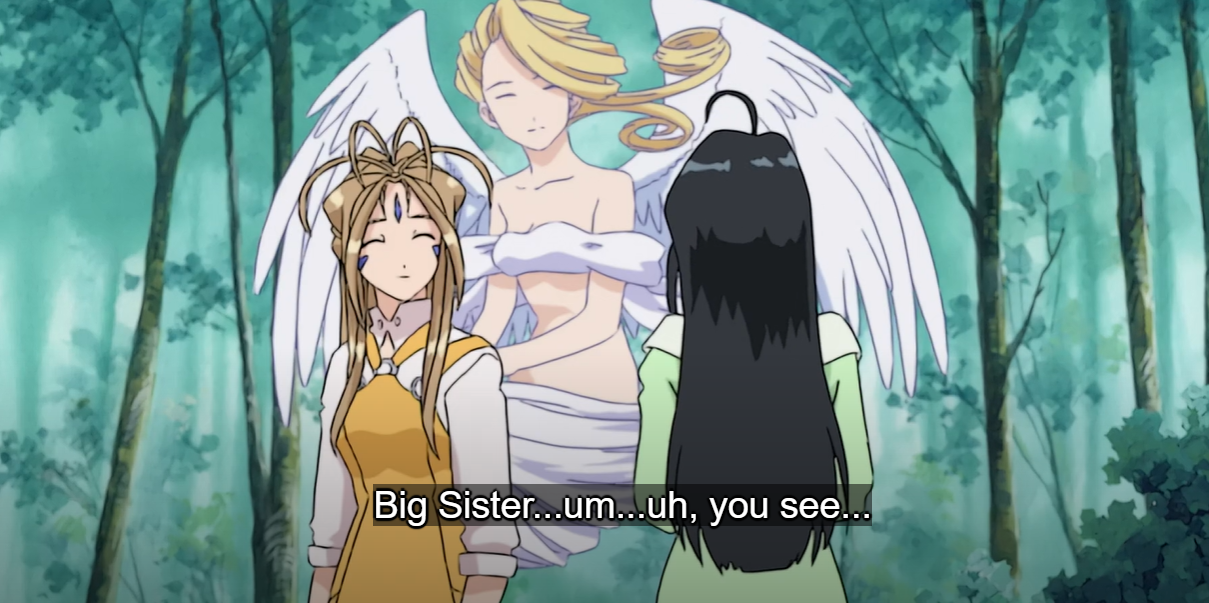
To get an angel, you need to practice your magic until you reach a certain level of mastery and then swallow a magical egg that causes your angel to manifest in a burst of experimental animation that inspires genre-redefining platformer games. As for that manifestation, well, I wasn't being snarky when I said it's basically a stand. Takes on an appearance that reflects your inner soul. Hovers behind and slightly above you when you summon it. It doesn't have unique abilities that the projecting entity doesn't possess (at least, I don't think?), but it amplifies their existing abilities.
Anyway, Belldandy won't give Skuld an angel egg until she's ready, so Skuld throws a dumb tantrum and tries to cheat by building power-amplifying machines to either bring herself to that point artificially or remove the need for an angel outright. Urd gets dragged into this drama when Skuld demands to see her angel as well, and - when Urd refuses - Skuld concludes that she must not actually have one and becomes even more committed to unlocking her own angelic potential before her oldest sister does.
The reason why Urd can't summon her angel, we eventually learn, is because of an order she gave it after it's first-ever manifestation.
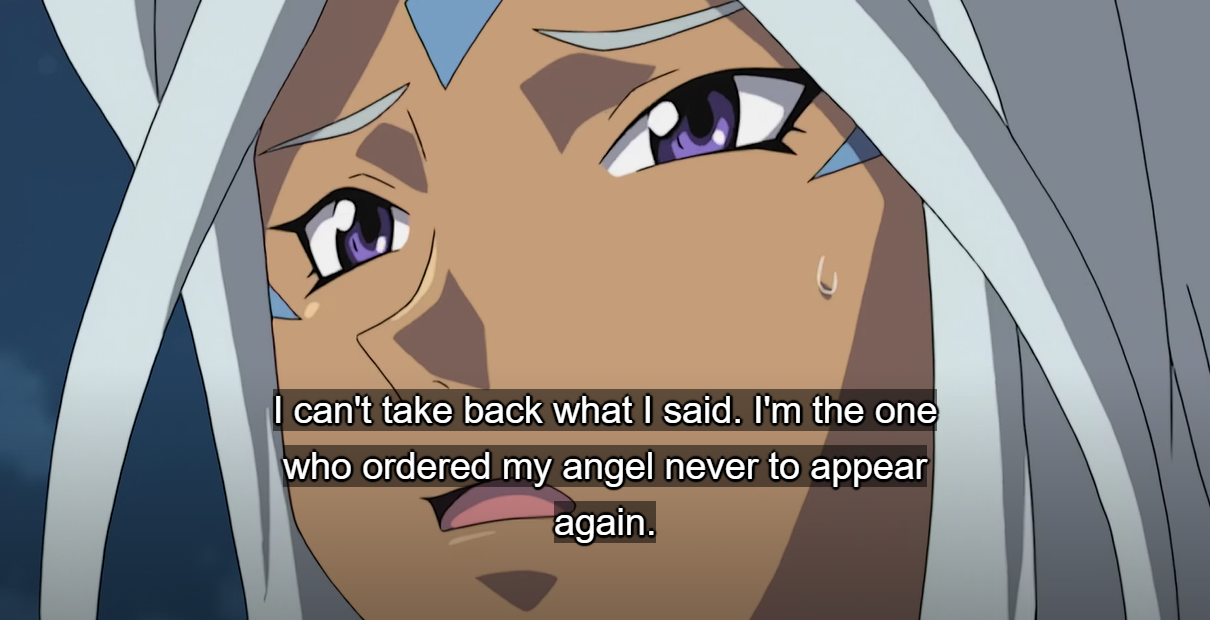
Urd apparently didn't know that she was half-demon, growing up. She suspected it, but didn't know. It was only when she saw her angel appear and physically reflect her own innermost soul that she had to accept the truth, and she didn't handle it well.
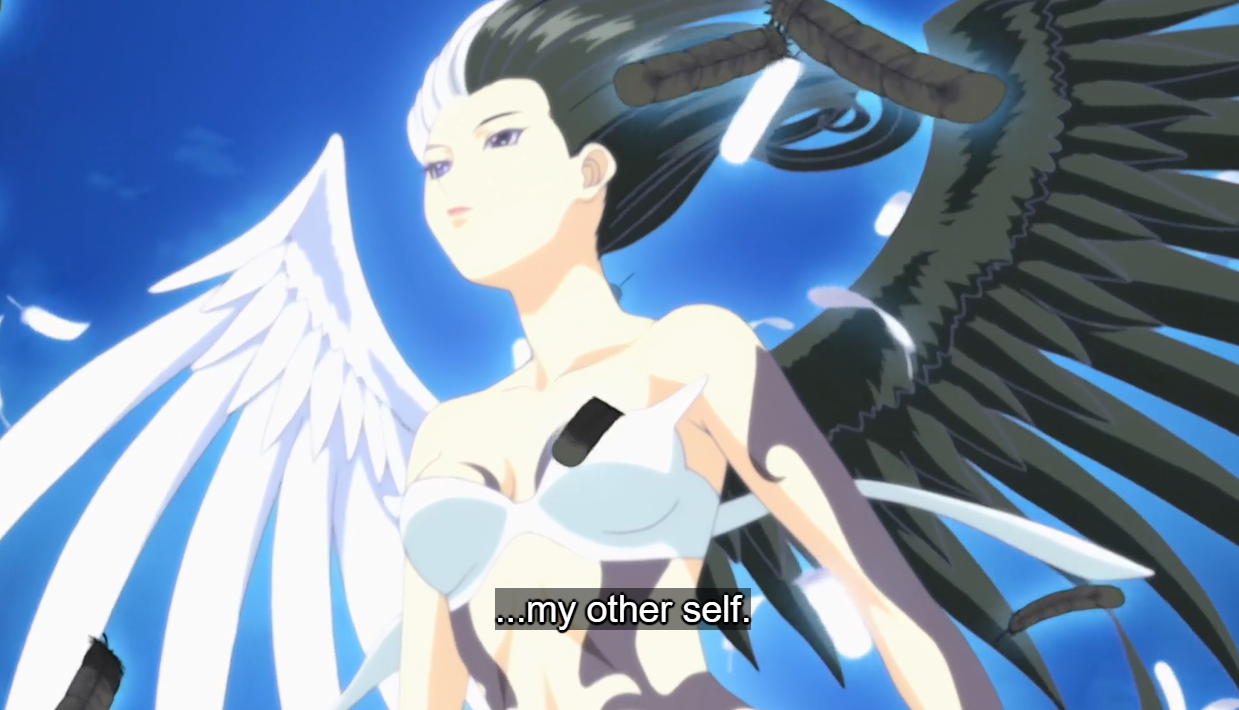
Personally I just think it looks kinda tacky, only mildly embarrassing. But the spirit world obviously has prejudices that make it worse for Urd than just that.
Anyway, Urd gave it the order to vanish and never let her see it again. Angels obey their masters to the letter, without question. So, she hasn't been able to resummon it since then, as it's been loyally keeping its distance as ordered. Amusing take on the "literal genie" problem, I don't think I've seen this version of it before.
Urd's angel problems come to a head when Skuld fucks up her power-amp machine so badly that it starts uncontrollably siphoning out her life force to conjure an endless barrage of elemental water, and she passes out before she can turn it off. Belldandy's wind powers aren't enough to break through the water vortex alone, and she needs Urd's maximum fire power to evaporate it before they can get at the machine. In the end, it's Belldandy's encouragement - her boundless love, acceptance, and appreciation for nearly all things - that enables Urd to dig deep enough into herself to resummon her own angel. Ironically, Belldandy's pure white-winged stando is what Urd always wishes she herself could have had, but it turns out that her jealousy of that was her problem all along.
Which...is kind of great, to be honest? Not everyone should want to be Belldandy. If you are her, and like being her, then great, other people probably appreciate it. But that's not neccessarily the best way to be. Maybe "second-wave feminist" actually is spot on for this show? Granted, I'm watching a short list of curated episodes, but based on them I feel like Urd's treatment by the show when she's the focus really does a lot to dispel OMG's sketchy reputation vis a vis gender stuff.
Also, check out her aura-farming up on the roof by sunset:
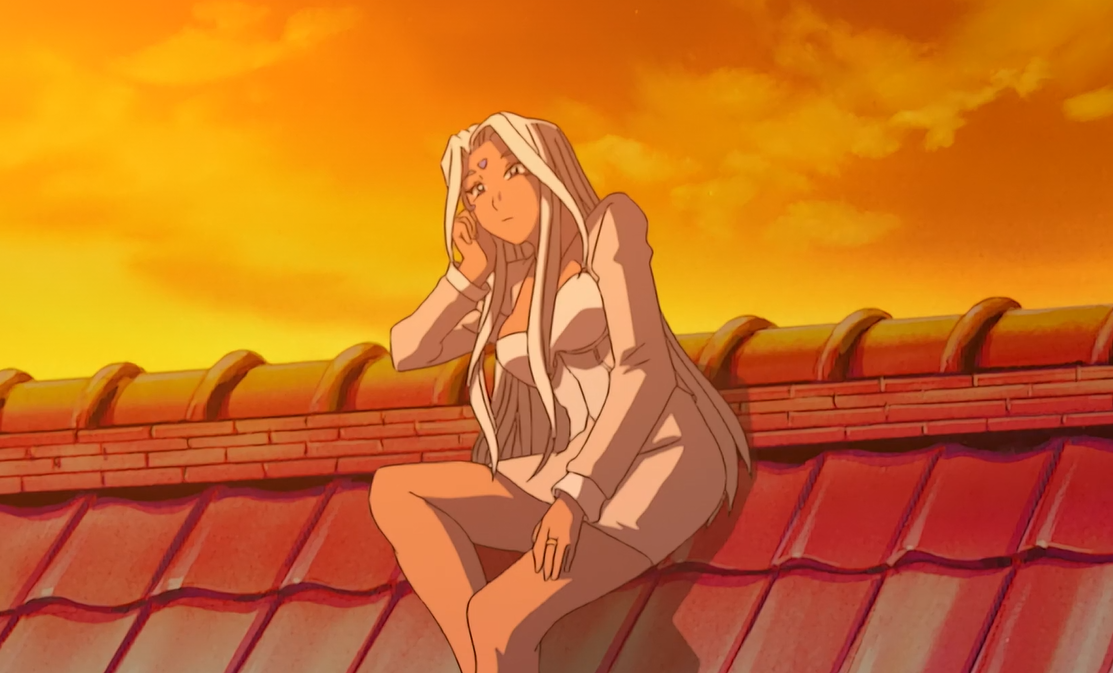
#aesthetic.
When you look at the beats of this episode's plot, it's really fairly generic. As a character study of Urd (and Belldandy to a lesser degree) that explores aspects of her that I wouldn't have thought even existed though, it's an interesting addition to the series.
Next time, the third and final episode of "That Time I Dated a Norn (But It Didn't Completely Cure My Bad Luck)" in this order.