Epic: the Musical: the Curated Fanimatic Series (the continupocalypse)
The Ithaca Saga is the last chapter of Epic. And, if you showed it to me on its own as the ending of an Odyssey rock opera adaptation, it would be close to flawless. In the wake of everything else Epic has done, though, it has issues.
...
Also, as an addendum to the previous post, Jojo Fraga is a god among fan artists for doing what he did with "600 Strike." See, during the celebratory watch-party for the Vengeance Saga's release, Rivera-Herrans released an (very janky-looking, but that's beside the point) "official" animation for 600 Strike. It turns out that the authorial intent was for the ghosts of Odysseus' crew to help him tie the wind-bag to his back so he could use it as a jetpack to launch himself out of the water and beat Poseidon in an aerial video game battle.
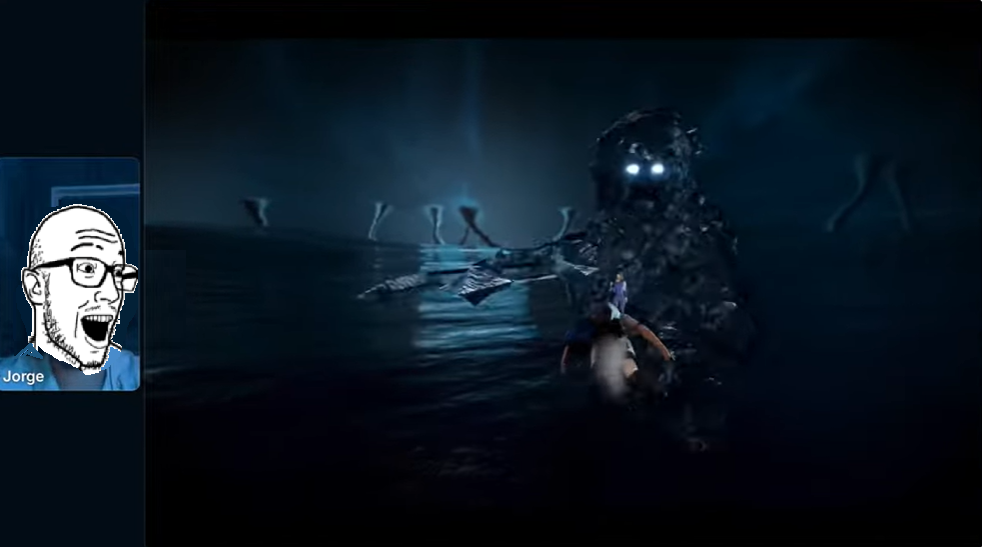
I'm not really sure how this is supposed to work onstage.
I, uh. I think I'll go with Jojo Fraga's vision over the author's in this case. Kthxbai.
...
But anyway, Ithaca now.
36. "The Challenge"
Animatic by AnniFlamma.
At long last, we get Penelope. We've heard her singer before; she had a brief dialogue bit in the dream sequence in "Keep Your Friends Close," and a robotic autotune-y performance as the sirens impersonating Penelope in "Suffering," but this is the first track that allows her to let loose and show her organic talent. Which she's got a ton of!
It's still kind of a trip, hearing Penelope's viola leitmotif and then actually hearing Penelope instead of Odysseus pining for her, heh.
Penelope recounts how she's been stalling the demands of the suitors by dragging out the weaving of a burial shroud, secretly undoing her progress every night to stall for one more day. In the Odyssey, this shroud is for her father-in-law Laertes, who recently died of (very) old age. The song doesn't specify who the shroud is for, though, so an uninformed audience might assume that it's a memorial thing for Odysseus. I think that ambiguity is by design, and I think it was a good choice. A literalization of her holding out hope that her husband isn't actually dead despite the suitors all wanting to think that he is. Anyway, she had to finally finish the shroud now, so it's on to her final ploy.
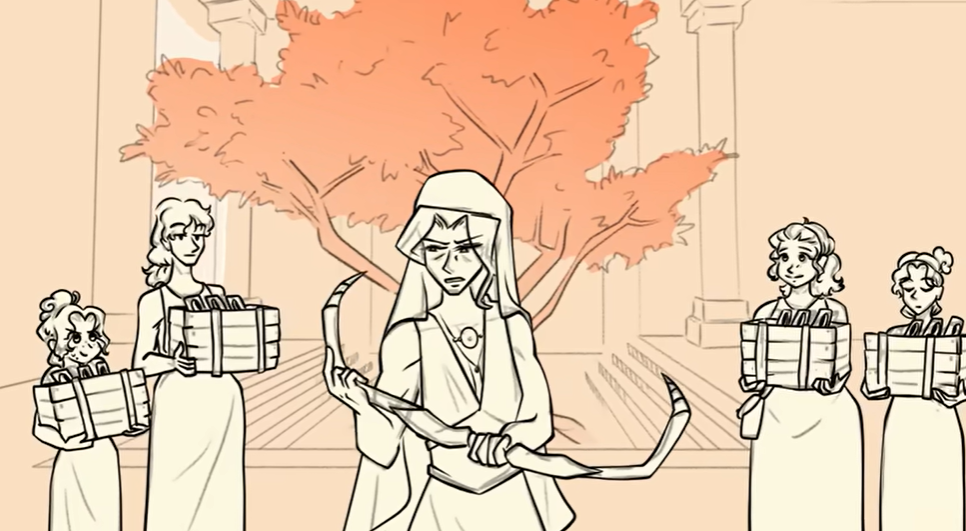
Anniflamma captures the insane design of that bow. And also works in some glimpses at that olive tree that's going to be important later.
She issues a challenge; if any of the one hundred and eight men aggressively pushing for her hand can string her last husband's bow and shoot through the handle-rings of twelve axes stood in a row, she will marry him. If nobody can, she'll marry none of them. If two of them can...eh, I'm sure they can work it out between themselves through reasoned discourse like the rational adults they are.
This bow notably isn't one that Odysseus took with him to Troy, though, and there's a reason for that. In addition to being a priceless heirloom, it's also kind of a gimmick weapon that's more useful as a showpiece than in an actual war. A ridiculously overbuilt recurve-bow that requires both exceptional strength and mechanical puzzle-solving in order to bend and string. Arming this bow singlehandedly AND making this exceptionally difficult shot requires a particular combination of skills that nobody Penelope has ever met possessed, save one.
She has hopes that the unusually potent storm that occurred just offshore last night was an omen for her. If not, then this challenge is her last best hope for discouraging these guys.
37-38. "Hold Them Down" and "Odysseus"
Animatic by Stella Luna.
The challenge begins, and predictably none of the suitors are up to the task. The song opens with the suitors reprising Penelope's "challenge" verse, but with some clever wording changes to fit their own perspective on the matter. Then, after they've all tried and failed, Antinuous starts rabble-rousing. His singer didn't have that much opportunity to shine until now (he only had about a third of "Little Wolf" and a couple of sentences at the end of "Legendary"), but even in those brief appearances he packed a lot of flavor and charisma into Antinuous. Here he gets an entire song to go full ham in, and...I wouldn't call him a better singer than Athena's or Tiresias', but he's a strong contender for the most effective voice actor in the show. Robert Pattinson has some big shoes to fill, is what I'm saying.
To put it in short, he feels like he and the other suitors have now wasted some of the best years of their lives trying to woo a woman who refuses to be wooed. He's convinced that this bow is literally unstringable, and this entire "challenge" is just to mock them. Well, since none of them are going to get to be king anyway, why even keep trying? They have the manpower onhand to just sack the palace and kill the remaining royalty out of spite, so why not do that.
The song takes the malice and depravity of Antinuous and the men who he sways to this cause up to eleven. Fantasizing downright lustfully about how much he looks forward to murdering Telemachus. And then even more openly lustfully about how he looks forward to gang-raping Penelope before leaving her dead in a thoroughly despoiled palace.
Like, he really goes into detail about how much he wants them all to take turns raping Penelope, and the singer puts so much entitlement, bitterness, and cruelty into those words. You need multiple showers after listening.
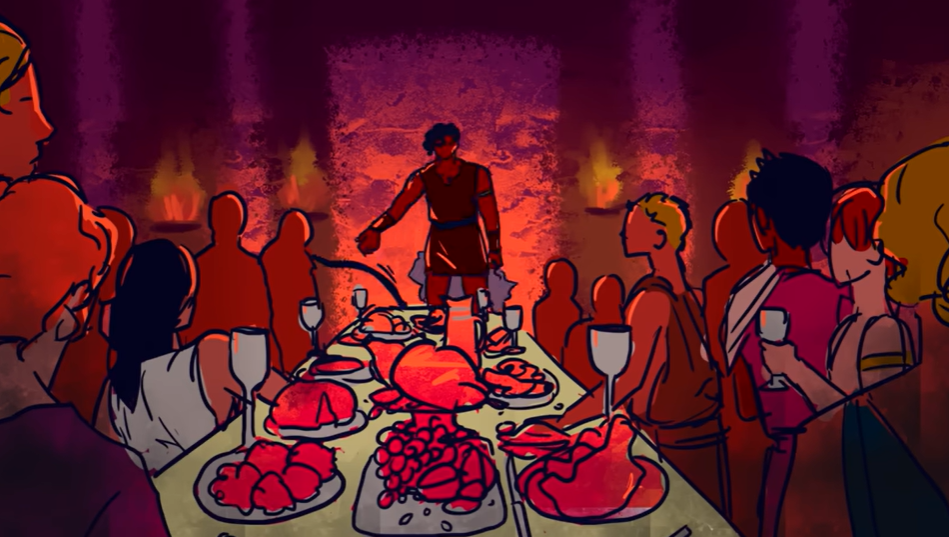
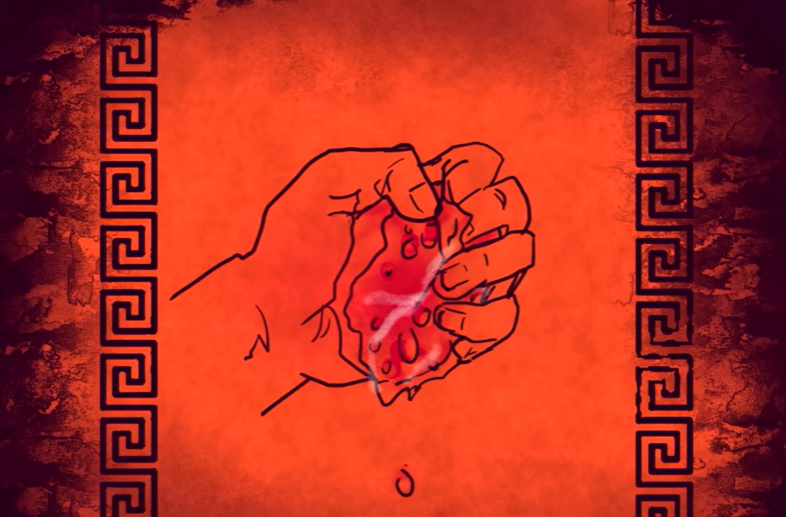
The animatic is more slideshow-y and less animated than most, but the style works well for that. It alternates between murky redscale visuals of the suitors conspiring against Penelope and Telemachus in their own house while eating their own longsufferingly-provided food, and some faux-terracotta art depicting their vile plans. In the former the reddish-purple hues and blots of the artwork suggest both a drunken wine-haze and a spreading bloodstain. In the latter, the clarity of the painted lines highlights just how deliberate the monstrosity of Antinuous' proposal is, as well as the sense of unearned grandiosity motivating him by illustrating it as a mythic tale worth commemorating.
There are also some interesting callbacks to earlier songs that...hmm. Antinuous' rabble-rousing, for instance, has some wording that points straight back to the pep-talk Odysseus gives his men inside the horse in "The Horse and the Infant." The melody that finishes off each verse ("Where in the hell is our pride and our rage?" "Only the ocean and I will know!" etc) too me a while to place, but it's the exact same tune as Odysseus' "I am not letting you get in my way!" back in the Mutiny sequence. All instances of Odysseus, himself, being dishonorable and/or vindictive. Which...definitely raises some questions about the next song, but I'll get to that in a bit.
Top tier villain song. Buuuuut this is also where we start getting into the "this works much better without the preceding material" issues. When talking about murdering Telemachus, Antinuous just casually mentions that the prince is on his way back to the island from a nondescript "diplomatic mission" and that they should ambush his ship as it docks.
...
What is this mission Telemachus is returning from?
In the Odyssey, the whole point of Athena's visit to Ithaca was her telling Telemachus that his father was still alive and that he should go looking for him. It's Telemachus' call to adventure, and it results in him being in the right place at the right time to aid his father in defeating the suitors. In this version though, Telemachus was never sent on such a quest. So, um.
Why is he leaving his mother alone with these people? Remember, Antinuous already got physically aggressive with him at least once, and not-so-jokingly implied he wanted to rape Penelope. What sort of mundane mission is urgent enough to bring Telemachus away from the palace when he knows these guys are skulking around in it?
Why DIDN'T we send Telemachus on that quest back in the Wisdom Saga?
On that note, there's also a weird contradiction in Antinuous' plans here that are puzzling even without the earlier material. Like, he acknowledges that killing Telemachus and disposing of his body at sea is necessary for plausible deniability ("When the crowd wonders where the prince is only the ocean and I will know.") But then, he's also planning to do this by boarding the ship AFTER IT DOCKS AT ITHACA (in the Odyssey, his plan was to attack the ship at sea far from any witnesses). And also...if he's still concerned about the public reaction to them openly murdering the prince, why is he so convinced they'll be able to get away with raping Penelope and looting the palace? Are there any forces available to resist them, or not?
This would work a lot better if we both a) sent Telemachus out to look for Odysseus, and b) had Antinuous be much more subtle in his aggression, back in the Wisdom Saga. Which, uh. Is exactly how it was in the source material.
Epic is doing this weird thing with the suitors, where they simultaneously are having to be stealthy and cunning with their plots like in the Odyssey, and are also openly acting like a barbarian army who have already basically conquered the island.
...
Anyway. "Hold Them Down" ends when Odysseus, who has been quietly slipping his way into the palace this entire time, finishes stringing the bow and shoots Antinuous in the throat. Stella Luna has him shoot through the twelve axe handles to in the process. Which is cinematic and all, but the geometry of this is kinda confusing me. It looked like Antinuous was standing on the table at the time, and...just how high off the ground are these axes supposed to be? Heh.
On to "Odysseus." The slaughter of the suitors. Odysseus hid the suitors' weapons and locked the palace doors while they were busy plotting, and now he can use his superior knowledge of the place to sneak around and kill them a few at a time as they scramble and panic.
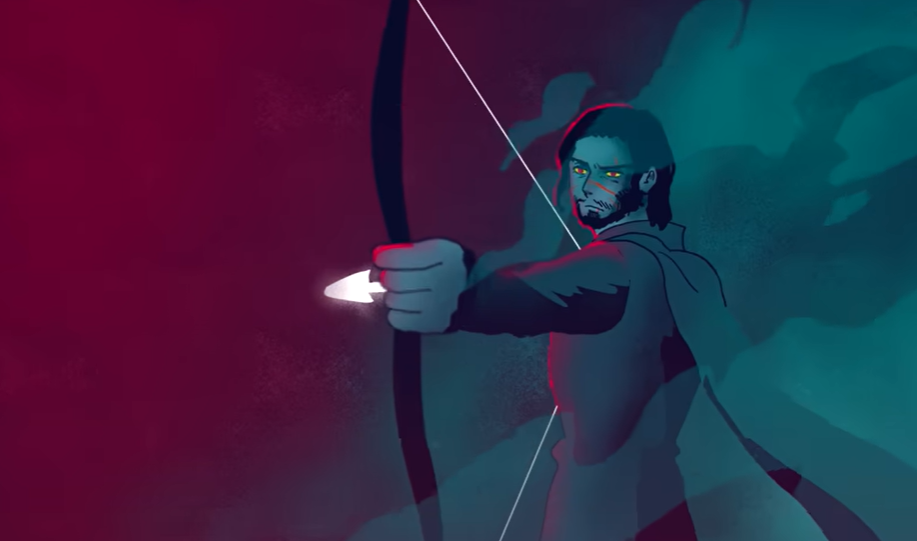
The opening monologue Odysseus starts the song with openly calls attention to the parallels between the suitors' ransacking of his palace and his own sack of Troy. This much is carried over from the source material, iirc. However, the song also does some heavyhanded parallels between him and Polyphemous. The background chorus chanting "Ody-sseus...Ody-sseus" is similar to the chanting Polyphemous' name received in "Survive." And, in this version, where Odysseus did in fact break into the cyclops' cave and started killing and looting, it's a pretty strong parallel.
There are also a few moments that connect Odysseus' rampage to Scylla's. Particularly when he hides in the peripheries of a dark hallway and takes aim at the heads of any suitors who come close enough to the torches for him to spot.
The song is largely sung from the suitors' perspectives as they're picked off. Odysseus framed, throughout, as an inhuman, monstrous figure that they can't escape from.
Even the song's title is telling us something. The only songs to be named for characters in Epic are named for monsters, without exception. "Polyphemous." "Scylla." "Charybdis." And now "Odysseus."
And um. There's also this one line of his. "My mercy's long since drowned. It died to bring me home."
So, this is where I have to confront the fact that my perception of what Epic's been doing with Odysseus is not, in fact, what Epic thinks it's been doing with Odysseus. Here is where I got really, really confused about what this musical is trying to say.
...
It appears that Epic thinks that the events of "600 Strike" showed Odysseus finally going from man to monster. Or, perhaps, that it showed him finally casting aside his pretentions of not being a monster and embracing the monstrosity that's always been there.
I have multiple problems with this.
In fact, I have so many problems with this that I'm not even sure where to start.
First: I don't believe that there is any point in Odysseus' life, before or during the time of his journey home, when he would have seen stabbing Poseidon a bunch of times as morally beneath him.
More importantly, I don't think there is any point in his life when he would have even PRETENDED to think that this was morally beneath him.
Even at his most self-righteous and pretentious, right after the encounter with Polyphemous, I believe that if you had poised that situation to Odysseus as a hypothetical, he would have happily told you that torturing Poseidon into submission was the right thing to do in that situation. I don't believe he would have hesitated before telling you this.
Second: As I pointed out in my reaction to "600 Strike," that song is not structured as a surrender to monstrosity. The struggle ends with Odysseus forcing Poseidon to admit that ruthlessness toward others is not, in fact, mercy upon one's self, by putting him in a situation where only showing mercy toward someone else could end his own torment.
The fact that Poseidon's surrender is followed by dead silence, punctuated by a very loud, clear sound of the trident being dropped is also impossible to reconcile with "Odysseus is a monster now." He stopped stabbing the instant that no more stabbing was required. He used the exact minimum amount of violence necessary for the situation.
Third: If this entire musical is supposed to have been leading up to Odysseus learning that ruthlessness and brutality really are the way for him, then please, explain to me what the bloody hell were we doing in the Circe Saga?
Why does the Circe Saga exist in anything even remotely resembling its current form?
The original Homeric version of the Circe encounter is a much better thematic fit for this sort of arc than Epic's version. Why would you change it in that direction if your goal is to...gaaaaaahhhhh!
Fourth: Even the points within this song itself that are clearly meant to demonstrate a newfound ruthlessness in Odysseus fail to do that. Specifically, I'm talking about a couple of points where cornered suitors beg for mercy and promise to be good from now on if he'll spare them, but he cuts them down anyway. The thing is...
Back in "Dangerous," there was a line of Hermes' that I believe I pointed out at the time. "When strangers lurk around the isle, when danger greets you with a smile, fight your way through, do what you must do."
See the problem here?
That had to have been Hermes warning him about these specific scenes. These suitors promising to be good now that their leader is dead and pretending to have wanted the old king back all along are the ONLY examples of "danger greeting with a smile" that he could have meant. Odysseus had divine warning that these men were snakes in the grass who will betray him again if given the opportunity.
So...how is this supposed to reflect on him being more brutal now, rather than him simply having an informational advantage?
I guess you could say that it's similar to the warning he ignored from Athena about Polyphemous? But...that wasn't really the same situation at all. Polyphemous didn't have any obvious way of continuing to threaten them after they fled his island, unlike these guys. Even if he did, though, if that's the parallel being pointed to, then are we actually just going to completely ignore the significance of Odysseus revealing his name in that encounter? Like, is that not just Odysseus trying to avoid calling attention to that detail like I surmised last time? Does the musical itself want you to not think about that part? And, consequently, to also not think about what the legendary "my name is nobody" line might be about?
If so, it could have just cut those bits out from the cyclops encounter. It chose not to. Why did it choose not to?
ON TOP OF THAT, we're really working against theme by making Polyphemous so much more sympathetic than he was in the Odyssey and also making the suitors so much worse. Epic wants you to feel bad for Polyphemous. Epic also wants you to have nothing but hatred and disgust for the suitors. If the story is about Odysseus becoming more monstrous and ruthless over time, shouldn't his final display of monstrosity be inflicted on someone who doesn't deserve it? Shouldn't he have hesitated to kill a more monstrous enemy like Polyphemous, and then thoughtlessly slaughtered a less monstrous version of the suitors? Isn't that, you know, how fucking character arcs work in storytelling?
Of course, to flip this around, there's another parallel between these two incidents, and it's one lampshaded by Odysseus now being the one with his name getting choral deliveries. Polyphemous returned to his cave, found people ransacking it, and tried to kill them all. Odysseus returned to his palace, found people ransacking it, and killed them all. This parallel was explicit in the Odyssey too. BUT, once again, if we're trying to use this as a showcase of Odysseus' newfound monstrosity...it's really hurt by Polyphemous being less monstrous than he was in canon, and the suitors being more monstrous than either Epic Odysseus, Epic Polyphemous, Canon Odysseus, OR Canon Polyphemous.
I guess it's saying that they're what he was during the Trojan War, with those musical motifs connecting them to "The Horse and the Infant?" Maybe? But then Odysseus ruthlessly murdering all of them and ignoring their pleas for mercy is supposed to represent...what, exactly?
The absolute most charitable interpretation I can manage is that Epic is using the word "monster" as a synonym for "pragmatic." And defining it in opposition to "doing excessive amounts of harm." I have never, ever heard of anyone using that word to mean this thing, but it's literally the best I can do here.
...
Toward the end of the rampage, some of the suitors find their way into the armory where Odysseus hid their weapons before starting. It turns out that Telemachus has also snuck his way back into the palace during their plotting, and he made the mistake of leaving this room unlocked when he went there to arm himself.
Telemachus manages to get a kill or two on a group of suitors, accompanied by a spirited return of the "Legendary" leitmotif. And then gets overwhelmed and mobbed by the rest of the group until his father intervenes and saves him.
...
Why is Telemachus even in this story?
He did nothing at all in the Wisdom Saga, besides motivate Athena by...um...existing.
We had the absolute vaguest gestures to him maybe doing something relevant to the story, with him coming back from an unspecified "diplomatic mission."
I was sure that there'd be SOME kind of payoff for the amount of screentime Telemachus had in the Wisdom Saga. Hearing his theme and seeing him appear armed and ready for battle in the animatic, it seemed like that payoff was about to come. But no. He's completely ineffectual. His own efforts amount to less than nothing in the battle with the suitors.
He's exactly the same as when we first met him; willing to stand up and fight, but not skilled enough to accomplish anything through it. Athena's actions did nothing for him in practice. His own actions did nothing to alter the course of the story in practice.
No arc. No consequences. Just a waste of space.
...
There is one moment, involving Telemachus, where it seems like it might be doing something different and interesting. After killing one or two guys, Telemachus tells the other suitors in the armory to surrender, and that he'll make sure they're spared. Before replying to this with a furious attempt to capture him as a hostage, one of them verbally disregards it with the words "After seeing what the king will do to us? We wouldn't dare!"
Implying that they actually would have surrendered here, if they weren't sure that Odysseus would overrule his son's promise of mercy. Which in turn means that Odysseus' ask-no-questions rampage imperilled his son and made the battle harder for himself than it otherwise had to be. Something else to keep in mind for my final analysis.
The song ends with the suitors all dead, and Odysseus standing over their bodies with his son.
Bonus content!
It just so happens that in the last couple of weeks before making this post public, I've seen "Hold Them Down" come under serious fire for shoehorning sexual violence against women into a story where it didn't already exist. I've looked over those arguments, and they got me to do some thinking. Since my Ithaca Saga review was already long enough to split into two posts, I figured I might as well add those new thoughts here and then split it.
I'm actually going to mostly be defending "Hold Them Down" here. Not entirely, but mostly.
My interpretation of Epic has kept coming down to grandiosity. Particularly the types of grandiosity that tend to hitch a ride with male pride. Through that lens, and taking Epic in its cultural context as a post War on Terror work, I think portraying the suitors this way is actually kind of important. Because, these guys growing up in the precarious postwar environment where none of the spoils ever trickled down to street level, who think they're entitled to wealth and women just for doing the bare minimum society expects of them, and who decide they'd rather burn it all down when they don't get those things? Those guys are real. Those guys have at least one foot in the door of political power. And, frighteningly enough, Epic's suitors are not even remotely an exaggeration of those guys.
You can draw a line directly from "Monster" to "Hold Them Down." The aggrieved self-righteousness turned spite. The performative embracing of cruelty in reponse to a cruel world (that was actually created at least in large part by the singer's own bad decisions). These things are steps on a road that lead to Antinuous. And, unpleasant though it is, portraying this in verse necessarily means luxuriating in the details of violent rape fantasies, because that's what it means to be an incel.
A related critique of "Hold Them Down" is that it seems like it mostly just exists to make Odysseus justified in killing all the suitors, making his alleged moral fall meaningless. This is a critique I do agree with, and it's pretty close to the one I made myself earlier in this post. This is part of what I mean by the Ithaca Saga seeming like a perfect ending to a different version of Epic.
Finally, I've heard it said that "Hold Them Down" falls into a larger pattern of Epic either infantilizing or victimizing the Odyssey's female characters, while turning the male ones into deserving targets of Odysseus' spear and bow. And...while I kind of see where this argument is coming from, I don't fully agree with it.
It's true that we're damseling Penelope to an extent that she wasn't damsel'd in the Odyssey. In the original, the suitors were still trying to pressure her into marrying one of them to the very end; they never reached the point of wanting to just blow it all up out of frustration. On the other hand...there's also a key detail in "The Challenge" that sort of turns this on its head. In the Odyssey, Penelope bought herself a few extra months by weaving the burial shroud over and over again, but the suitors figured it out before the start of the story. In Epic, she's managed to keep that charade going right up until the day of the archery challenge, making her seem more proactive in keeping a lid on things up to the present, and also making her smart enough to keep Antinuous and Co from figuring it out for much longer. Granted, she also seems stupider for not getting a fighting teacher for her son, but that's a problem with a different saga.
The other cases in point here are Circe and Calypso. And, well...I liked what Epic did with Circe on its own, but as a data point within a broader pattern I can definitely see the problem. Especially when you factor in the vaguely-implied sexual violence that Circe indicated she or her nymphs suffered back before she learned how to pigify people (importantly, this too is original to Epic. I don't recall Circe's island being raided by anyone in the past either in the Odyssey or in any other Homeric myth that features her). I'll grant that "Done For" was extremely vague about what Circe meant when she said "the last time we let strangers live we faced a heavy loss." The animatic went with rape insinuations, and at the time I took that as reflective of the musical's intent, but I might have been wrong to do so. I don't know. If that was the intent, then it definitely helps paint a problematic picture of the "every female character needs a rape attempt" that plagues modern fantasy.
The weird thing is that as of "Love In Paradise," Calypso seemed like the perfect antidote to this ailment. Sexually aggressive female villain who isn't the least bit sympathetic, and who isn't a past victim. Almost a distaff counterpart to the suitors. But then "Not Sorry For Loving You" came along and ruined that (along with the many other things that "Not Sorry For Loving You" ruined). True, it didn't make Calypso a RAPE victim, specifically, but it still played heavily into the damseling and infantilization.
So, it's not looking good so far. But hold on, we have a counterexample! There's also an antagonistic male character from the Odyssey who gets turned into a smol bean only trying to defend what's his. He doesn't have the rape implications anywhere in his story, but if we're talking about culpability versus innocence of Odyssey antagonists, Polyphemous is there to counterbalance Circe and (sigh...) Calypso. And, like...I feel like that really does help. It makes this less of a gendered thing, and more of a general humanizing of the Odyssey's antagonists who aren't the suitors.
I've seen it pointed out that the sadistic butchering of the sirens also felt kind of rapey. And, on its own, I think that that's okay. It shows Odysseus having a very aggrieved-masculine kind of moral fall, and it helps set things up for the incel-coded Antinuous to act as Odysseus' shadow self. But, the way that things end up actually going down with Odysseus slaughtering the suitors, and this being framed as part of that same moral fall, kind of muddles everything up.
On the other hand, I will point out that the sirens aren't the only sea monsters who get brutalized in Epic but not in the source material. Poseidon himself gets more or less the same treatment.
Meanwhile, there's also Scylla. Scylla's femininity consisted entirely of being referred to with female pronouns in the Odyssey, but here she gets a big, very female sounding vocal section that make her come across as much more "woman" than just "creature." And, Scylla gets off scott free (sorry Ares ). Making her another type of counterexample.
So, overall? There's definitely problems here. Definitely room for improvement. But I don't think that they're nearly as bad as some other critics have been saying. In general, I think the issues are mostly a cumulative side effect of other missteps Epic made (specifically, the indecision about what it wanted Calypso to be, and the incoherence of Odysseus' overall moral arc). Fix those other problems, and you'll mostly fix this too, without ever having to directly adress it.
Anyway, next time, the rest of Ithaca. And, following that, a final analysis of "Epic: the Musical."