Epic: the Musical: the Curated Fanimatic Series (continued moster than even the mostest)
31. "Gaslight, Gatekeep, Girlboss"
Animatic by BrittPowPixel.
Offscreen, Zeus has sent Hermes to Calypso with the message that she's got to release her pet or else face the wrath of bigger gods. The song itself opens with Calypso reluctantly relaying the news to Odysseus, and trying to emotionally blackmail him into - if not staying with her - at least indulging her delusion that she was good for him while it lasted. And also offering nonapologies like "sorry for coming on too strong" and "sorry my love was too much for you," in a manner that mirrors Odysseus' own sanctimonious nonapology to Poseidon from "Ruthlessness."
It's pretty well written. Calypso plays victim here, and she has the melodramatically sad version of her old calypso music to go with it, but the reality of who she is and what she knows she's actually been doing bleed through more than once. The most telling part is when Odysseus tries to get a word in edgewise, and she cuts him off with an aggrieved "LET ME SPEAK!" Pretending that she's been holding her tongue all these years until now. Trying to make him think that he's been the one talking over her all along, rather than her constantly silencing and smothering him.
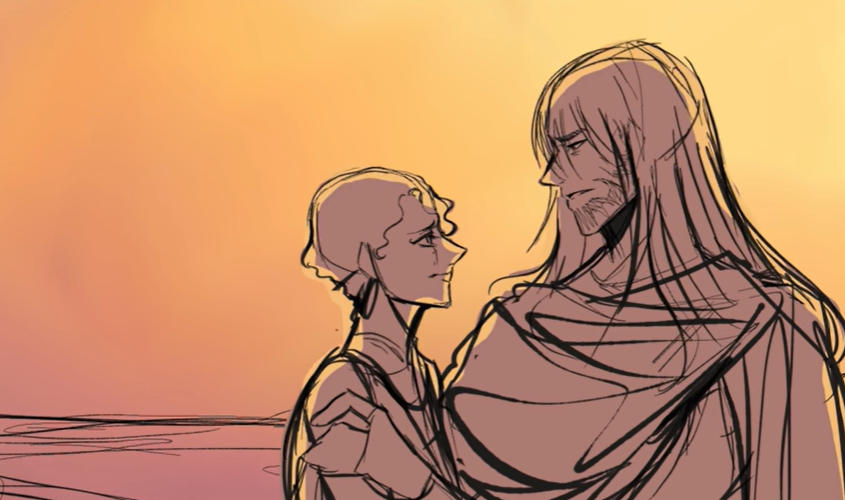
Judging from her sob story of having been exiled to this island and lived a lonely existence for centuries, Epic is going with the "surviving Titan" version of Calypso. She's been lonely, miserable, going quietly insane with isolation, until a handsome man washed up ashore like a bone thrown to her by the Olympians. Can you blame her for ignoring his protests, in that situation? Can you hold her accountable for not being sane enough to hear his protests over her own wishful thinking?
Back in "Love In Paradise," though, Calypso's lyrics included this line, which she delivers in a gloating tone in response to Odysseus' insistence on leaving:
Calypso: "Under my spell we're stuck in paradise. Nobody comes or goes, my island stays unknown."
The words "under my spell" leave zero room for ambiguity. If anyone other than her was keeping this island unseen and uncontactable, she'd have said that instead. She'd have had no reason to lie, and indeed every reason to tell the truth.
Why am I going into so much detail about the specifics of this obvious liar's obvious manipulation attempts? Well, unfortunately, I have to build a case here, because going forward the musical itself seems to believe the later version of Calypso's story.
I'm serious.
"I'm Not Sorry For Loving You" ends on a mournful, piteous note without Odysseus calling her out, and indeed he seems genuinely sorry for her when he tells her "I love you, but not in the way you want me to." It's not framed as him having been successfully gaslit by her, either. In fact, flashing forward a bit to the final song of Epic, when Odysseus is lamenting over how much pain he's caused to other people over the course of his journey home, there's a musical callback to "I'm Not Sorry For Loving You."
-_____-
Jorge, what the fuck?
I don't think reinterpreting Calypso as a victim of circumstance driven to her own kind of monstrosity by isolation and loneliness is necessarily a bad idea. It fits neatly into a lot of the themes of the musical. But that's not what "Love In Paradise" did at all.
It feels like the creator actually just changed his mind about what he wanted to do with Calypso in between finishing the Wisdom Saga and starting the Vengeance Saga. And, uh, I'm sorry bro, but you were just a smidgeon too late for that.
Fortunately, the next song is far, far less objectionable.
32. "Dangerous" (alternate)
Animatics by Zieru and Ximena Natzel.
This is a long one, a BIG one, and it keeps up a high energy from beginning to end. This is one of those over-the-top showstoppers that everyone remembers long after they step out of the theatre, the kind that would be spread around in video clips even if Epic came out before YouTube and never had a fan-animator community. Musically, it reprises several earlier songs, all of them of the optimistic, "go-get-em" persuasion. You hear it, and you know immediately that we're back in business; Odysseus' imprisonment is over, and it's time to bring this journey full circle.
It starts with a sombre reprise of "Full Speed Ahead's" chorus, with Odysseus assembling a crude sailboat and thinking back on how much he's lost since the first time he tried to set sail home from the war.
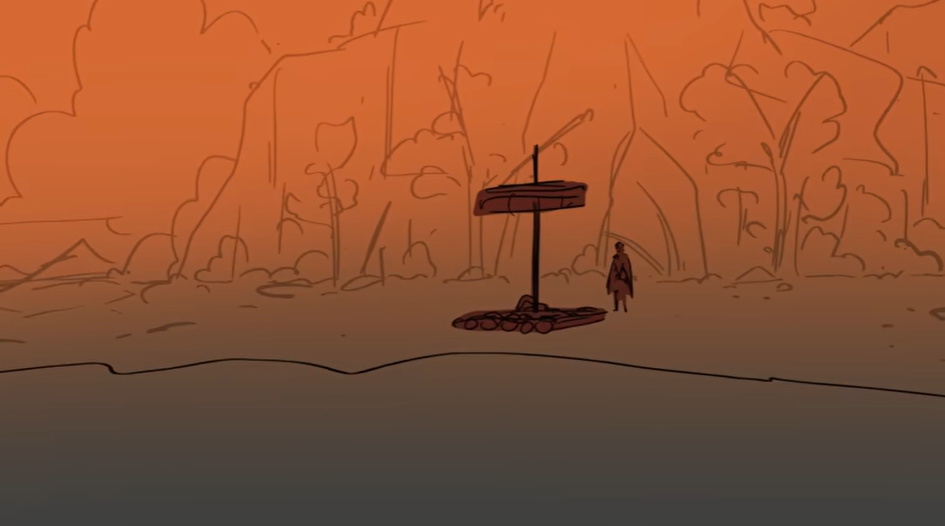
There's no chorus of crewmen to answer each of his couplets this time. No Polites and Eurylochus to bounce off of. Just heavy, lingering silences in the places where their lines used to be. Then, suddenly, Hermes shows up and turns the song into a bouncy electro hybrid-reprise of "Wouldn't You Like" and "Keep Your Friends Close" as he guides Odysseus' boat in the right direction and advises him on how to deal with the remaining hazards in his path.
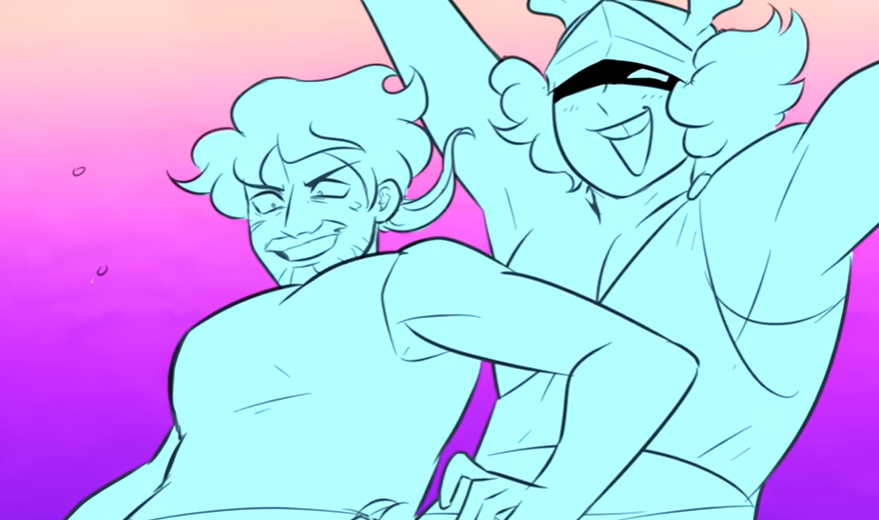
This is going to be Odysseus' last chance. No more help is going to come his way from above after this, and he'd better make sure he doesn't make the gods regret giving him this reprieve. Above all, he must let go of that ego and elevated self-perception of his. If he wants to get home, then he has to do everything in his power to get home, and not entertain any distractions or delusions. It's going to be dangerous, and he needs to confront these realities in a way he's never allowed himself to before.
As a final boon, Hermes gives Odysseus another of Aeolus' magic wind-bags that he's taken the liberty of shoving Poseidon's storms back into. Don't fuck it up this time.
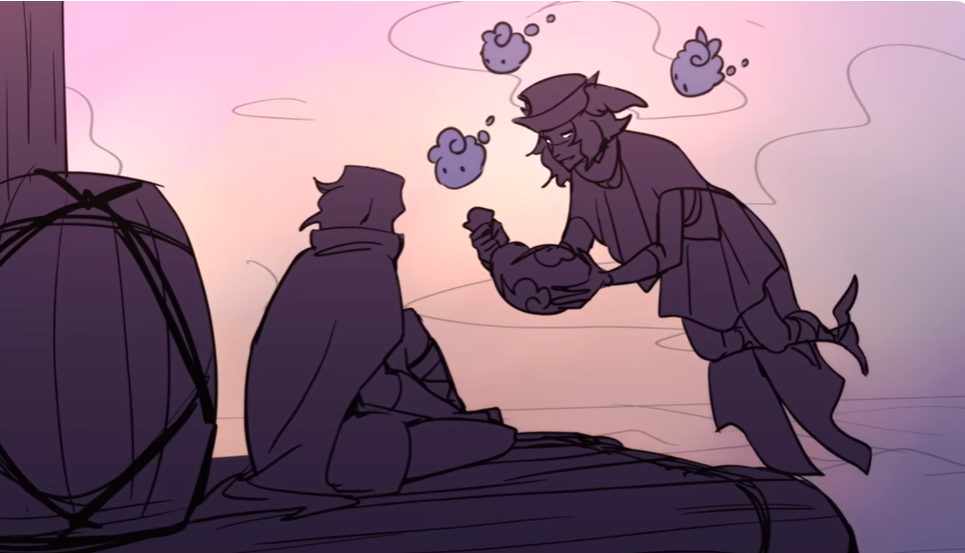
Aeolus' little chorus of squeaky air elementals briefly join into a reprise of "Keep Your Friends Close" at this part, only this time they share Hermes' accent, reflecting his own control over their element in this instance. Nice touch.
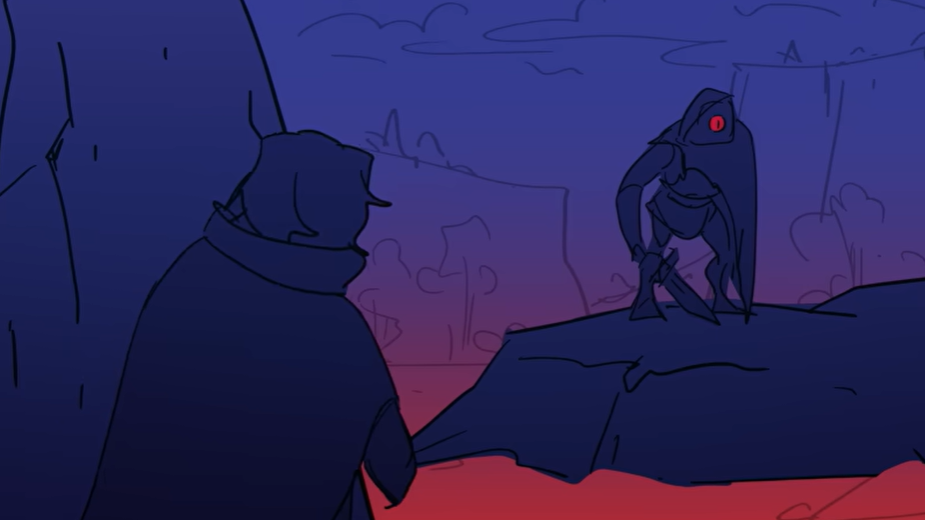
Zieru's animatic has a more detailed, realistic style, and does some cool illustrations of the hazards (both past and future) that Hermes urges Odysseus to learn from and prepare for, respectively. Including a knife-fight with a demonic figure that seems to represent the suitors, which accompanies Hermes' warning about "strangers lurking around the isle, danger greeting with a smile" who must not be mistaken for friends.
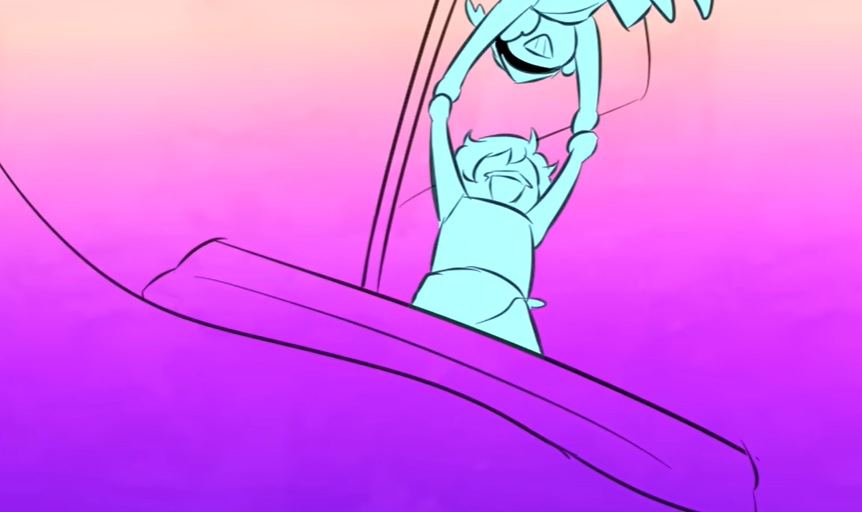
On the other hand, Ximena Nazel does much more with Hermes himself. Extra goofy, extra cartooniness, with him doing things like dragging Odysseus through a silly set of excercise stretches before casting off, or sending his raft bouncing wildly over a series of reefs like Calvin and Hobbes sledding down a hillside.
The color shifts to represent the passage of time as Odysseus sails and Hermes watches over him is also well done.
They're both fun.
Before leaving him alone for his final approach, Hermes turns away Odysseus' thanks, telling him that it wasn't he who petitioned Zeus to strongarm Calypso for him. He implies that another god did, but doesn't say which one, leaving Odysseus to silently wonder if Athena really has returned to him.
33. "Charybdis"
Animatic by Lemonpoet.
In the source mythology, the sea monster Charybdis forms part of a deadly gauntlet with Scylla, with sailors having to choose which horror they'd rather deal with if they want to pass through the cursed straits. The chunk of ship-debris Odysseus clung to after the Zeus-smiting drifted back through those straits, forcing Odysseus to have to deal with Charybdis too after having already just lived through Scylla. Later, after Hermes frees Odysseus from Calypso, his raft is hit by another storm courtesy of Poseidon, which forms the last major sea-hazard of his journey.
Putting the Charybdis encounter right after "Thunder Bringer" would have messed with the pacing for Epic, though, and it's Doing A Thing with the wind bag and the storms again, so another storm at this late juncture wouldn't make sense. So, the musical disassociates these two monsters, and has Charybdis show up as an obstacle sent by Poseidon in place of the second storm.
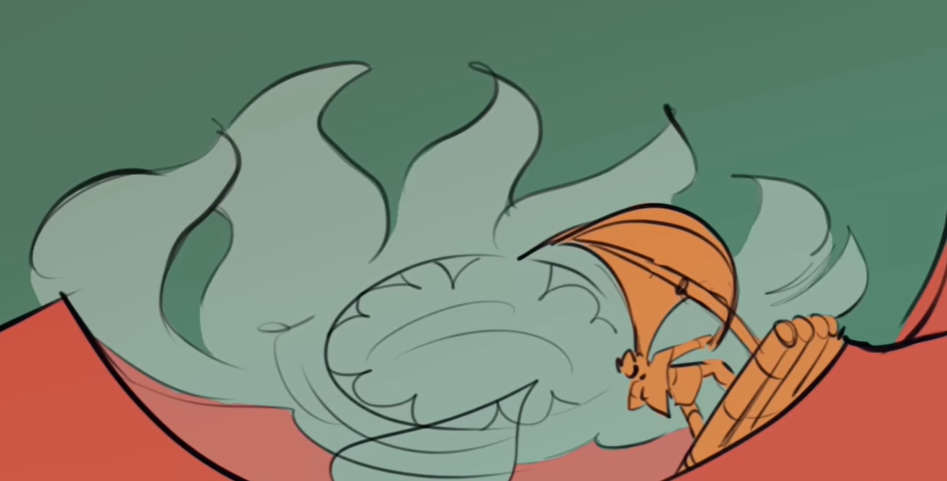
Charybdis isn't sapient, so this song is an Odysseus solo. And, it has some of Rivera-Herrans' best vocal work of the entire show in my opinion. Those voice riffs on the "ohhhhhhh-ohhhhhhh bring it onnnnnnnnn"s. Those riffs.
Charybdis creates huge whirlpools to suck food - up to and including entire ships - into its mouth. However, it can only keep sucking in water for so long before it has to spit it all out again, and when it does that the outflow is strong enough to push any surviving prey far enough from the beast to escape before it can recover and inhale again. Odysseus has been warned about what's ahead, and simply keeps his raft at the edge of the whirlpool to wait it out.
As he very poetically puts it "I don't have to kill you; I just have to avoid you, because if you don't spit it out soon all that water will destroy you."
Sure enough, Charybdis eventually exhales, and Odysseus gets clear. The shores of Ithaca finally come into view, and Odysseus lets out a heartwrenching plea and promise to see his family again...only for the sea to churn again, and something even worse than Charybdis to emerge.
The animatic is...eh, fine. I've looked at some others for "Charybdis," and there don't seem to be any really good ones yet, so fair enough. I hope Gigi gets to this one eventually. She's the queen of the 360 degree panorama. It's a song about a guy spinning around a giant monster. Match made in heaven, right?
34-35. "Get In the Water" and "Six Hundred Strike"
Animatic by Jojo Fraga.
The Vengeance Saga is a lot like the Ocean Saga rearranged. "Dangerous" is it's own version of "Keep Your Friends Close." "Charybdos" closely mirrors "Storm." And now, finally, Poseidon returns for a revisitation of "Ruthlessness."
The brass and bells keep this song continuous with Poseidon's previous number, but aside from that it's very different. Slow. Quiet. A deep, bubbling rumble rather than an explosive splash. Poseidon's own voice is even deeper and grittier than last time, and his unpredictable switching from song to plain speech makes him come across as almost unhinged. "Ruthlessness" was declarative, denunciating, combative. "Get In the Water" is just angry. It's been ten years since Poseidon uttered the words "today you die" to a mortal, and yet that mortal remains alive, and that mounting frustration and humiliation have turned septic. The animatic leans into this well with its incredibly bitter and spiteful looking old man take on Posiedon. The form he takes on is semiliquid, almost more slime than seawater.
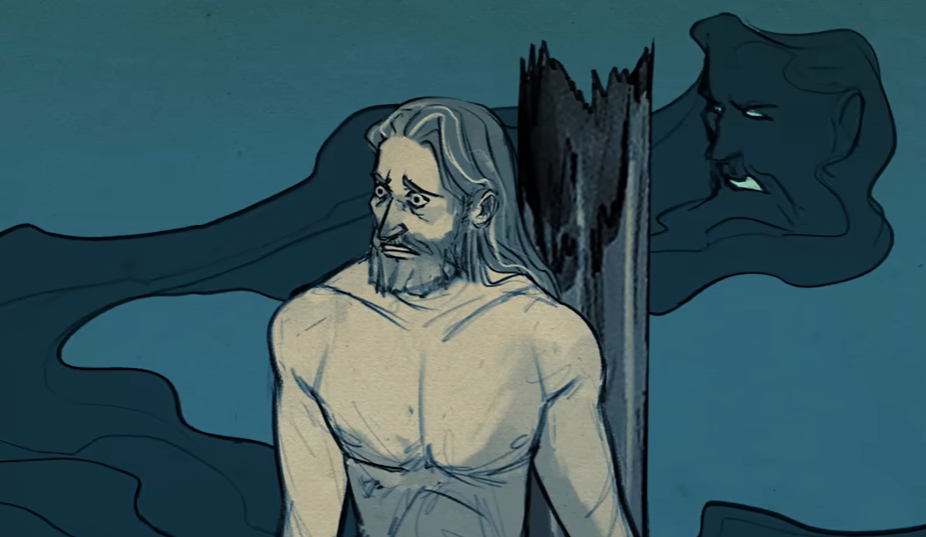
I also appreciate it that this artist doesn't feel compelled to make Odysseus look like his real life performer. Much more traditional depiction. I doubt Jojo Fraga would have given us Glasses Polites and Buzzcut Eurylochus either.
And yet, despite all that, Poseidon remains remarkably self-aware about what he's doing and why. There's one solitary line where Poseidon's voice softens, sounding tired rather than hateful, and the music briefly becomes more dignified, when he admits that he doesn't want to be doing this. He's here becomes his fearsome reputation is the thing that keeps his oceanic kingdom in order and ensures that mortals respect his kin and creatures. He has to do this.
Jojo Fraga does something really brilliant with the visuals by having Poseidon shape the seawater into a temple to sacrifice Odysseus in.
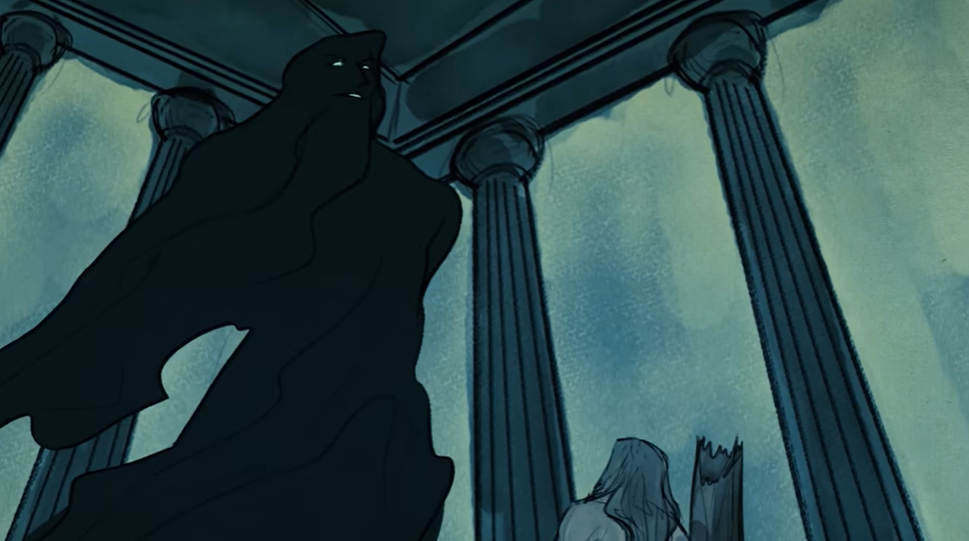
The god has gods of his own. Poseidon the wrathful overlord is bigger and more important than Poseidon the conscious entity, and the latter must worship and appease the former.
It's a perfect mirror to the problem Odysseus has been having all along. Puffing up this larger-than-life version of himself, either with performative sanctimony or performative cruelty, and sabotaging his real life in the process. There's also a beautiful return to the central allegory when Poseidon threatens Odysseus' family and community if he won't drown himself.
"I'll raise the tides so high, all of Ithaca will die."
"I'll make tidal waves so profound that both your wife and your son will drown."
What does the ocean represent, in Epic? What tends to happen to the wives and children of men who bring it home with them?
Odysseus makes one final appeal to Poseidon for mercy. Have ten years of untold suffering and loss not been enough? Poseidon already admitted that he just wants to put this entire thing behind him, so can't he just...do that?
...
I'm not sure how genuine versus how sanctimonious Odysseus is still being at this point when he urges Poseidon to learn how to forgive, considering that he himself still never gave a proper apology for blinding Polyphemus.
Granted, there are two complicating factors here. The first is that Poseidon admitted that this isn't about Polyphemus anymore. He declared that he was going to kill Odysseus, so Odysseus has to die, or else Poseidon loses his legend.
The second is that, being totally honest, can Odysseus apologize for that incident? His men were hungry. He needed to feed them. In the ancient world, feeding armies away from home meant raiding. Raiding means injuring and killing those who resist. If he was in that situation again, would he do anything different? Could he do anything different? If not, how could any apology he gives possibly be genuine?
Eurylochus was the one who openly, bluntly, prosaically suggested a raiding expedition when they first came to that island. Odysseus' response was to shut him down, entertain Polites' delusions of their own innocence, and then...go raiding anyway. As always, Eurylochus is the truth that Odysseus is desperate to hide from.
...
Well, predictably, pleas for mercy are ineffective. Repeating his mantra that ruthlessness is mercy upon ourselves, Poseidon gets sick of waiting for Odysseus to drown himself and just grabs the mortal and sucks him underwater himself. The choral "Underworld" motif returns, along with the voices of the dead that have been haunting Odysseus since the war, as he begins to drown.
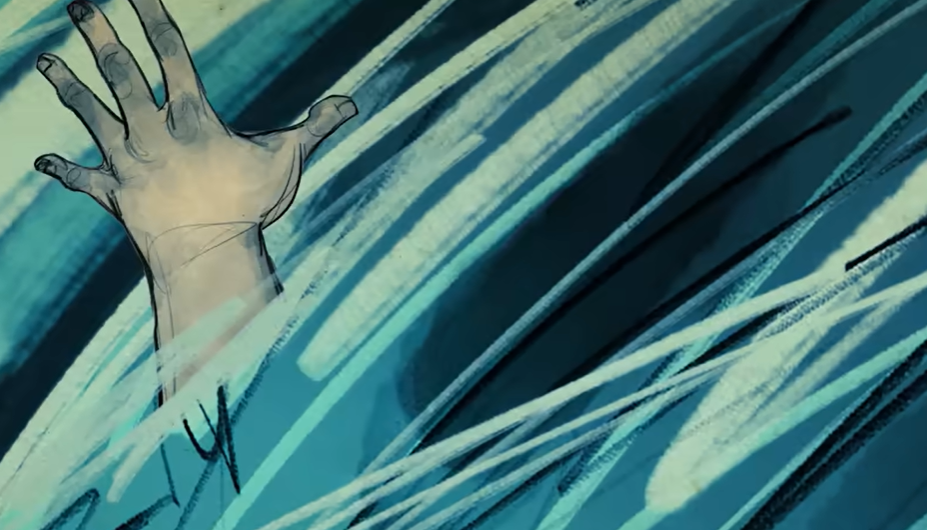
That's where we segue from "Get In the Water" to "600 Strike."
This song...well, within the extended metaphor, it works really well. In the context of Greek mythology it's pretty dumb, but within the thematic framework the play has established it really couldn't have not done something like this.
While drowning, Odysseus manages to get his hands back on the wind-bag containing the storm. As established back at the end of Ruthlessness, Poseidon has something of a weakness to wind when it's applied directly, and here Odysseus is able to use it to blast the water clear and stand on the seabed.
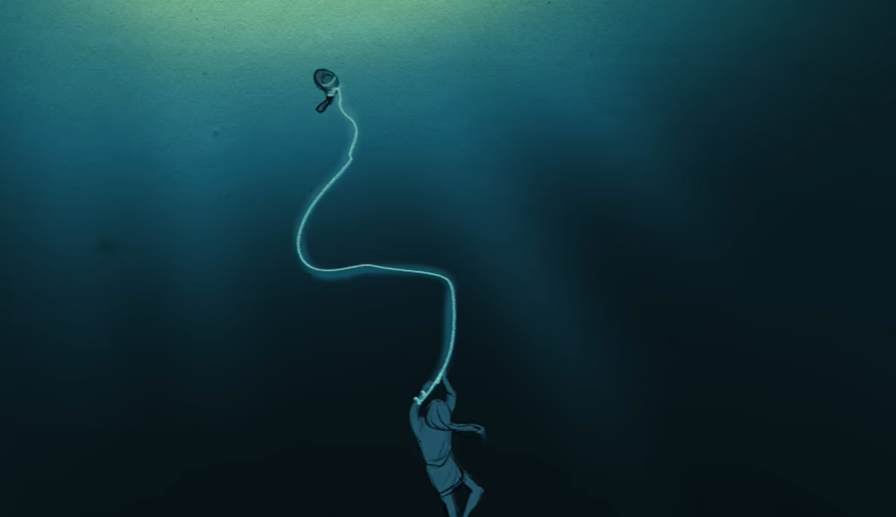
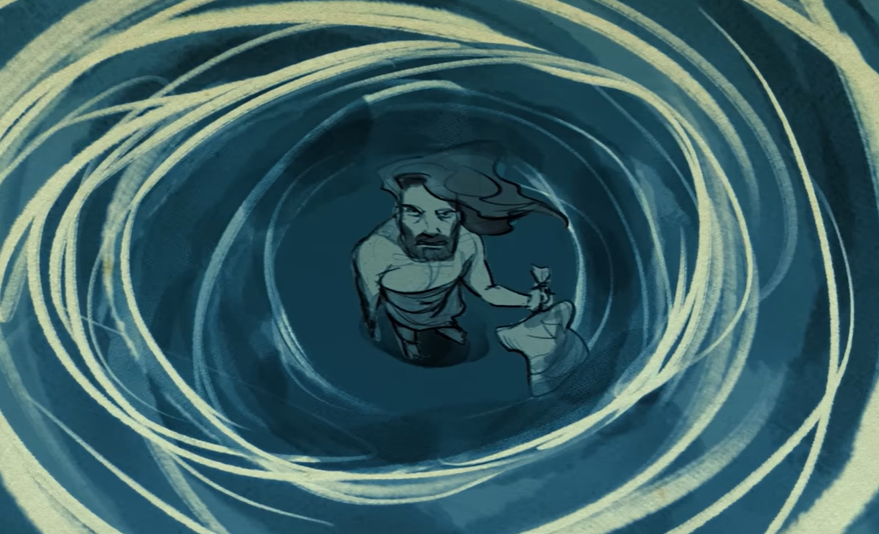
Last time the bag got opened, it happened while Odysseus was asleep and Eurylochus was free to act. This time, Odysseus does it himself, fully aware and fully cognizant of what he's doing. And, in the vortex of wind and water produced, the ghosts of his dead crew appear to aid him, Eurylochus and Polites both included.
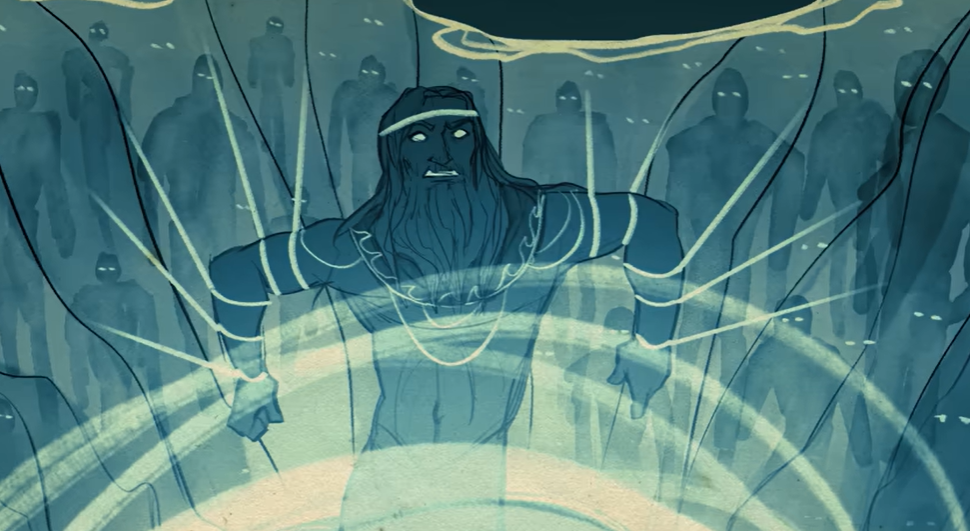
Amid the thunderous, high-energy reprise of the oft-remixed "Storm" and "Full Speed Ahead" leitmotifs, Odysseus somehow gets the ghosts of his men to tie Poseidon up with strands of solid wind. Once again, I get the metaphor, but the lack of any explanation for how he could have summoned these specters (or even how a few hundred mortal shades are supposed to be a threat to Poseidon in his own element) is a weakness of the sequence. There are examples of mortal heroes defeating gods in combat in Greek mythology, but Odysseus isn't that kind of hero, and Poseidon isn't that kind of god. Especially not when you're in the sea. Again, I can roll with it in the name of the allegory, but I wish the story had done a little more to justify this in-universe.
Anyway, Poseidon is tied up by the ghost-ropes, and the wind is still rushing out of the bag and keeping the water from flowing back in. Still, the god is gloating. The storm is back now, and there's still a good distance of tidal rapids, gale force winds, and sharp rocks separating Odysseus from the beach. Odysseus has thrown away his one last chance of ever getting home just to spite his tormentor. Isn't that just perfectly pathetic?
Well, no, actually. Odysseus picks up Poseidon's trident, and tells him that he's going to turn off the storm right now. Poseidon scoffs at first. What is he even going to threaten him with? Death? He's immortal. It's only when Odysseus steps toward him and the "Different Beast" instruments that accompany Odysseus' "monster" aspect start up that he starts to realize what's happening.
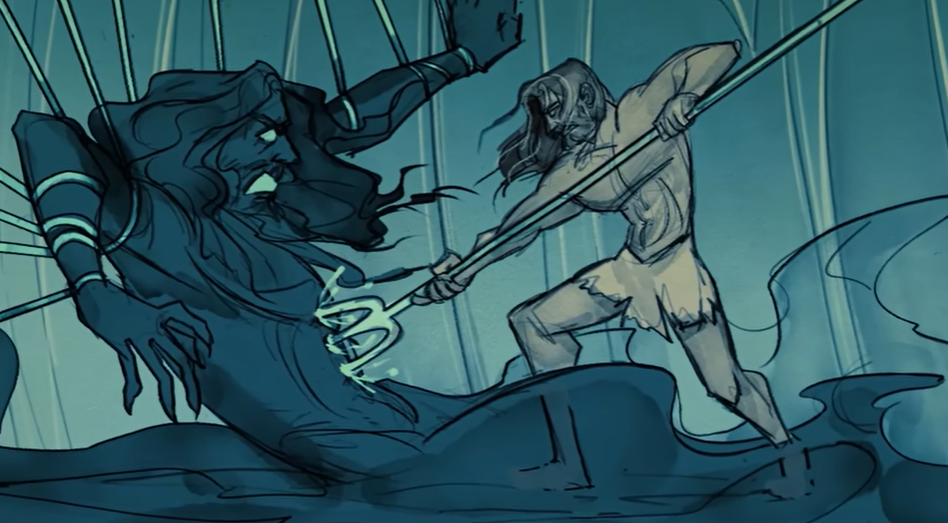
Again. And again. And again.
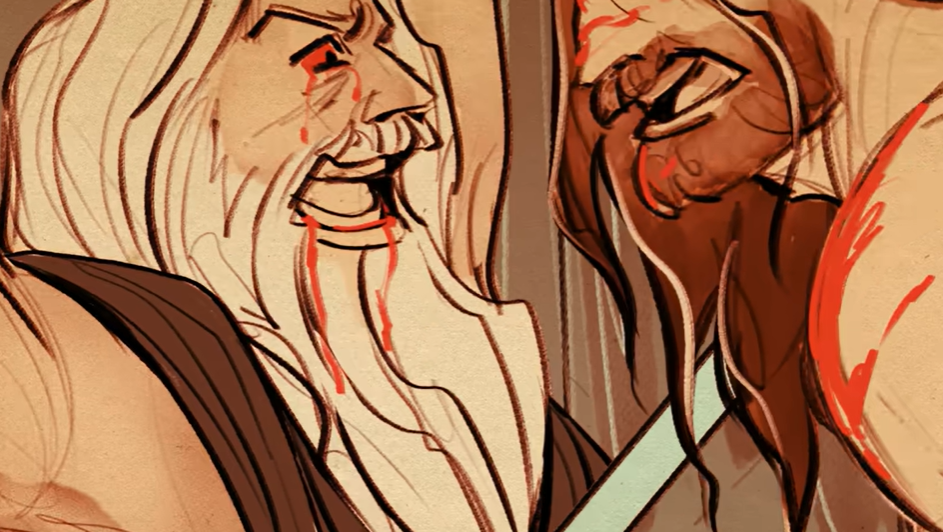
He can't die. But, when stabbed with a magical weapon like his own trident, Poseidon can very much feel pain.
He begs for mercy. Odysseus gives him none. He screams (along with the music, amusingly enough). Odysseus keeps stabbing. With each jab, Poseidon's body gets smaller and less watery, the reality of what he's suffering banishing any inflated sense of self and cultivated larger-than-life image, until he looks like a normal human. Just an angry, sad old man, screaming and feeling sorry for himself, struggling to avoid doing the one thing that can end this.
If you don't spit it out soon, all that water will destroy you.
After countless agonizing stabs, Poseidon finally relents. Meaningfully, Odysseus is just in the middle of the sentence "Didn't you say that ruthlessness is mercy upon-" when Poseidon gives up and ends the storm.
The only way to end his own suffering was to allow Odysseus to live. Ruthlessness is ruthlessness. Mercy is mercy. They're different things.
And then, the instant that Poseidon surrenders, Odysseus drops the trident to the seabed with a metallic clang.
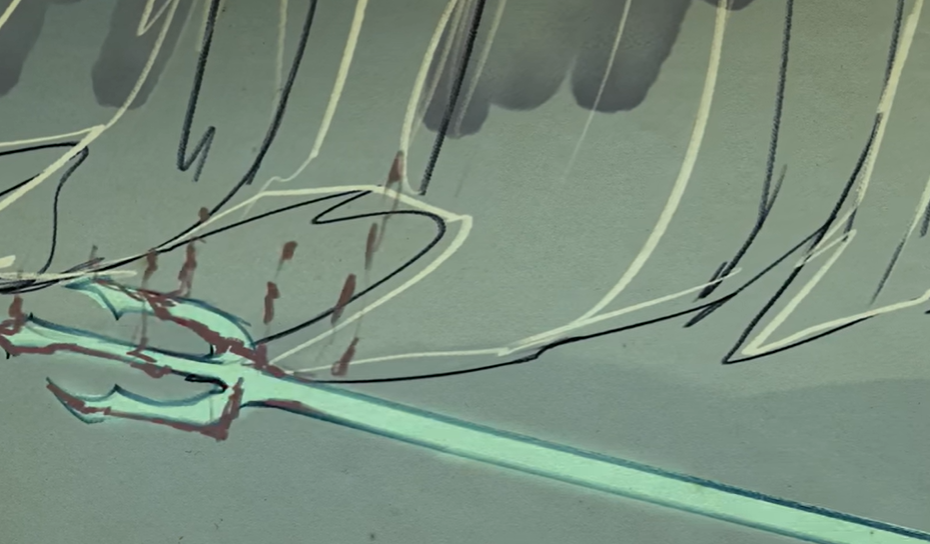
Evoking a mic drop, and also showing us why this isn't the same at all as Odysseus stupid "monster" arc from the Thunder Saga. There's no performative cruelty here. No romanticization of the self as a tragic villain. Odysseus uses the exact amount of brutality necessary to ensure his victory. No more, no less.
As he begins his trek inland, Poseidon asks him how he's going to sleep after everything he's done. Odysseus' answer, "next to my wife," demonstrates that he is simply passed caring. He just needs to go back to living, so that all those people won't have died for nothing.
Jojo Fraga gives Poseidon a humble little smile as he disappears back into the water. To some extent, this might be satisfaction at seeing Odysseus at least no longer putting on airs. Moreso though, it comes across as Poseidon finally managing to laugh at himself. This whole thing really was pointless, wasn't it?
Well. That's what I got out of these songs. The final Ithaca Saga makes it seem like the author's intent was, um, something different. And one that I have some serious criticisms of. But, it looks like that'll have to be its own post after all.