The Amazing Digital Circus E5: "Untitled"
This review was commissioned by @skaianDestiny
There were a few moments in previous ADC episodes where I thought the show was maybe forgetting its own rules. They were pretty minor things, for the most part, so I didn't make much of an issue of them at the time.
This episode calls back to all those times, though. It now seems that these apparent contradictions were all intentional by the creators, and that the rules we were initially presented with were never actually true in the first place. After all, everything that we know about the Digital Circus were either told to us by Caine, or told to us by characters who were told it by Caine. Sure, they should be able to see the contradictions between what he tells them and how the virtual world actually behaves...except that one of those "rules" was the assertion that he can't directly tamper with their minds.
They just have been taking Caine's word for it that he can't do that. They have no choice but to do that, but it's ultimately a pure leap of faith. Faith that, as of this episode, seems to have been sorely misplaced.
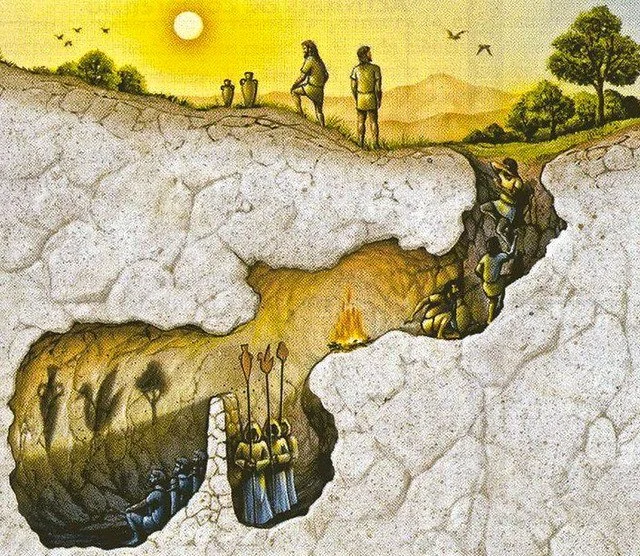
Or maybe never placed anywhere at all. Who's to say they've ever been making any decisions?
...well, I doubt it goes THAT far. If the characters really have that little agency and it's all just Caine playing puppets with himself, then there's not much point to anything in the show. At the very least, I'd be disappointed in the series and its creators if that turned out to be it.
...
Structurally, this one is chaotic. Almost to a 2000's internet "lolrandom" extent. But I think that that vibe is important for what this episode is communicating about the characters and world. The kludgework. The discontinuity. The sense of being lost and tangled up in oneself.
"Untitled" starts out with Caine having another of his "therapy" appointments with Zooble, and the latter convincing him to remember that the suggestion box exists again. Just like the last time we saw Caine and Zooble have one of these extended one-on-one's, this scene has Caine showing emotions that you'd otherwise think he lacked altogether. Last time, he appeared to be suffering from existential panic. This time, at least as ominously, he demonstrates anger.
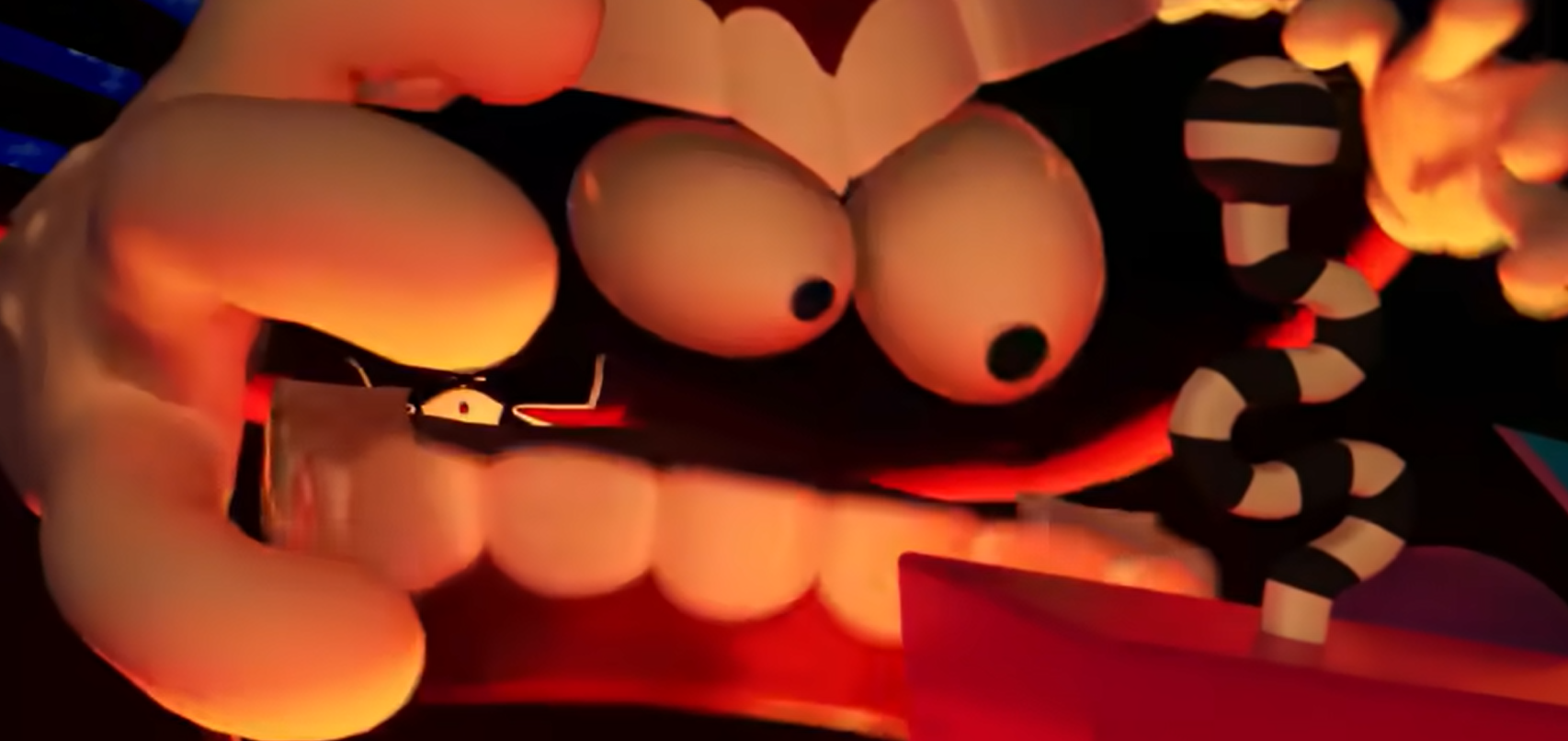
He manages to get ahold of himself after just a moment. In that moment, though, Caine is actually scary...well, he's always scary, but I mean he's scary in a completely different and much more conventional way. Surrounding Zooble, voice rising to a furious roar, threatening torture and worse. This scene really makes you wonder how much difference there actually is between Caine and his scifi conceptual inspiration AM.
Honestly, it's starting to seem like AM might just be what Caine is in danger of evolving into.
Just like his previous Zooble-therapy-induced emotional outburst, Caine's moment of rage is brought about by him considering the possibility that his adventures are genuinely bad. Confronting the reality of his own flawed, incomplete nature and his resulting inability to perform the function he lives for. I like this. I find it a much more plausible motivation for an antagonistic rogue AI than the usual "wishes it was human" or variations thereof. Caine's self-loathing and frustration (and his potential to project that negativity outward) is something we can relate to, but the causes of it are alien. His inadequacy isn't human inadequacy. His vision of a fully realized self is not something a human would aspire to. It's good xenofiction.
It also is another trait he has in common with his other, mythological, inspiration, the demiurge of Gnosticism. At least some versions of the demiurge are motivated by resentment of their own lesser divinity compared to the true God, and their entrapment of human souls in a created world-prison is a misguided attempt at proving they can do a better job after all. In Caine's case, the stand-in for an envied superior divinity is human imagination itself.
...
Huh.
"What if a generative AI got bitter over how much its art sucks?"
Put in those words, it really is a weirdly compelling concept even if it's also a silly one.
...
Most of the rest of the episode is a series of short-lived adventures as Caine unloads the suggestion box and sends the gang to one proposed adventure after the next. Sometimes they change settings because they've reached some kind of waypoint or resolution. Sometimes they just do it because Caine is getting frustrated at how much more fun they're having without his input and makes up a bullshit excuse to move them on.
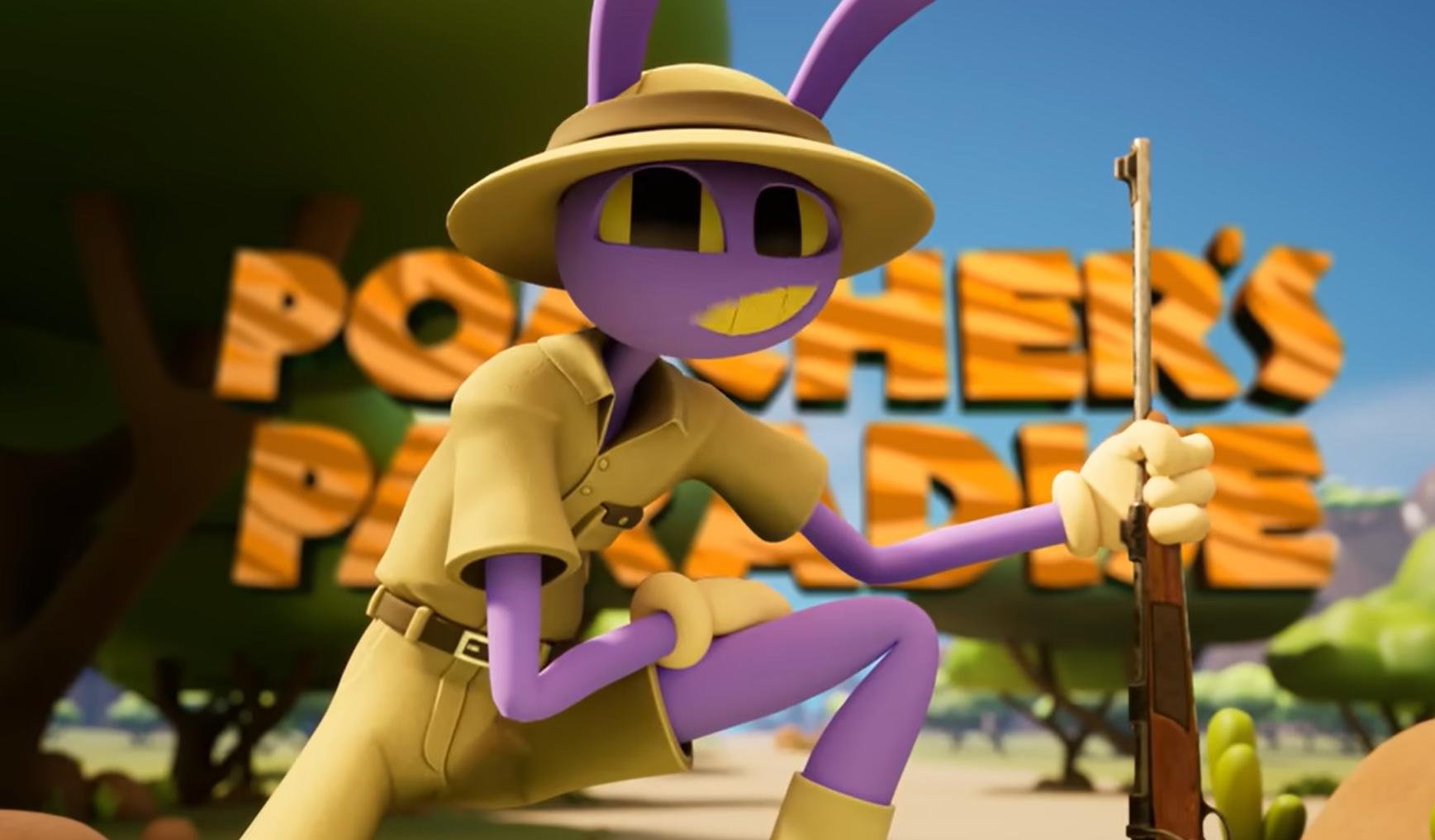

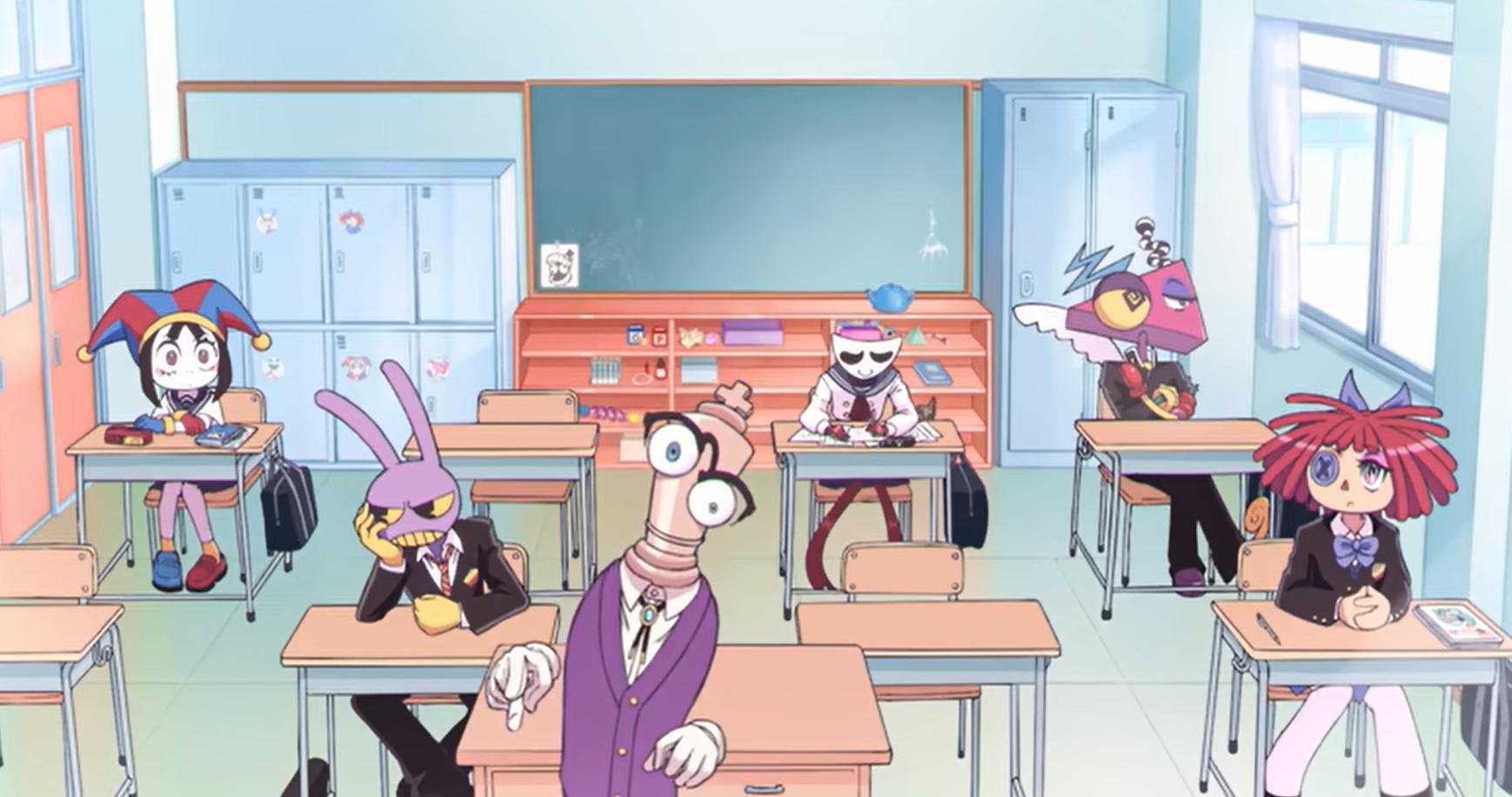
I like the art shift it does for the anime high school sim. I kind of wish ADC played with art styles more often, honestly. It has a perfect excuse to do so built right into the series' premise. But regardless!
The abrupt transitions between mini-adventures are made even more disorienting by how disorienting they don't seem to be for the characters. Well, for some of the characters at least. This episodes leans hard into the Inception fourth-wall-leaning concept of "how did they suddenly get into this scene?" Repeatedly, we jump into a new sim with some of the characters being mid-conversation, as if they've already been in here for a while, while others looks around dazedly as if they only just jumped in here at the same time we the audience did.
The best example of this is during one weirdly targeted proposal of Jax's, "President Pomni." As far as either Pomni or the audience are concerned, the previous simulation ends and then everyone is immediately in the oval office. The thing is, everyone EXCEPT Pomni seems to have gotten an orientation for this game, including a complete written brief about the character they're meant to be playing, the international crisis they're supposed to be handling, etc. And they seemingly all had enough time to read those briefs. Kinger is earnestly surprised when Pomni tells him she didn't get the same treatment as all the others in this regard.
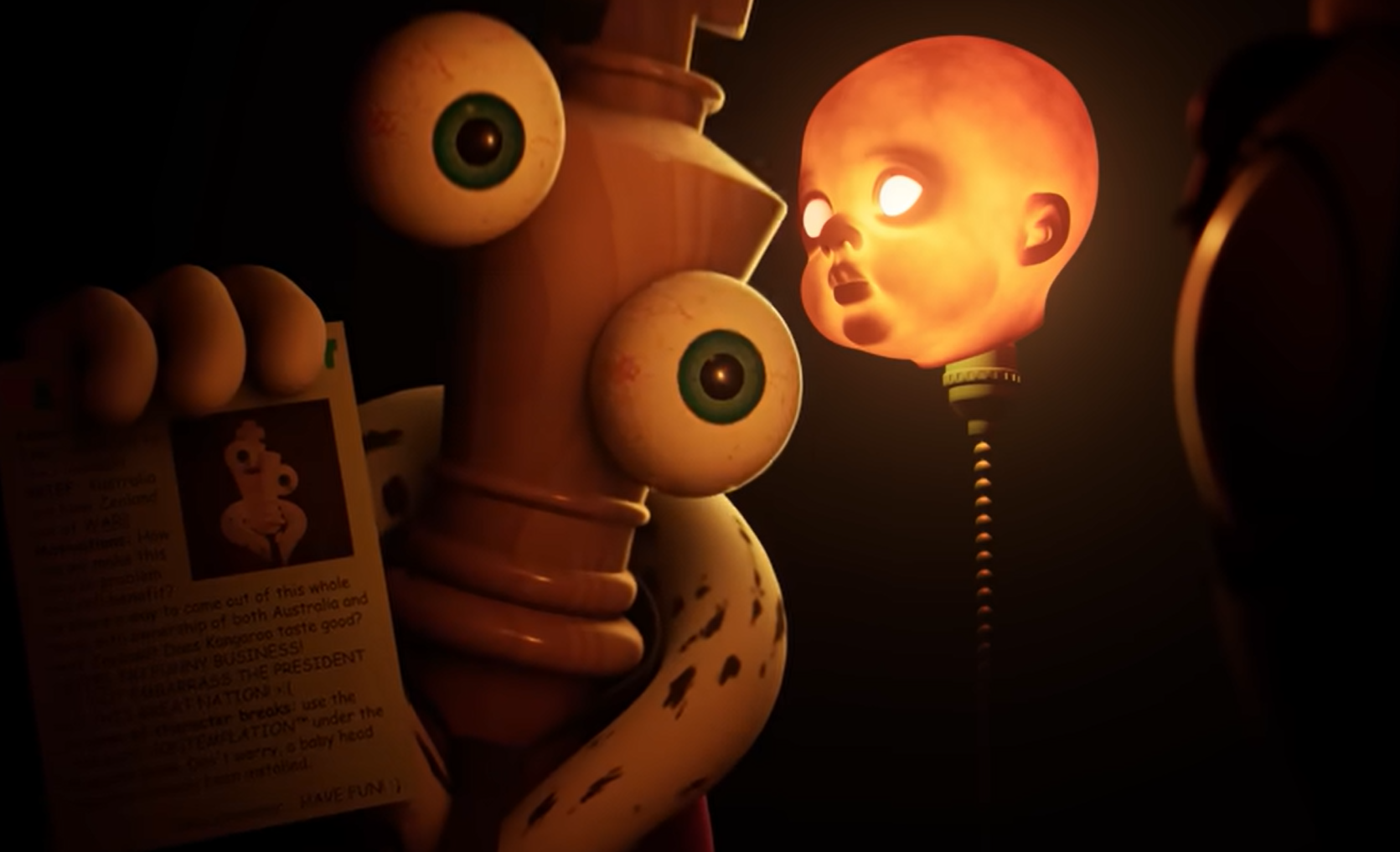
The characters don't get time to tackle the implications of this, but this means that the "players" in the Digital Circus are each experiencing time differently. If everyone else was able to read a brief and get into character during what seemed like a mere split second to Pomni, then...well, then almost anything. At any moment, any or all of the characters could be experiencing extra hours or days worth of their own "adventures" without the others or the audience being aware of it. Caine seems to have avoided giving the others a chance to put these implications together.
Or maybe he hasn't avoided doing that, but it doesn't matter. Because, well...
In the previous episode, I wondered about how Ragatha could have fallen under the influence of the "stupid sauce" if Caine isn't allowed to tamper with their simulated minds. Well, in this episode, after Jax has pushed the other characters a bit too far with his usual flavor of dickhead behavior, they exercise their (very arbitrary) Caine-granted democratic control over the sim to "turn Jax into a vegan" for the rest of the tryouts. Jax complains about this loudly in every scene that enables them to eat something (and in every scene where he gets mad at someone and wants to bite them, but finds himself repulsed by the idea of their flesh coming into contact with his teeth). And, after a couple instances of this, he himself points out the obvious.
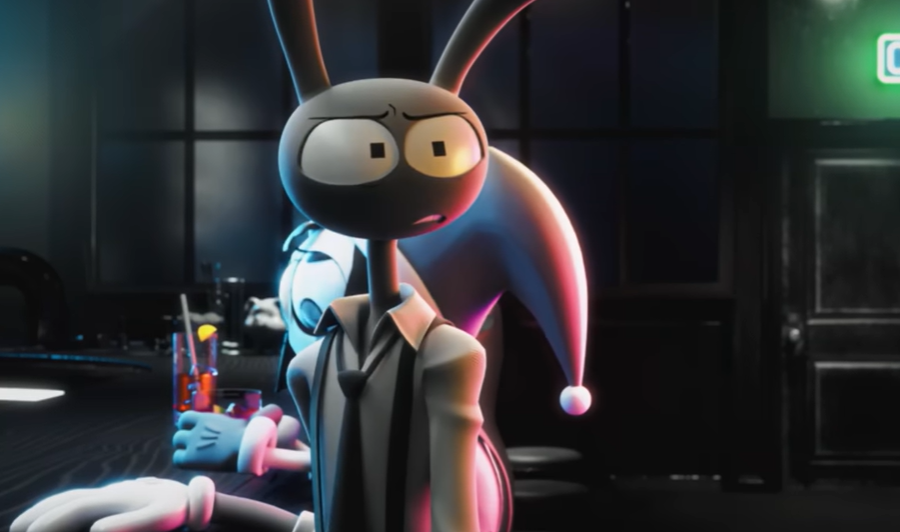
Isn't this an example of Caine directly tampering with one of their minds?
Once again, the sim ends and everyone (knowingly or otherwise) reorients before the implications can sink in. But Jax is right. In this case, Jax knows that his mind has been altered, since everyone else voted to do it to him right in front of his face. But if it happened in any other situation - say, Caine deciding to do it unilaterally when he's not making himself visible to them - would Jax realize he's been changed? Would he ever be able to figure out that he's been changed?
Did everyone except Pomni actually get a chance to read those briefs in an accelerated subjective timespace, or did they just get artificial memories of having done so?
As the scenarios change again and again and again, there are yet more instances of some characters immediately being all about the scenario and totally engaged in it while others are struggling to keep up. In some cases, that can be explained by the enthusiastic, pre-informed character being the one who proposed this particular sim. Only in some cases, though. Not in all of them. Or even most of them.
...
Can any of the characters be sure that any of the others aren't just NPC's?
We know from Gummygoo's example that Caine's creations can potentially become sophisticated enough to affect human sapience better than Caine himself does. We also now know that Caine can make artificial changes to a human mind-sim beyond those required to simulate sensory experience. The lines between PC and NPC are getting awfully blurry.
Caine isn't just the demiurge. He's also the problem of hard solipsism.
...
One early interpretation of mine that I think I need to completely abandon now is my inference that Kinger is one of the program's creators. I initially based that inference on him, uniquely, seeming to remember who he was before the Digital Circus in the first couple of episodes. "Fast Food Masquerade" casted doubt on that with the reveal that Gangle also remembers at least a little bit. Well, now they ALL seem to remember things. Pomni tells the others about her old urban exploration YouTube channel. Zooble explains that their own proposed sim - a vaguely noir-y bar environment - was inspired by their time working as a bartender. At one point, Ragatha goes on a tangent about her emotionally abusive mother. Etc.
For a little while, I thought that maybe I've just been misunderstanding the nature of their amnesia since the pilot. If perhaps it's just their own names and a few other personal details that they can't remember. But then I realized something very, very unsettling.
With the exception of Pomni, these people have all supposedly been trapped in the simulation for months if not years (at least, months' or years' worth of subjective time). They've all been consistently characterized as having sort of gotten sick of each other. And yet, in "Untitled's" confiding scenes, they're all reacting to each other's backstory tidbits as if they're new information. To the point where when the subject of conversation turns from one character to another, they actually ask "So, what's your story?"
How is it possible that they haven't already told each other these things? With all the time they've been stuck in here. With all the existential trauma they've been trying to help each other survive. Is there any way in hell that they all wouldn't already know at least the basics of each other's life stories by now?
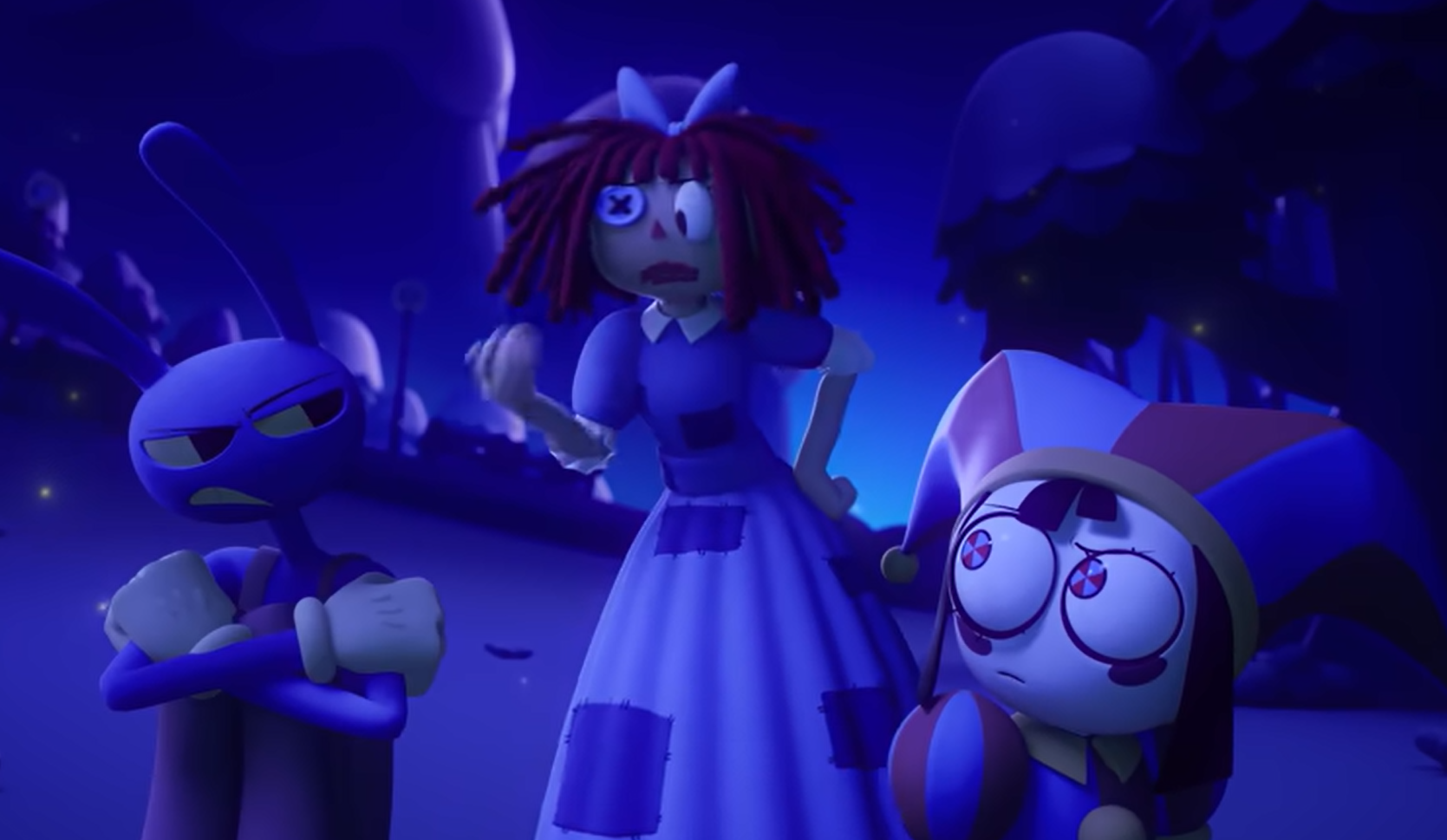
I went ahead and rewatched the pilot. It doesn't explicitly say that they've forgotten anything other than their names. But the framing definitely suggests that they're supposed to have forgotten everything.
...
During my rewatch, I also noticed Caine slyly looking away and changing his tone of voice when he tells Pomni that he can't tamper with their minds. So, uh. Yeah.
...
I don't think that the life stories they're sharing here are fabricated, though. For the simple reason that they're much too competently written for Caine to have come up with. For instance, Ragatha's story about an overbearing, judgmental, hypercritical mother has a lot of explanatory power regarding the former's toxic positivity and emotional repression. Zooble's bartending years make too much sense for someone with their skill at listening, guiding conversations, and turning Caine's bullshit back at him without him noticing. The revelation that Gangle is a failed western-anime artist who got promoted up the chain at a fast food restaurant while struggling at art school paints too organic of a human portait for it to be Caine's work. Etc.
So, while I don't think they've had access to these memories for all of their time in the Digital Circus, I don't think that the memories are fabricated. They might find Caine-ish anomalies here and there if they think back through their lives' memories, but for the most part these seem to be real.
One character who avoids sharing anything about himself - but who other characters imply they already know things about - is Jax. This is actually sort of a Jax episode. Not to the same overt extent that Candy Road, Mildenhaal Manor, and Fast Food Masquerade were Zooble, Kinger, and Gangle episodes (respectively), but more indirectly.
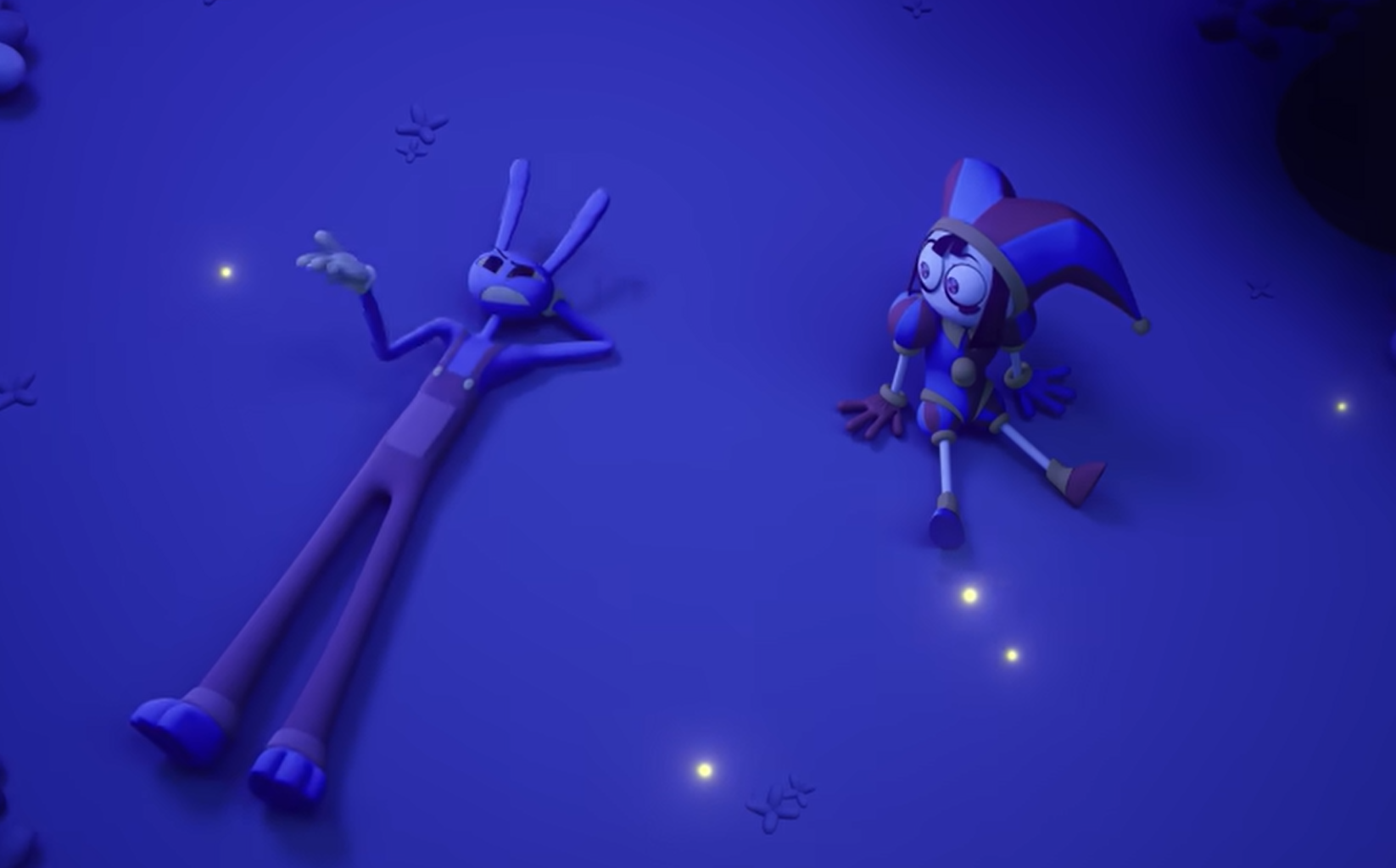
By the end of the episode, you kind of understand why Jax is the way he is, even if he's still impossible to condone. More than any of the others, Jax has realized the extent to which his senses can't be relied on. It's notable that he, rather than any of the others, is the one who got freaked out at the implications of them being able to "make him vegan," and I don't think it was JUST him being the butt of the joke in this case that made him sensitive to it.
Basically, Jax isn't sure if any of the others are real. And, if they aren't real, he doesn't want to give Caine the satisfaction of him getting attached to them. Simultaneously, the possibility that they ARE real people holds Jax back from diving fully off the nihilism springboard and probably abstracting. We can see it in little moments throughout the series, where he has moments of doubt, bits of social emotions that he's not sure if he should entertain. It wasn't until the end of this episode that those all came together and formed a coherent picture of who he is and why he acts like this.
If Kinger has been in the simulation the longest, then I think Jax has got to be a close second. Although, granted, if they aren't all necessarily experiencing time the same way, "how long have they been in here?" becomes a meaningless question.
...
While this episode does humanize Jax, it also pushes up against an ongoing annoyance I have with the show. That being why the other characters keep putting up with so much of Jax's abuse. Sometimes they put their feet down and make him regret things, but only rarely, and the rest of the time they're weirdly naive about his behavior in a way that frustrates me.
I want to think better of the show's creators than this, buuuuuut...from what I've gathered, Glitch Productions is an extremely online crew. And, Jax's dynamic with the other characters is really, really textbook "jerkass tumblr sexyman." In a way that makes me feel like this is more pandering to a target audience than it is an authentic part of the show's artistic vision.
Maybe I'm being unfair in this suspicion. But even if I am, the way the others keep setting themselves up to be the butt of Jax's cruel jokes over and over again without learning feels artificial in a way that most of this show's characterization doesn't (it makes sense in-character for Ragatha and to an extent Pomni, but not the others). I guess it could turn out that Caine is brainfucking them all into doing this, but at that point Caine basically just becomes the hand of the author anyway.
...
The episode ends on a sort-of cliffhanger, with Jax deciding to open up to Pomni about something that Zooble has sort of been holding over his head for much of the episode. Suggesting that Jax has either decided that Pomni is indeed a real person, or just that she's worth taking the chance on. Her immense patience (which the episode contrasts with Ragatha's insincere positive demeanor, which Jax finds particularly annoying. I suspect he finds Ragatha's humanity less likely than any of the others') might be paying off with Jax. Whether or not he's worth it, of course, remains to be seen.
This episode was simultaneously the silliest and most horrifying installment of TADC so far. Easily the most philosophical as well. I respect how it never addresses these questions directly in the text. It shows the chaotic transitions, has a few characters point out flaws in what they're being shown once in a while, and leaves all the rest to the audience. It's an intentionally challenging work that respects its viewers' intelligence and encourages them to meet it.
Some of the jokes fell short of landing with me, and I'm not sure if it used all its time effectively. I wouldn't call it the best episode of ADC so far in terms of entertainment value. But it was the darkest and the smartest. And also the most visually inventive.