Dungeon Meshi S1E4-6 (part one)
This review was commissioned by @Bernkastel
Each of these episodes seems to adapt 2-3 manga chapters, with the chapter breaks being clearly delineated. And, I'm noticing a pattern of extra silly chapters alternating with more heavy and serious (well, by Dungeon Meshi standards ) ones. One skit, we're teetering on the knife's-edge of ethnic tensions breaking out into a violent redress of historical grievances. The next, we're using the supernatural chill of ghosts to make ice cream. One skit, we travel back and forth through time to steal a few bites from historical royal feast. The one after that, we're doing a tense survival horror thing with one of the characters trapped in a room with a monster that's traumatized him.
There's a throughline of silliness going through even the heavier chapters, owing to the postmodernist comedy premise and snarky characters. And there are some poignant and thought-provoking bits even in joke episodes. Overall, this tonal pacing works. Light step, heavy step, light step, heavy step. It's a bit awkward, but it propels you forward. Like fumbling through a dark corridor with a ten foot pole held out in front of you.
To recap, our ambiguously heroic adventuring party of Laios the himbo human fighter, Marcille the prissy elf sorceress, Chilchuk the longsuffering halfling rogue, and Senshi the weirdo dwarf warrior-chef are dungeon-delving on a budget in effort to recover the corpse of Laios' cleric sister before the resurrection period expires. Since they're broke and lost their wagons and hirelings, they've got to live off the megadungeon itself as they complete their weeks-long corpse run. Most recently, they've made their way through an upper layer of enchanted forest-ruins and breached the more conventional "dungeon" stratum of this megadungeon, where they defeated some armor-animating clams and cooked them.
The stinger of episode 3 had one of the armor-animating molluscs surreptitiously infest the hilt of Laios' sword.
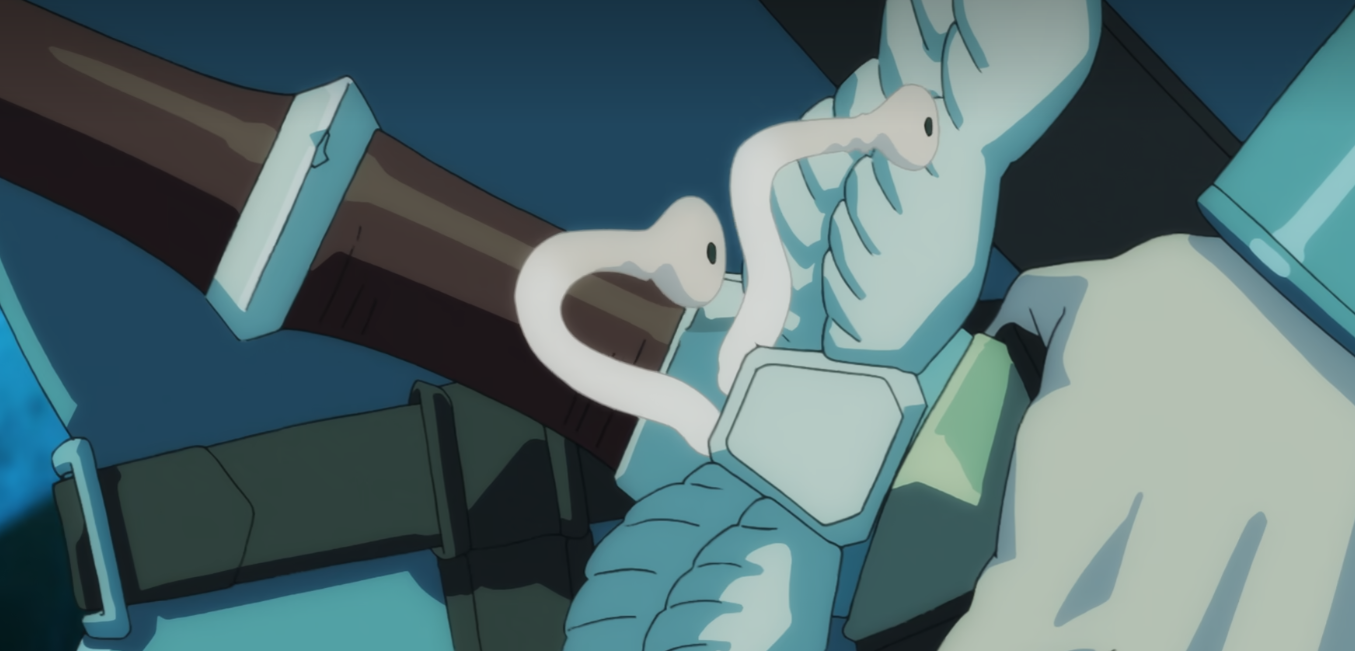
Without a colony to network with, it can't do more than make his sword rattle around a little in its scabbard. However, it's tendency to do this when it smells the presence of other monsters (either ones it recognizes as predators, rivals, or prey, Laios isn't quite sure which) serves as a helpful warning system for its wielder. Laios takes up the b-plots of a few chapters in his efforts to make a pet of this creature while keeping it a secret from his companions, probably for fear of Marcille getting jumpy or Chilchuk silently judging him too hard.
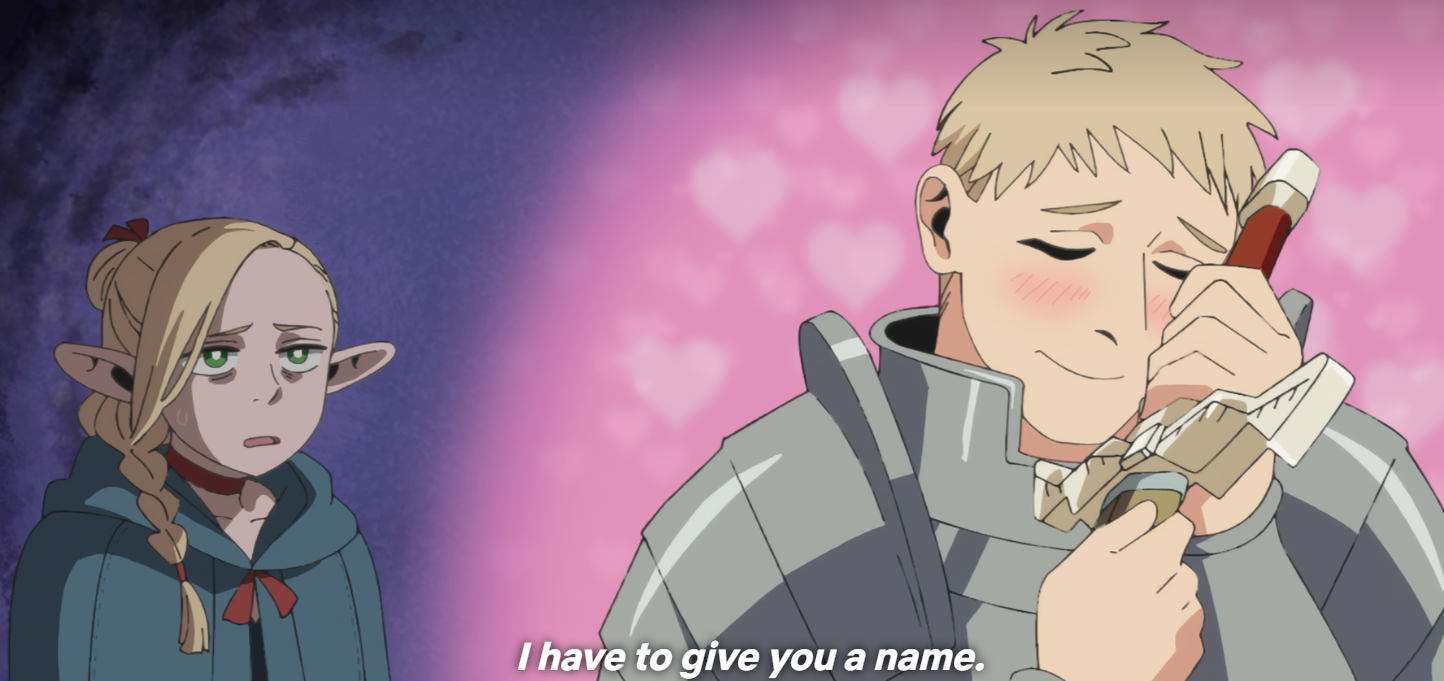
So, that's a throughline that runs through the next little while's worth of show. And also opens doors to figuring out more about the megadungeon's internal ecology. Which, in turn, opens doors to finding more food sources.
As for main plot threads, episode 4 "stewed cabbage/orcs" is a real case in point for the show's tonal duality. The party are in a transitional stratum, where a crew of earth golems prowl the level and keep the undead from the galleries below from rising up to the pseudo-forest above. These constructs are both powerful, and hostile to all other monsters in the megadungeon, so there aren't many threats on this floor besides the golems themselves. And, we soon learn, this transitional floor is also the site of Senshi's semi-permanent campsite. A little stone chamber hidden behind a secret door that he found years ago, and that he's been basing his own explorations out of ever since.
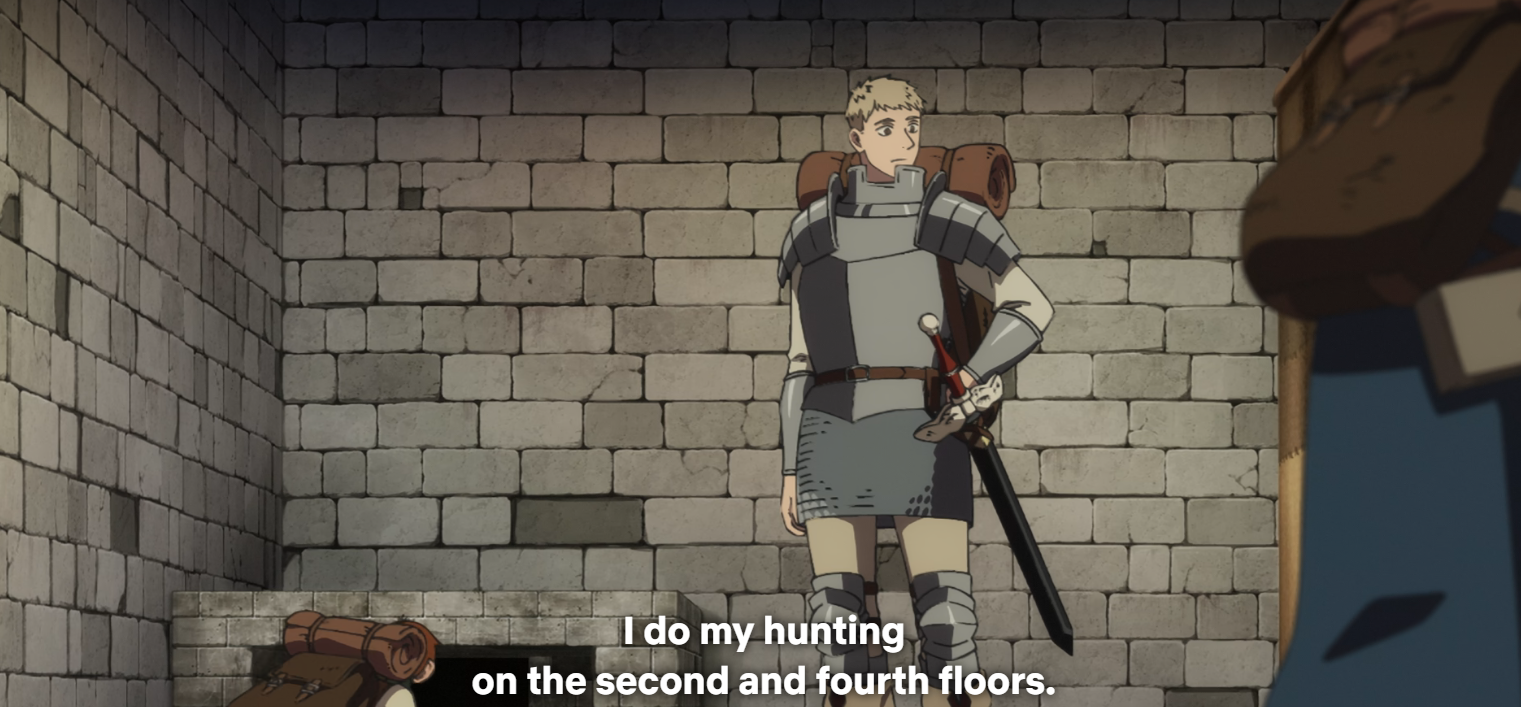
The show already made it clear that Senshi is an experienced dungeon-chef, and implied that dwarves as a whole are sort of used to this kind of thing. I hadn't realized until now how long he's been operating in this specific dungeon, though. This episode and the following ones make it clear that he's been doing this for at least a few years. Long enough for him to consider this underground murder-maze his home and to have brought some bits of furniture, spare clothing, spices, pots and pans, and other supplies piecemeal into this campsite.
It's sort of surprising he has anything left to learn about dungeon cuisine, at this point. But I guess that's what made Laios' discovery of the edible armor-slugs so impressive to him!
A better question is why he thinks of these other adventurers as anything more than intruders and despoilers, considering that he actually lives in and depends on this environment while they're just here to smash and grab without any investment in the dungeon's longterm state. And...well, to my immense satisfaction, that's actually a question that the show engages with in just a few minutes! Before we get to that, though, we spend a chapter exploring the reason why Senshi has chosen the earth golem killzone floor as his base camp, and it's got to be the silliest thing in the entire series so far.
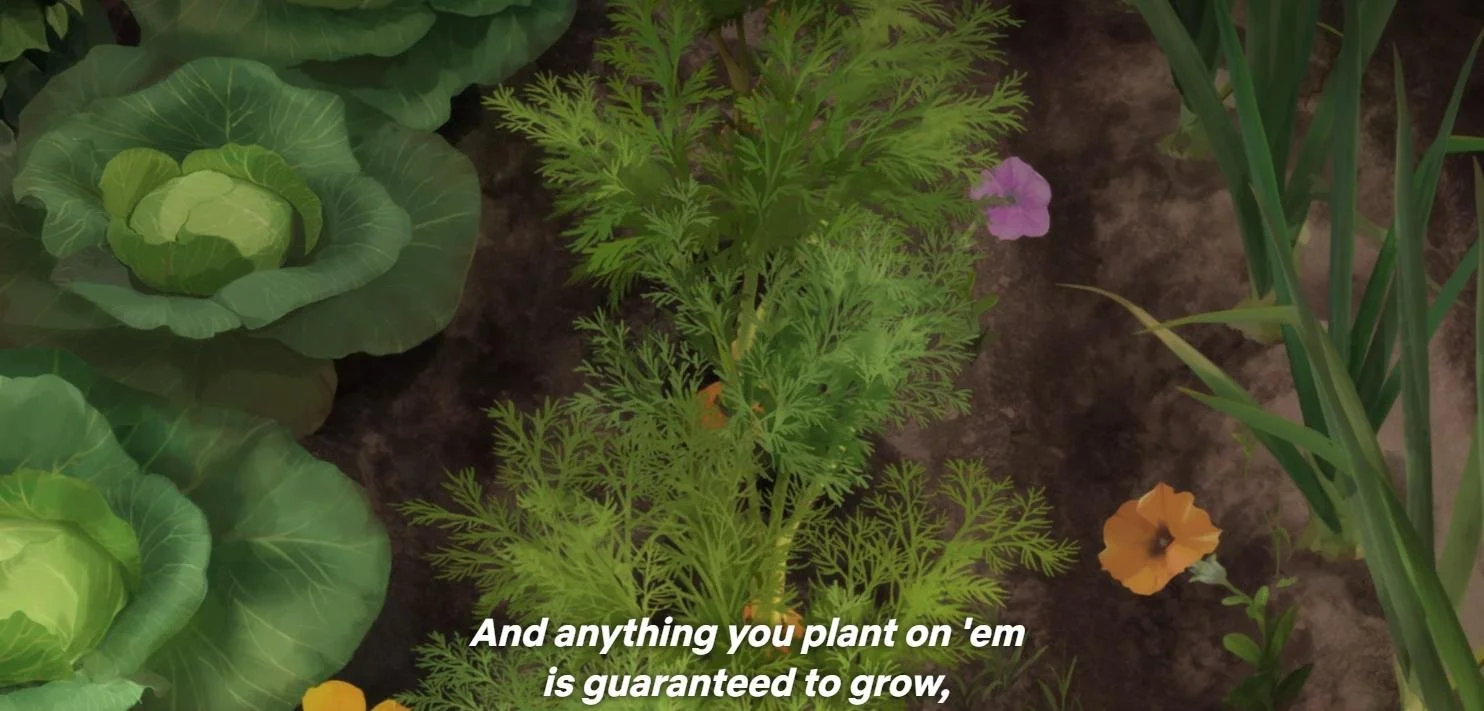
What Dungeon Meshi calls "golems" are less like standard DnD golems or the Ashkenazi folklore that they're loosely based on, and more like what most fantasy gamers would call "earth elementals." They're masses of soil held into shape and animated by a network of magical crystals implanted by their wizard creators. If you know how to disable the crystals, you can switch the golem off and on again almost at will, and while they're off they are basically just piles of dirt. Piles of magical dirt. Magical in a way that allows plants to use their arcane energy in place of sunlight for glucose production.
You just need to make sure you till, aerate, and fertilize the soil when you plant the new seeds each time before reanimating the golems. And also, make sure you remember to rotate your crops between golems for each planting season, you don't want to have to deal with nutrient depletion.
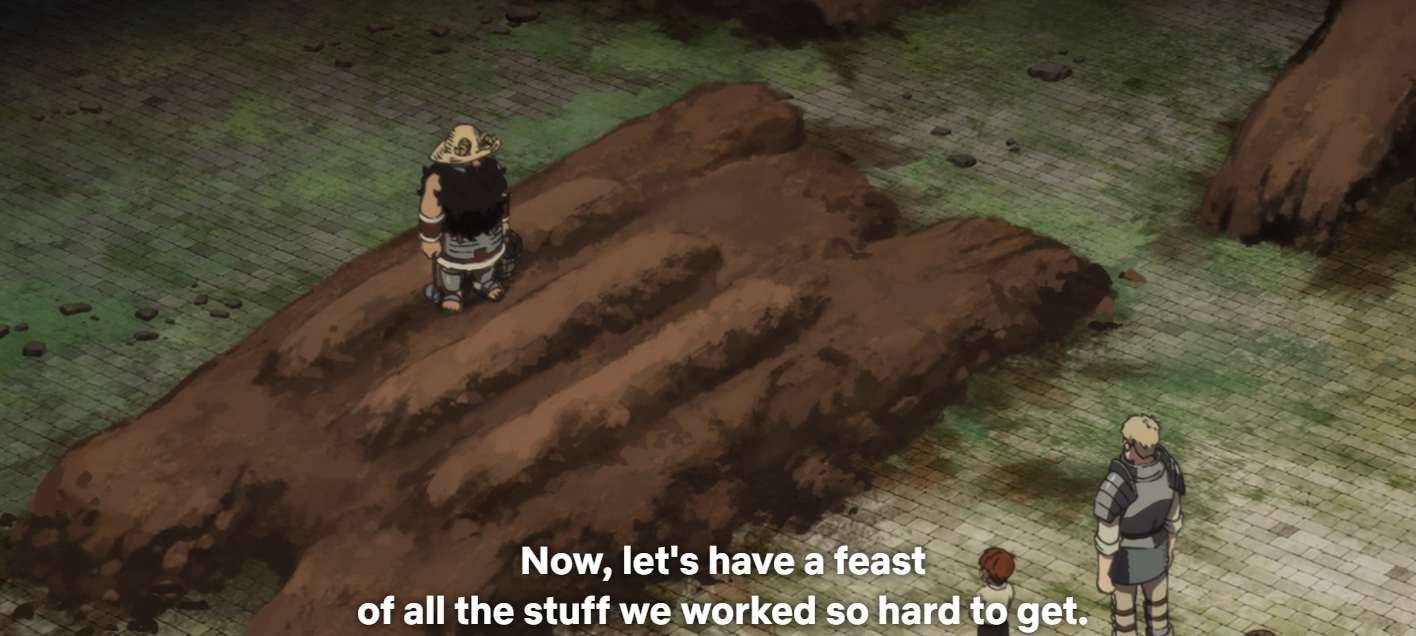
I think my favorite detail is that Senshi puts a straw farmer's hat on over his helmet when he does this. Even though there's no sunlight.
Also, while Marcille's relentless squeamishness annoys me in general, I managed to be mildly amused at her reaction to learning where Senshi gets his fertilizer, and the others' reaction to her reaction.
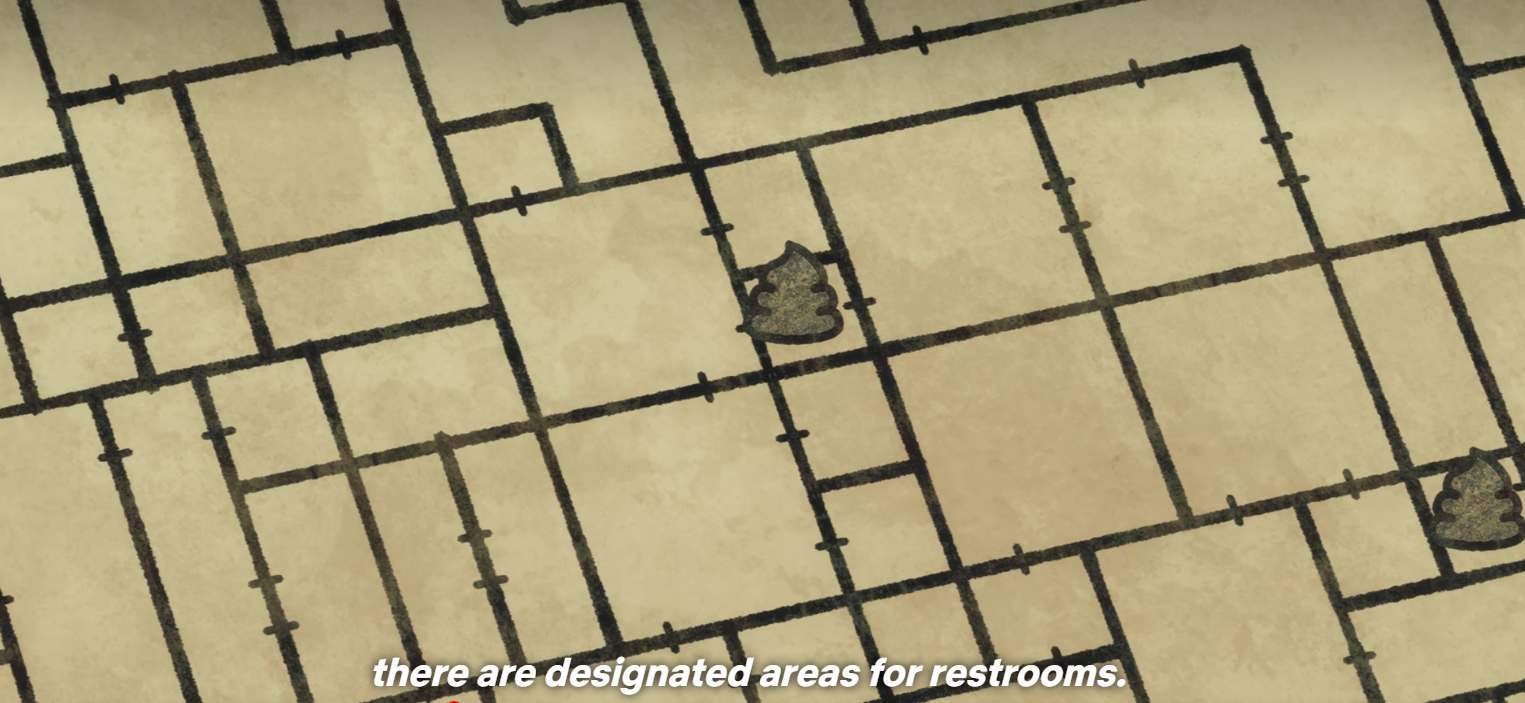
Throughout the years that adventurers have been systematically picking this place clean of valuables, a consensus emerged about which rooms on the upper, well-travelled levels should be used as toilets. Until today, Laios, Marcille, and Chilchuk had all sort of wondered who keeps emptying the latrines and setting out fresh toilet paper and scented candles in those rooms. Turns out, it was all Senshi procuring nightsoil for his animated vegetable patches.
Anyway, Marcille's reaction to learning she's just eaten plants grown on humanoid waste is one I've seen sheltered city kids have in real life. So it's satisfying when Chilchuk, who's presumably had a typically hobbitesque rural upbringing, informs her that she's been doing this for her entire life.
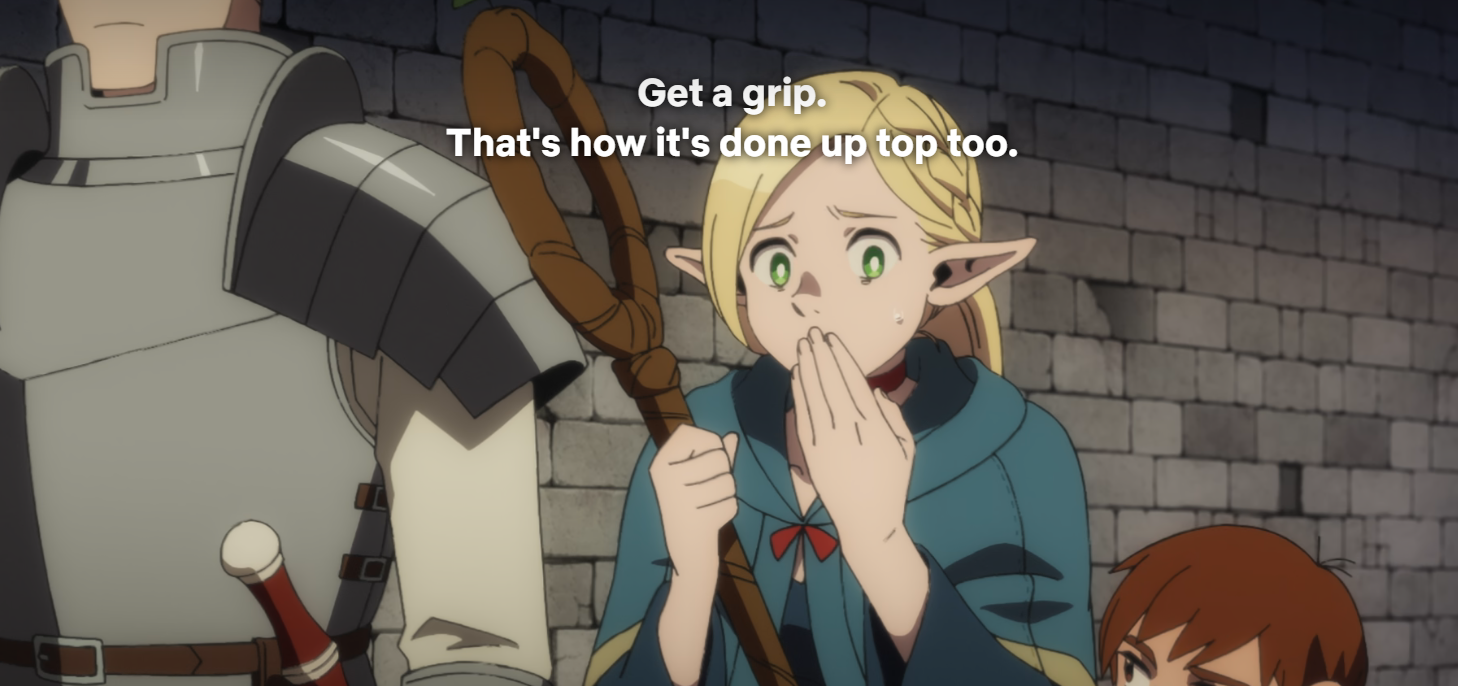
I think part of what's annoyed me about Marcille is that her flavor of squeamishness comes across as specifically modern. Even aristocratic cityfolk in premodern times knew where their food came from, and the urban populations were small enough that they had to have direct contact with farmers. Granted, we have no idea what urban life is like in Dungeon Meshi world. They could have magitech-y civil infrastructure that produces similar social outcomes to modern cities. She makes sense in that case.
Granted, people like that also sort of annoy me in real life where they don't raise worldbuilding questions, so perhaps I'm just making excuses for myself. :P
The whole farming segment ends with this almost National Geographic-like interview, where the other three ask Senshi about his lifestyle and self-appointed custodianship of (part of) the dungeon, and he waxes philosophical about how humanoids are just as much a part of ecology as dire rats and gelatinous cubes are.
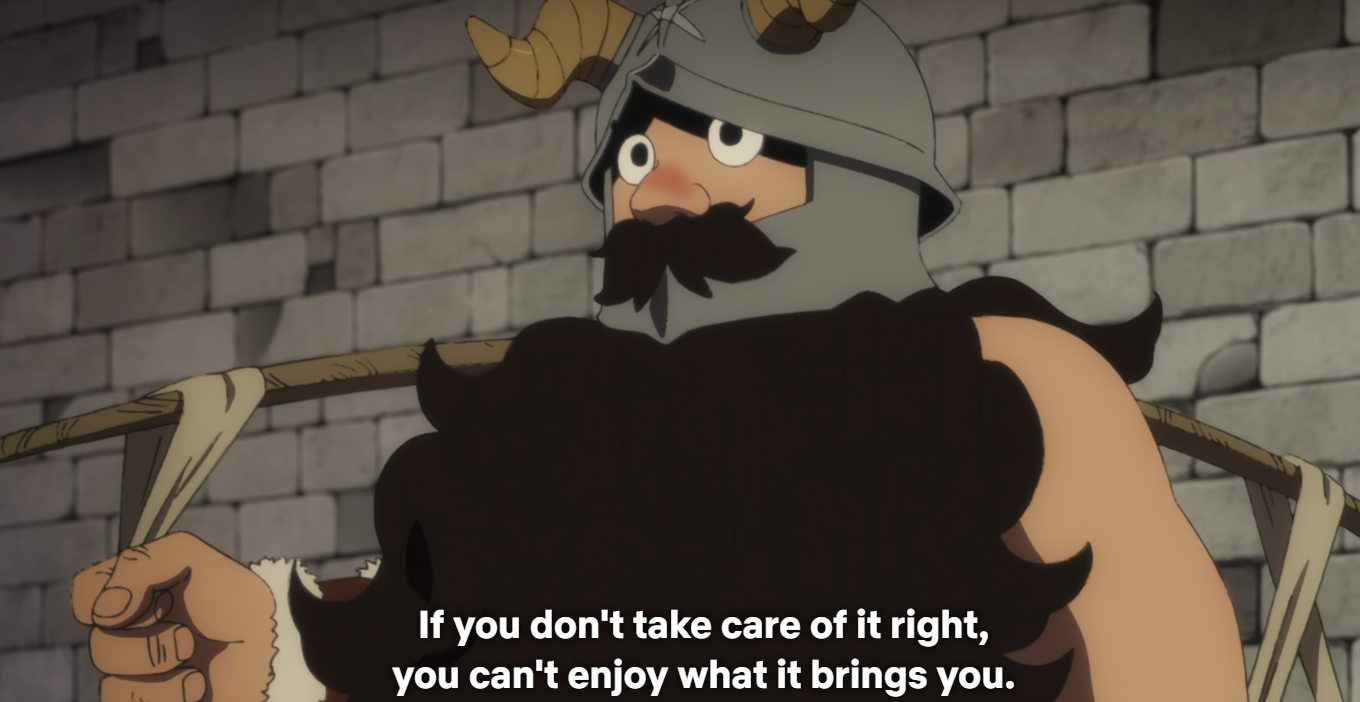
I laughed, but honestly, it's only half-parody at most. The analogues to real life human ecology is really on-point, and explain themselves articulately enough to actually be informative for people who haven't studied this stuff at all.
The human ecology thread continues into the next segment, where the gang brings Senshi's latest vegetable crop deeper down and try to trade them for less perishable supplies. And, here's that very strong case of Dungeon Meshi following silly up with serious that I alluded to before.
Senshi normally sells his produce to an orcish tribe that lives a bit deeper down, but they haven't been reachable lately. So, instead, they find another of those little adventurer-taverns that someone has set up inside of the dungeon. I figured we were past the last of those by now, but apparently not! On one hand, it makes sense that - with the upper levels depleted of treasure and people having to go deeper in order to keep up the profitable dungeoncrawling - the staging areas would be advancing downward. On the other hand, the upper levels above this point still seem pretty darned monster-infested, and you'd think people would make a point of ensuring these dungeon-taverns are accessible before establishing them. Maybe there are narrow corridors down that are kept safe, whose custodians charge steep prices for using that our heroes can't afford at present? That would make sense.
Well, anyway, the adventurer tavern people aren't interested in vegetables.
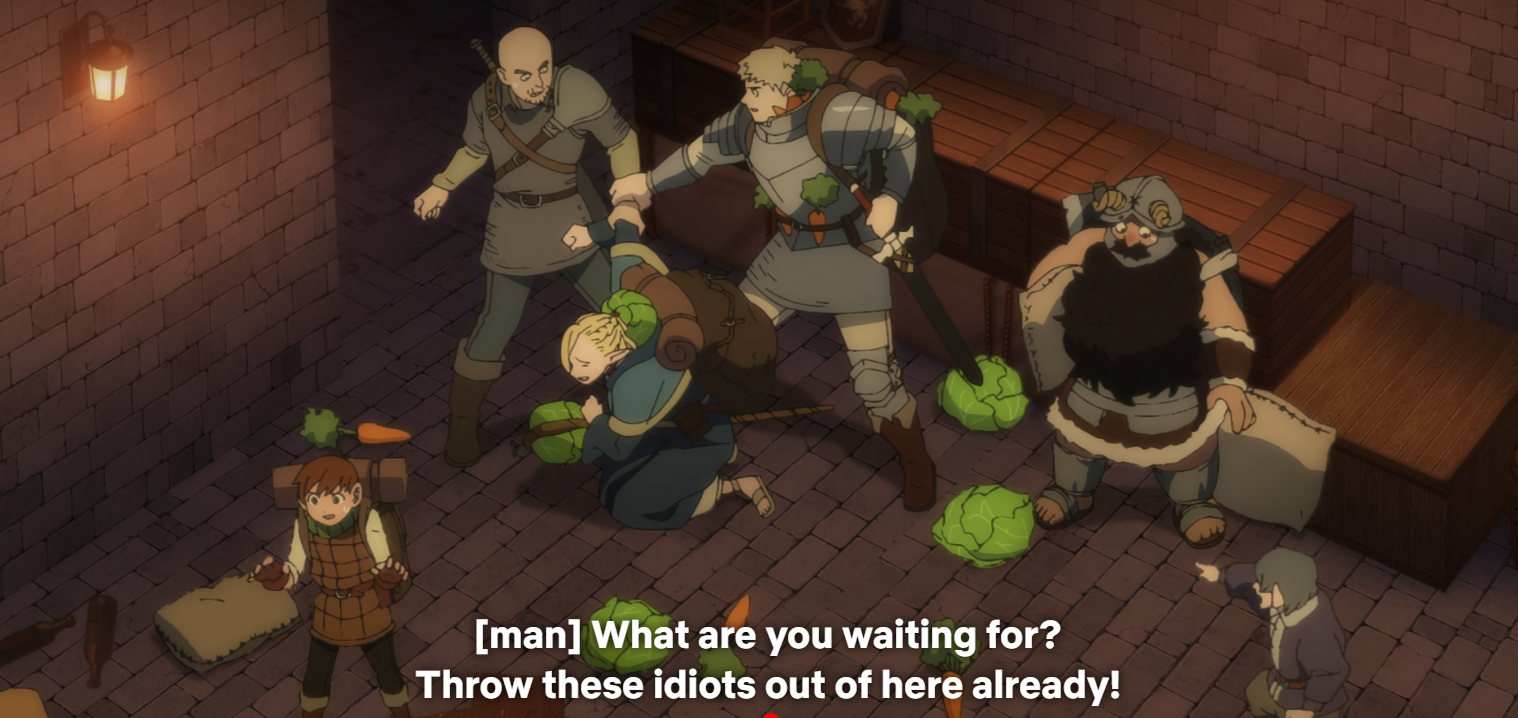
I'm not sure why they aren't interested in vegetables, tbh. You'd think fresh produce would be something you could turn a real profit on down here. But for whatever reason, they're interested in nothing but coin. And also just really hostile in general.
The commotion over the vegetables is interrupted by some more serious commotion, when Senshi's habitual customers take advantage of the distraction to force their way in and kill everyone besides the four of them.
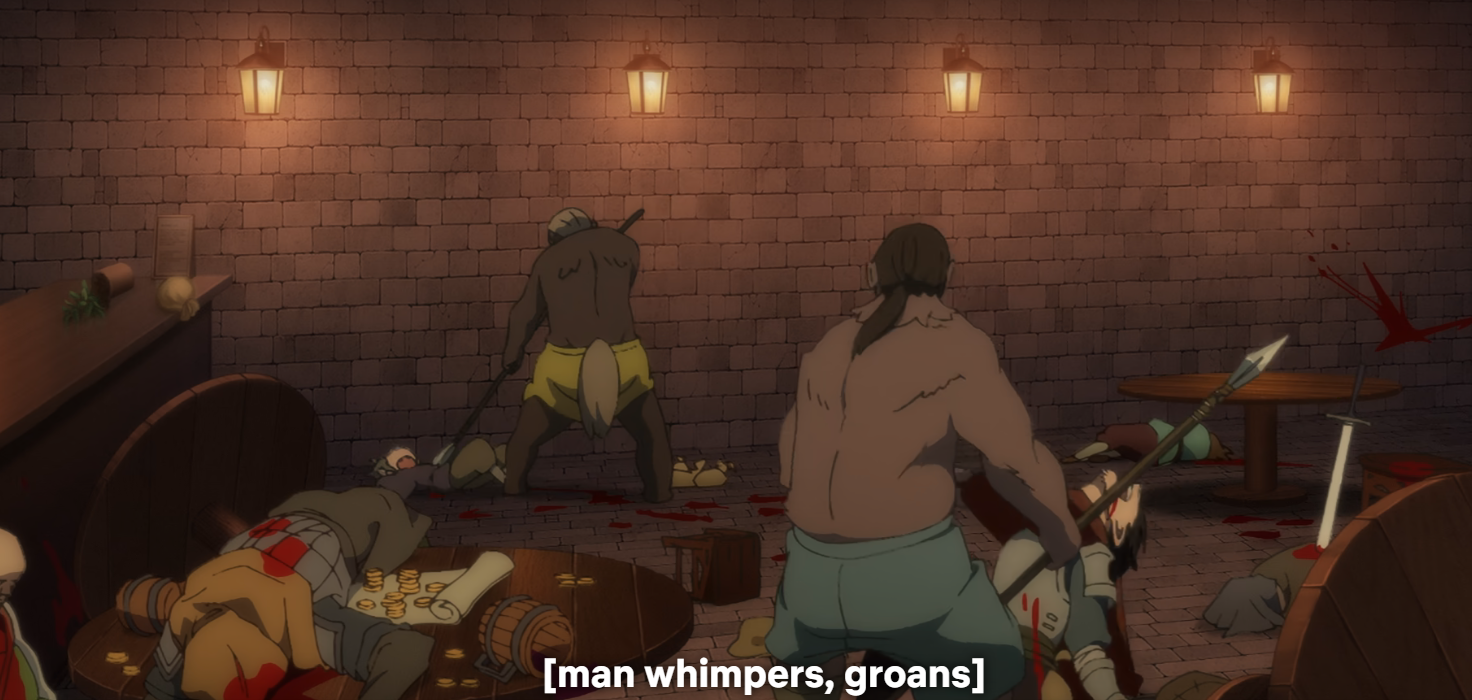
Senshi's sort-of friendship with the chieftain, named as Zon, stays the orcs' hands when it comes to his own party, but only barely. Seeing an elf and a human in Senshi's company is almost enough to make Zon write Senshi off as well.
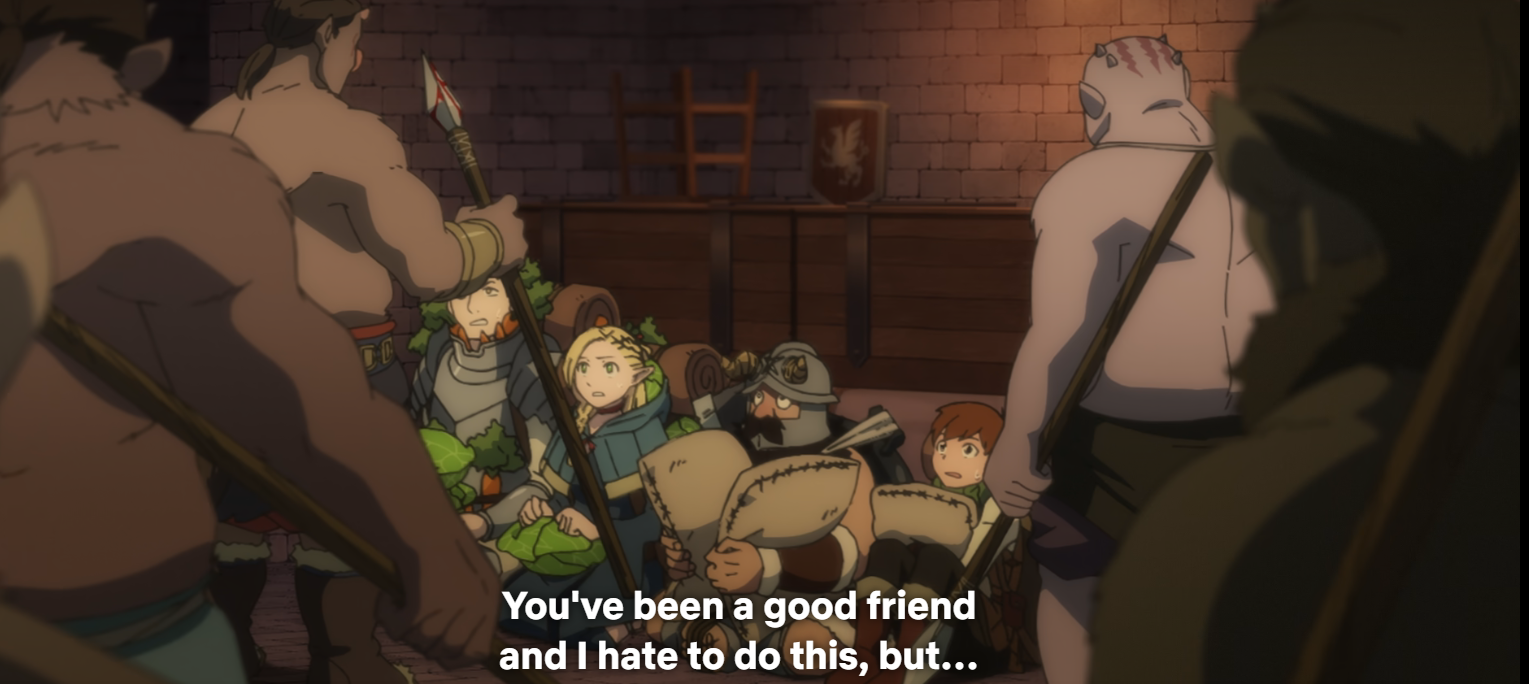
Orcs. There's no fantasy RPG mainstay that's been subject to more controversy. I have thoughts on the matter, but if I started writing them down I'd end up with a thousand+ word essay, and I don't think this review has room for that. For now, I'll just say that Dungeon Meshi takes the de-colonial approach to Dungeons & Dragons' colonial approach to Tolkien's uncomfortable creations. We learn the details of it over the course of the episode, mostly in the form of barely-restrained barbs hurled back and forth between Lucille and Zon as the orcs take them back to their own campsite. Seemingly due to the former (owing either to education, or to a long elf lifespan) knowing enough about history to argue with him.
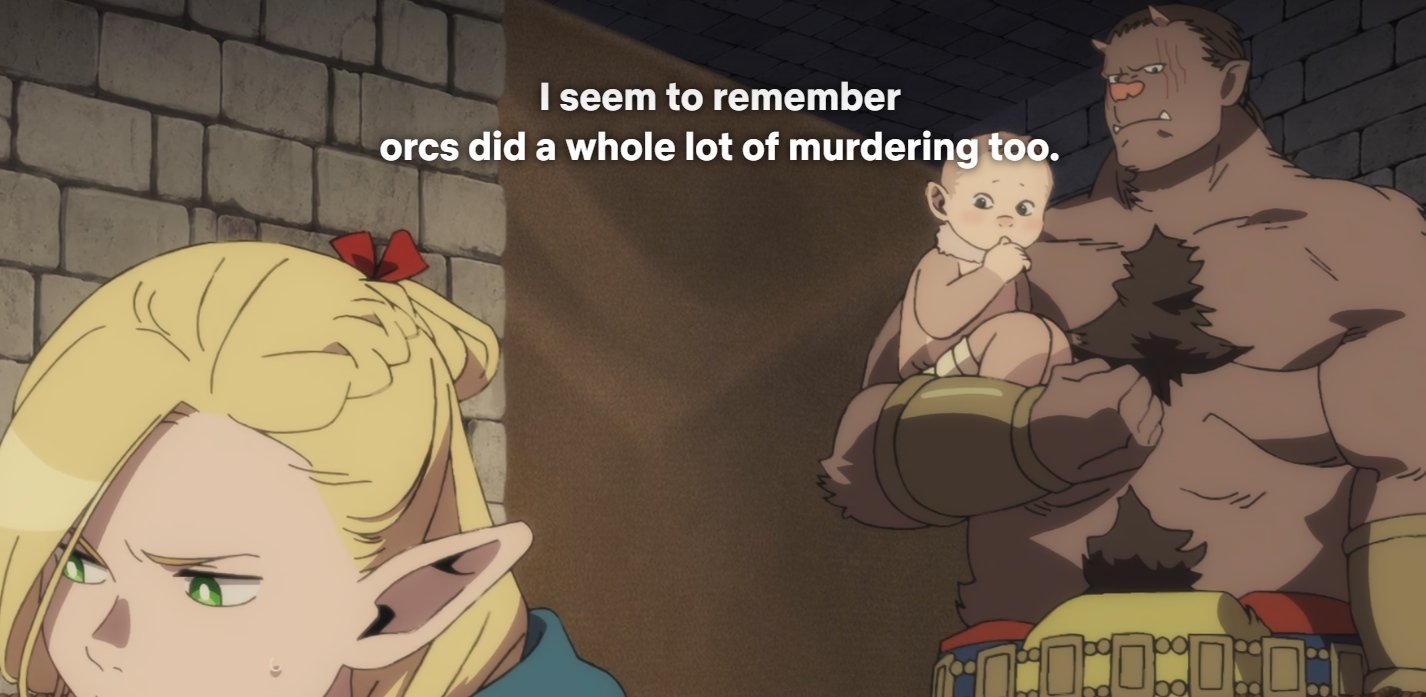
Daaawwwww babby orc.
They're able to go tit-for-tat on atrocities and offensives. But, as this goes on, it becomes very clear that the historical trend has been humans and elves ending up living on land that used to be orcish, while the orcs are forced to retreat ever further into the badlands and under the ground. Zon's tribe in particular were evicted from the cave complex they'd taken residence in when humans - in response to the orcs' persistent raiding of the surrounding countryside, according to Marcille - literally smoked them out. Since then, groups of them have been pushed into odder underground spaces, including some that found their way into this megadungeon complex. And now bands of armed treasure-hunters, most of them humans and some of them elves, are showing up here too.
Basically, they're at the point where it doesn't matter who started it anymore. By this time in history, the situation has become a settler colonial one, and the people in power don't have any interest in changing that.
...
Within the DnDesque fantasy milieu, there's an unusual detail here in the orcs' apparent lack of antipathy with dwarves. Zon's tribe were apparently not too resistant to dealing with Senshi in good faith, and while Zon talks about the suffering his people have endured at human and elvish hands he never mentions dwarves. Which is a bit surprising, since usually those two are particularly fierce adversaries.
The reason behind this is pretty self-explanatory. Unlike in a lot of heroic fantasy settings, Dungeon Meshi's orcs aren't natural troglodytes, whereas dwarves seemingly still are. Orcs only started living in places where they could theoretically come into conflict with dwarves fairly recently in historical terms.
One possibility that comes to mind is that we might eventually meet dwarves who have been recently displaced from their native caves BY the orcs who got chased underground by men and elves. That kind of second-order colonization is all too common in these situations. However, if Senshi's own people have ever had to deal with this, Senshi himself doesn't show it.
...
Anyway, Senshi is able to keep them alive for a little while longer by pointing out that the tavern the orcs just raided has ample quantities of flour and yeast, and that he and his companions would be happy to bake it into bread for them. Normally orcs are (for good reason, as we've just learned) careful to kill any outsiders who learn where their village sites are, so the others think Senshi is just making things even worse for themselves. And, there are a few times where it seems like Marcille's inability to keep her mouth shut might be about to make the worst case an inevitability. When they finish baking the bread and cooking the vegetable stew, Zon actually starts to declare that they won't be eating any of it themselves; Senshi just asked to cook it after all, not eat it, and presumably he'll then have to kill them all to keep their location secret. Their reprieve comes in the form of Zon's toddler son.
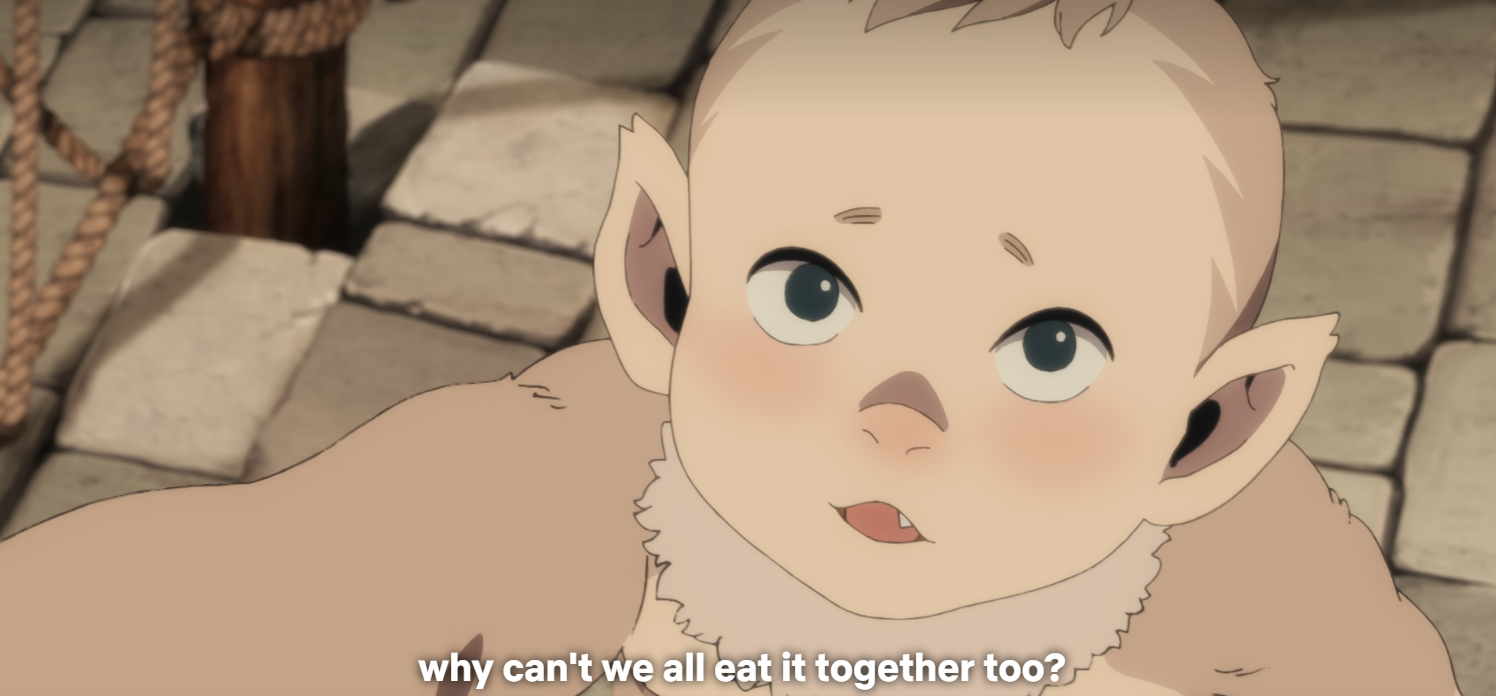
He's never seen the people who cook the food not also get to eat some of the food. It strikes him as a profound abnormality for that not to happen. The fact that Laios and Senshi have been playing with the little boy and including him in the cooking (at his request) while his father and Marcille were busy gnashing their teeth at each other likely played an important role in this.
And, what answer can Zon give his son that won't shatter the boy's developing sense of right and wrong?
The act of both preparing and then eating a meal together, enabled by childish innocence, ends up turning the adventurers into people who the orcs can't just murder in cold blood. Even the human and the elf. Despite the elf's own best efforts.
The role of food, and cooking, in sociology. The human ecology themes of the previous chapter continuing, and eventually reaching inward.
As a result of this, they are also all able to learn that they have a more pressing common enemy. The reason the orcs have moved on from their old sites where Senshi is used to trading with them is because a huge red dragon moved into the area. Almost certainly the same creature that the party is hunting. Sharing information about its whereabouts and observed capabilities turns out to be in their mutual interest.
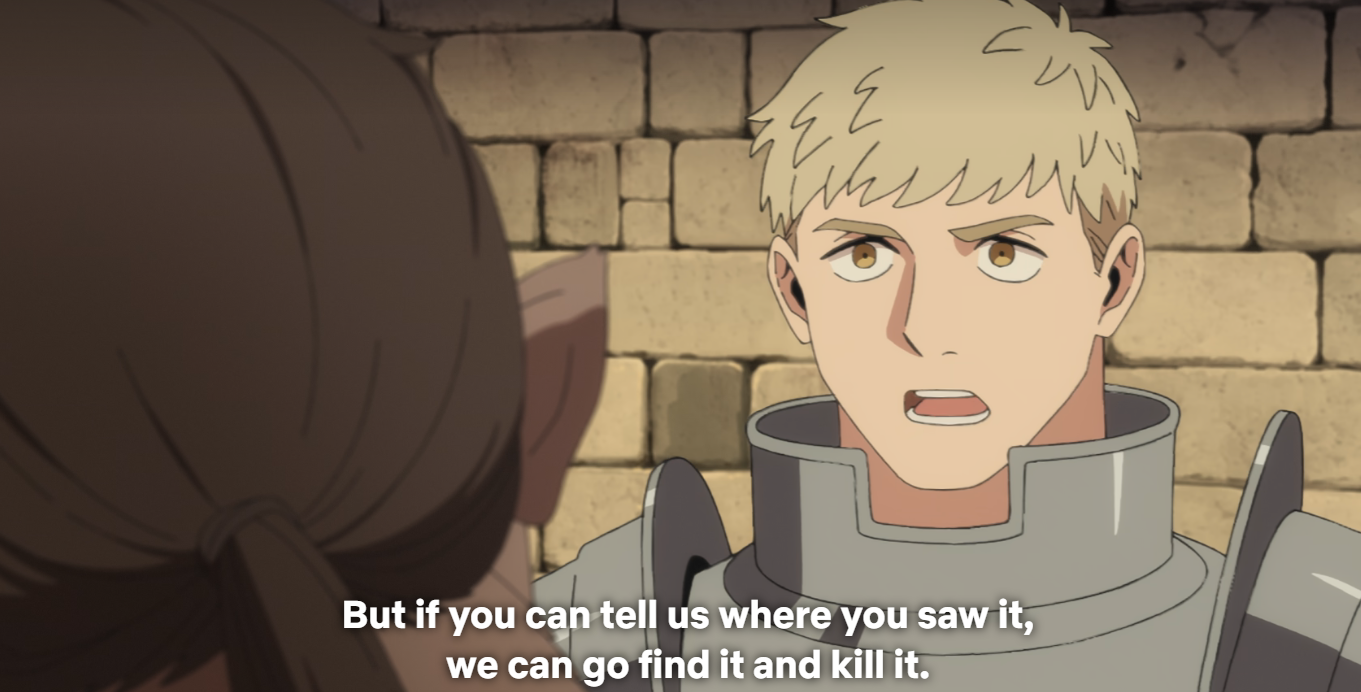
Before parting ways, Zon asks Laios about the adventure hook that brought the first generation of adventurers here, before mere treasure-seeking became the primary motivator. Back when this megadungeon was first revealed, a ghostly figure appeared over the fissure, claiming to be the last king od the civilization that was entombed below, and promising that whoever journeys to the depths of that kingdom and slays the mad wizard who sunk it underground will become the new ruler of the restored kingdom.
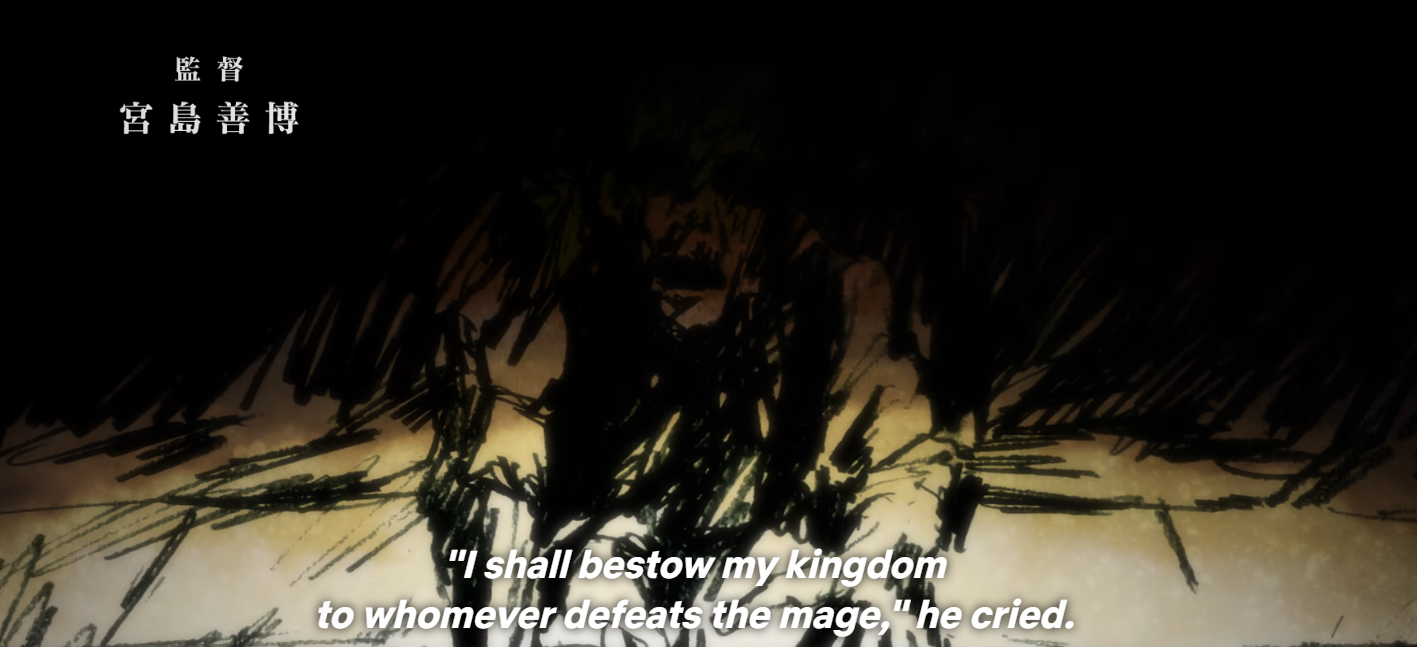
Naturally, the orcs don't want any more human kingdoms in the world than there already are. And they especially aren't keen on being displaced yet again by this one's restoration. So, Zon asks Laios, very intently; if Laios were to become the ruler of this place - as an underground dungeon or as a restored surface kingdom, whatever - what would he do?
Laios replies truthfully that he never thought about that, and that he never expects to have to think about it. He and his companions first came here to look for gold and jewels left behind by the old kingdom. Now, they're trying to resurrect his sister. None of them have any interests in this place beyond that, and they probably won't be staying any longer once they've revived their cleric. Frankly, Laios doesn't know the first damned thing about being a king, and he isn't especially interested in having to learn.
This answer seems to satisfy the orc. Letting these people go might not help his tribe deal with other, less ethical, adventurers, but it won't hurt them either. No reason to kill them.
...
Whether or not a party of orcs would have been able to get similar treatment from a human or elf lord, of course, is a question left to the audience.
Even taking into account the fact that unlike the orcs, said human or elf would have little to fear from letting orcs learn where their large, obvious surface town is located.
But, for now, this is just a story about this one handful of individuals.
...
So, they part on good terms. Hopefully this won't be the last time.
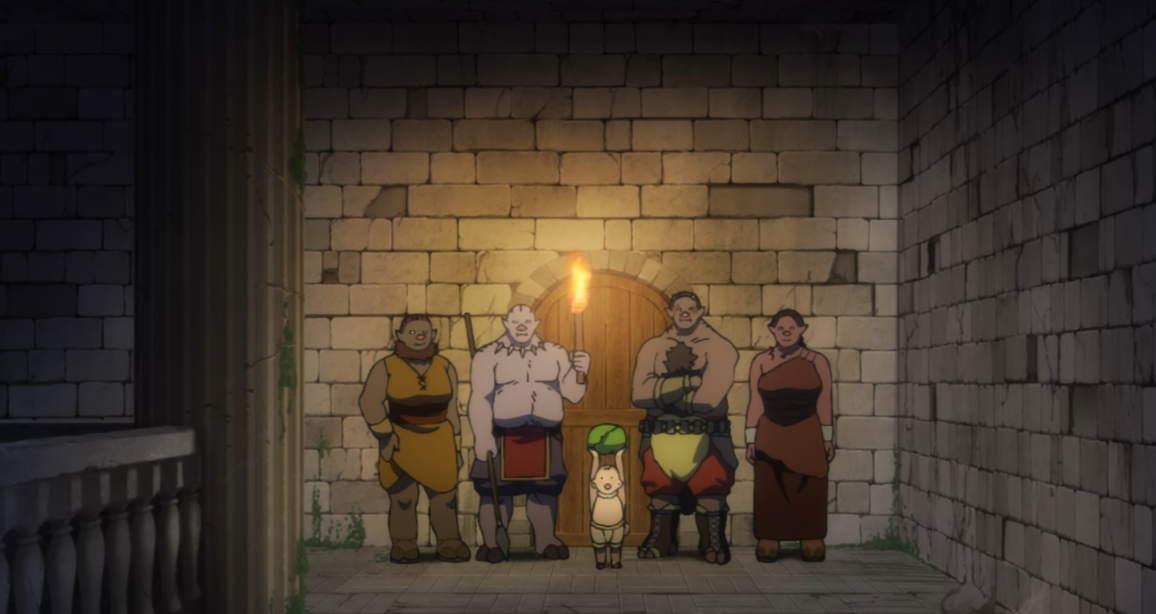
The fact that Zon's tribe just did a highly successful supply raid and killed a bunch of people who really did pose a threat to them probably helped, of course.
The following episodes bring the party down into a maze of undead-infested castle. Undead are, unfortunately, inedible (no one in the party is a Victorian aristocrat), and there aren't many other monsters to be found in places where they roam. Fortunately, the party gets a windfall, though it comes in the form of another group's grisly demise. And, after that, we have a zany time travel adventure that starts to fill in the lore behind this entire dungeon and the ghostly king who first advertised it. Also, there's ghost ice cream.
Those will be covered in the next post.