Girls' Last Tour E1-2: "Starry Sky; War" and "Bath; Journal; Laundry" (part one)
This fast-lane review was commissioned by @Bernkastel .
Post-apocalyptic slice-of-life is an increasingly prevalent little subgenre. This mid-2010's manga-anime series is a particularly artistic example of it. Calling it "slice-of-life" doesn't feel entirely appropriate, since the chief concern of the characters is day-to-day survival, but "survival" feels like an even less fitting genre label. The atmosphere. The relaxed pace. The amount of time spent on characters just chatting with each other, and the lack of anything more urgent that they could or should be doing during that time. Taking the feel and sensibilities of the story into account, slice-of-life really is the least bad fit.
In terms of other descriptors, I think "cute," "heartwarming," "tragic," and "haunting" would probably top the list. Maybe followed just shortly by "beautiful." Both visually and conceptually. From the pilot's opening shot of dripping water showing a split-second reflection of the unseen starfield above the decaying roof, to the second episode's melancholy flooded cityscape.

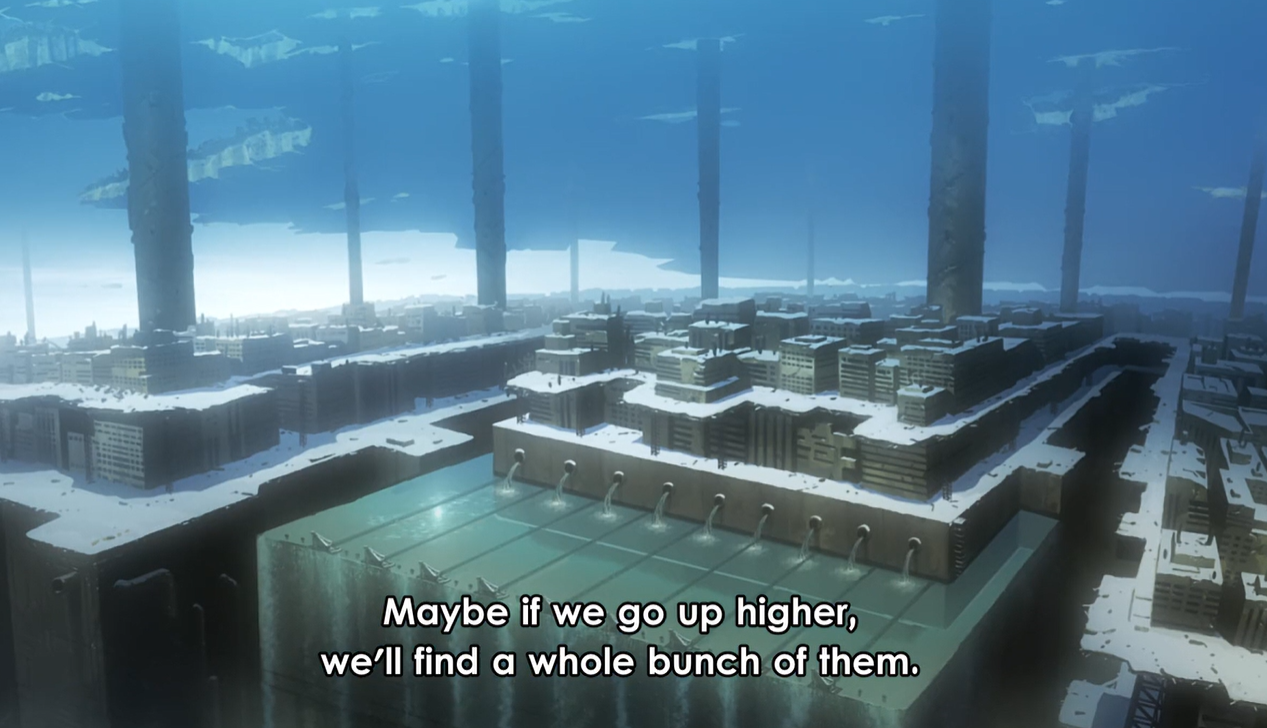
There are some very unusual visual choices made in this series. For the most part, the art style is gritty, technical, and incredibly detailed. Recognizably anime-looking, but having more in common with photorealistic art or even outright technical diagrams than with most other anime environments. Even the rare natural elements like snow, rivers, etc have a crispness to them that feels almost industrial in its stark perfection, almost too exact to be real.
And then there's the character art. There are only two characters in these episodes (possibly in the entire series), and they look like this:
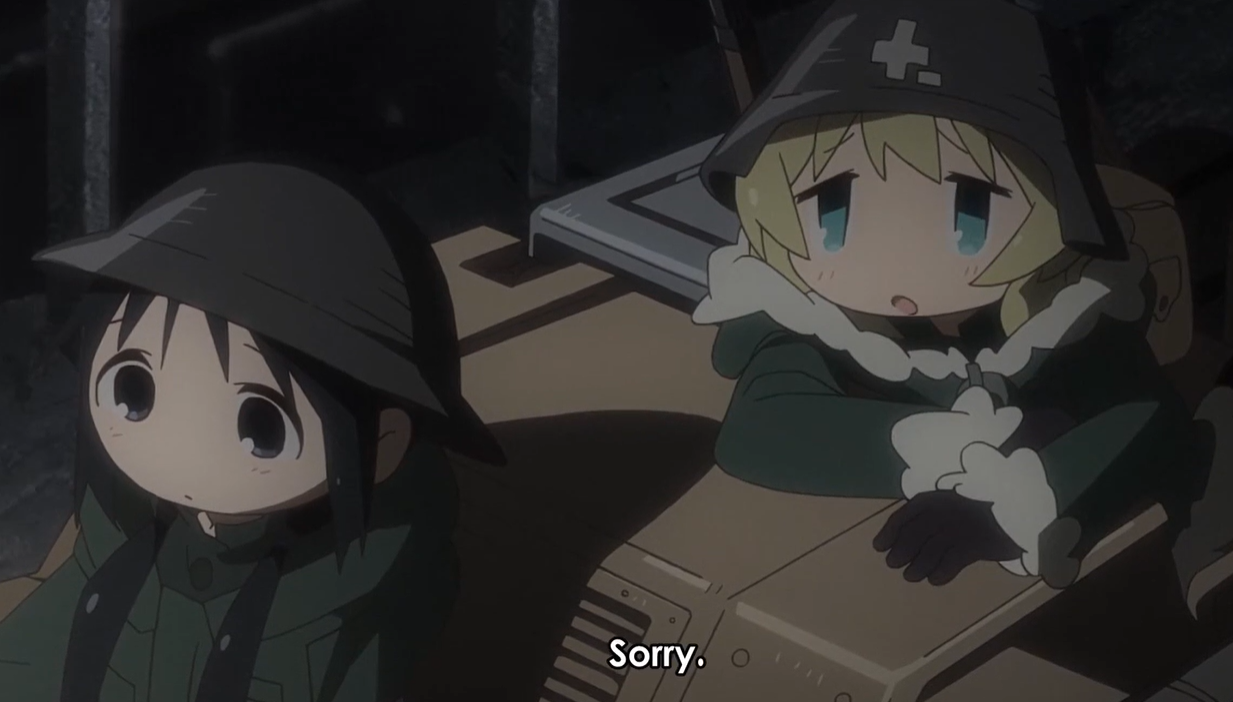
Is it jarring? Well, it was for a little bit, right at the beginning. I got over it very quickly, though. The out-of-placeness of these two little chibi girls serves to emphasize that they are, in fact, out of place. They shouldn't be here. Nobody should be here. Least of all these two innocent preteens struggling to hold onto some sparks of optimism and innocence despite the death of the world around them, and - against all odds - mostly succeeding in that struggle.
We don't know where Chito and Yuuri are from, or why they appear to be the only two survivors in this ravaged post-apocalyptic city. There are mentions of the two of them having departed from Yuuri's grandfather's house some time before the opening, but it's not clear where that was, how long ago that was, or whether the grandfather in question was still alive at the time. We don't even know where these two girls know each other from; based on their interactions in these early episodes, they haven't known each other for very long. I would say weeks at most.
The ruins they wander through are strongly evocative of the Winter War. The occasional, very brief flashbacks to the actual conflict that we occasionally see in Chito's memories have a grainy, fuzzy look to them, evoking WW2 era video footage.
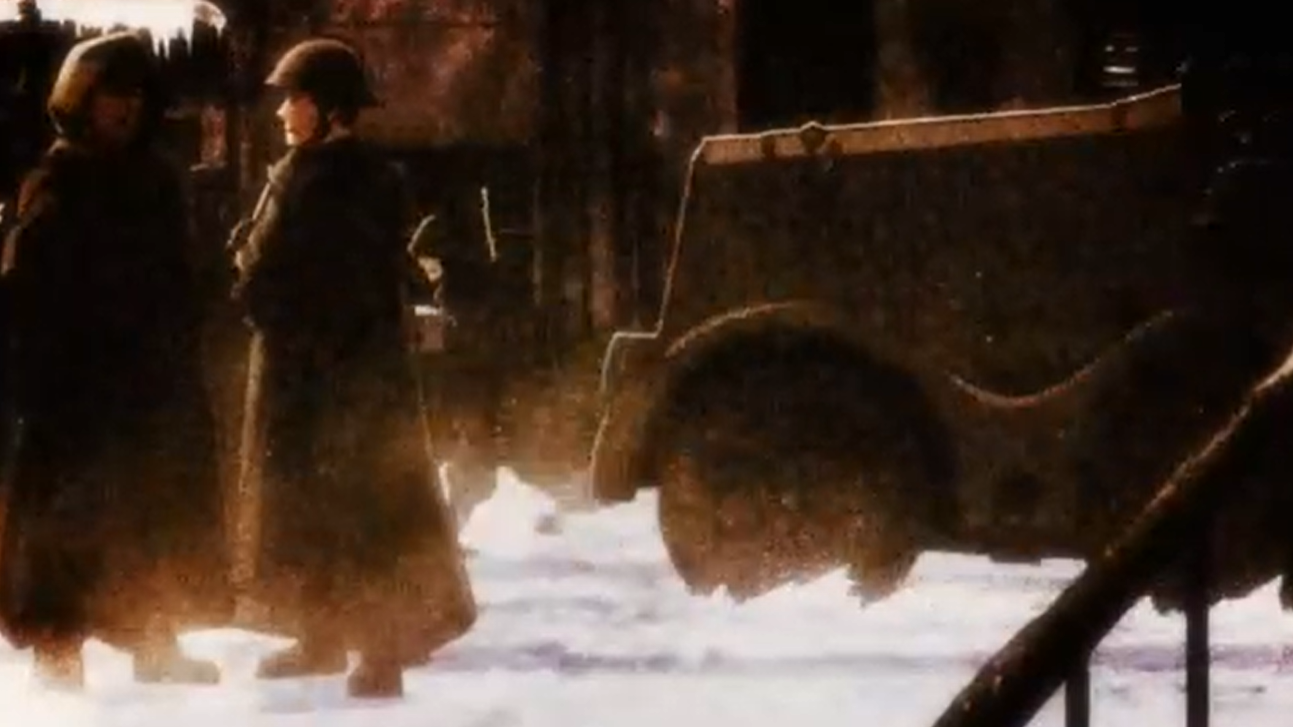
The vehicle that allows them to travel through the ruins is specifically a Kettenkrad motorcycle-tractor, a German vehicle with a service history of 1941-1945. Other recognizable WW2 vehicles and weapons are featured, abandoned and rusting, throughout the environment. However, the scale and complexity of some of the mechanical ruins they drive their blueprint-accurate halftrack through are more "fantasy dieselpunk" than historical 1940's.
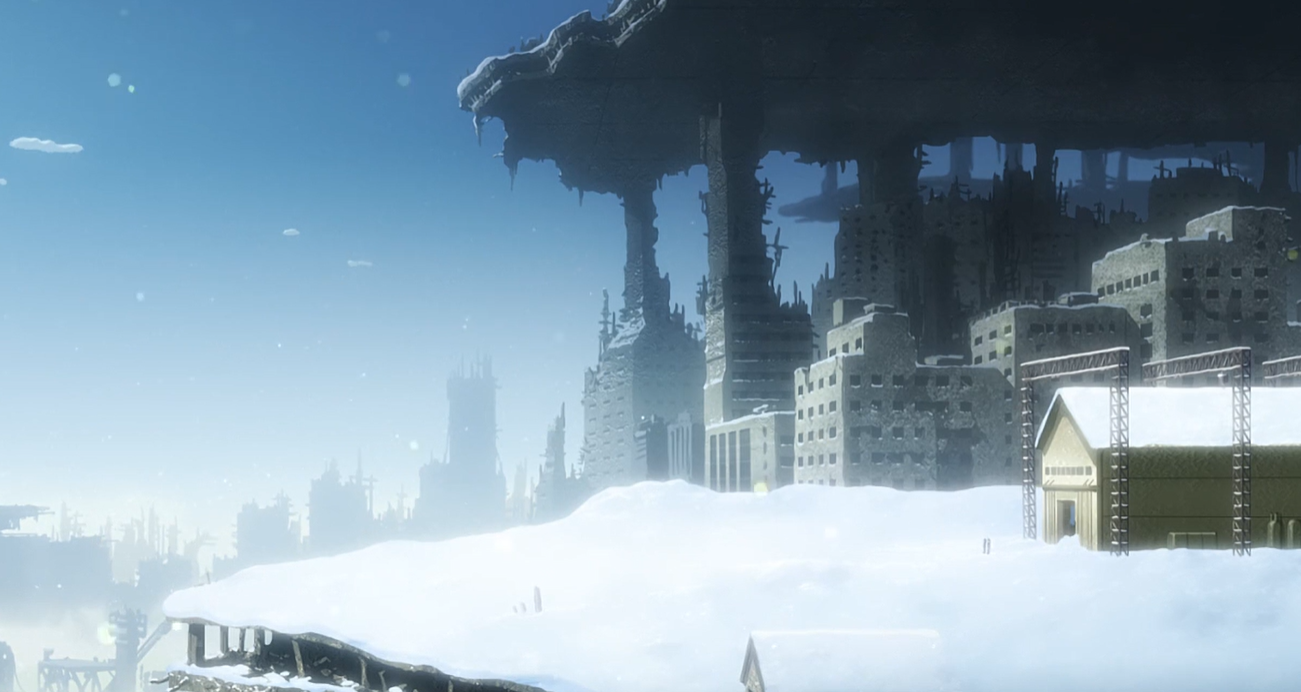
It almost looks like an eastern-front-colored version of "Blame!"
The scale, nature, and reason for the war are unknown. Maybe it was just this one city that was depopulated, maybe it was the entire planet. When wondering about the causes for the war, the closest the girls come to being able to understand it is Chito telling Yuuri that "when you have three people, but there's only enough food for two, then I guess you get war."
Honestly, that moment might have been one of the most heartbreaking ones in these episodes, for me. These two children literally can't even conceive of the kind of irrational greed, hatred, and ego that a war like this requires. Chito isn't trying to whitewash the people who caused the conflict, but her imagination isn't dark and cynical enough to grasp at the truth. Even as she suffers through the lonely, hopeless ruins that these people inflicted on her, Yuuri, and whatever other poor souls might still be clinging to life in the region.
It's actually Yuuri, the more simpleminded of the two, who idly comes closest to the truth (without realizing it) while idly griping about how hard it is for them to scavenge supplies.
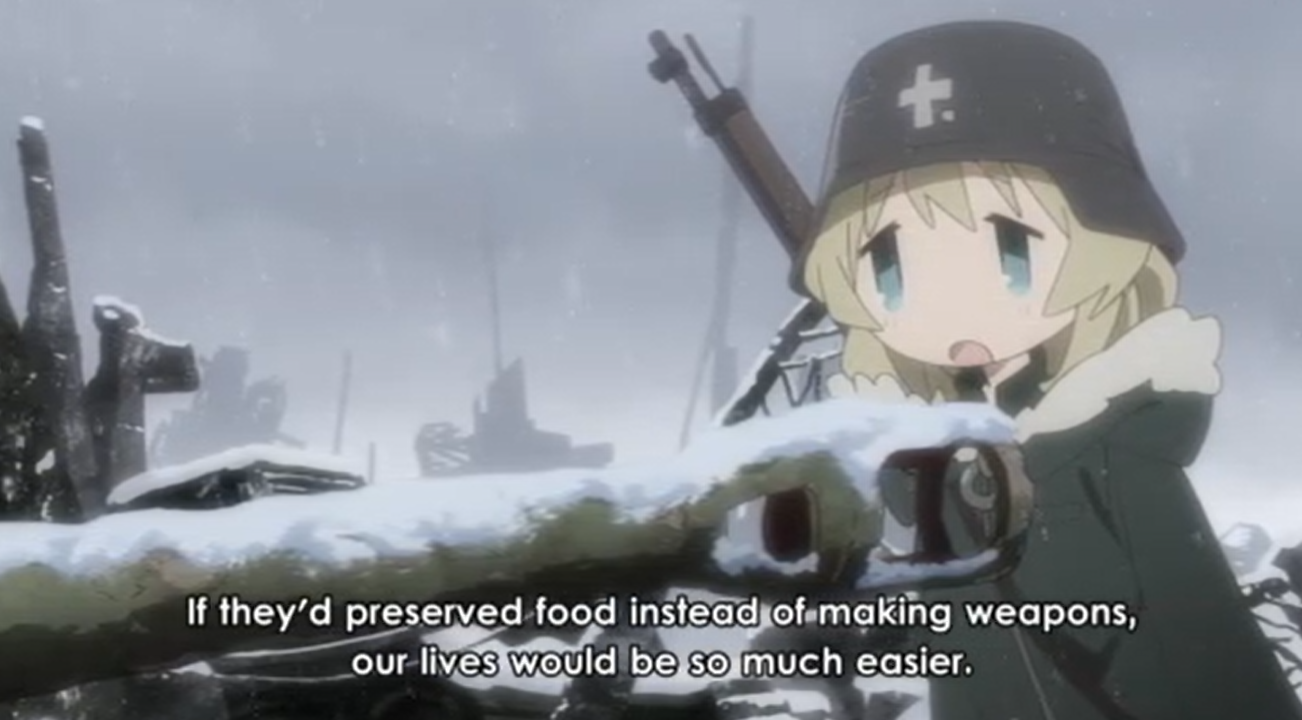
Chito was wrong. They could have produced more food. They chose to do this instead.
Chito and Yuuri themselves are at least as mysterious as the war that stole their future. Chito is the one who knows how to drive and maintain their vehicle, understands how cities are designed and where to search for stuff in them, and generally seems like a child who's survived years of war-refugeeism. Yuuri...I described her as "the simpler of the two" earlier, but that's probably both an understatement and a bit of a misdiagnosis. Yuuri seems to be ignorant of not only war and survival, but also of basic things that you'd expect a kid her age to know in general (she's iliterate, among other informational deficiencies). Her personality is more childish than Chito's, and she's emotionally immature, but I don't know if "slow" is exactly right. Also, despite being very sheltered, Yuuri seems to know her way around a rifle in a way that Chito doesn't.
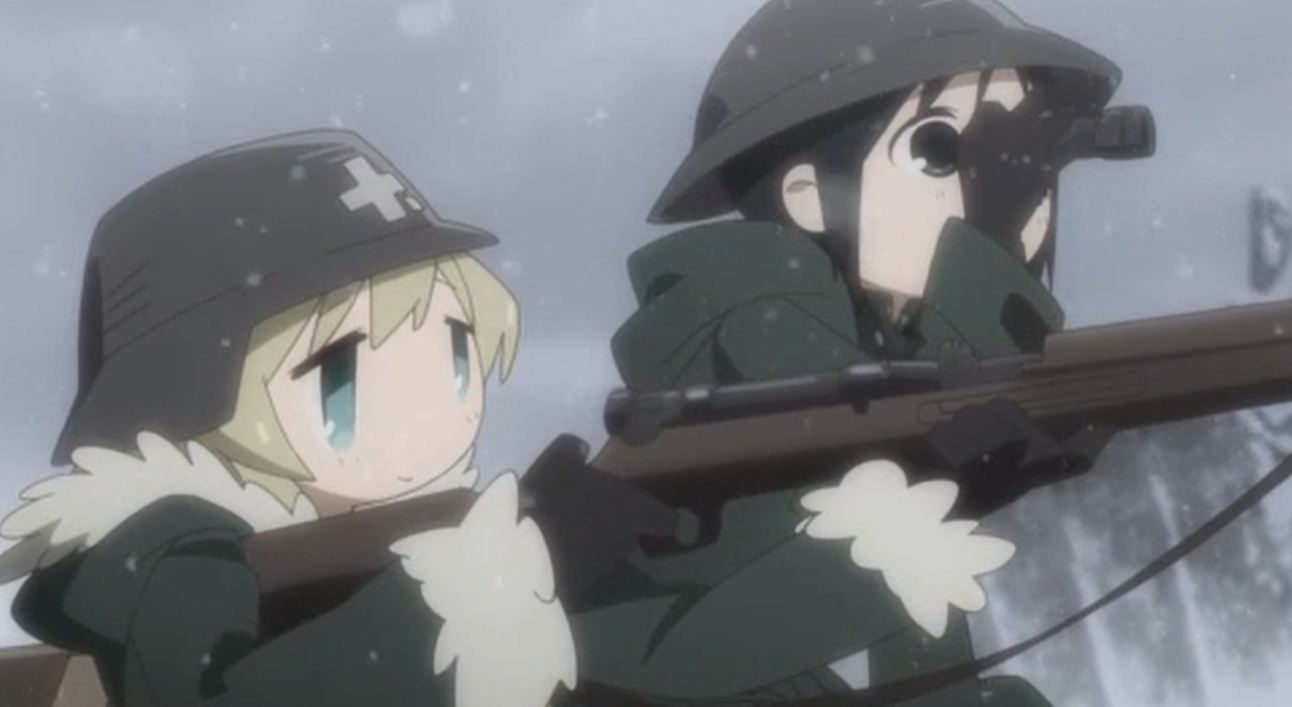
Not that there's anyone they need to defend themselves from. The gun seems to be as much a totem of security as it is something they'd ever need to use as a weapon. That said, it does come in handy sometimes, like when they need to shoot open a pipe to access the water. Scope or no scope, Yuuri's accuracy despite being a kid and the rifle having recoil is fairly impressive.
For all their youthful innocence though, the relationship between these two isn't purely saccharine. At the end of the day, they are both severely traumatized (though seemingly not in the same ways), and they don't appear to have chosen each other for companions. They can get downright nasty to each other sometimes, in ways both realistically childish and realistically born of pain and fear.
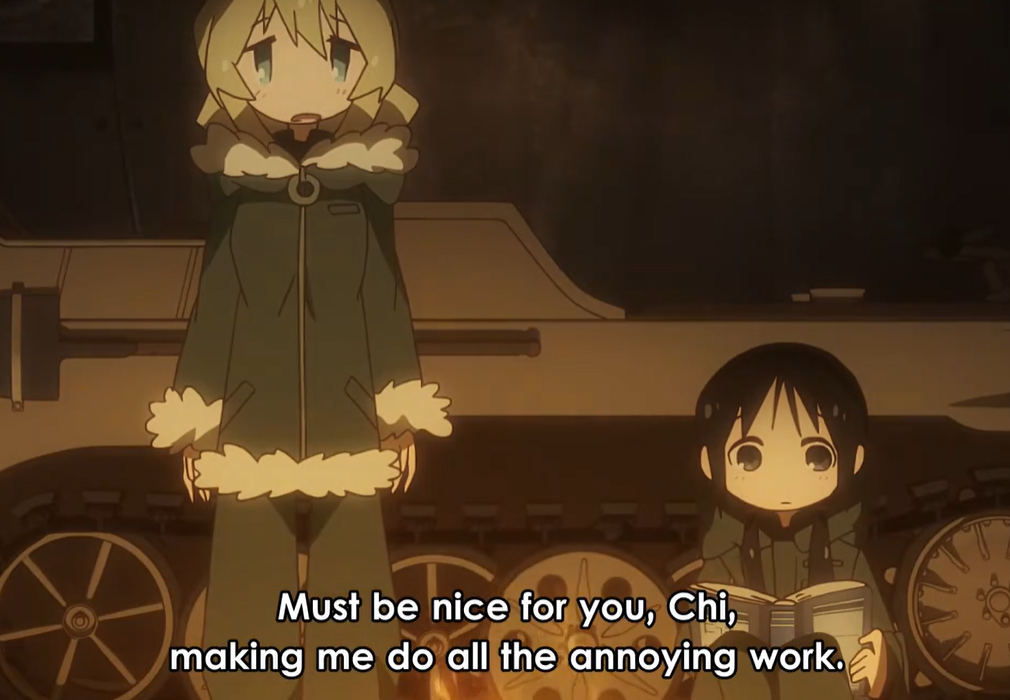
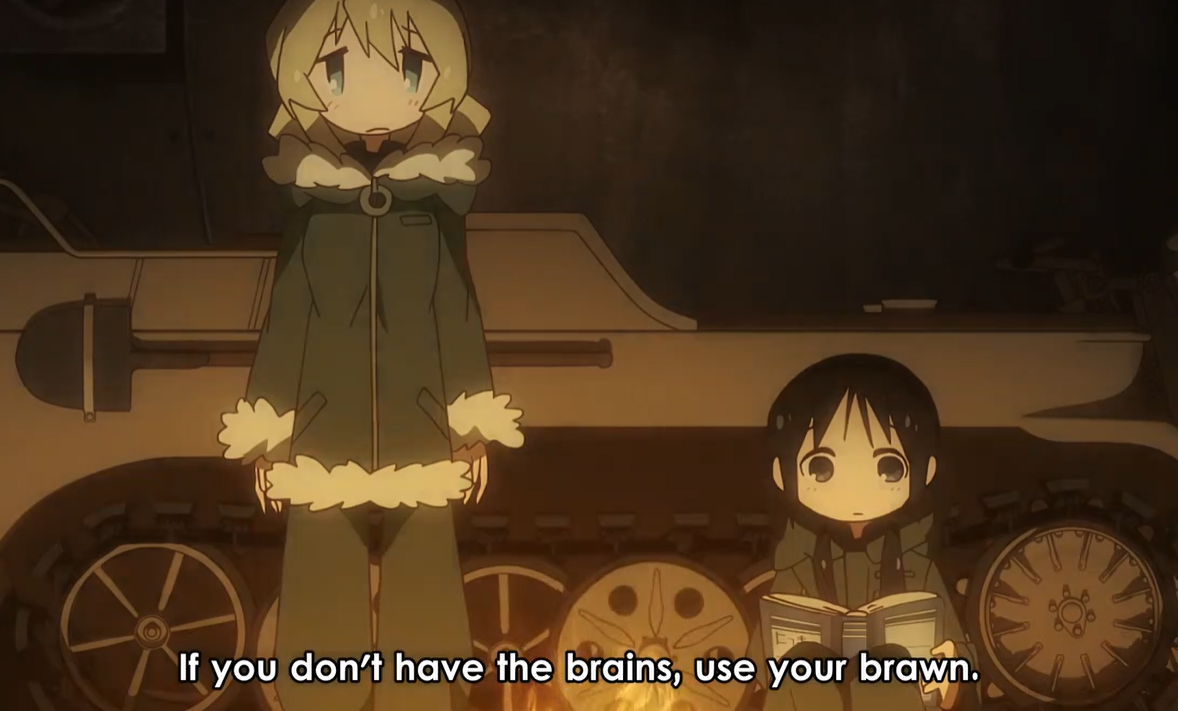
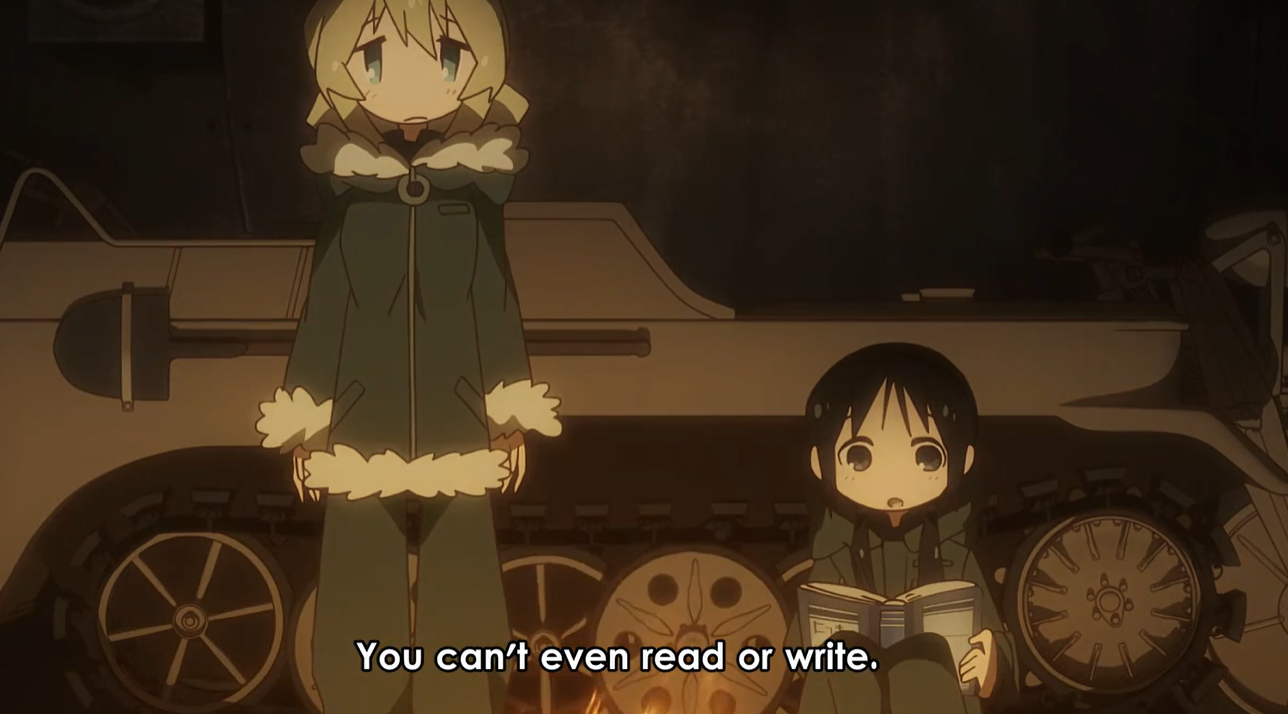
Chito could have said "you're taller and stronger than I am," or "I'm exhausted from driving for hours, and both answers would have been at least as correct as this.
It isn't as simple as "Chito is emotionally abusive toward Yuuri" either. Yuuri gets revenge for the above by using one of Chito's few remaining books (which Yuuri can't get any use out of, a fact that Chito just rubbed her face in) to feed their heating fire when fuel runs low. She sort of plays innocent while doing it, but it's not an act that either I or Chito completely buys (even though I don't think she understood the severity of her action until she saw Chito's reaction to it).
And yet, despite this, their reconciliation at the end of that little arc is heartwarming and bittersweet-optimistic again. Yuuri having gained an understanding of just how much books can mean to people able to use them, and also of how important it is for her companion to be able to keep writing more things down in the journal she's been keeping. Yuuri's apology gesture, using a little spare room in one of Chito's journal notebooks, also demonstrates that the former has other skills besides marksmanship.
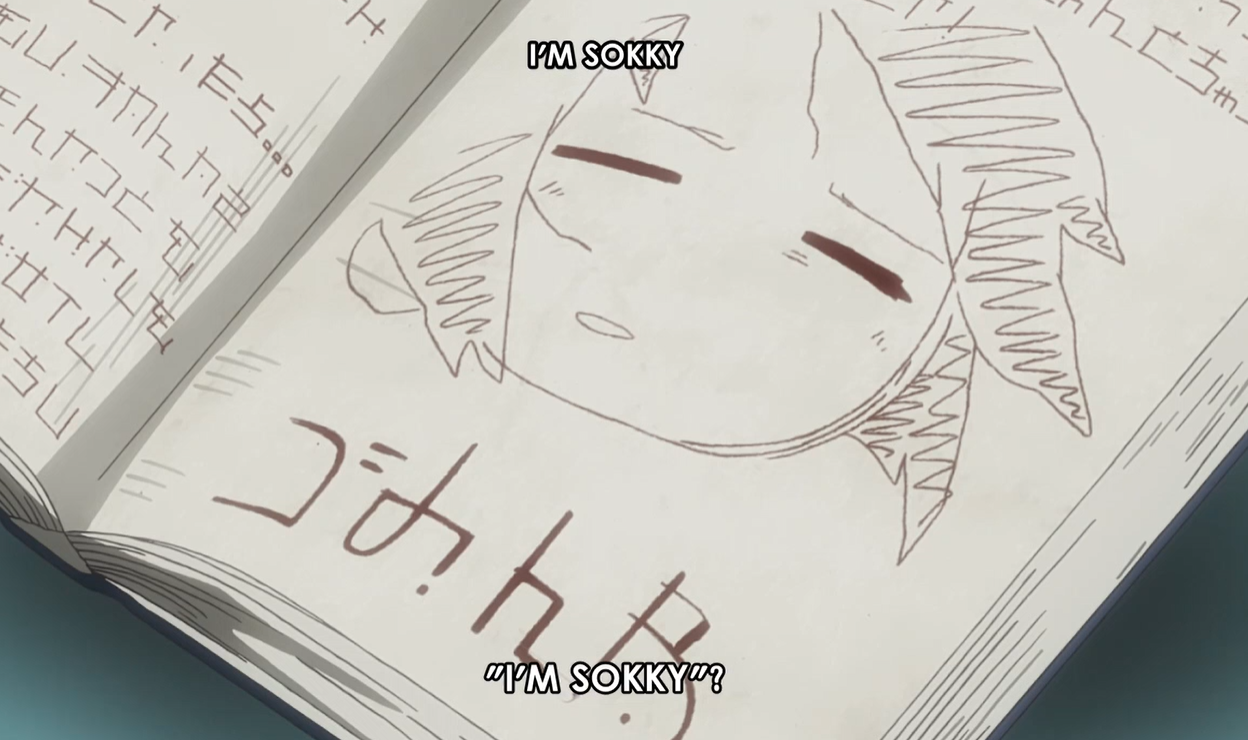
Or, well, I think it does. The characters being chibi-style makes it hard to tell if this is a typical childish scribble, or an incredibly lifelike self-portrait. But I choose to interpret it as the latter.
Another scene like this happens in the first episode, shortly after Chito tries to rationalize the war as "not enough food for three people" and Yuuri accidentally nails it with "chose to make weapons instead of necessities." After some time scrounging among the ruins of an old base, they find a military cargo plane full of supplies. Among the standard MRE's, they discover a package of chocolate bars. It tells us quite a bit about the state of the world prior to these two being abandoned in the ruins that neither of them have ever had chocolate before; they've only heard of it, at best.
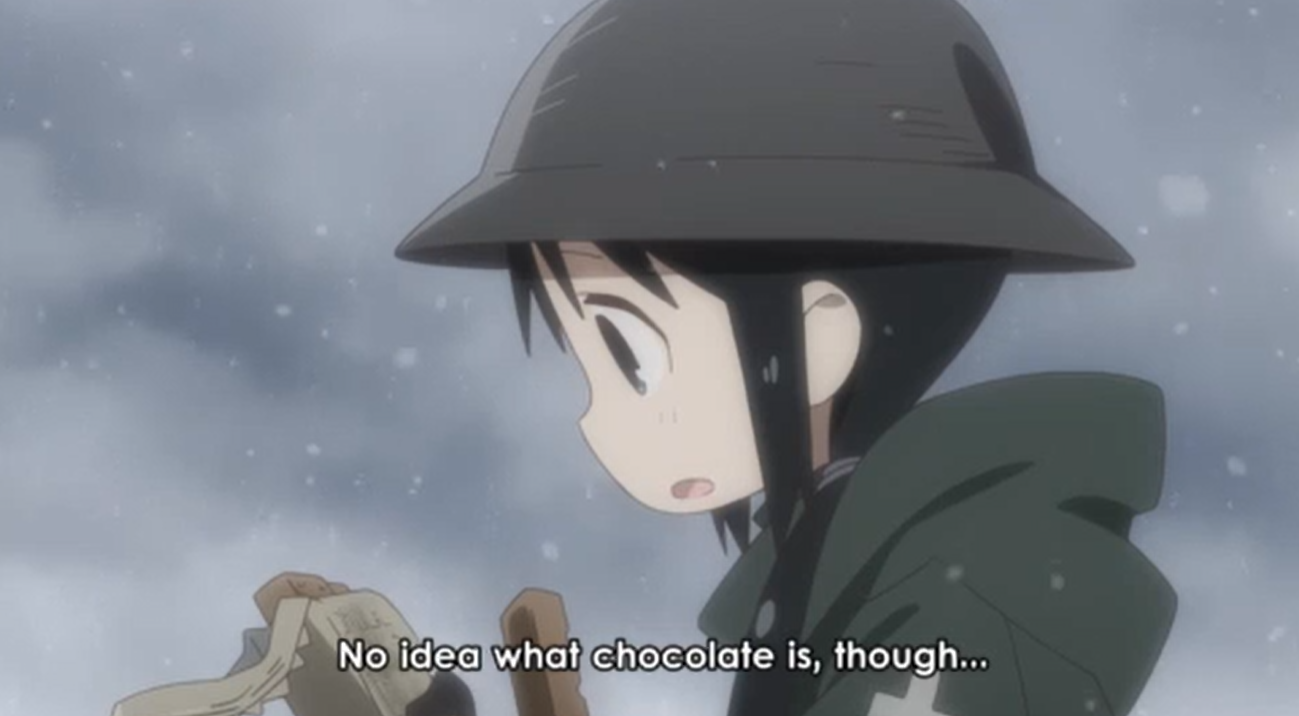
In all probability, these bars are probably shitty, watered down, army-grade chocolate. However, to children who have known only wartime deprivation, the taste is enchanting. Almost mindblowing. The simple joy the two of them experience at their first taste of chocolate. After snarfing their way through four of the five chocolate bars in the package, it comes time to decide how to split the fifth one. At which point Yuuri coldly observes that they have two people and only enough chocolate for one. This is Chito's own logic, yes?
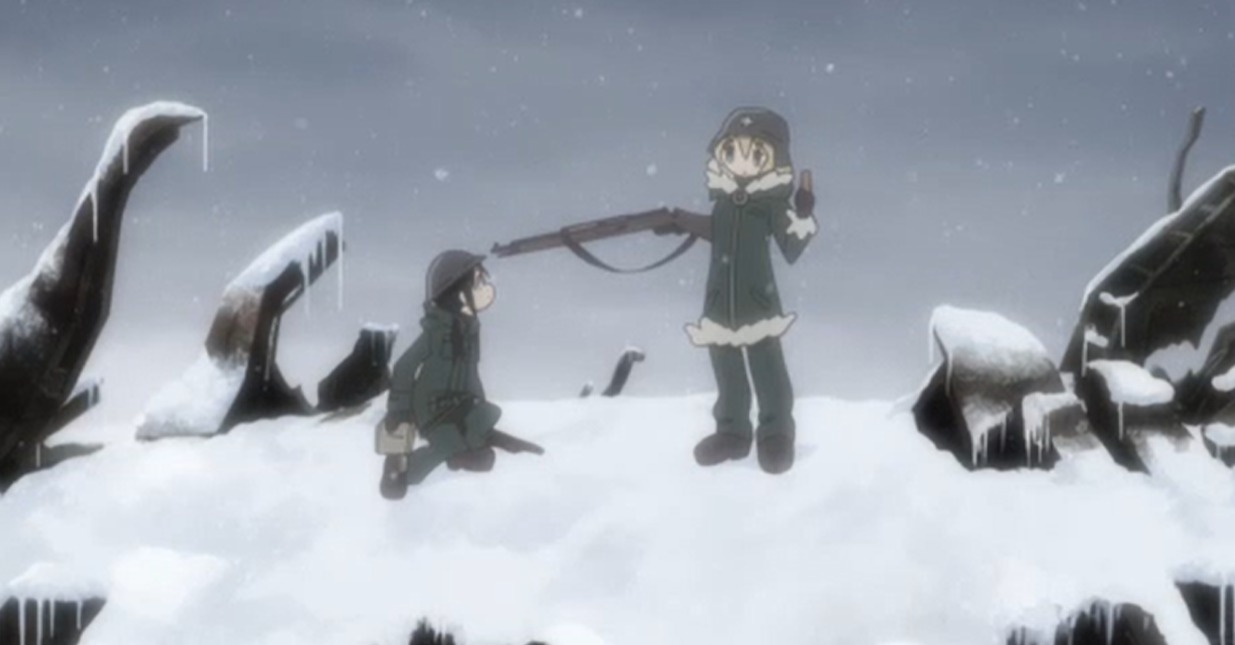
There's this dead silent moment as Yuuri holds Chito at gunpoint and takes the last candy bar. Chito comments on how foolish she was to not carry a weapon of her own and trust her companion with an effective monopoly on violence. Yuuri nods grimly and tells her that yes, yes she was.
Then Yuuri stuffs the chocolate in her mouth, prompting Chito to let out an outraged "YOU ACTUALLY ATE IT!" and throw herself at the other girl in a furious wrestling match.
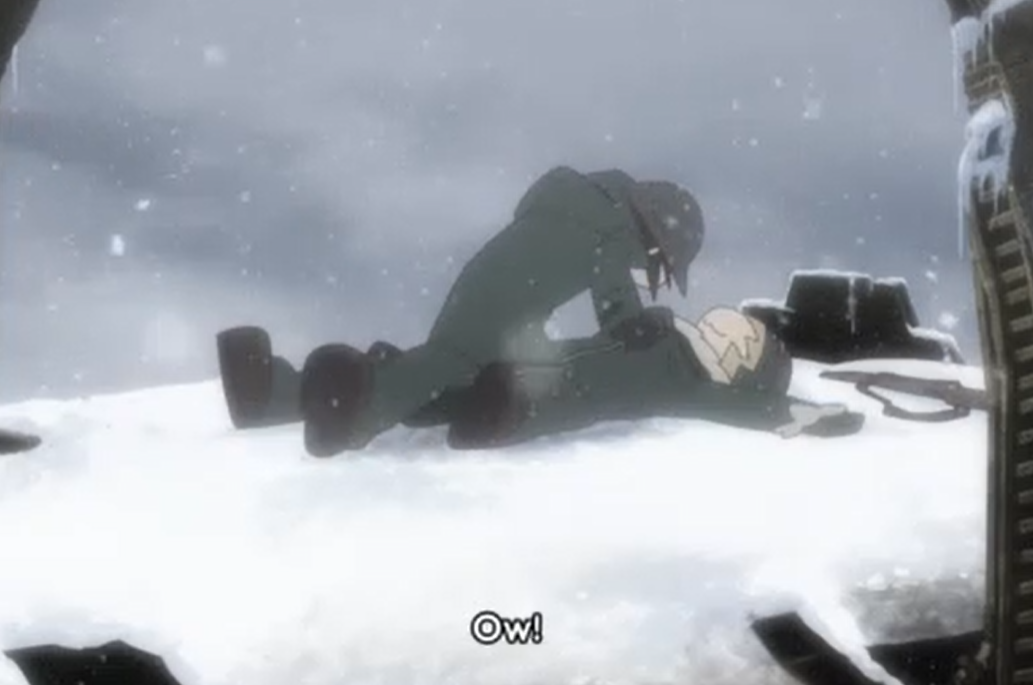
Which in turn devolves into exhausted giggling and not-that-serious griping.
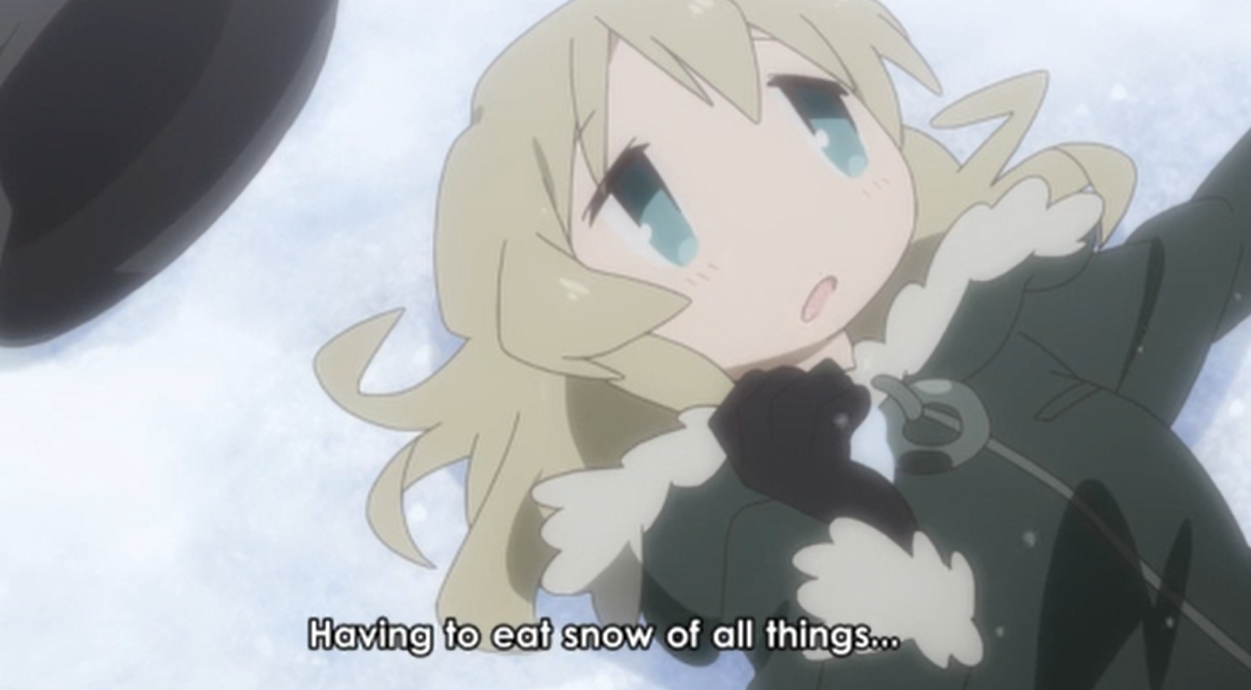
We are then shown that the rifle wasn't loaded. Chito's life wasn't actually in danger. What's less clear is if Chito knew that her life wasn't in danger throughout that entire sequence. Was she really just playing along when she fearfully gave up the candy bar, only getting actually upset when it actually went in Yuuri's mouth? Or did she actually think that Yuuri was serious for the first few seconds before noticing (either before or after giving up the candy) that the clip was open?
In the former case, it's whatever. In the latter though, then it really shows just how immature and lacking in understanding of consequences Yuuri is, and how desperate Chito is for friendship if she's this quick to forgive such an action. How warped her sense of what's acceptable must be, after living the life she's lived, for her to be able to see this as just a prank.
The ambiguity of this interaction perhaps makes it one of the weaker examples, but it's still a case in point of how Yuuri and Kito's relationship bobs between cherubic friendship and compassion, and fairly nasty mutual abuse of at least the emotional kind if not physical. They're just damaged enough for it to feel real, and just pure enough for it to be heart-tugging.
Splitting it here.