Dungeon Meshi S1E4-6 (part two)
I may have spoken too soon on the "silly and serious alternating" front. After all, episode 5 delves deep into Laios' love and appreciation for his sister Falin, and manages to make the audience - despite only having seen her for a few seconds at the start of the pilot - invested in her revival as well. Sure, any cleric can use turn undead, but it's only a rare few who can feel earnest compassion for said undead even while they're trying to kill them. A woman who could pacify some evil spirits with sheer displays of earnest compassion, even before bringing out any of the divine magic.
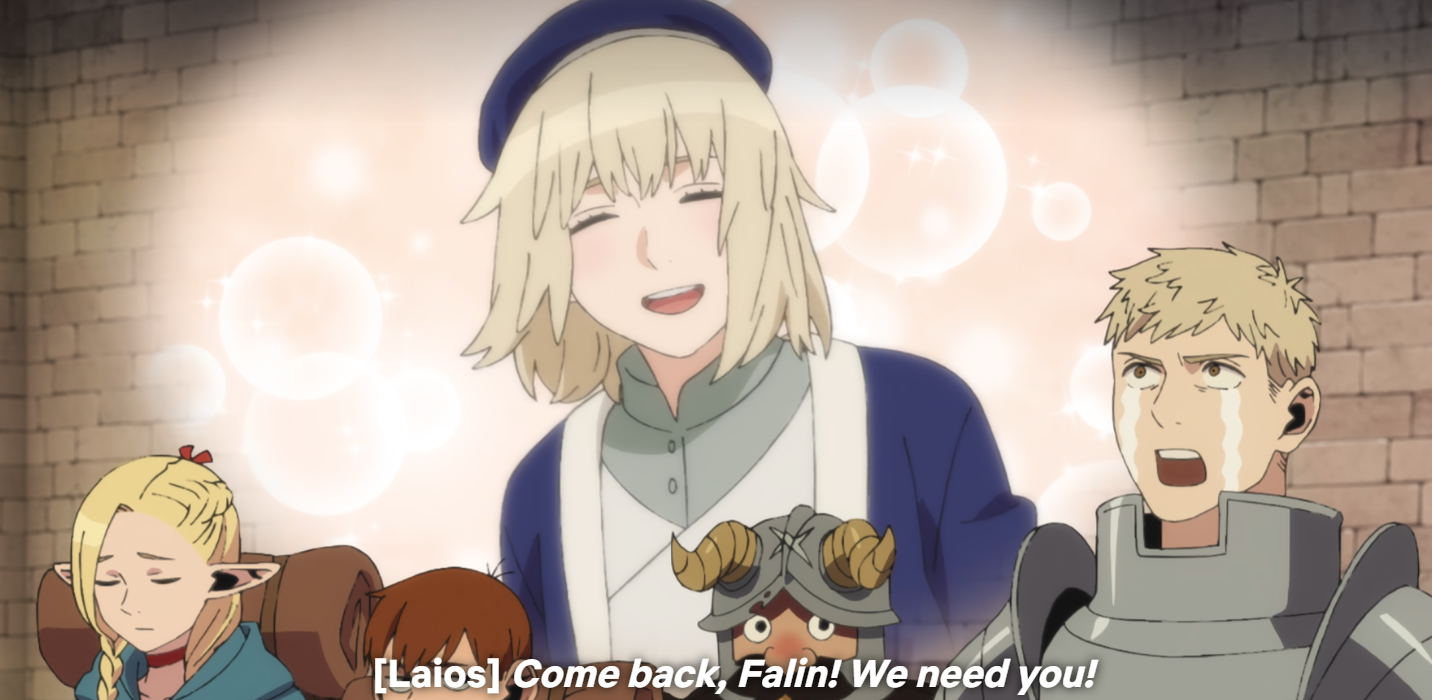
It is during the party's encounter with a pack of vengeful ghosts that Laios and the others most sorely miss Falin, and - implicitly - wonder if any of them have it in themselves to measure up to her spiritual strength and goodness.
And then they make ghost ice cream.
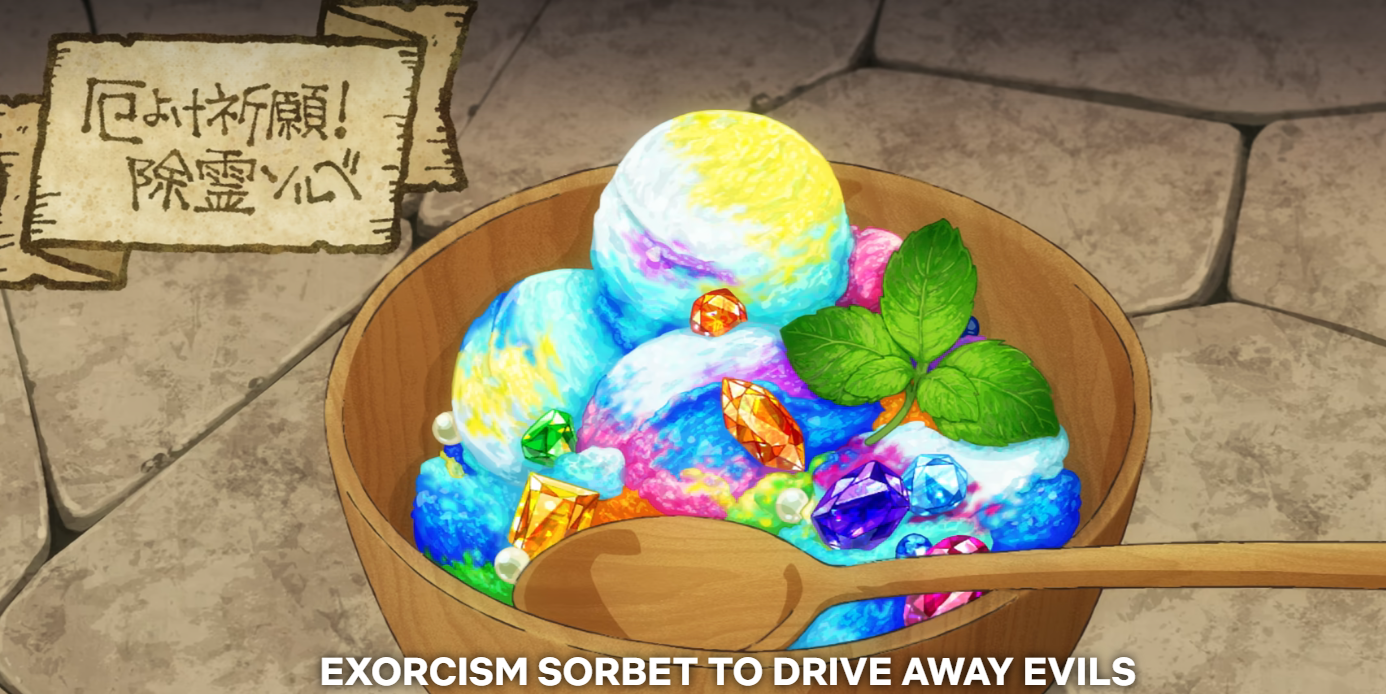
Technically ghost sorbet, since there's no milk in it, but same idea.
Disregard all of the above. This is still a silly one. I was wrong.
That said, there's actually a bit of...worldbuilding? rules lawyering? not sure what to call it exactly...that I think I should take into account in my own DnD (and DnD-like. Shadowdark ftw) games. Since containers will go right through incorporeal undead, you don't need to actually expend your holy water to deal with them; just swinging an object containing the sacrament through them will bring them into contact, without you having to open it up and splash like you would on a skeleton or zombie. Genius!
The fact that in this case the party's bargain bin substitute for a conventional sacramental liquid - an extemporaneous mixture of alcohol (sacred in some cultures), salt (also sacred in some cultures), sugar (because it looks like salt), some herbs with both ritual and culinary utility, and fried insects that look a little bit like holy sun-scarab beetles if you squint - gets chilled solid as a result of its usage against the ghosts provides a built-in reward.
The aforementioned fried insects have a bit of a story behind them too. The chapter before this one actually opens up with a set of decoy protagonists; another of the many adventuring parties plumbing the megadungeon. We get a montage of them eating at an inn on the surface, making their way underground, and doing some quirky team bonding that makes it seem like we might be meeting some ongoing deuteragonists.
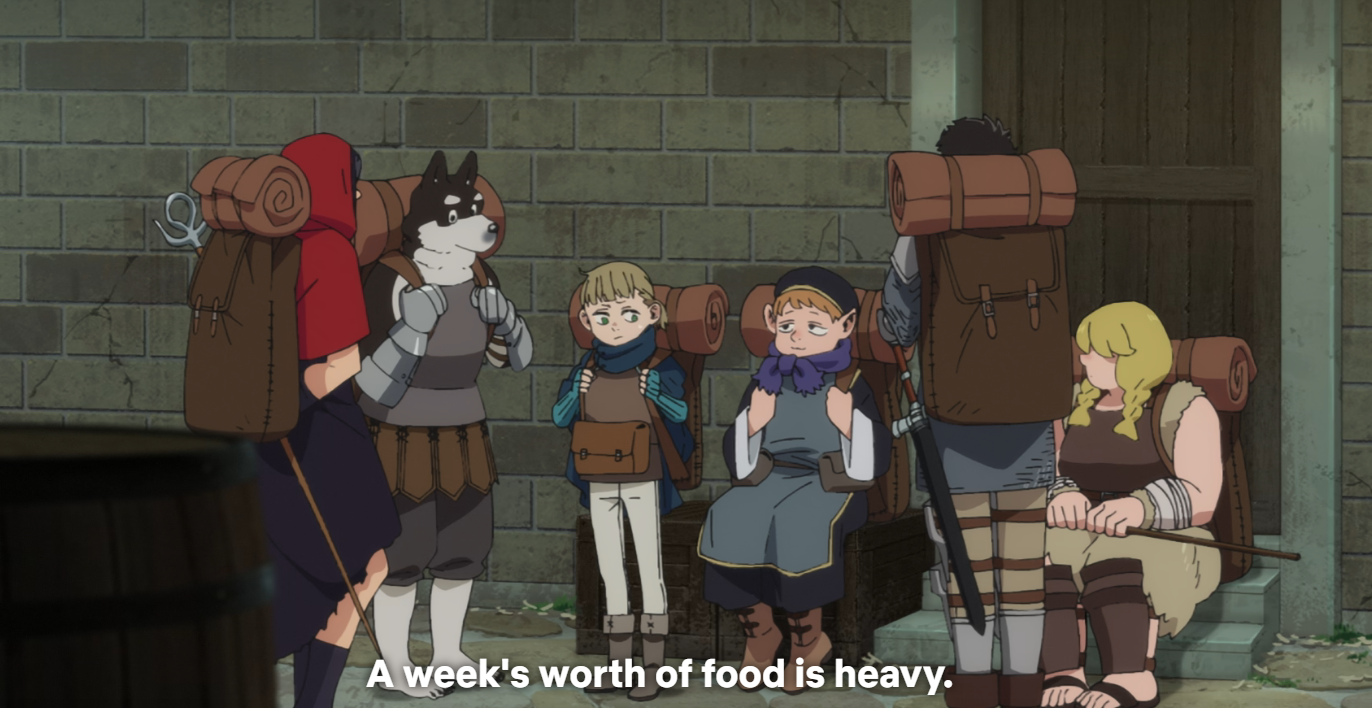
Not sure what's up with the anthropomorphic husky.
The montage ends with them finding a small treasure chest that seems just a little bit too packed full of jewels for this upper dungeon stratum that's already been picked clean. Unfortunately, the adventurers are too eager for some good luck, and they don't question their improbable windfall.
Cue the main party finding their dead bodies, surrounded by innocent-looking gold coins and jewellery.
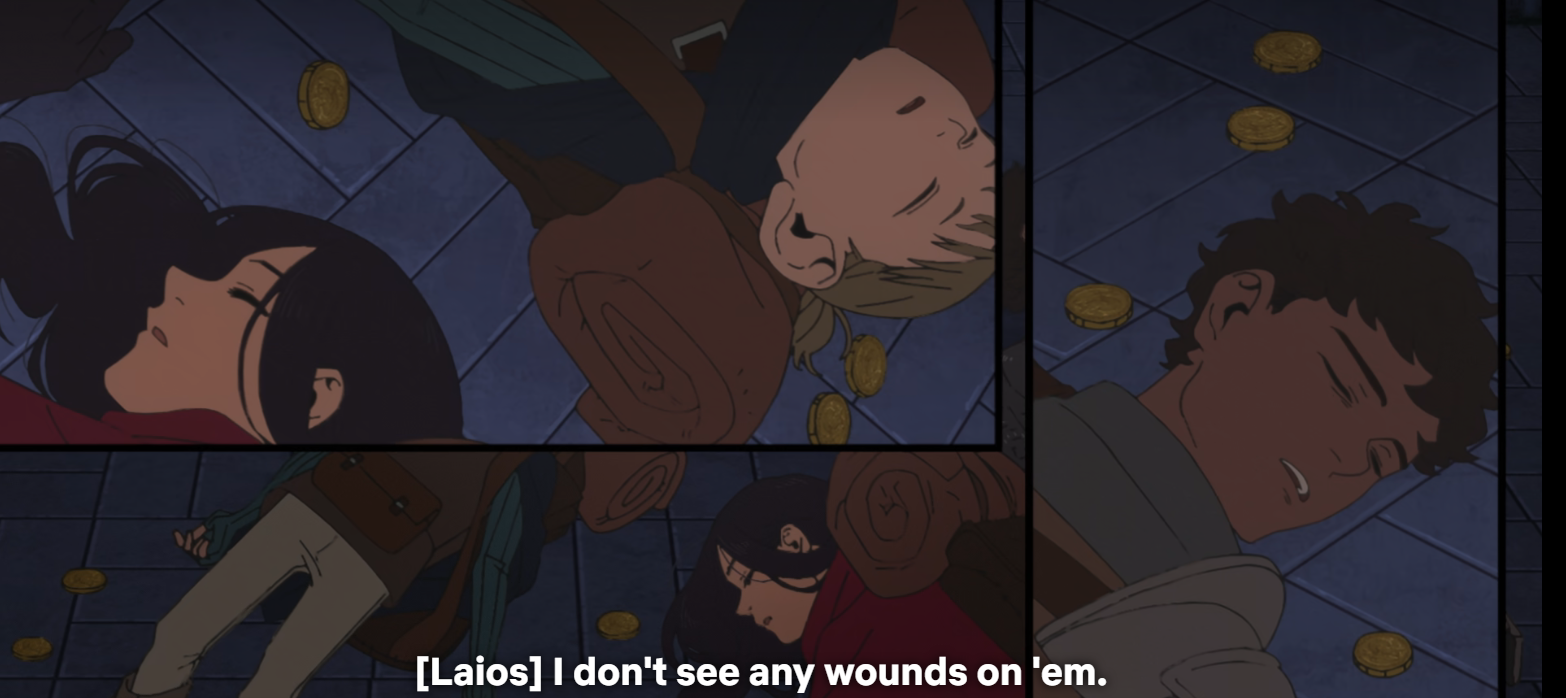
This is where we meet the "treasure insect." A family of related insect species that can tuck in their limbs and look indistinguishable from gold and jewellery when dormant. They also pack a deadly sting. And also are good fried, even if it takes one of Marcille's limited-use spells to bring them all down.
There's also a punchline to this skit where Senshi, after carefully sorting the bugs up into edible and inedible piles and throwing the latter away, casually mentions that the ones he discarded were inedible due to being real treasure. It's funny, even though I saw it coming. And it also says something about Senshi, that he sees literally no value whatsoever in wealth that can't be readily used for something. An interesting contrast to how dwarves have typically been portrayed; I wonder if Dungeon Meshi dwarves are all greedless like this, or if it's just another way in which Senshi is an oddball?
Anyway, the treasure insect episode both provides the, erm, "scarab" for the exorcism sorbet, and contextualizes another antagonist in the more serious instalment "Boiled In Saltwater."
Back in the first couple of episodes, we learned that Laios has resurrection trauma connected to the animated armor monsters (though not to the little molluscs that animate said armors, given how he dotes on the one that's moved into his swordhilt. In fact, his pet armorclam is to thank for warning them something was amiss about the treasure scattered around those corpses, as it vibrates violently in the presence of what seems to be a natural enemy of its). Well, it turns out that Chilchuk has a similar PTSD complex related to mimics. It's not clear if one has ever actually killed him or not, but he's been mauled by them enough times throughout his thief-ing career for them to become his most hated creature.
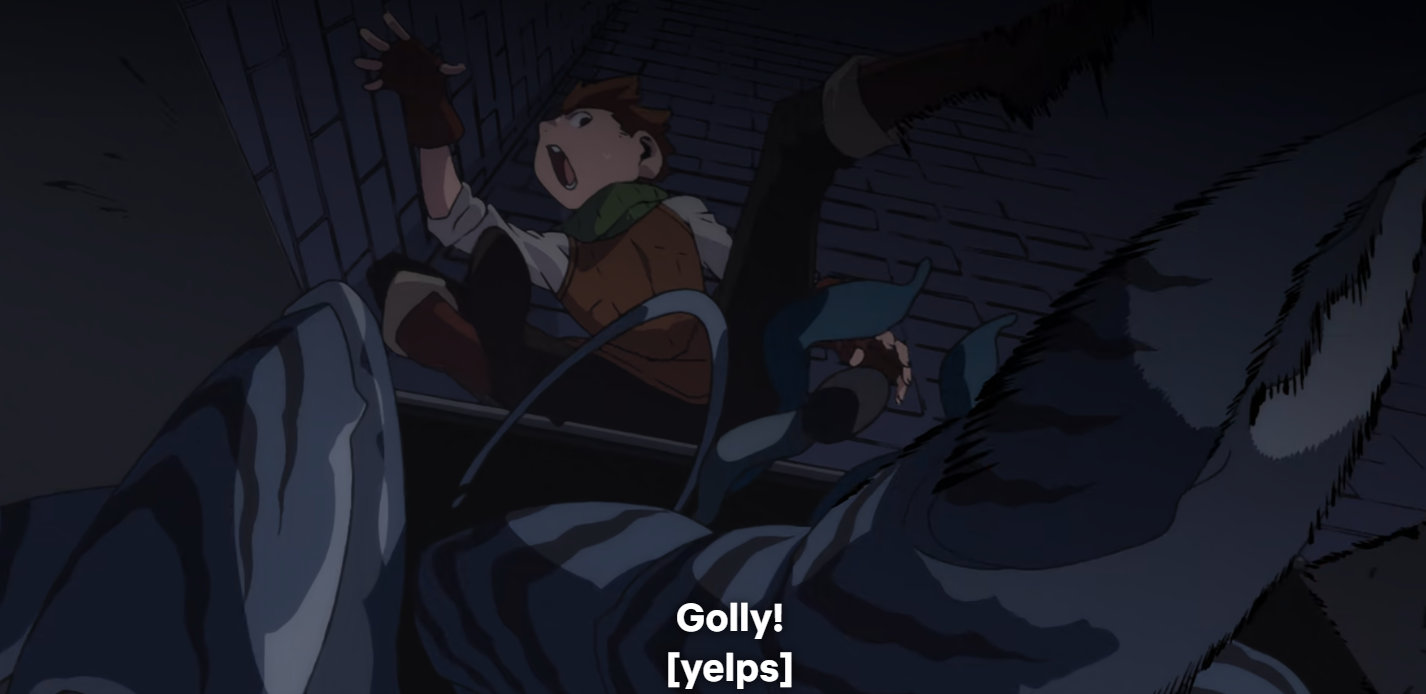
I'm actually not sure why these creatures are called "mimics," though, because they don't actually do any mimicry (if anything, the "treasure insects" are much more meriting of that name). Dungeon Meshi's mimics are giant terrestrial hermit crabs that use boxes, buckets, and pieces of furniture as their shells. They don't mimic the object, they just hide inside of it and carry it around with them.
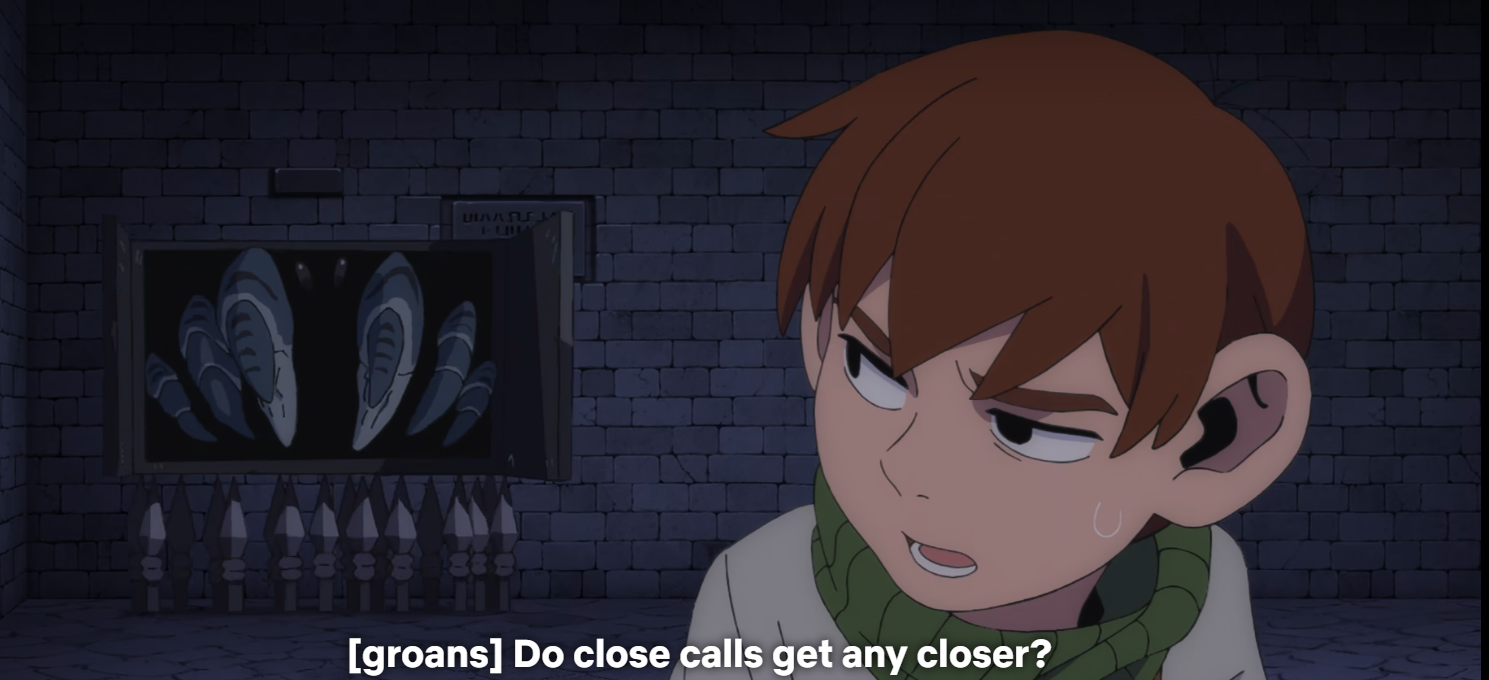
Ah well.
Anyway, Chilchuk spots a mimic while the group is pushing onward into the undead-infetsted region, and declines to mention it to the party since he's afraid they'll want to eat it, which in turn will mean they'll have to fight it. Later, while getting water from a nearby fountain as the others rest, Chilchuk spots a lone treasure insect scuttling along the hallway. Thinking he can perhaps track it to a nest that they can convert into more food, he follows it (Stupid. Stupid. Stupid. Seriously, this guy is an experienced dungeon crawler, right? Shouldn't he know better than this? Meh, whatever...) into a nearby room that turns out to be trapped. And also to contain another, particularly large, mimic curled up inside of a hardwood bookcase. There's a surprisingly tense little survival story here, as Chilchuk tries to figure out how to disarm the traps keeping the room inescapable while staying barely one shoeless step ahead of the hungry mimic.
They might be ambush predators by preference, but they absolutely will pursue aggressively once the jig is already up and they really need food. And, the animators managed to make a giant hermit crab wearing a bookcase as a shell look a lot scarier than the description suggests.
He ends up using the room's spear-traps to keep the mimic flipped over and slowed down even if they can't penetrate its adopted shell. And then, recognizing the ancient text over the door as identical to that on the old kingdom's coinage (which Marcille has already translated for them), he's able to use the buried kingdom's national motto to solve the puzzle and open the door. And then close it again on his pursuer.
It's...kind of a shitty trap, tbh, if the solution is obvious to anyone who's so much as looked at its maker's coins and knows how to read the script, but regardless!
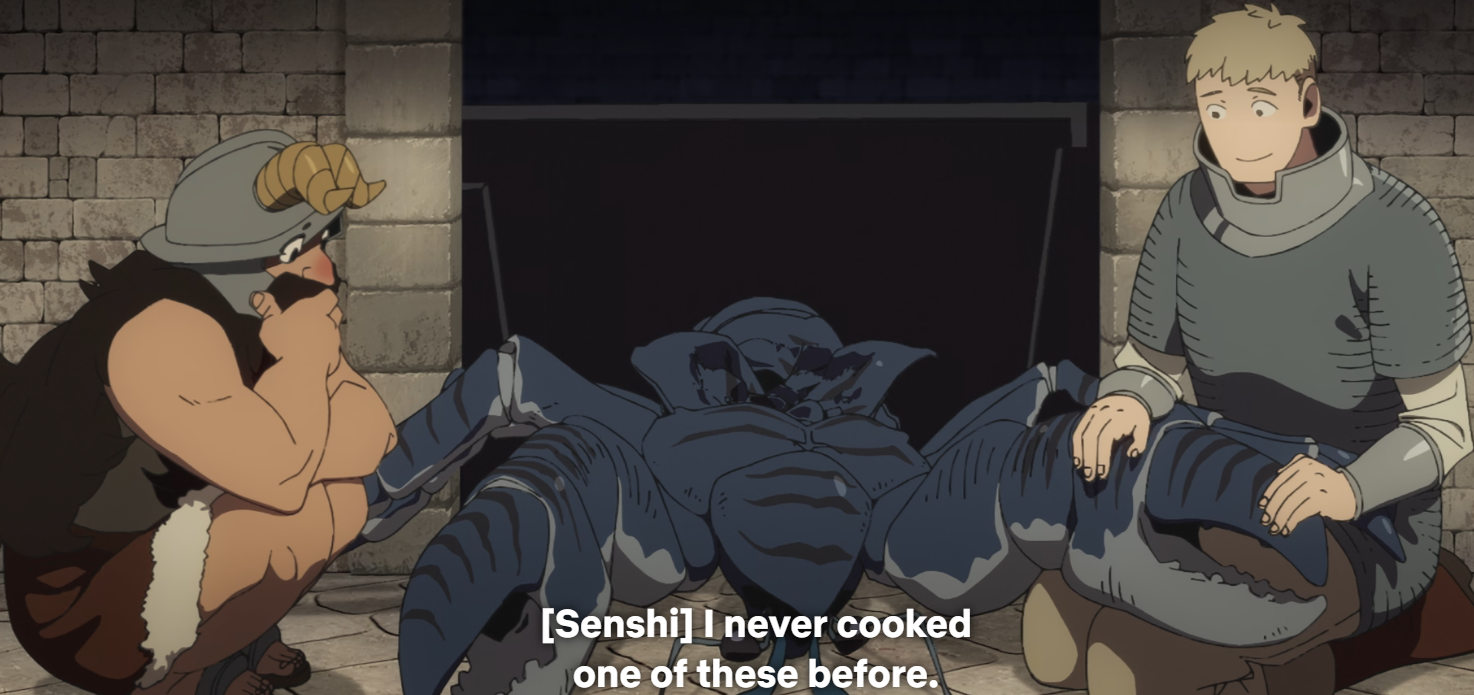
Anyway, hermit crabs are actually in the king crab family, and have a similarly rich taste to them. Very good eating, albeit kind of a pain in the ass to pick the meat out of their limbs. The tissues inside the main body are, as with most crabs, considerably less appetizing. Not a problem when you make it this much bigger, though.
Also, Laios (who apparently is a wealth of obscure mimic facts, because of course he is) informs Cilchuk that the treasure insect is a parasitoid that preys on mimics. They creep into the container, lay their eggs, and the box of giant enemy crab is slowly converted into a box of fake gold and gemstones. They then count on adventurers to open the container and allow them to escape and begin their adult lives.
...
I'm amused by the notion that adventurers have been raiding dungeons frequently enough - and over a long enough period of time - for this kind of coevolution to take place. That said, it also raises the question of how common these megadungeon complexes are actually supposed to be in the world. The circumstances behind the sinking of this old kingdom seem to have been very specific and exceptional, rather than these endless ten foot wide corridors just being a ubiquitous feature of the world or whatever.
To be fair, this kind of questionable worldbuilding goes all the way back to first edition ADnD, and I'm not sure at all that Dungeon Meshi wants to be taken seriously enough to have these conceits of its interrogated. But then, on the other hand, Dungeon Meshi actually does want you to take its fantasy ecology seriously sometimes at least, and there are moments where it wants its non-comedic worldbuilding in particular to be a selling point, so...I dunno.
...
Anyway, Chilchuk learns a lesson about avoidance. And we learn some stuff about his personality apart from him just having to play the straight man to the others' shenanigans all the time. The episode definitely helped me appreciate him a bit more.
The last chapter of this order is very, very different from everything else so far. Not tonally (we've already been up, down, and all around as far as tone goes), but more...honestly, it almost feels like this part is from a different series outright.
It's interesting. Interesting enough that I reserved the entire back half of this post for it. But I also feel like the story is sort of getting away from itself with this one.
Let me summarize it, and then I can explain my mixed feelings.
In a hungry period of descending through floors inhabited only by inedible undead and all-too-uncommon treasure insects, before they have their mimic encounter, the party finds what appears to be an ancient feasthall. Adorning the walls are paintings from the life of King Delgal, the once (and presumably last) ruler of the old kingdom before its dungeon-ing. Food is a common motif in all these paintings (makes sense, given their location), but unfortunately they're also trapped and will magically pull you into them if you get too close.
Wracked by hunger since they finished their ghost sorbet, Laios wonders if you can actually eat the food portrayed in the paintings if you let them suck you in.
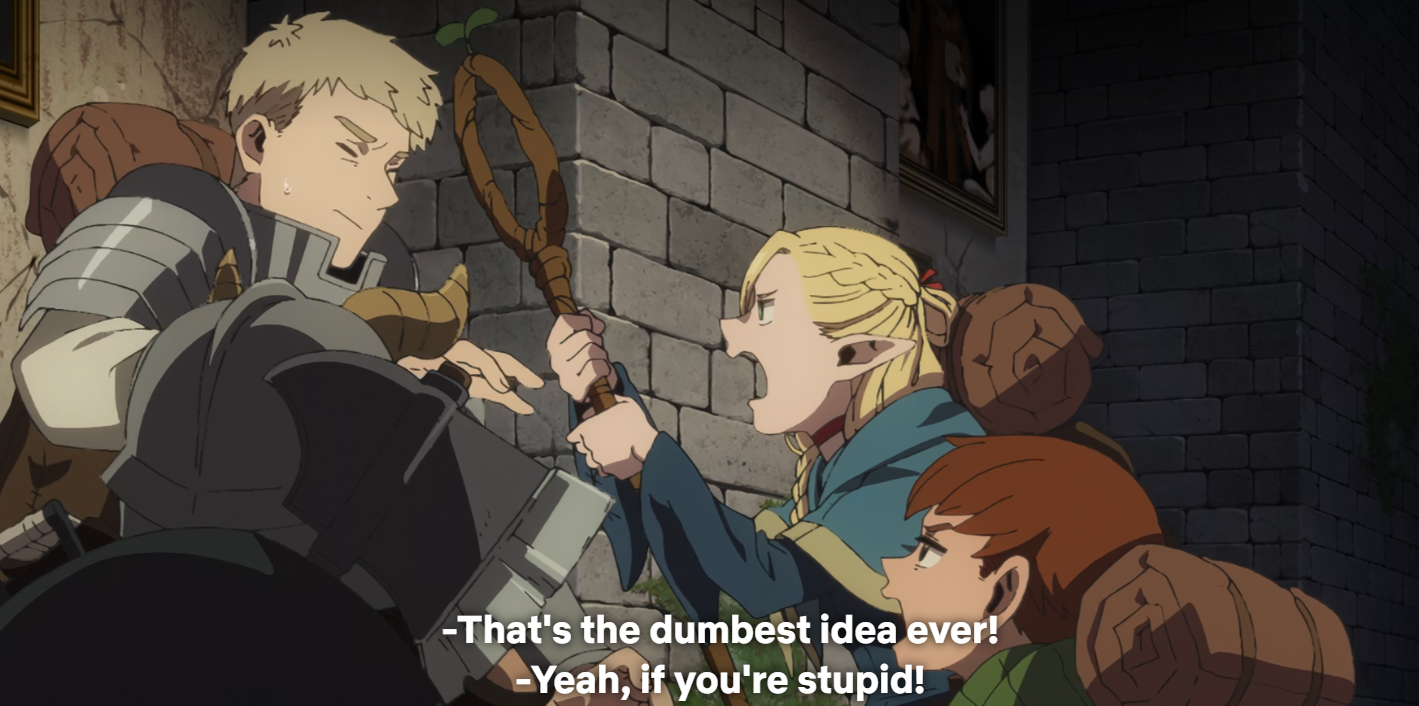
He manages to convince them to tie a rope around him so they can pull him back out after the paintings ingest him. A very reckless plan, and the others tell him as much, but he insists. And, it turns out that the paintings are actually portals into the past. Or portals into preserved, relive-able memories of the past, at least. It's not clear which. Anyway, Laios dips in and out of these moments from the life and times of King Delgal, primarily for the purposes of stealing food, but also - after the first couple of times - out of curiosity.
The first painting he dives into takes Laios to the scene of Prince Delgal's birth, where he witnesses the joy of his elderly father and doesn't quite get a chance to nick any refreshments off of the nearby table.
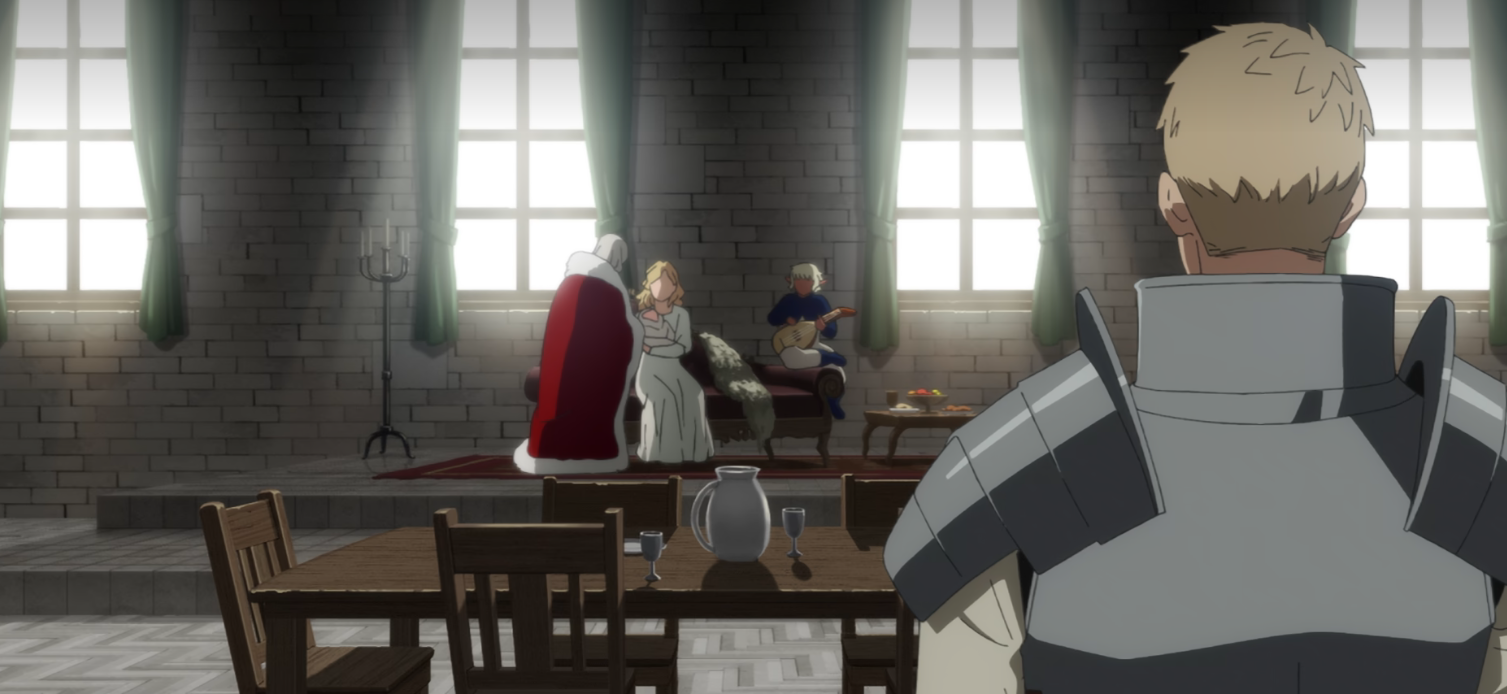
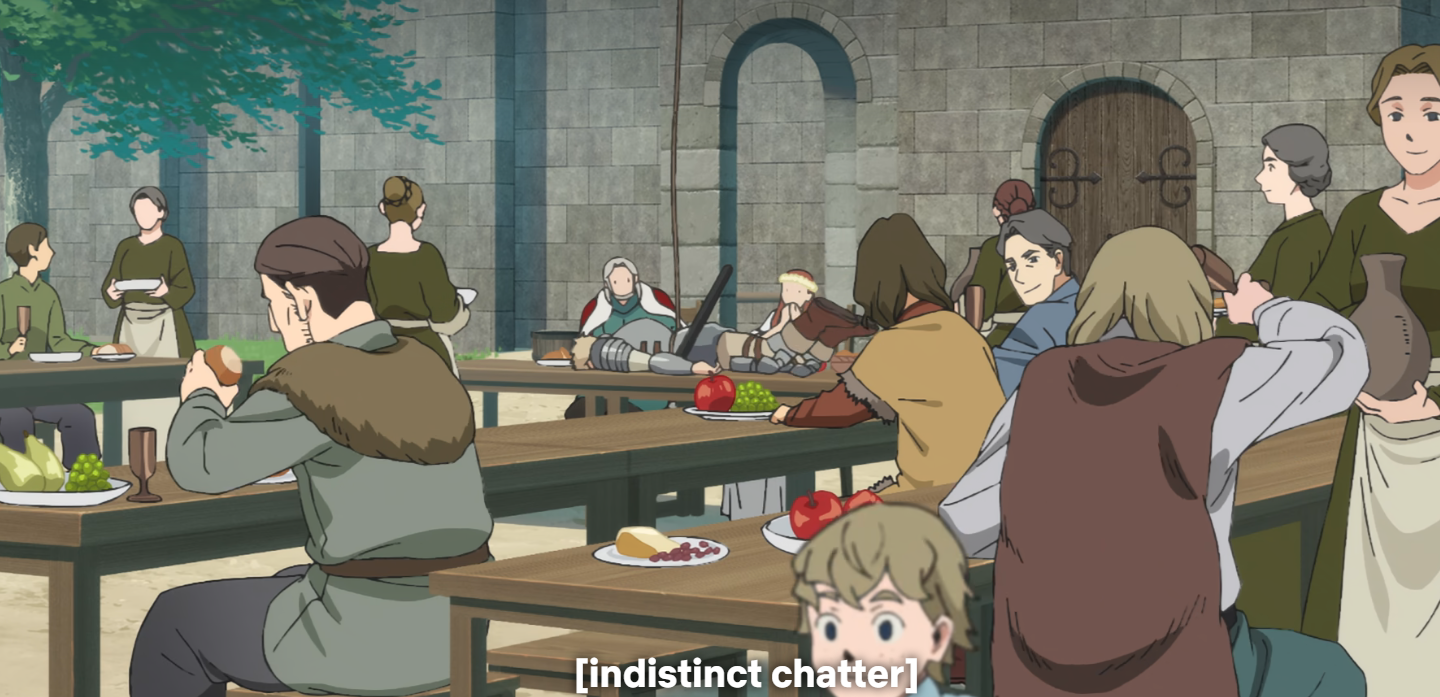
Next is a banquet scene, outdoor in a castle courtyard. This one turns out to have been painted a couple of decades later, capturing the celebration of the prince's wedding. This time, Laios gets much more engagement from the depicted characters (or actual historical people, if this is indeed time travel rather than virtual memory preservation). He first appears on a table, and is yelled at for his breach of decorum, only for Prince Delgan himself to tell everyone to calm down and let this enthusiastic knight dance for joy wherever he wishes on this blessed day.
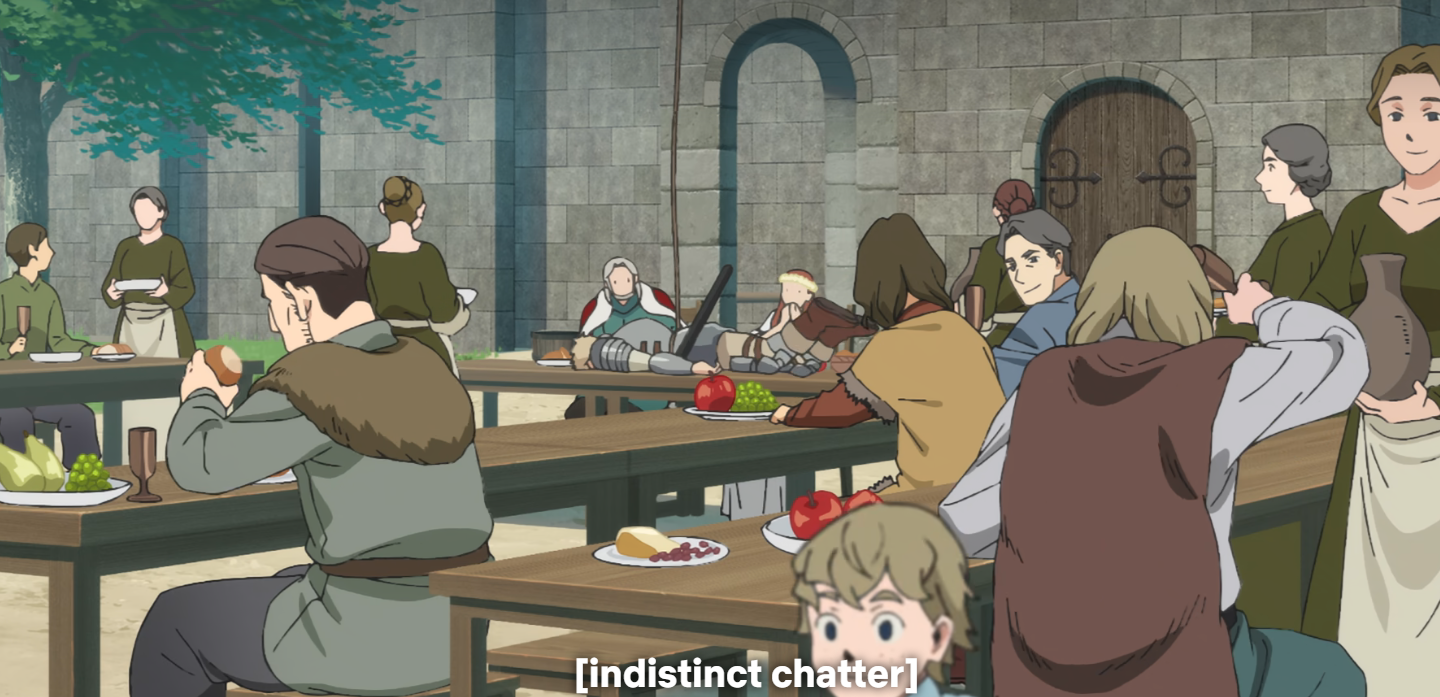
Curiously, no one seems to notice the rope. Or at least, they don't ask about it.
More tellingly still, a few people - including a serving girl who was present for the prince's birth, and an elf who seems to be the court wizard or some such - look at Laios with a wary familiarity. As if they remember him from his previous timeline intrusion, twenty years ago as they remember it. Definitely makes it seem like this is ACTUAL time travel and not just a mockup.
Laios surreptitiously stuffs some food items into his pack to bring back to the dungeoncrawling present, while curiously keeping his eyes and ears out. And, a few minutes after the prince's celebratory toast with his father, it turns out that one of the wedding planners might have been a George RR Martin reader.
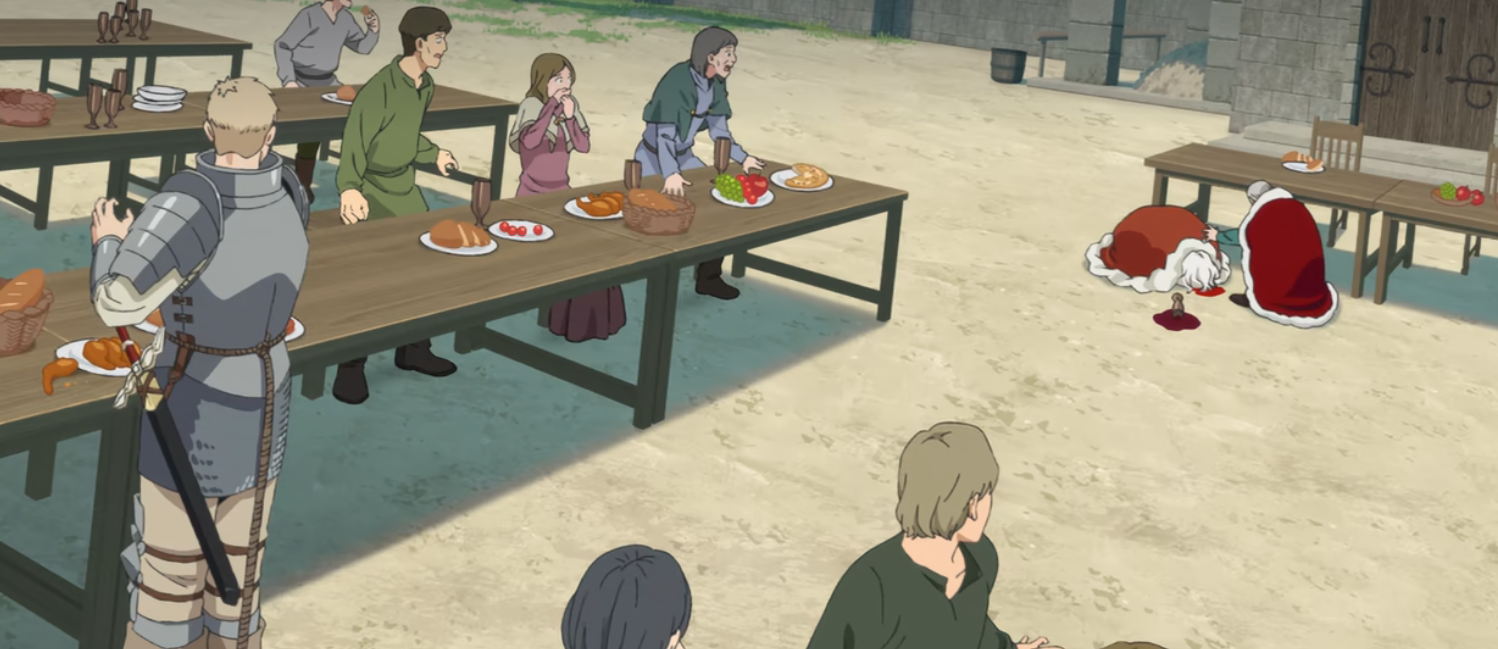
Delgan's father appears to be a very old man at this point, so I don't think the prince himself is responsible (no need to be impatient for succession when it won't be more than a decade or so regardless). It's definitely poison, though. I guess there's no point in speculating on the culprit until we learn more about the politics and dramatis personae of the era, which I imagine will happen in later episodes.
When Laios returns this time, he finds that the food seems to have vanished from his pack. Desperate, motivated at least as much by stubbornness as he is by hunger or curiosity, he tries again. This time materializing a few weeks or months later in the timeline, at King Delgan's coronation feast.
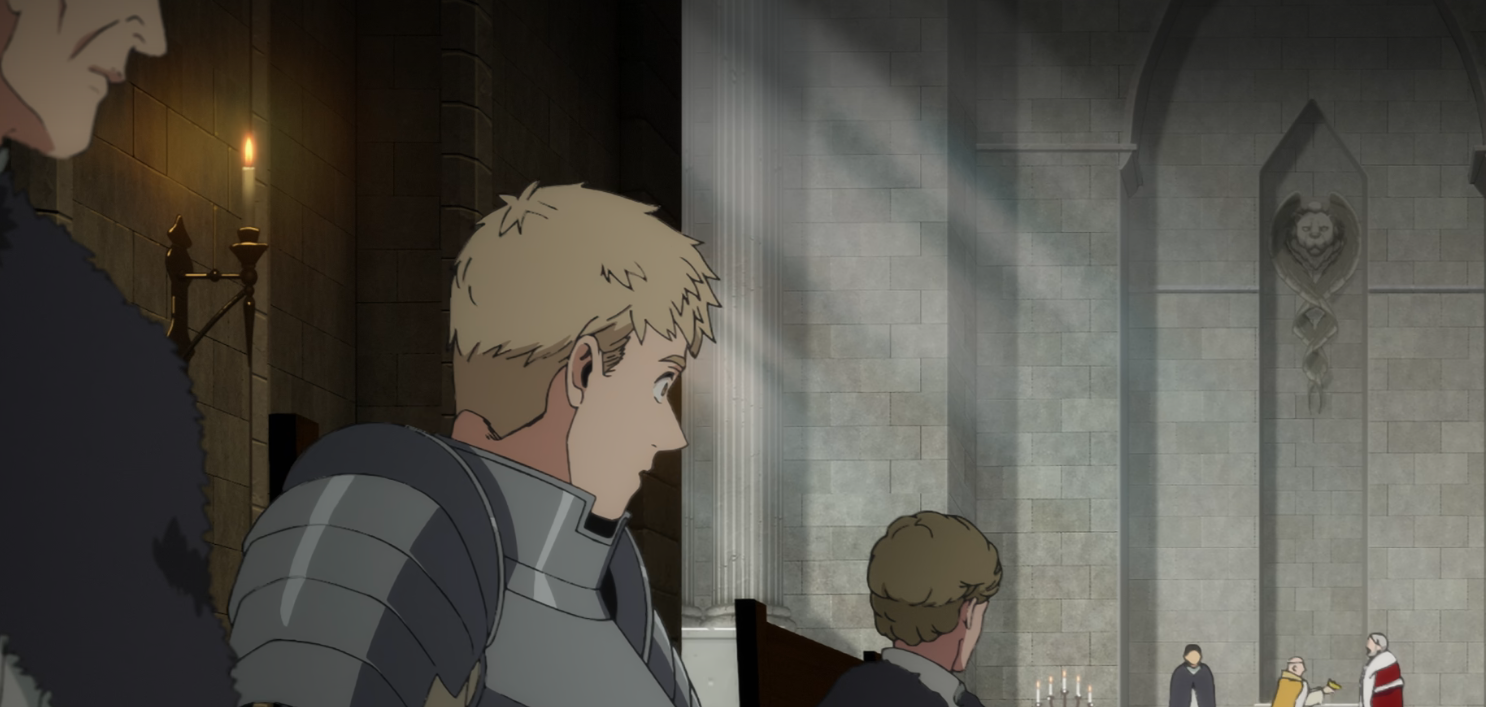
This time, Laios just helps himself to the food rather than trying to bring it back through the painting with him. And, it's good. About as good as you'd expect a royal feast to be. Filling, too.
Unfortunately for Laios, that elf wizard who recognized him last time recognizes him again, a third time. And this time he's much more sure of what he saw, and demands answers of the intruder.
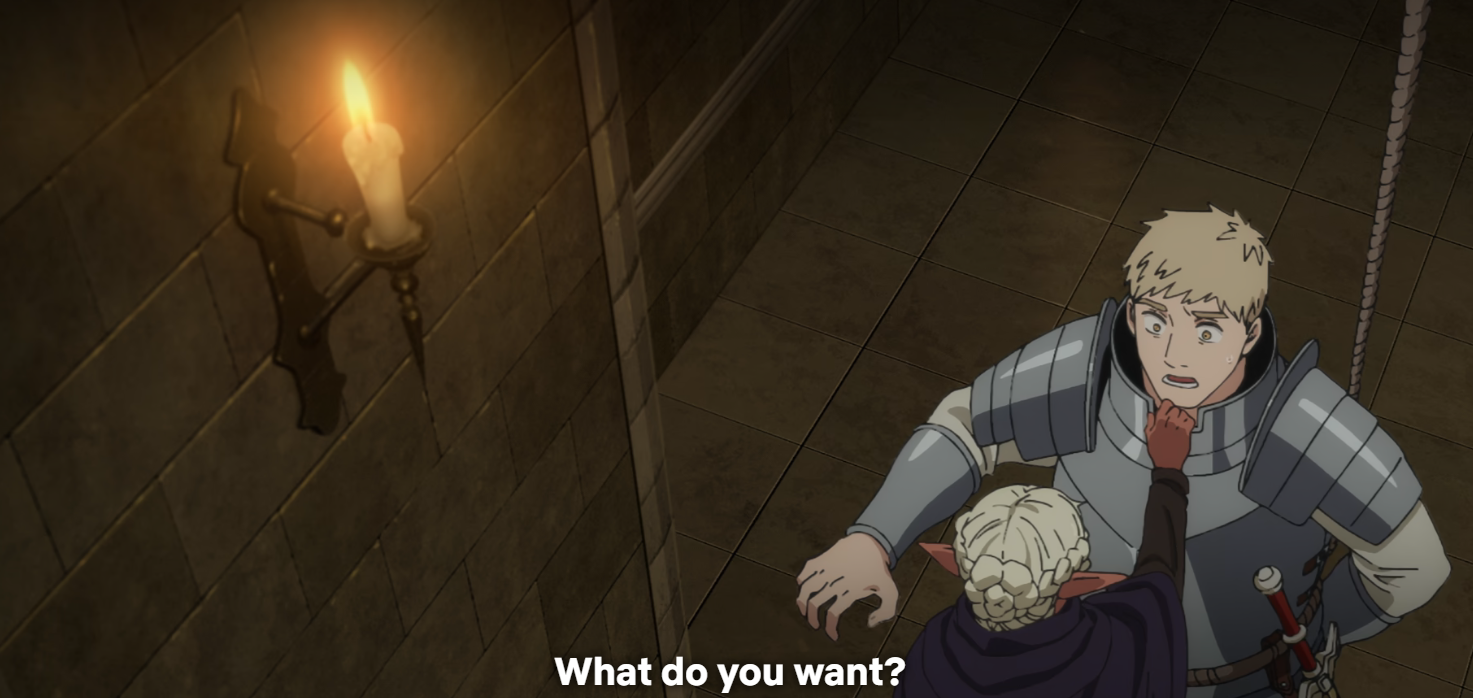
The rope seems to be actually invisible to timeline natives, but Laios himself isn't. Wonder why that might be?
Laios isn't able to answer him satisfactorily. And, this wizard seems to be a "shoot first" mentality, as he goes straight for a lethal-looking fire spell instead of trying to take the intruder alive for questioning or the like. Laios is just barely able to escape in time by yanking the rope and signalling his companions to pull him back to the present.
...
The ghost of probably-Delgan at the beginning said that the restored kingdom would go to whoever journeys to the bottom and "defeats the mad mage."
This mage was there at the time, and he doesn't seem to be all there.
Could be a red herring, of course. The thought just occurred to me.
...
It turns out that being inside of Laios' stomach doesn't allow the food to be taken back with him. It might be for the best that he had to return before he could digest it and integrate that matter into his body.
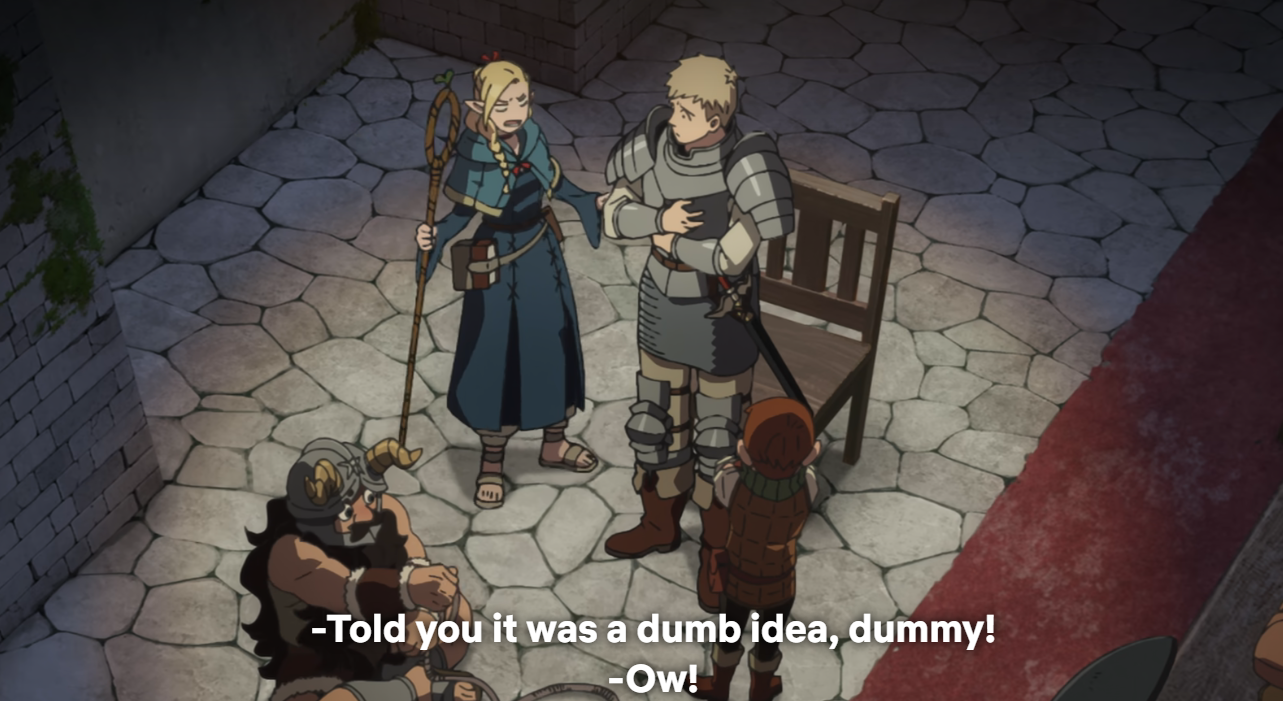
They're forced to move on from the feasthall, and eventually get some proper food out of the mimic.
So. This chapter.
On one hand, the series wouldn't have bothered giving us the context for the dungeon back in the pilot if it wasn't going to be relevant at some point. Obviously the ghostly figure (presumably King Delgan. Hard to be sure, due to the art style shift, but given that he seems to have been the last king of this place it was probably him) who issued the challenge to adventurers to come plumb the depths and life the curse was going to turn up again sooner or later.
But...what did our heroes do to merit this, exactly?
We've been reminded time and again that adventurers have been coming down passed this floor for years. Some of those adventurers must have surely been interested in the history rather than just the treasure. Hell, even just some of the greedy ones must have been reckless in the same way as Laios. I know for damned sure that if I ran this dungeon, a good two out of three player groups would ignore their better judgements and try the rope trick at the paintings. How has word of this not gotten out until now? Why is it just Laios, and not also a bunch of other overcurious murderhobos, who the historical people are reacting to?
The exposition just happening to play itself at Laios is...I don't know. It feels artificial.
It also feels like this is someone else's adventure that the characters are randomly being made to have. In a way that feels jarring rather than horizon-expanding.
Maybe it's just a little too early in the series? If this episode came later, after some more minor incidents bringing the place's history into narrative focus, it might feel more merited. It would also explain why previous parties haven't already found the paintings and told people about it, if this room was on a lower level that hardly anyone has been to yet.
I don't know. It's an interesting chapter, but it's a weird one.
Dungeon Meshi has proven to be a more diverse series than I expected. Sometimes a little bit too much for its own good, but for the most part it works very well. If the entire series was just zany food escapades and snarky adventurer buddies, I suspect the joke would wear itself out pretty quickly. Throwing just enough serious stuff in (even if it's hard to take seriously, on account of everything else surrounding it) helps keep the humor strong. A palette cleanser, if you will.
I was told I would probably enjoy Dungeon Meshi, including by people whose tastes I've learned to trust. I didn't think I'd be enjoying it this much though. It's a good show.