My Little Pony Fanworks: "Lullaby for a Princess" and "Children of the Night"
This pedantic ultra-high excruciatingly detailed autistic review was commissioned by Aris Katsaris.
An unusual review this time. This pair of short MLP:FiM fan animation projects were made by different people, five years apart from one another, but both are said to expand on the same part of Equestria's backstory. I haven't been told which part exactly, but going by the titles I'm guessing they have something to do with Night Mare Moon.
Which, uh...okay, it's been a while since somebody told me about this, and I honestly can't remember if I ever saw the main Night Mare Moon episode(s) myself, so I'm gonna have to look this up to make sure I'm remembering it right. Okay, right, so, the god-queen of ponykind, Celestia, has a sister named Luna. They used to control the sun and the moon respectively, but a spat between them saw Luna growing spiteful toward their mortal subjects and turning into the demonic Night Mare Moon. Celestia ended up having to banish her maddened sister to...outer space? I think?...in order to protect the mortal ponies. During the time of the series, Night Mare Moon ends up coming back to Equestria for revenge, and I think the characters turn her back into her old Luna self somehow.
That's more or less what I recalled, but good to be sure before going in. Assuming that these videos actually are about Luna/NMM, of course.
The first of these videos, "Lullaby for a Princess," is a six and a half minute (excluding intro and end credits) musical animation. The song - a low, moody ballad that falls halfway between the conventions of the titular lullabies and something more operatic - is an original piece, according to the credits, which impressed me. It's well written, well sung, and a very strong fit for the general "style" of musical number from the actual series, if considerably longer and more intense than most official MLP songs.
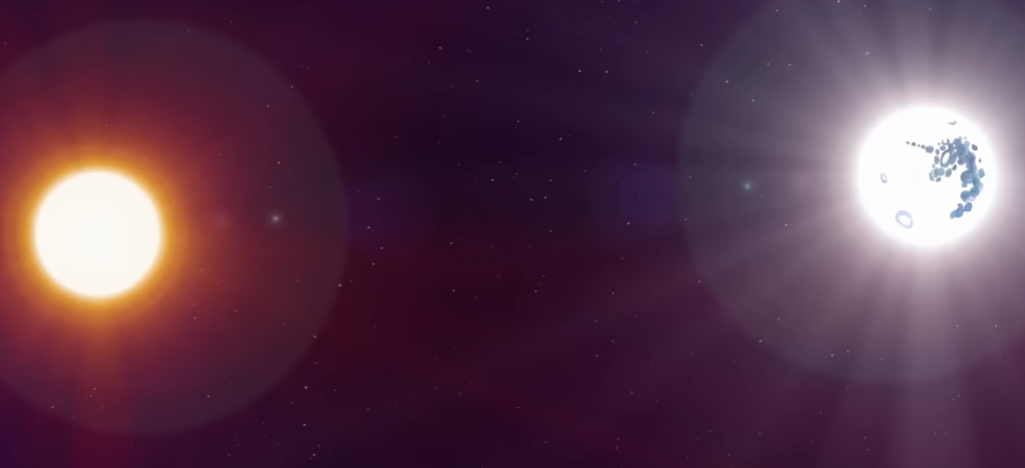
The music, lyrics, and vocals are all impressive, but the voice is especially so.
As for the visuals...in terms of detail, direction, composition, it's incredible. Animation quality, well...you can definitely tell it's an unpaid amateur work. Some high-effort sequences are fluid and energetic, but others are stiff and sluggish in the way where you can tell the creators just didn't have as much time and effort to spend on them as they wished. There's also some stylistic clashing, where the transitions between conventional cartoony MLP style, a softer watercolor look, pseudo-illuminated-manuscript imagery, and anime action scene stuff sort of spill into each other instead of transitioning or merging naturally. It's still pretty, but for these reasons watching it in motion is a little distracting at times.
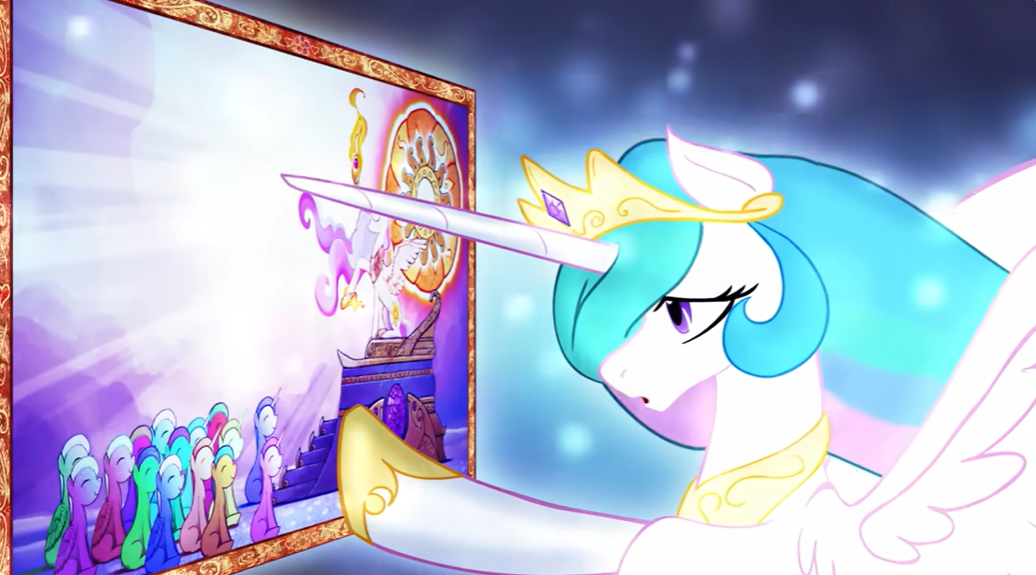
The ballad is being sung by Celestia to herself, sometime prior to the start of the series, as she reminisces on the loss of her sister, and blames herself for Luna having gotten so unstable that she needed to be exiled. Back when the two of them were co-rulers of Equestria, they administered the day and night respectively. Celestia being kinda-sorta a sun goddess, while Luna is what both her original name and her later demonic moniker suggest. Celestia was beloved and celebrated by all of ponykind, while Luna was paid grudging, half-forgotten respect to at best and totally forgotten at worst. Celestia saw that Luna was sinking into depression, but was too busy riding high on the people's adoration to care all that much, so she basically ignored her sister just like the mortals did.
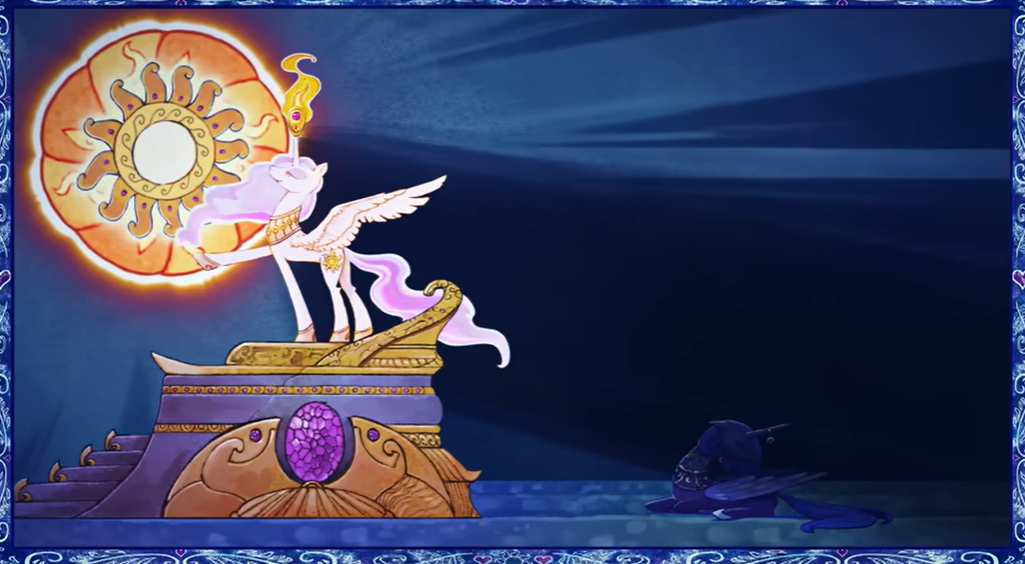
By the time Luna's sadness and envy transformed her into Night Mare Moon and sent her on a destructive rampage, it was too late for Celestia to change her ways. She was forced to fight NMM, despite knowing that her having been reduced to this was her own fault. Every injury she inflicted on her mutated sister was punishing her extra for having had suffering already inflicted on her. Even if it was NMM who initiated the hostilities.
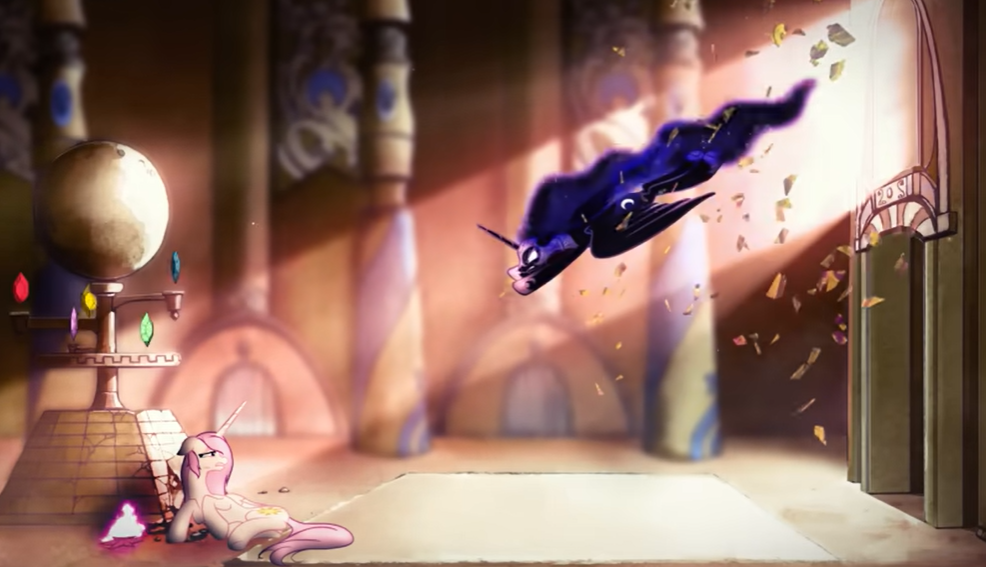
The sight of the moon has been torturing Celestia for all time since this event. So too, this video posits, is Celestia's own appearance; she used to be a pure white alicorn before battle damage from her sister gave her her current, multicolored look. All she can do, night after night, is think of Luna, sing her this lullaby, and hope that she's having dreams that bring her some degree of peace and solace as she sleeps through her centuries of imprisonment.
As far as this story goes, well...I get that it's mostly meant to be a character study of Celestia. I've mentioned my own emotional weak spot related to siblings getting each other into bad situations. And, through the lens of the latter, I can appreciate what the former is going for.
But, at the same time, I'm not sure if this animation realizes just how bad it makes Luna look. And how that in turn colors Celestia with her own view of what happened between them.
On one hand, gods often don't work on the same wavelength as people, in terms of how stories expect you to judge their actions and motivations. But, if we're going to humanize Celestia, then we've got to do the same thing for Luna, and, um...the fact simply is that from a mortal perspective - especially that of an agrarian society like Equestria's - Celestia just plain had a much more important job than Luna. People don't need the moon the same way that they need the sun. They just don't.
If Luna wanted more attention, why didn't she go out and do things to make the people love her, instead of sitting around sulkily waiting for them to come to her? Alicorns are powerful enough to make a mark wherever they go, building stuff and solving problems and such. Or hell, she could have left to find a kingdom of her own to rule. Her decision to sit around stewing in envy until she exploded was just that; her decision.
Maybe there's some important stuff from the series that I don't know about which changes this. I'm just going off of the story told by this fan short.
There's also some imagery at the end, when Celestia is mournfully singing about her hopes that Luna is having peaceful dreams that the two of them can meet in, that I feel like I lack the context to understand. This foal who looks a lot like Luna curled up in an ornate, sort of criblike bed.
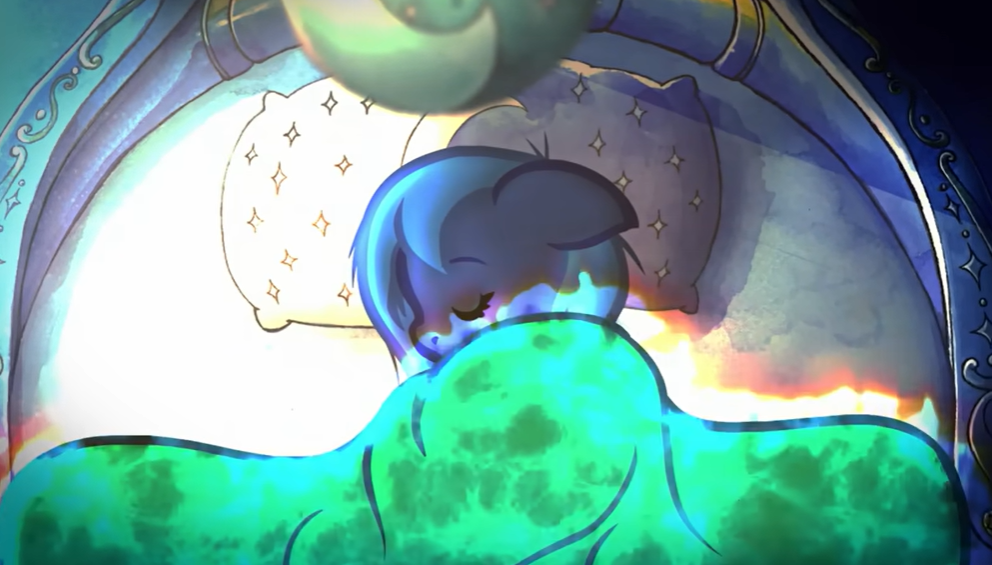
Not sure if this is supposed to be Luna as a child (were the alicorn sisters ever children?), or some sort of rebirth thing that eventually happens, or someone else entirely. Inadequate pony knowledge on my part.
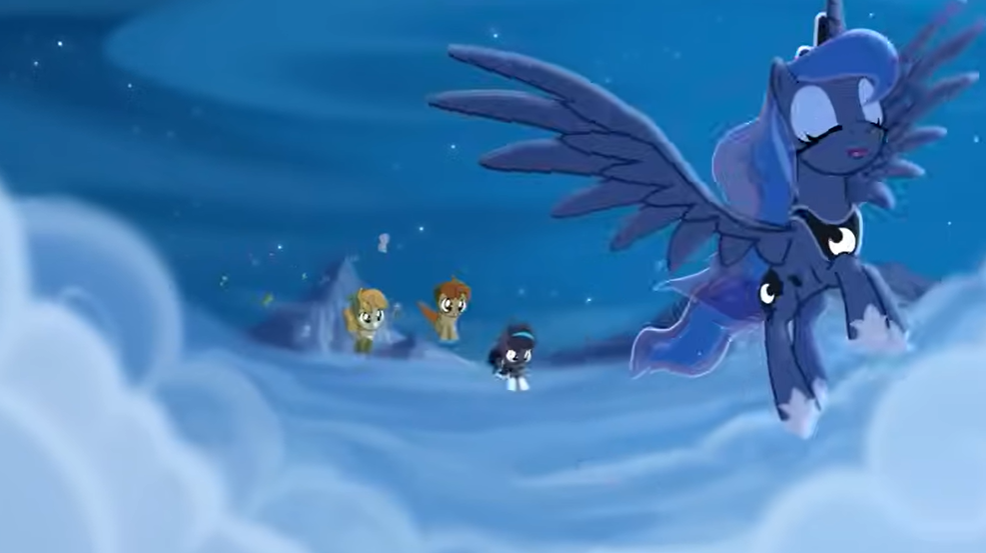
"Children of the Night" is a less ambitious piece all around. It doesn't aim as high either visually or musically, but it succeeds very well within its self-known limitations. The visual style is much less experimental, instead essentially being a more detailed, better-shaded version of the actual show's art style. It's smooth, it's consistent, it does exactly what it sets out to do.
Of course, the real draw for "Lullaby for a Princess" was the original song itself, and there's not really any comparison to be drawn here. Children of the Night is built around the song "Come Little Children," from the movie "Hocus Pocus." I don't think it's the original cinematic version of that song (iirc, the movie version had the song broken up and spoken over by the characters), but I don't think this rendition of it was created for this short either.
Anyway, the story being told here is interesting in how it complements the previous piece's, though once again I can't comment on its accuracy to official pony lore. According to the intro monologue of this video, Luna actually did try to take some mortals off to a new kingdom of her own where she could be worshipped. Early in the sisters' reign - just shortly after their defeat of John de Lancy, when Equestria was in a bad way and a lot of ponies had lost everything - Luna proposed to take some struggling ponies elsewhere to start fresh and build from scratch. Celestia was against this idea, but Luna went ahead and did it anyway, focusing her recruitment on orphaned children. Depending on how you interpret the video, she might still be doing it.
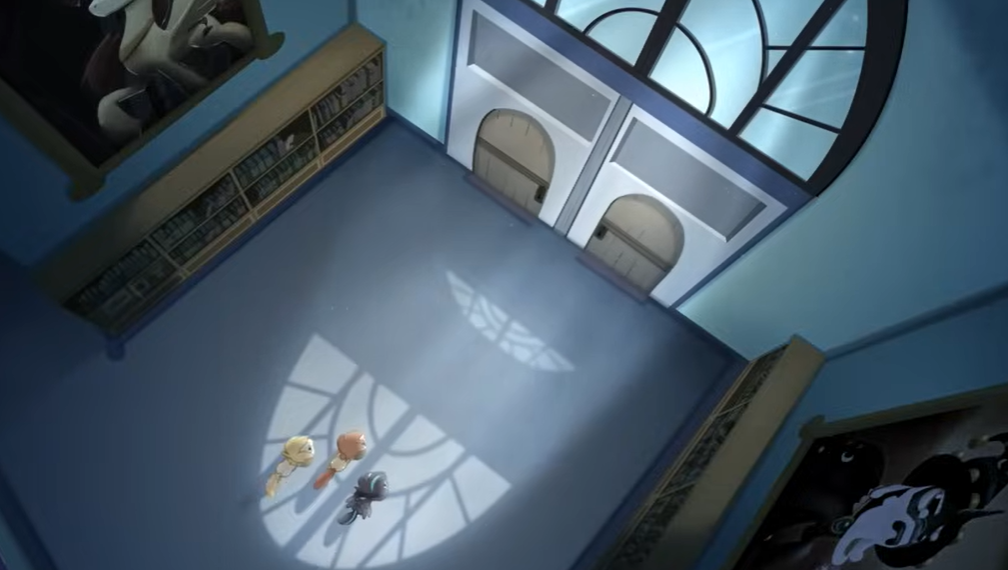
Except, if she actually did get her own kingdom this way, she wouldn't have ever turned into Night Mare Moon, would she have? I don't know. Again, not sure what's official, what's fanon, etc.
In "Hocus Pocus," this song is a siren lure being used by typically demonized witches to attract children for culinary purposes. In this video, Luna's intentions appear to be genuine. The babby ponies she's calling away to the moon with her all appear to be orphaned, unwanted, or abused in various flavors. There's no indications that she's planning to suck their souls out. The introductory monologue suggests that she did indeed settle them on a new homeland where they built a thriving civilization of their own, worshipping her just as the equestrians continue to revere Celestia.
Apart from the very solid animation (again, not as ambitious as the first video's, but more competently executed for that), I think the metatextual use of this song is the most interesting thing about this piece. Because, looking at "Hocus Pocus," and looking at this short, it pretty much has to be deliberate.
...
Back in an earlier review of mine, I talked about the night-demon archetype. Nocturnal. Uncanny. Usually blood-drinking. Often consumes children in order to age backward, especially when the entity is depicted as feminine. A sort of photo-negative mockery of normal human life. Witches - at least, the kind imagined by early modern Protestants - fit neatly into this category of monster. The night-demon often has misogynistic undertones, but in this version of it they were more like overtones. A witch was the antithesis of a proper woman, and embodied the threat that impropriety among women can supposedly pose. Which is why, starting in the late nineteenth century and continuing on to the present, witches ended up becoming a kind of offbeat feminist symbol. Which in turn led to the birth of an archetypal entity who I shall refer to as Goth Mommy Lilith.
Goth Mommy Lilith is the goddess of the undesired and undesirable. She rules over the night, not as a stalking predator (well, sometimes she preys on people who deserve it, depending on the incarnation, but that's different) but as a protective shroud that hides her chosen from persecution by those who need light to see. The association of nighttime with chaos and entropy is reinterpreted as freedom from stifling laws, even those normally deemed "natural." Goth Mommy Lilith takes children away from their homes, in order to rescue them from the horrors inflicted by a tyrannical Adam and his enabling Eve. She's often sexually alluring, but when she is it's almost always framed in a "you wish you could be her" way rather than a "wish you could be with her" one.
As a shunned sister associated with nighttime and chaos, Luna/NightMareMoon already had at least one hoof in the door of night-demonhood. The "Children of the Night" animation is pushing her the rest of the way in, and applying the Goth Mommy Lilith reclamation to the results. This basically reimagines Luna in the same way that feminist revisions reimagine witches and lilim. Using the song from Hocus Pocus - a movie that plays the early modern night-demoness take on witches 100% straight - for a video about a good-aligned Luna rescuing deprived children away to a nocturnal paradise in defiance of her uncaring sunlit sister's designs is a very pointed statement.
...
These two are interestingly oppositional takes on the same MLP backstory material. The quality of the original song in "Lullaby for a Princess" is the most impressive thing in either short, in my opinion. However, on balance, I consider "Children of the Night" to be a more balanced production with more going on thematically.