Epic: the Musical: the Curated Fanimatic Series (continued the mostest)
This review was commissioned by @Kaiya
It's been...a very long time. Not THE longest hiatus in a review series I've ever done, but probably the third or fourth at least. It's time to conclude Epic: the Musical, using @Kaiya's playlist of hand-picked fan-animatics.
I'm not going in blind this time. Since I reviewed the first 2/3rds of Epic, the rest of the concept album has been released, and I've heard all the songs and seen most of the animatics on the list. I have...thoughts...about how this wrapped up. Appreciative thoughts for the most part, but also some very confused ones. I made a bold thesis in my analysis of the first six sagas, and these last three prove my interpretation...incorrect? I think?
Maybe?
Like I said, it's a puzzler. I'd be interested to hear what my readers think the message really is at the end of these posts.
Before moving on to the new material though, I want to go back to the final song I reviewed last time ("Thunder Bringer") to give AnniFlamma's animatic the credit it deserves. I only saw an incomplete version of it last time, and it's only now that I can appreciate what the animatic is going for. This more ethereal, cow-horned vision of Zeus might not be as strong of a visual as NealIllustrator's more classic depiction, but it feels much more like the haunting presence of a guilty conscience.
I suspect that AnniFlamma was also reaching beyond Greek mythology and channelling the biblical Accusing Angel, who points out the sins of mankind for judgement.
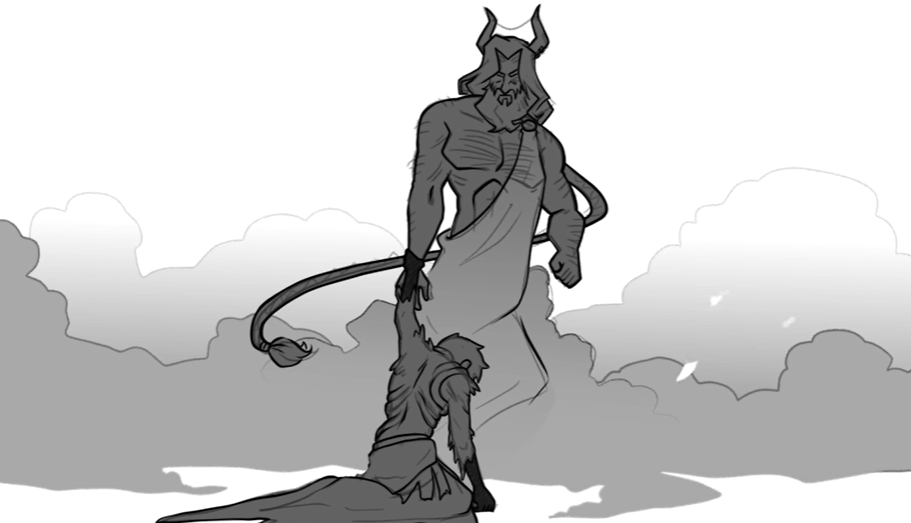
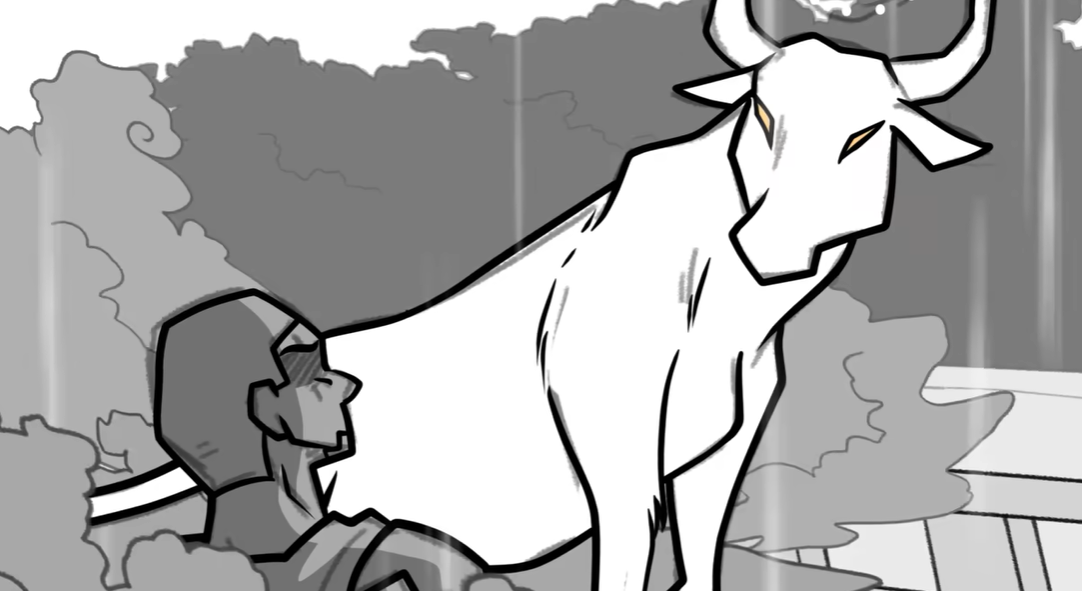
The Accusing Angel is often associated with horned animals (both those used for atonement sacrifices, and the golden calf of idolatry). In Christian belief, the torah's Accusing Angel's role is usually folded into the Satan character, which - along with cross-pollination from Pan - is probably one of the reasons Satan is often depicted with horns and/or hoofs. Obviously, part of the reason AnniFlamma leans into Zeus' totem animal here is because Eurylochus' transgression literally involved a cow, and in general she leans into the animal imagery in her god depictions (ie, her very equine Poseidon for "Ruthlessness"). But, the way this Zeus floats around the ship casting his accusations from the surrounding weather, the humans having an understated reaction to his presence as if he's simultaneously there and not there...it just fits too well.
I also like that in some parts of the song, Zeus seems to be singing at Eurylochus rather than Odysseus himself. Making it seem less like Zeus just wants to fuck with this one guy, and more like he is punishing a guilty party and asking Odysseus if he's willing to take responsibility for being unable to control his underlings. Which definitely makes more sense, and fits the lyrics better.
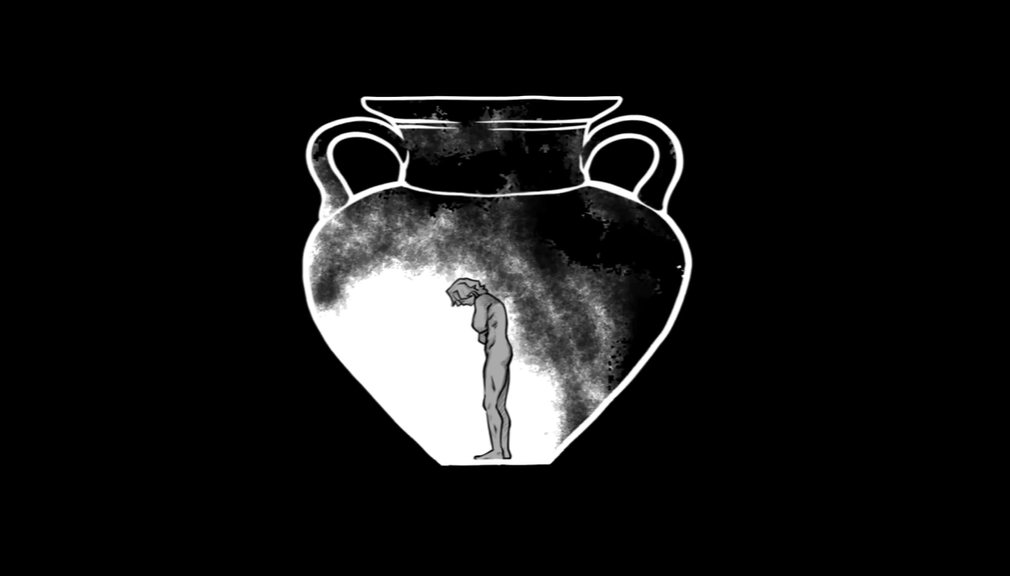
The visual of Zeus melting down and sifting through Odysseus in a vase, likewise, is a very powerful image; almost literally a crucible for isolating Odysseus' true nature.
The only misstep in this animatic is showing Odysseus floating, unconscious, in the ocean after Zeus throws the lightning bolt. It makes it look like Zeus didn't actually spare him at all, and simply blew up the ship without paying attention to who died immediately and who lingered on in the waves for a bit. If I recall correctly, in the Odyssey, this encounter left Odysseus clinging to a piece of ship-debris; still more or less the same situation where this animatic leaves him, but conscious, uninjured, and very clearly spared. A depiction like that would both be truer to the source material, and better fit the story the song seems to be telling.
That's just the last couple seconds of the animatic, though. Other than that, AnniFlamma's completed animatic blows NealIllustrator's out of the water like a lightning bolt hitting a wooden ship.
Well, anyway, on to the new material. Starting with the Wisdom Saga. And, uh...if this saga is your favorite part of Epic: the Musical, then all I can do is apologize in advance, because this is where I started having my first real problems with it.
26. "Legendary"
Animatic by Gigi.
I'll start out by saying that the music in this song (and really, the Wisdom Saga as a whole) is some of the most hummable out of the entire musical. Not necessarily the best, but specifically the most hummable. I still randomly hum the "du-du-du-du-DU-du-du-du...du-du-du-du-DU-DU-du-DUs" to this day, over a year after first listening to this song. The upbeat, optimistic jingle is both really different from everything else we've heard so far (fitting, as for the first time we're switching protagonists), and has enough recurring motifs to still sound like part of the same story.
So, we cut ahead seven years from the events of the Thunder Saga, and across the Mediterranean to Odysseus' home island of Ithaca. Odysseus' only child, Telemachus, is now a young man, and the situation he and his mother Penelope are living in has been steadily decaying. It isn't lawful for Telemachus to take the throne until they get confirmation of his father's death, but two decades of kinglessness have NOT suited Ithaca. Many powerful men - both from among the Ithacan elite, and unwanted guests from nearby city states - think that if Telemachus isn't going to be the new king, then maybe one of them ought to marry his mother and do the job instead, and just take it on faith that Odysseus died at sea. But, neither the queen nor the prince will give up hope in Odysseus' return, so tension has just been building and building. At this point, they're about nine tenths of the way to a palace coup.
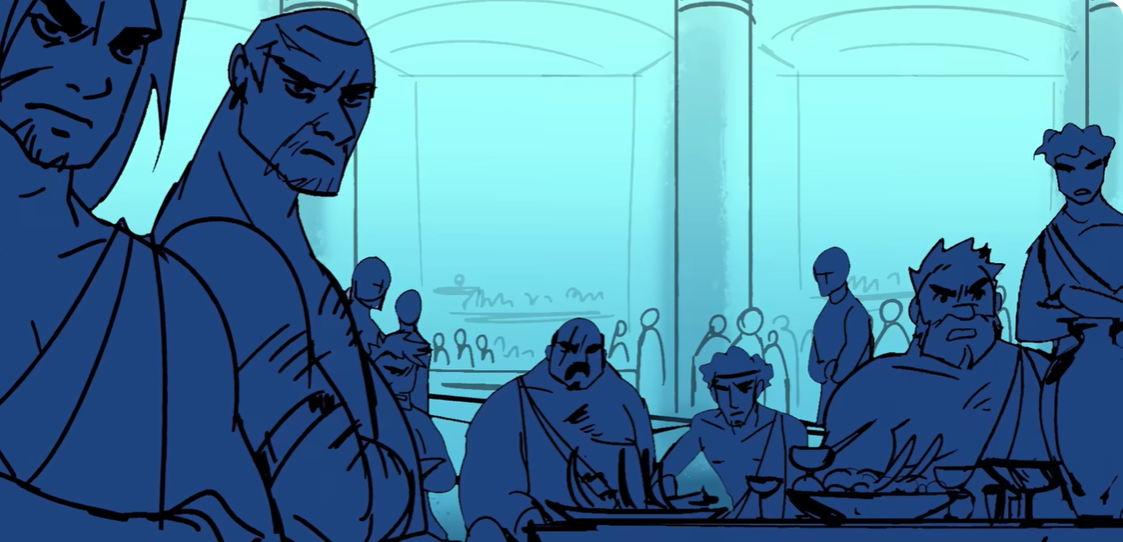
I haven't read all or even most of the Odyssey. However, I have read this part of it. Which is part of the reason why I'm so baffled by Epic's characterization of Telemachus.
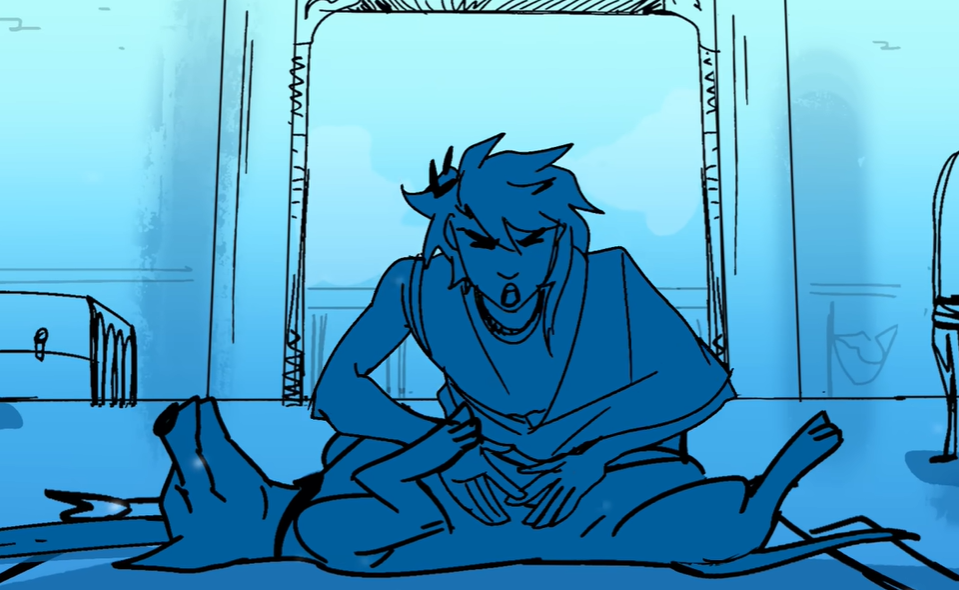
In the Odyssey, Telemachus is exactly what you'd expect from someone who grew up in these circumstances. Scrappy, resourceful, so used to running around putting out fires before they can get out of control that he's forgotten what it's like to be at rest. Here, he's...like, just a kid.
Like, not even a Greek warrior-aristocrat kid. A modern kid.
I feel like this writing could work for, say, a 13 year old Telemachus just coming to grips with his father's fleet never returning, and the first of Penelope's suitors just starting to arrive. Not a 20 year old one who's been dealing with these assholes for half of his life.
There's impressive vocal work from singer Miguel Veloso, who manages to make himself sound for all the world like a younger Jorge Riverra-Herrans (seriously, I thought that it WAS Jorge singing a little bit higher than usual until I checked the credits). Also, having seen some other "Legendary" animatics, I appreciate that Gigi tried to do the best with what she was given and show Telemachus acting like an actual prince here and there. The song opens with the line "It's just me myself and I, stuck in my bedroom living in the world you've left behind," and a lot of animators took this at face value. Gigi's animatic wisely decides to take lines like that one as melodramatic exaggeration on Telemachus' part, and shows him doing things like overseeing Ithica's marketplace (and building rapport with the commonfolk there), going to council meetings, and reading through ledgers.
Gigi did really well here. I can't exactly blame the other artists for having Telemachus spend the entire song moping around the castle like an imprisoned Disney princess, though, because that IS the picture that the song paints. It's about to get worse, too.
27. "Little Wolf"
Animatic by Duvetbox.
The previous song ended with Telemachus bumping into a group of his mother's rowdy suitors, including the group's informal spokesman Antinuous. In the Odyssey, this scene was a tense verbal standoff with Telemachus and Antinuous each trying to win over a watching crowd. In this version the only witnesses seem to be other suitors, and Antinuous is a lot less, uh, diplomatic. And by that I mean that he baits Telemachus into a physical altercation by calling the queen a tramp to her son's face and implying that he and his friends are planning to rape her.
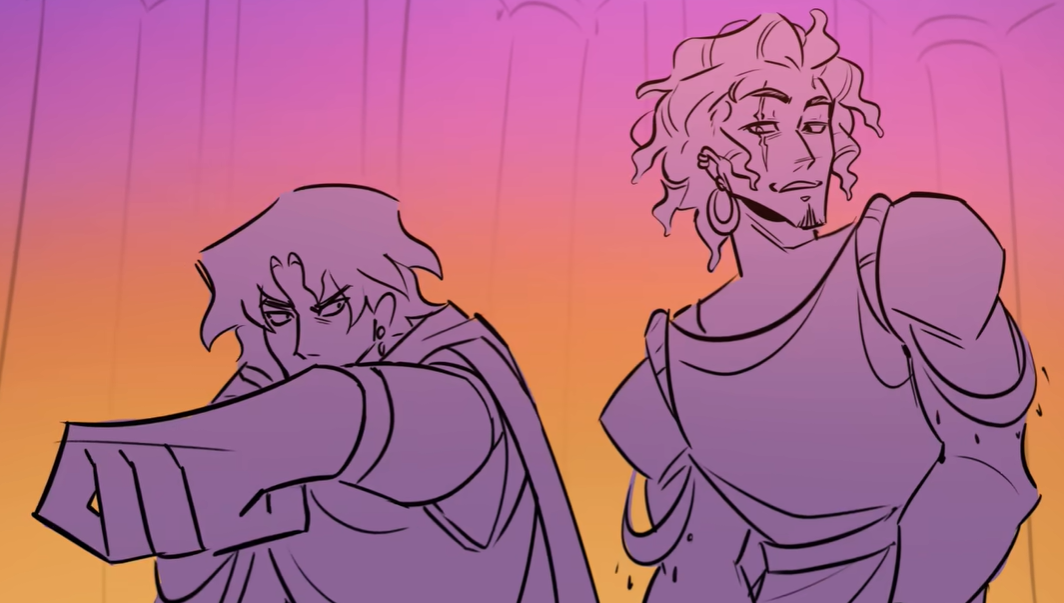
In the source material, Antinuous and his cronies kept their behavior just on the right side of social acceptability when dealing with Telemachus in person, and meanwhile tried to arrange an accident for him behind the scenes. In a situation where no one else can see or hear them, I could maybe believe Antinuous trying the tactic of provoking Telemachus into a fight so he can then credibly claim to have killed him in self-defence. It raises some questions about how they're able to get away with being this bold (if there are literally no loyal men-at-arms left for Telemachus to have arrest this punk, then what are the punks even still waiting for? Also, would this mean Antinuous is basically taking one for the team by removing Telemachus from the equation but also making it supremely unlikely that he himself will be chosen as king?), but the broad strokes concept makes sense.
Except...they're fist fighting. No weapons drawn. And, when Antinuous eventually wins the brawl, he just smugs at the beaten Telemachus for a bit and then leaves him there.
-___-
So, uh. What was the point of doing any of this?
...
I'll say here that one of the other animatics I saw for "Legendary" had it end with Telemachus reaching for his sword, but then tossing it on the ground and raising his fists. I really like that addition; it makes it seem like Antinuous might have been hoping to bait a deadly battle, but Telemachus wisely deescalated in a way that avoids the appearance of cowardice. Essentially beating Antinuous before the fight even starts. I liked that. That's more like something that the original Telemachus would do.
A pity that the rest of that animatic was very much "moping Disney princess."
...
So, they punch each other. Antinuous is easily overpowering Telemachus. Suddenly, Telemachus has a vision of Athena, who magically accelerates his thoughts so that she can coach him on his fighting style mid-combat and let him see and avoid Antinuous' blows.
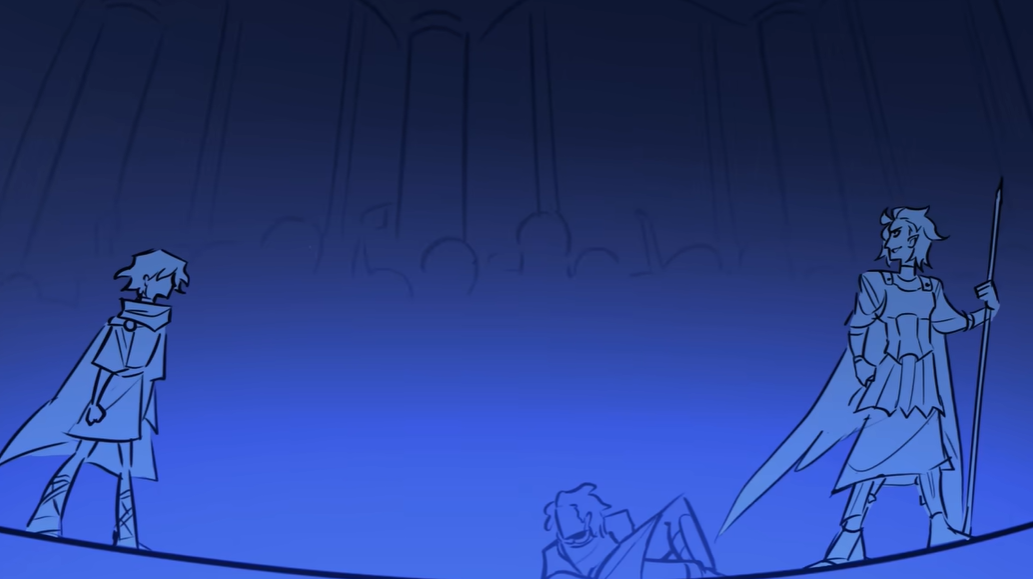
It's not enough for Telemachus to win, he still ends up on the floor with his opponent standing over him, but it turns what would have been a one-sided stomp into a fight that actually bloodies Antinuous a bit and prevents Telemachus from looking like a total pushover.
The thing is, there's this one line from Telemachus that just...I don't even know what the hell to think of this.
Athena: "I suggest you fight back."
Telemachus: "I don't know how!"
Athena: "Uppercut him. Now!"
I'm sorry, but..."I don't know how?"
Huh?
Epic might be modernizing some of the ethics and sensibilities of the setting, but it specifically hasn't ditched the core setting premise of warrior kingdoms. The whole thing with Astyanax at the beginning is rooted in that. So, how the hell does a prince manage to go nineteen years without being taught how to fight?
Does Epic realize just how bad it's making Penelope look by doing this? Like, think about this. At no point in the last decade did she get someone to teach the crown prince, the man who will potentially be leading Ithica's army, how to fight?
Before I said that Telemachus feels like he's too young. This is the part that made me feel like he's too young and also a time traveller.
It's a great song, technically. I forgot how strong Athena's voice talent was in the time since she last showed up. The way she reprises Antinuous' song and turns it back against him really gets your blood pumping, and feels just right for a "turning the tides of battle" moment like this. Antinuous has a great voice too, and he captures just the right kind of suave-but-thuggish villainy for the character, always sounding like he's carefully measuring his performative machismo as he gives it amid changing circumstances (and kudos to Duvetbox for making him look *exactly* the way he sounds). I also got a chuckle out of "I just made your thoughts quick," "Oh, that is SO SICK!" But, I'm really confused at what the story thinks it's doing with Telemachus.
After Athena's intervention prevents Telemachus from losing as badly as he otherwise would have, and Antinuous and the others strut away, Telemachus asks the goddess why she came to aid him. Which segues into the next song, where we kind of reframe the entire story to a certain extent. This is an aspect of the Wisdom Saga that I actually do like.
28. "We'll Be Fine"
Animatic by Gigi.
Oh man I love Gigi's Athena. Not quite as much as mircsy's, but almost. The way she looks perfectly normal aside from being ten feet tall and occasionally twisting her torso like a snake, armor and all, just makes her seem even more unreal and divine. Literally "larger than life."
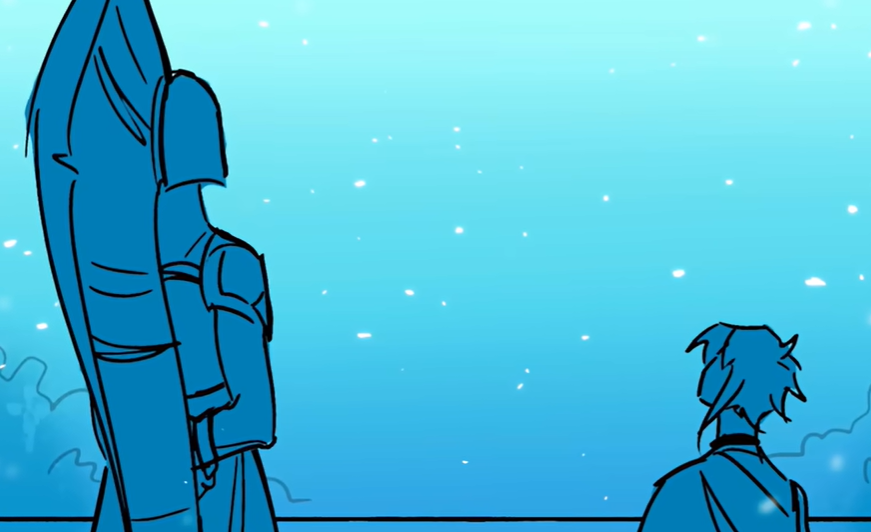
A classic duet, similar in structure to a couple of earlier songs featuring Athena and Telemachus' father. Same melody for each of their verses, but faster and bouncier when it's Telemachus singing, and then a gorgeous synthesis when they harmonize at the end. Very specifically mirroring what Athena and Odysseus did with their voices in "Warrior of the Mind."
Anyway, without naming Telemachus' own father as the person being referred to, Athena tells the prince that she's been doing some introspection over a would-be-hero she failed to properly mentor. Without admitting exactly what she should have done or shouldn't have done, Athena explains that this hero went dark in the moral sense and then dark in the "lost without a trace" sense, and she thinks that she might be to blame.
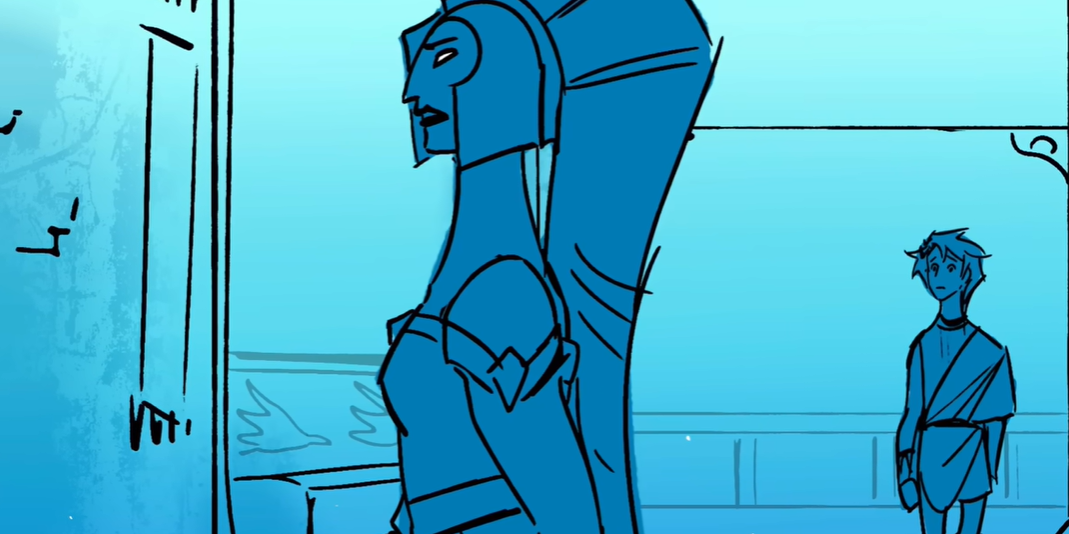
So - once again, without explicitly saying that Telemachus is this other man's son and that the current situation on Ithaca is indirectly her fault as well - she tells him that she's looking for another brave soul capable of rising to meet challenges that she can hone to its full heroic potential.
...
Now, if you remember the events of the Cyclops Saga, you probably don't need me to point out how different this behavior is from the Athena we met earlier. Hearing her perspective on this also brings to mind some lyrics of hers from the previous song, "Little Wolf."
Athena: "I've no respect for bullies, those who would force their will. I've seen plenty enough to understand this kind of filth. Let's teach this dog a lesson in front of all his kind; one young wolf has a bigger heart than all these men combined!"
No respect for bullies? Contempt for those who live by the rule of might-makes-right?
This isn't quite diametrically opposite from the earlier Athena, but it's at least 90 degrees off. And, I think I understand what the story is doing with that. Put a pin in this for now, I'll get back to it later.
...
I rolled my eyes at Telemachus' "I got in a fight and I didn't die!" but I've already gone into the reasons why I dislike this. And, the rest of the song did quite a bit to win me back after whatever the heck the last two were doing.
Telemachus and Athena are both respirited by her helping him and him being so grateful and eager to learn more. After leaving the palace, Athena resolves to go find out what exactly did happen to Odysseus after she left him all those years ago.
29. "Love In Paradise"
Animatic by Noir.Hyacinth
I love the framing device for this one, with Athena scrying on Odysseus' past and present to bring both herself and the audience up to speed. Athena's slow, clocklike theme music forms a kind of display case for bits and snatches of multiple previous songs, as well as the brand new one for the brand new character. We have the chorus of "Remember Them" as Athena remembers her own last meeting with Odysseus, then a quick succession of bits from "Keep Your Friends Close," "Ruthlessness," "Done For," "No Longer You," "Different Beast,” and “Scylla," before the nonmusical dialogue from the end of "Thunder Bringer."
None of these are clips, I'm pretty sure; they actually got the singers to reprise a couple lines for a new recording here. Clips would have perhaps made more sense diagetically, but "Epic" remembers that it's supposed to be a stage play, and the concept album reinforces that with touches like this.
After all of that, and then a little more Athena downtime, we do the actual "Love In Paradise" section. Followed by more of that synthesized with "Underworld," an extremely different song that somehow, bizarrely, is able to mix with it in a way that evokes dueling mindspaces rather than just auditory chaos.
Crazy track, this one.
Anyway, after being left alone and adrift at sea, Odysseus washed up onto the island of Ogygia, home to the other magic lady who rapes Odysseus in the book. "Epic" heavily reimagined the Circe encounter and made the rape not happen, but it does not do the same for Calypso.
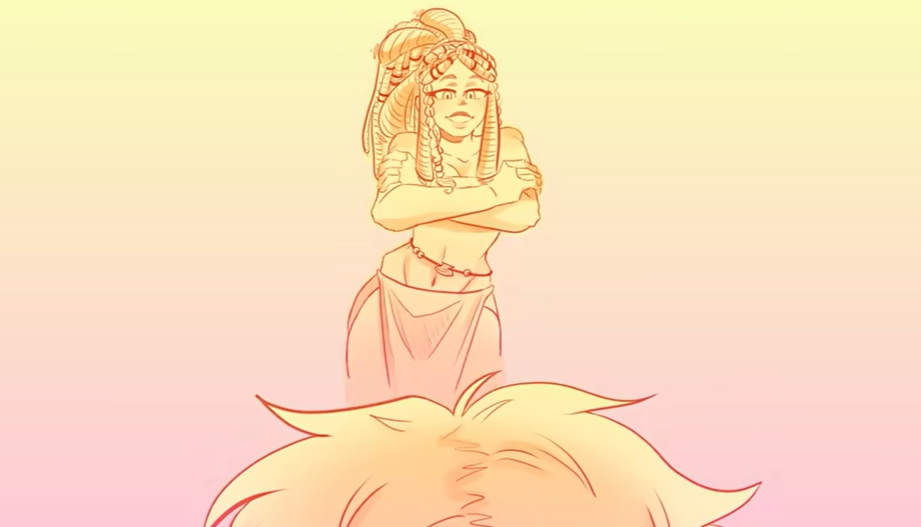
NoirHyacinth's character design for Calypso is the second Pirates of the Caribbean reference we've had in these animatics lmao.
Accounts vary on who and what Calypso is. In some versions, she's just some stronger-than-average sea nymph. In others, she's a member of the ancien regime who was allowed to go into self-imposed exile after the Titanomachy instead of being chained like the others. In either case, she's very powerful within her domain if not everywhere, and she's also the worst kind of yandere.
Musically, Calypso is much lower-key than most of the other gods and supernatural beings we've met so far. Gentle, lulling island-techno keyboard inspired by, heh, well, calypso music. Quiet, unemphatic anodyne voice that sounds like it's trying to put you to bed even when it's telling you to bow down you puny mortal. The overall effect makes you feel like you're trying to swim through honey. And that the honey is also laced with chloroform.
Calypso keeps Odysseus prisoner on her superficially paradisical island for seven full years, using him for unspecified but strongly implied purposes all the while. Even moreso than in the Odyssey, "Epic" characterizes Calypso as an utter narcissist. Constantly asking Odysseus, in this sickeningly sweet and loving voice, what he wants and promising to bring her sweet beloved anything, but then totally ignoring him when his answers are anything to the tune of "I want to go home" or "I want to stay true to my wife." She doesn't even register that she's heard them.
The last stretch of the song, taking place in Athena's present, is where it makes the metaphor obvious. Odysseus standing at the edge of a cliff, reprising the tormented chorus of "Underworld" and trying to will himself to jump, while Calypso stands behind him and tries to calm him back down and pull him back into her imprisoning embrace with shallowly comforting words and promises of ephemeral pleasure.
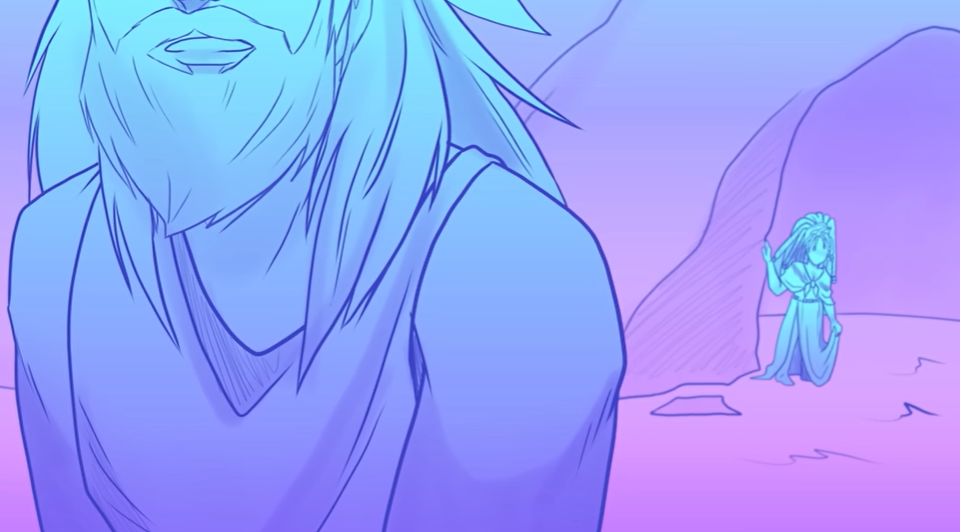
Even when the ghosts of Odysseus' past start howling their own reprises in his mind, Calypso's soothing anodyne works to keep them down and blur their voices just enough to provide a vestige of protection, and keep Odysseus from jumping for one more day. While also, simultaneously, being the thing that's keeping him imprisoned with his regrets and making him suicidal.
For the most part, Epic plays its allegory for war trauma in pretty abstract forms, rather than a direct one-to-one "Odysseus doing thing X is supposed to represent real world veterans doing thing Y." Calypso is an exception. She's drugs. She's just drug addiction.
At the end, in the throes of despair, Odysseus finally swallows his pride and calls out to Athena - the patron he long ago rejected - for deliverance. Athena herself is, finally, after quietly swallowing her own pride and rethinking her own positions for these last few years, in a mind to answer his prayer.
As a final note, I like Noir.Hyacinth's interpretation of Athena's divination magic. They leaned into the clocklike "time slows down" aspect of Athena's theme music and gave her this sort of clockpunk-ish magitech scrying device.
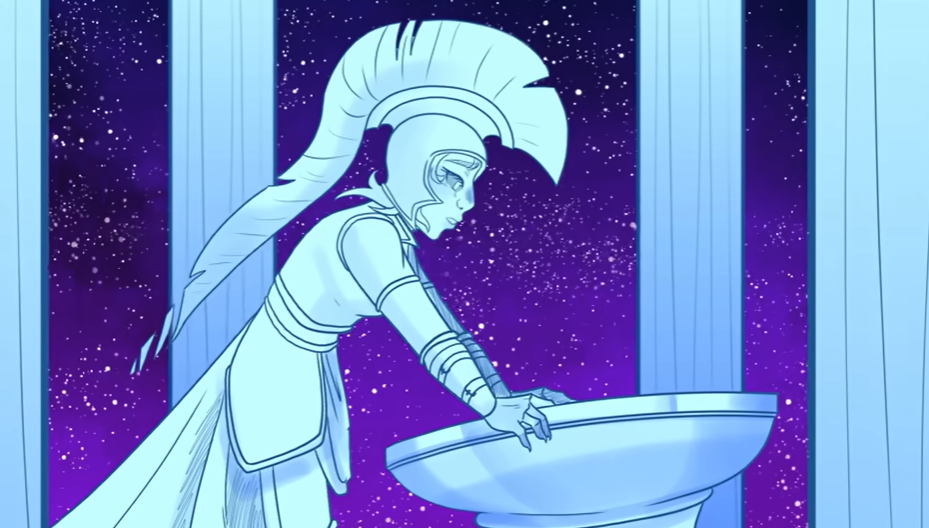
Looks like she and Hephaestus might have collaborated on that thing. It's cool flavor, and it feels like something that could be from the source mythology even though it isn't.
30. "God Games"
Animatic by AnniFlamma
Finally, after twenty-nine songs, seven acts, and ninety-eight minutes of show time, we begin the very first scene of Homer's "Odyssey."
In the original work, this scene was a very short and straightforward one. Athena goes to her father Zeus and asks for an official divine command for Calypso to release her captive. After looking around to make sure that Poseidon isn't in earshot, Zeus says "yeah, sure," and does it. And that's it. Epic's decision to drag this out into a whole production is basically just one big self-indulgent excuse for these theatre kids to show a bunch of gods who aren't actually in the Odyssey and give them all colourful bit roles and whacky musical motifs. The narrative justification for this doesn't really make sense if you think about it, but it's also pretty unashamed about being an Excuse Plot for the content the creators wanted to make. You can almost think of it as an intermission skit. And, for what it is, "God Games" is fun and entertaining in all the ways you'd expect from that.
Well, mostly. There's one little bit of it that might actually be important.
In "Epic's" version, Zeus and Athena are both much more invested in Odysseus than they were in the original. Athena is willing to jump through hoops to get him his reprieve. Zeus, meanwhile, is contemptuous of Odysseus because of his dishonorable choice in "Thunder Bringer," and thinks he really isn't someone the gods ought to go out of their way to help. So, Zeus gives Athena a little challenge: convince several other gods that Odysseus should be freed, and he'll free him. Otherwise, Calypso gets finders keepers. To make things harder, the majority of the named gods are ones who supported Troy during the war, and thus have every reason to be predisposed against Odysseus.
So, we get a musical montage of Athena bouncing off glam-rock Apollo, metal Hephaestus, pop Aphrodite, diss-rap Ares, and disco Hera. And, for the most part, it's just goofy fun.
Apollo doesn't really care one way or the other about Odysseus himself, but - being the god of music among other things - he's annoyed at anyone who kills sirens. It's actually an interesting bit of characterization there; Apollo doesn't care that the sirens use their music to kill people, any more than a human bird-watcher cares about how many beetles get eaten. Athena wins him over by pointing out that this group of sirens were way too aggressive toward humans, and imperilled their entire species by inviting retaliation. By culling them now, Odysseus has actually helped maintain the evolutionary fitness of the greater siren population.
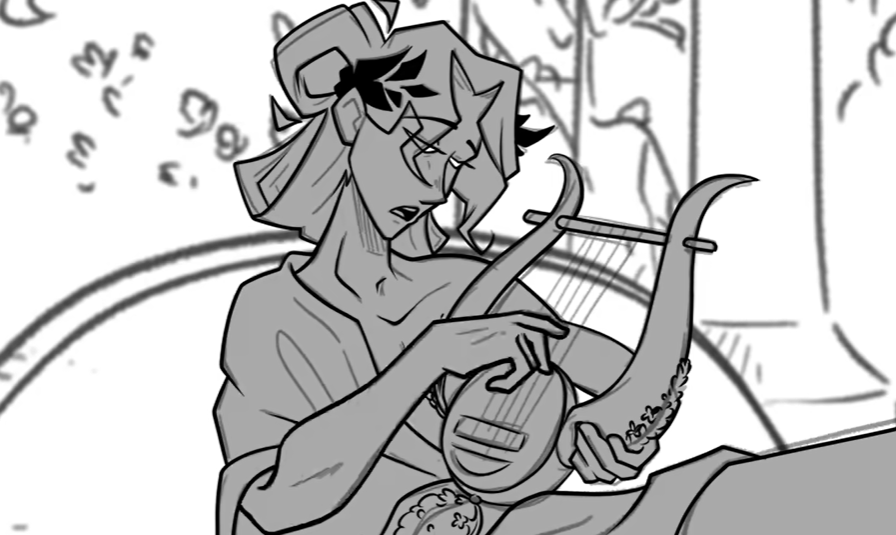
No, really, that's her argument. It's glorious. 15/10. I fucking love it.
Hephaestus, interestingly, is the only member of the pantheon to have a Puerto Rican accent. This is due to him being voiced by Riverra-Herrans' own father. Heh, and he already got his mom to be Anticlea back in the Underworld Saga, that's pretty kawaii. Unlike with Anticlea though, I feel like it kind of works here. Hephaestus is sort of a black sheep among the Olympians, and giving him a different accent from the others puts a sense of distance between them. His own argument with Athena is kind of perfunctory, though, and he gives in without her really coming up with any clever arguments. The same goes for Aphrodite and Ares, who confront Athena as a pair.
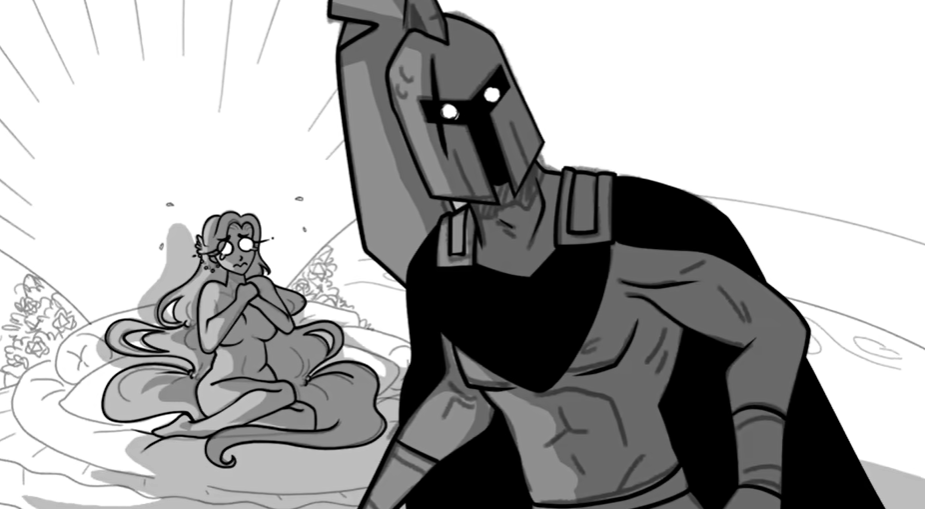
It's a little too bad in Ares' case, though, because Ares actually makes some really substantive critiques of Odysseus' character, and instead of engaging with them the song just has Athena quiet him by appealing to his desire to see more battles get fought.
Ares: "What kind of sick coward holds back his power and watches his friends get devoured? He didn't try to fight Scylla, didn't even try to kill her! Hides inside a wooden horse to get the job done, never handles things up front! Pathetic and weak like his son!"
And like...yeah? Yeah, aside from the stray shot at Telemachus at the end, this is a pretty incisive takedown? It's too bad Athena sidesteps it instead of engaging with it.
Ares is the standout character of "God Games" in general, honestly. His own lietmotif is a string version of Athena's (probably on account of him being a war god like her) that ties him better into the rest of the story than the others. He puts by far the most emotion and energy into his section out of all the bit role gods. Aside from his usual depiction as a bloodthirsty butcher, Epic also acknowledges that Ares is a god of honor, which is a virtue Odysseus sorely lacks. Yeah, he SHOULD have died protecting his men from Scylla instead of forcing them to die protecting him.
The last god who needs convincing is Hera. And she gets won over by a joke about Zeus' infidelities. It's pretty funny, but it's also basically just a gag like Apollo's thing. A bit of a letdown after Ares (or rather, after what Ares could have been). But hey, if "God Games" just wants to be a lighthearted intermission, then I guess maybe this is just as well.
Finally, we get to the ending, which is also the part that feels like it might NOT just be cutting room floor material. After winning over all the named gods, Athena returns to Zeus to get the release order. And, despite having given her a very easily winnable challenge and this subject as a whole NOT being one that Zeus has particular reason to care deeply about, he reacts with terrifying fury. As if he's actually been humiliated, somehow. AnniFlamma's depictions of the gods has generally been among the bests of the animators I've seen, and her work on raging Zeus here is phenomenal. Going from the horned man form from "Thunder Bringer," to bull, to eagle, to shapeless eldritch abomination of lightning and ivory in the space of a second. Still images unfortunately don't do it justice. He starts lightning-blasting Athena. Keeps blasting her as she holds up her aegis shield and a horn version of her leitmotif rings out defiantly. Keeps blasting her until she collapses and is burned half to death.
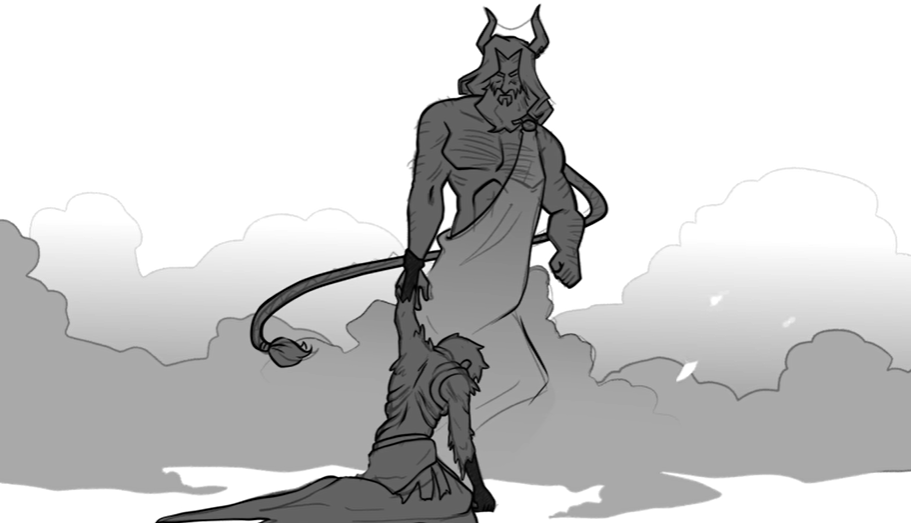
But, after all that, she still begs him to let Odysseus free.
On one hand, "God Games" is basically the "let's meme about Greek mythology" song, and one popular meme on the subject is "Zeus is a temperamental jerk." So, maybe this is just that, and you're not supposed to think about it any deeper.
But, on the other hand...well, once again, this is an Athena moment that I'll be coming back to at the end. Put a pin in this one too.
Next post, I'll go through the Vengeance Saga and probably the first track or two of the Ithaca Saga.